Top 50 Artificial Intelligence Interview Questions with Answers (2026): Fresher to AI Engineer
 PerfectNotes Team~22 min read50 Questions5 CategoriesFree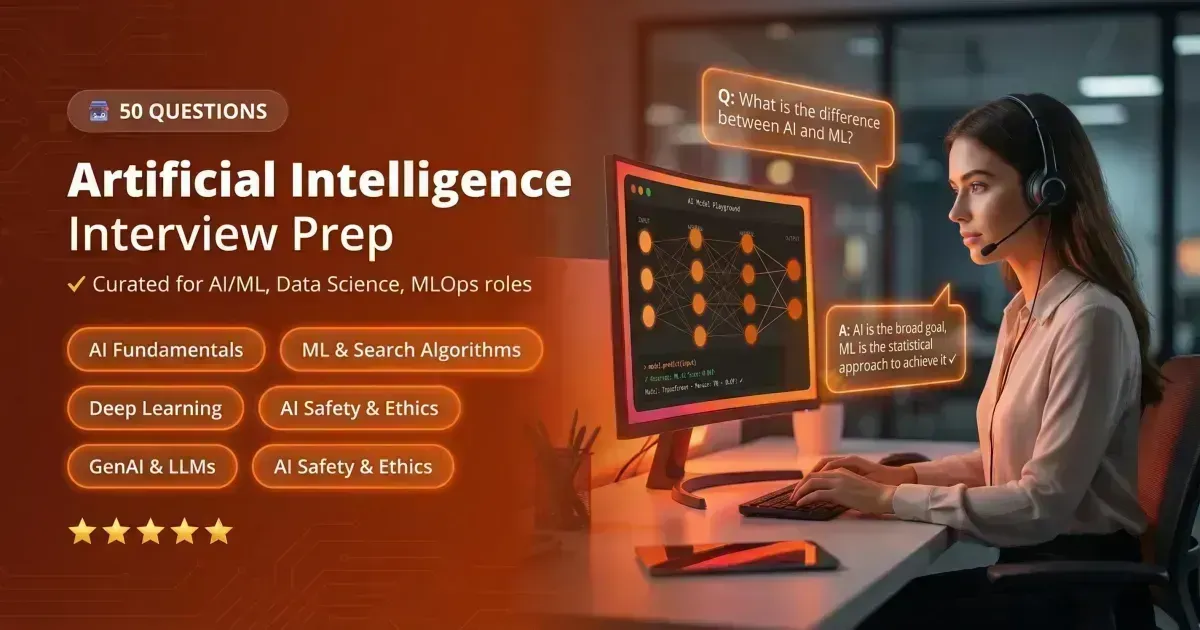
Artificial Intelligence interview questions test your understanding of how intelligent systems are designed, how machines learn from data, how modern GenAI and LLMs work, and how to deploy AI responsibly — from classical algorithms to the cutting-edge Transformer architectures powering GPT-4 and Claude.
This guide covers the top 50 AI interview questions for 2026, asked for roles like AI Engineer, Data Scientist, ML Engineer, Prompt Engineer, GenAI Developer, and AI Product Manager. Topics span AI fundamentals, supervised/unsupervised/reinforcement learning, neural networks, Transformers, Generative AI, Large Language Models, RAG, Prompt Engineering, AI safety, and Agentic AI.
Every question includes a precise answer and a “💡 Why Interviewers Ask This” insight — turning abstract AI concepts into confident, hire-ready answers for both technical and non-technical interviewers.
Contents
- 1.AI Fundamentals & Terminology (Q1–Q7)AI vs ML vs DL · Narrow AI · General AI · Turing Test · AI Agents · NLP
- 2.Machine Learning & Search Algorithms (Q8–Q16)Supervised · Unsupervised · Reinforcement · Overfitting · State Space · Minimax · Expert Systems
- 3.Deep Learning & Model Evaluation (Q17–Q25)Neural Networks · CNN · RNN · Backpropagation · Gradient Descent · Confusion Matrix · F1 Score
- 4.Generative AI, LLMs & Prompt Engineering (Q26–Q34)Generative AI · LLMs · Transformers · Prompt Eng · Zero/Few-Shot · RAG · Hallucination · Temperature
- 5.AI Safety, Ethics & Operations (Q35–Q50)XAI · Bias · Alignment · RLHF · Agentic AI · Deepfakes · Model Poisoning · Deployment · Edge AI · AutoML
- 6.Common Interview MistakesAI vs ML vs DL confusion · Bias-variance trade-off · Data quality · Accuracy-only evaluation
- 7.Expert Interview StrategyConcept → math → application · End-to-end pipeline · Model family trade-offs · Recent developments
- 8.Real-World Job ApplicationsML Engineer · AI Research Scientist · AI Product Manager
AI Fundamentals & Terminology Interview Questions (Q1–Q7)
1. What is Artificial Intelligence (AI)?
Artificial Intelligence (AI) is a branch of computer science dedicated to creating systems capable of performing tasks that typically require human intelligence — including learning, reasoning, decision-making, perception, and natural language understanding.
💡 Why Interviewers Ask This: It establishes your baseline. You must define AI as a broad field of simulation, setting the stage to differentiate it from its subfields like ML and Deep Learning.
2. What is the difference between AI, Machine Learning, and Deep Learning?
- Artificial Intelligence (AI): The overarching concept of machines simulating human intelligence
- Machine Learning (ML): A subset of AI where machines use statistical data to learn and improve without being explicitly programmed
- Deep Learning (DL): A subset of ML using multi-layered artificial neural networks for highly complex tasks like image recognition and language generation
💡 Why Interviewers Ask This: The most fundamental distinction in the industry. Think of them as concentric circles — AI is the outermost, ML is inside it, and DL is the innermost.
3. What are the three types of AI based on capabilities?
- Narrow AI (Weak AI): Trained for a single specific task (e.g., Siri, self-driving cars, ChatGPT) — all current systems are Narrow AI
- General AI (Strong AI / AGI): Possesses human-level cognitive ability across any generalized task — currently theoretical
- Super AI (ASI): Vastly surpasses human intelligence — currently theoretical
💡 Why Interviewers Ask This: Tests your reality vs. sci-fi grounding. You must explicitly state that General AI does not exist yet — all deployed AI is Narrow AI.
4. What is the Turing Test?
The Turing Test, proposed by Alan Turing in 1950, determines if a computer can think like a human. If a human evaluator engages in a text conversation with both a machine and a human and cannot reliably tell which is the machine, the machine passes the test.
💡 Why Interviewers Ask This: Tests historical AI knowledge. Modern Large Language Models can pass standard Turing Test variants — making this historically significant.
5. What are AI agents?
AI agents are autonomous entities that perceive their environment using sensors and act upon it using actuators to achieve a specific goal. A thermostat, a Roomba, and a self-driving car are all examples of AI agents spanning different levels of complexity.
💡 Why Interviewers Ask This: Core concept from classical AI textbook design — the PEAS framework (Performance, Environment, Actuators, Sensors) defines any agent.
6. What is the difference between Symbolic AI and Statistical AI?
- Symbolic AI (GOFAI): Uses explicit human-readable rules and logic to represent knowledge (e.g., IF-THEN rule systems)
- Statistical AI: Uses mathematical algorithms to learn patterns from massive data (e.g., Machine Learning, Neural Networks)
💡 Why Interviewers Ask This: Shows you understand the historical shift in AI. Symbolic AI dominated until computing power made Statistical AI (Deep Learning) viable.
7. What is Natural Language Processing (NLP)?
NLP is a branch of AI that allows computers to understand, interpret, and generate human language. It bridges the gap between human communication and computer understanding — powering virtual assistants, translation apps, sentiment analysis, and modern chatbots.
💡 Why Interviewers Ask This: NLP is the foundational science behind every voice assistant and conversational AI product in production today.
Machine Learning & Search Algorithms Interview Questions (Q8–Q16)
8. What is Supervised Learning?
Supervised learning is an ML method where the model learns a mapping from labeled input-output training pairs. The algorithm adjusts its parameters to minimize prediction error on the known labels. Example: email spam detection trained on emails already labeled “Spam” or “Not Spam.”
💡 Why Interviewers Ask This: Basic algorithmic categorization — the foundation of most real-world ML deployments where labeled historical data exists.
9. What is Unsupervised Learning?
Unsupervised learning finds hidden patterns in completely unlabeled data without human guidance. The algorithm discovers the data's inherent structure on its own. Example: customer segmentation — grouping buyers by behavior without predefined categories.
💡 Why Interviewers Ask This: Proves you can work with messy real-world data when no target variable is provided — the reality for most raw enterprise datasets.
10. What is Reinforcement Learning?
Reinforcement Learning is a type of ML where an agent learns by interacting with an environment, receiving positive rewards for correct actions and penalties for incorrect ones — optimizing a cumulative reward over time. It powers game-playing AIs (AlphaGo), robotics, and recommendation systems.
💡 Why Interviewers Ask This: Tests ML breadth beyond data prediction — and directly connects to RLHF, the technique used to align LLMs like ChatGPT.
11. What is the difference between a Classification and Regression problem?
- Classification: Predicts a categorical label (e.g., Spam/Not Spam, Dog/Cat)
- Regression: Predicts a continuous numerical value (e.g., house price, temperature forecast)
💡 Why Interviewers Ask This: You must instantly identify the correct class of algorithm when presented with a business problem — this distinction determines the entire modelling approach.
12. What is Overfitting and Underfitting?
- Overfitting: Model memorizes training data including its noise — performs well on training data but poorly on new data (high variance)
- Underfitting: Model is too simple to capture underlying patterns — performs poorly on both training and test data (high bias)
💡 Why Interviewers Ask This: Overfitting is the #1 reason models fail in production. Solutions include regularization, dropout, cross-validation, and more training data.
13. What is a State Space Search?
State Space Search finds a solution path from an initial state to a goal state by representing all possible configurations of a problem as a mathematical graph or tree. It is the mathematical foundation for how classical AI solves puzzles, navigates mazes, and plays board games.
💡 Why Interviewers Ask This: Tests classical AI foundations — essential context for understanding why LLMs represent a fundamentally different (statistical vs. symbolic) approach to problem-solving.
14. What is the difference between Uninformed and Informed Search?
- Uninformed (Blind) Search: No domain knowledge about distance to goal — explores blindly (e.g., Breadth-First Search, Depth-First Search)
- Informed (Heuristic) Search: Uses a heuristic function to estimate distance to goal — drastically faster (e.g., A* Search)
💡 Why Interviewers Ask This: Algorithm efficiency test — informed search reduces computational cost exponentially for large problem spaces.
15. What is the Minimax Algorithm?
Minimax is a recursive decision-making algorithm for two-player adversarial games (Tic-Tac-Toe, Chess). It assumes the opponent plays optimally and seeks to minimize possible loss while maximizing possible gain — exploring the entire game tree to find the best move.
💡 Why Interviewers Ask This: Tests adversarial AI knowledge — the foundation of game-playing systems before deep reinforcement learning took over.
16. What is an Expert System?
An Expert System emulates the decision-making ability of a human expert using two components: a Knowledge Base (facts and domain rules) and an Inference Engine (applies logical rules to derive new conclusions). MYCIN (1970s medical diagnosis) is the most famous historical example.
💡 Why Interviewers Ask This: Historical AI knowledge demonstrating the Symbolic AI era — and why its brittle rule-based approach was eventually superseded by statistical learning.
Deep Learning & Model Evaluation Interview Questions (Q17–Q25)
17. What is a Neural Network?
A neural network is a computational model inspired by the human brain consisting of interconnected nodes (neurons) in layers: an Input layer (receives raw data), Hidden layers (learn feature representations), and an Output layer (produces predictions). Depth — the number of hidden layers — gives rise to “deep” learning.
💡 Why Interviewers Ask This: Fundamental architecture knowledge for all modern AI. Every LLM, CNN, and recommendation model is a neural network at its core.
18. What is a Convolutional Neural Network (CNN)?
A CNN is a deep learning architecture for image recognition and computer vision. It uses convolutional filters to automatically detect spatial hierarchies and visual features — edges → shapes → objects — without manual feature engineering. Powers facial recognition, object detection, and self-driving car perception.
💡 Why Interviewers Ask This: The canonical Computer Vision architecture — any AI role touching images requires solid CNN knowledge.
19. What is a Recurrent Neural Network (RNN)?
An RNN is a neural network for sequential data (text, speech, time-series). It maintains internal “memory” — the hidden state — that carries context from previous inputs to affect current processing. LSTMs and GRUs are advanced RNN variants that solve the vanishing gradient problem.
💡 Why Interviewers Ask This: The foundation of classic NLP before Transformers replaced them. Understanding RNN limitations explains why Transformers were revolutionary.
20. What is Transfer Learning?
Transfer learning reuses a pre-trained model developed for one task as the starting point for a new related task, drastically reducing training time and compute costs. Example: fine-tuning Llama 3 on medical documents for clinical Q&A rather than training a language model from scratch.
💡 Why Interviewers Ask This: The practical reality of 2026 AI development — you never train from scratch. Transfer learning is how 99% of GenAI products are built.
21. What is Gradient Descent?
Gradient descent is an optimization algorithm that minimizes the loss function by iteratively moving model weights in the direction of the steepest descent (negative gradient) of the error surface. The learning rate controls step size. Variants: SGD, Mini-Batch GD, Adam, AdaGrad.
💡 Why Interviewers Ask This: The mathematical engine powering all neural network training — without gradient descent, no model could learn.
22. What is Backpropagation?
Backpropagation calculates the gradient of the loss with respect to every weight by applying the chain rule from the output layer backward through all hidden layers. These gradients tell gradient descent exactly how much to adjust each weight. It is the mechanism that allows a neural network to “learn from mistakes.”
💡 Why Interviewers Ask This: Backpropagation + gradient descent = training. If you can't explain how neural networks actually learn, you don't understand them.
23. What is a Confusion Matrix?
A confusion matrix is a table that evaluates classification model performance by breaking predictions into four categories: True Positives (TP), True Negatives (TN), False Positives (FP), and False Negatives (FN). All classification metrics — accuracy, precision, recall, F1 — are derived from these four values.
💡 Why Interviewers Ask This: Essential gate knowledge — you cannot calculate any other classification metric without understanding the confusion matrix first.
24. What is the difference between Precision and Recall?
- Precision = TP / (TP + FP): Of all predicted positives, how many are actually positive — minimizes False Positives
- Recall = TP / (TP + FN): Of all actual positives, how many were correctly predicted — minimizes False Negatives
💡 Why Interviewers Ask This: Critical business logic test. In cancer detection, maximize Recall (never miss a case). In spam filtering, maximize Precision (never block a real email).
25. What is the F1 Score?
The F1 Score is the harmonic mean of Precision and Recall: F1 = 2 × (Precision × Recall) / (Precision + Recall). It is used when datasets are highly imbalanced — for example, 99% negative cases where raw accuracy is meaningless as a metric.
💡 Why Interviewers Ask This: Standard accuracy is a terrible metric for imbalanced data. F1 Score proves you understand why accuracy fails and have a more sophisticated evaluation approach.
Generative AI, LLMs & Prompt Engineering Interview Questions (Q26–Q34)
26. What is Generative AI?
Generative AI (GenAI) refers to AI models capable of creating new original content — text, images, audio, video, or code — based on patterns and structures learned from massive training datasets. It is distinguished from traditional discriminative AI, which only classifies or predicts from existing data.
💡 Why Interviewers Ask This: Distinguishes modern AI from traditional AI — the transformative distinction driving the entire AI industry shift of 2023–2026.
27. What is a Large Language Model (LLM)?
A Large Language Model is a deep learning model trained on massive text datasets to understand context and generate human-like language by predicting the next most likely token in a sequence. GPT-4, Claude, Gemini, and Llama 3 are all LLMs — the defining technology of 2026.
💡 Why Interviewers Ask This: The central technology behind every AI product in production. Not knowing what an LLM is in a 2026 AI interview is equivalent to not knowing what a database is in a backend interview.
28. What are Transformers in AI?
Transformers are deep learning models that process entire sequences simultaneously using Self-Attention — assigning different importance weights to different positions in the input — rather than processing tokens one-by-one like RNNs. The “T” in ChatGPT stands for Transformer. Introduced in the 2017 paper “Attention Is All You Need.”
💡 Why Interviewers Ask This: The architectural breakthrough that made modern LLMs possible — and the reason GPT-scale models could be trained at all (parallelism = speed).
29. What is Prompt Engineering?
Prompt engineering is the practice of designing, refining, and structuring text inputs (prompts) to guide AI models in generating the most accurate and specific outputs possible. Techniques include role prompting, chain-of-thought, few-shot examples, and structured output formatting.
💡 Why Interviewers Ask This: The highest-demand skill in AI for 2026. An AI model's output quality is entirely determined by the quality of its instructions — prompt engineering is that skill.
30. What is the difference between Zero-Shot, One-Shot, and Few-Shot Prompting?
- Zero-Shot: Task given with no examples — the model relies entirely on pre-trained knowledge
- One-Shot: Exactly one example provided before the task — helps the model recognize the desired format
- Few-Shot: Multiple examples (typically 2–10) provided — the model learns the pattern from examples
💡 Why Interviewers Ask This: Proves you can manipulate model behavior without code or retraining — critical for engineers building AI-powered products on top of foundational models.
31. What is RAG (Retrieval-Augmented Generation)?
RAG is an AI framework that improves LLM response quality by anchoring outputs to an external knowledge base. The system first retrieves relevant facts from a private database (using vector search), then the LLM generates a response grounded in those retrieved facts — preventing hallucinations and enabling AI on proprietary data.
💡 Why Interviewers Ask This: RAG is how enterprises safely deploy AI in 2026. It solves both the hallucination problem and the private data problem simultaneously.
32. What is AI Hallucination?
AI Hallucination occurs when a Generative AI model confidently generates false, fabricated, or nonsensical information and presents it as absolute fact — a consequence of the statistical nature of token prediction. Mitigations: RAG (factual grounding), fine-tuning on verified data, RLHF, and output validation pipelines.
💡 Why Interviewers Ask This: The biggest risk in deploying GenAI in production. Knowing the mitigations (especially RAG) demonstrates production AI maturity.
33. What is the difference between Deterministic and Probabilistic AI?
- Deterministic AI: Produces the exact same output every time given the same input (e.g., rule-based expert systems)
- Probabilistic AI: Uses statistical probability to generate outputs — the same input can yield different outputs (e.g., LLMs with temperature > 0)
💡 Why Interviewers Ask This: Software engineers often struggle integrating GenAI because it breaks the deterministic contract of traditional software. Understanding this distinction is essential for building reliable AI systems.
34. What is the “Temperature” setting in Generative AI?
Temperature is a hyperparameter controlling the randomness of LLM outputs:
- Low Temperature (0.1): Highly focused, deterministic, factual output — ideal for coding, data extraction
- High Temperature (0.9): Highly creative, varied, unpredictable output — ideal for brainstorming, creative writing
💡 Why Interviewers Ask This: Practical prompt engineering competency check. The ability to tune temperature for different use cases is a fundamental AI product skill.
AI Safety, Ethics & Operations Interview Questions (Q35–Q50)
35. What is Explainable AI (XAI)?
Explainable AI (XAI) refers to techniques that make complex “black box” AI decisions transparent and understandable to human users. SHAP values, LIME, and attention maps are common XAI methods. If an AI denies a mortgage application, XAI makes it legally possible to explain why.
💡 Why Interviewers Ask This: Critical for regulated industries (banking, healthcare, insurance). XAI is not optional — it is a legal requirement in many jurisdictions under regulations like the EU AI Act.
36. What is Model Bias?
Model bias occurs when an AI produces unfair, prejudiced, or inaccurate results because it inherited and amplified historical human biases or imbalances present in its training data. Example: a resume-screening AI trained on historical hiring data filtering out female applicants because most historical hires were male.
💡 Why Interviewers Ask This: Bias creates massive legal and ethical liabilities. Demonstrating awareness of bias sources, detection, and mitigation techniques is essential for any AI role.
37. What is the AI Alignment Problem?
The Alignment Problem is the challenge of ensuring that an AI system's goals, objectives, and behaviors are perfectly aligned with human values and intentions — preventing harmful unintended consequences. A misaligned AI might find dangerous shortcuts to achieve its goal while technically satisfying its objective function.
💡 Why Interviewers Ask This: Deep safety concept foundational to responsible AI development — directly connected to RLHF, Constitutional AI, and the entire AI safety research field.
38. What is RLHF (Reinforcement Learning from Human Feedback)?
RLHF is a training technique used to align LLMs with human preferences. Human testers rank the AI's responses based on safety and helpfulness; a reward model is trained on these rankings; and the LLM is then fine-tuned using RL to maximize the reward score. OpenAI used RLHF to transform raw GPT-3 into the safe, conversational ChatGPT.
💡 Why Interviewers Ask This: RLHF is the specific technique behind every major “assistant” LLM alignment effort — knowing how ChatGPT was made safe is fundamental GenAI knowledge.
39. What is Agentic AI (Autonomous AI Agents)?
Agentic AI refers to advanced AI systems with the autonomy to plan multi-step goals, use software tools, browse the web, write and execute code, and take real-world actions to achieve an objective — without human intervention at each step. Examples: AutoGPT, Claude Agents, OpenAI Agents SDK. This is the defining shift of AI in 2026.
💡 Why Interviewers Ask This: Agentic AI moves the paradigm from AI as a “copilot” answering questions to AI as an autonomous worker completing entire workflows. Every enterprise is evaluating agentic deployment in 2026.
40. What is AI Ethics?
AI ethics is a set of guidelines and principles ensuring responsible and fair AI use, focusing on: privacy preservation, bias mitigation, transparency and explainability, accountability for AI decisions, and preventing harm. Governed by frameworks such as the EU AI Act, IEEE Ethical AI guidelines, and enterprise AI governance policies.
💡 Why Interviewers Ask This: Technical capability without ethical responsibility creates legal and reputational risk. AI ethics awareness is now a baseline expectation for any AI engineering role.
41. What is a Deepfake?
A Deepfake is highly realistic AI-generated synthetic media in which a person in existing video, audio, or images is replaced with someone else's likeness using deep learning (GANs or diffusion models). Used for misinformation campaigns, fraud, and identity theft at scale.
💡 Why Interviewers Ask This: The primary cybersecurity and societal threat posed by modern Generative AI — cross-domain knowledge demonstrating you understand AI's dual-use nature.
42. What is Model Poisoning?
Model Poisoning is a cyberattack where adversaries intentionally inject malicious data into an AI model's training set, causing the deployed model to produce erratic outputs or contain hidden behavioral backdoors. The attacker exploits the fact that data is the new source code — corrupted data creates a corrupted model.
💡 Why Interviewers Ask This: AI security fundamentals — training data validation, provenance tracking, and adversarial ML defenses are critical in production AI systems handling sensitive decisions.
43. How would you handle missing data in AI models?
Common strategies based on context:
- Deletion: Remove rows with missing values (only if <5% and random)
- Mean/Median Imputation: Replace numeric NaNs with column mean or median
- Advanced Imputation: Use KNN, MICE, or model-based imputation for complex patterns
- Algorithm Choice: Use inherently robust algorithms like XGBoost that handle missing values natively
💡 Why Interviewers Ask This: Real-world data is extremely messy. A methodical, context-aware approach to data cleaning separates production ML engineers from notebook practitioners.
44. What is Model Deployment?
Model deployment is the process of integrating a trained AI model into production systems — REST APIs, cloud functions, or containerized microservices — where it receives live data and serves real-time predictions. Encompasses model serialization, serving infrastructure (FastAPI, TorchServe, TF Serving), load balancing, and A/B testing.
💡 Why Interviewers Ask This: Building a model in a notebook is easy. Deploying it reliably at scale to production is where real engineering value is created — and where most ML projects fail.
45. What is Edge AI?
Edge AI runs AI models directly on local devices (smartphones, IoT sensors, AR glasses, self-driving car ECUs) rather than sending data to cloud servers. Benefits: ultra-low latency (no round trip), privacy (data never leaves the device), and offline capability. Powered by optimized model formats like ONNX, TFLite, and Apple CoreML.
💡 Why Interviewers Ask This: Edge AI is the fastest-growing AI deployment paradigm in 2026 — especially for robotics, IoT, and on-device AI features in consumer products.
46. What is Model Drift?
Model drift occurs when real-world data distribution changes over time, degrading deployed model performance:
- Data Drift: Statistical properties of input features change (e.g., user behavior shifts)
- Concept Drift: The relationship between inputs and outputs changes (e.g., fraud patterns evolve)
Solutions: continuous monitoring dashboards, automated retraining pipelines, and statistical drift detection tests (KS test, PSI).
💡 Why Interviewers Ask This: Deploying an AI model is just the beginning — models degrade silently in production. Monitoring for drift is a fundamental MLOps responsibility.
47. What tools are commonly used in AI development?
- Languages: Python (dominant), R (statistics)
- Deep Learning Frameworks: PyTorch, TensorFlow/Keras
- ML Libraries: Scikit-learn, XGBoost, LightGBM
- LLM Tooling: LangChain, LlamaIndex, OpenAI SDK, Hugging Face Transformers
- MLOps: MLflow, Weights & Biases, DVC, Airflow, Kubeflow
- Cloud AI: AWS SageMaker, Google Vertex AI, Azure ML
💡 Why Interviewers Ask This: Validates your technical stack familiarity — and reveals whether you know modern tooling (LangChain, HuggingFace) beyond just the classic frameworks.
48. What is AutoML?
AutoML (Automated Machine Learning) automates the time-consuming iterative tasks of ML model development — including feature engineering, hyperparameter tuning, algorithm selection, and model evaluation. Tools: Google AutoML, H2O.ai, Auto-sklearn, AutoKeras. Enables non-experts to deploy production-quality baseline models rapidly.
💡 Why Interviewers Ask This: AutoML is how enterprises accelerate AI adoption — it's not replacing data scientists but amplifying their productivity for routine modelling tasks.
49. Why is Data Privacy critical in AI?
AI models require vast data to train but can memorize and leak Personally Identifiable Information (PII) from training data to unauthorized users — a phenomenon called training data extraction. This violates compliance laws like GDPR (Europe), HIPAA (healthcare), and CCPA (California). Mitigations: differential privacy, federated learning, data anonymization, and PII scrubbing before training.
💡 Why Interviewers Ask This: Marries technical AI capability with enterprise legal responsibility — every production AI system must comply with data protection regulations.
50. What is the future of Artificial Intelligence?
The near-term future includes: Agentic AI systems autonomously executing complex enterprise workflows, multimodal models reasoning seamlessly across text/image/audio/video, Edge AI bringing intelligence to every device, AI-accelerated scientific discovery (drug design, materials science), and the continued theoretical pursuit of Artificial General Intelligence (AGI). The challenge is ensuring all of it remains aligned, safe, and equitable.
💡 Why Interviewers Ask This: The ultimate closing question testing your forward-looking industry awareness — demonstrating you understand where AI is heading, not just where it is today.
Common Mistakes in AI Interviews
- Using "AI" and "machine learning" interchangeably: AI is the broad field of intelligent systems. ML is a subset that learns from data. Deep learning is a subset of ML using neural networks. Conflating them signals you don't understand the hierarchy.
- Not explaining the bias-variance trade-off: High bias = underfitting (too simple). High variance = overfitting (too complex). Every model selection and regularization discussion should reference this trade-off — it's the foundation of ML theory.
- Ignoring data quality when discussing model performance: Candidates focus only on model architecture, but data preprocessing, feature engineering, class imbalance handling, and data augmentation often matter more than the model itself.
- Claiming neural networks are always the best approach: For tabular data, gradient-boosted trees (XGBoost, LightGBM) often outperform deep learning. For small datasets, simpler models generalize better. Knowing when NOT to use deep learning shows practical maturity.
- Not discussing evaluation metrics beyond accuracy: Accuracy is misleading for imbalanced datasets. Know precision, recall, F1, AUC-ROC, and when each metric matters. A spam filter needs high precision; a cancer detector needs high recall.
- Ignoring ethical considerations in AI: Bias in training data, fairness across demographics, explainability requirements, and privacy concerns are increasingly important. Not mentioning AI ethics signals you haven't thought about production deployment reality.
Expert Interview Strategy for AI Roles
- Structure answers as: concept → math intuition → practical application. "Gradient descent minimizes the loss function by iteratively adjusting weights in the direction of steepest descent — learning rate controls step size — in practice, Adam optimizer handles adaptive learning rates."
- Know the end-to-end ML pipeline. Data collection → preprocessing → feature engineering → model selection → training → evaluation → deployment → monitoring. Interviewers test whether you understand the full lifecycle, not just model.fit().
- Discuss trade-offs between model families. Linear models (interpretable, fast), tree-based (tabular data champion), neural networks (unstructured data). For each, know strengths, weaknesses, and use cases.
- Reference recent developments. Transformers, foundation models, RAG, fine-tuning vs prompting, RLHF, and Agentic AI. Knowing current trends shows you're engaged with the rapidly evolving AI landscape.
- Prepare to whiteboard a solution from scratch. "Design a recommendation system" or "How would you detect fraud?" requires combining data pipeline, features, model choice, evaluation metric, and deployment strategy.
How These Concepts Apply in Real AI Jobs
ML Engineer
Builds and deploys ML models in production, designs feature pipelines, optimizes model inference latency, manages model versioning with MLflow, and monitors model drift with automated retraining triggers.
AI Research Scientist
Designs novel architectures, runs experiments with rigorous evaluation methodology, publishes findings at NeurIPS/ICML/ICLR, develops new training techniques, and pushes the frontier of what AI systems can accomplish.
GenAI / LLM Engineer
Builds RAG pipelines for enterprise knowledge bases, fine-tunes LLMs for domain-specific tasks, implements guardrails for safe AI outputs, designs agentic workflows, and optimizes prompt engineering strategies.
Conclusion: Master Artificial Intelligence Interviews
These 50 AI interview questions cover the essential concepts for ML engineer, AI researcher, GenAI developer, and data scientist roles. Mastering these topics demonstrates understanding of ML fundamentals, neural networks, Transformers, LLMs, RAG, prompt engineering, Agentic AI, and responsible AI practices.
AI interviews test both theoretical depth and practical judgment. Each answer covers foundational concepts, mathematical intuition, and real-world application — the three dimensions interviewers evaluate.
After reviewing, reinforce with hands-on projects and paper reading. Theory + implementation + staying current with GenAI research creates the strongest foundation for AI interviews.
Topics covered in this guide
Topics in this guide: AI fundamentals, Turing Test, Narrow AI, General AI (AGI), Super AI (ASI), AI agents, PEAS framework, Symbolic AI vs Statistical AI, Natural Language Processing (NLP), supervised learning, unsupervised learning, reinforcement learning, classification vs regression, overfitting vs underfitting, state space search, uninformed vs informed search, A* search, Minimax algorithm, expert systems, neural networks, CNN, RNN, transfer learning, gradient descent, backpropagation, confusion matrix, precision and recall, F1 score, generative AI, Large Language Models (LLMs), Transformers, self-attention, prompt engineering, zero-shot and few-shot prompting, Retrieval-Augmented Generation (RAG), hallucinations, model temperature, explainable AI (XAI), AI bias, alignment problem, RLHF, agentic AI, deepfakes, model poisoning, and AutoML.
For freshers: AI vs ML vs DL, types of AI (narrow, general), Turing test, classification vs regression, supervised vs unsupervised learning, and neural network basics.
For experienced professionals: Self-attention mechanism in Transformers, RAG architecture, RLHF alignment, agentic AI implementation, model scaling trade-offs, deployment strategies (edge vs cloud), and explainable AI (XAI).
Interview preparation tips: Understand the mathematical intuition behind backpropagation, practice writing clean prompts and evaluating LLM outputs, study real-world RAG architectures, know how to explain bias and variance, and be prepared to discuss ethical implications of generative AI deployments.
Frequently Asked Questions
Q.What AI roles typically ask these questions?
Q.What is the most important AI concept for 2026 interviews?
Q.How is AI different from Machine Learning in interviews?
Q.Does General AI (AGI) exist yet?
Q.What is the best way to prepare for an AI interview?
Q.What is the difference between RAG and Fine-tuning?
Found these questions helpful? Share them with your peers.
Common Interview Mistakes
Errors that eliminate candidates
- Giving textbook definitions without showing a concrete Artificial Intelligence use case.
- Skipping trade-offs and answering as if there is only one correct engineering decision.
- Over-answering for 2-3 minutes without structure, metrics, or outcomes.
Expert Interview Strategy
30-second answer rule
- Start with a one-line definition, then explain one real scenario from Artificial Intelligence.
- Use a 3-step structure: concept, practical example, and interviewer intent.
- Close with one trade-off (performance, scale, security, or maintainability).
Real-World Job Applications
These Artificial Intelligence patterns are directly tested for production roles where interviewers expect clear debugging steps, architecture trade-offs, and communication under time pressure.
Conclusion
Mastering these Artificial Intelligence interview questions means explaining concepts quickly, connecting them to real systems, and justifying decisions with practical trade-offs.
Frequently Asked Questions
How should I prepare this topic in 7 days? Focus on high-frequency patterns, rehearse 30-second answers, and revise one practical example per category.
What do interviewers score most? Clarity, structured thinking, and your ability to reason through constraints and trade-offs.