Top 50 Software Engineering Interview Questions with Answers (2026): Fresher to Senior SDE
 PerfectNotes Team~20 min read50 Questions5 CategoriesFree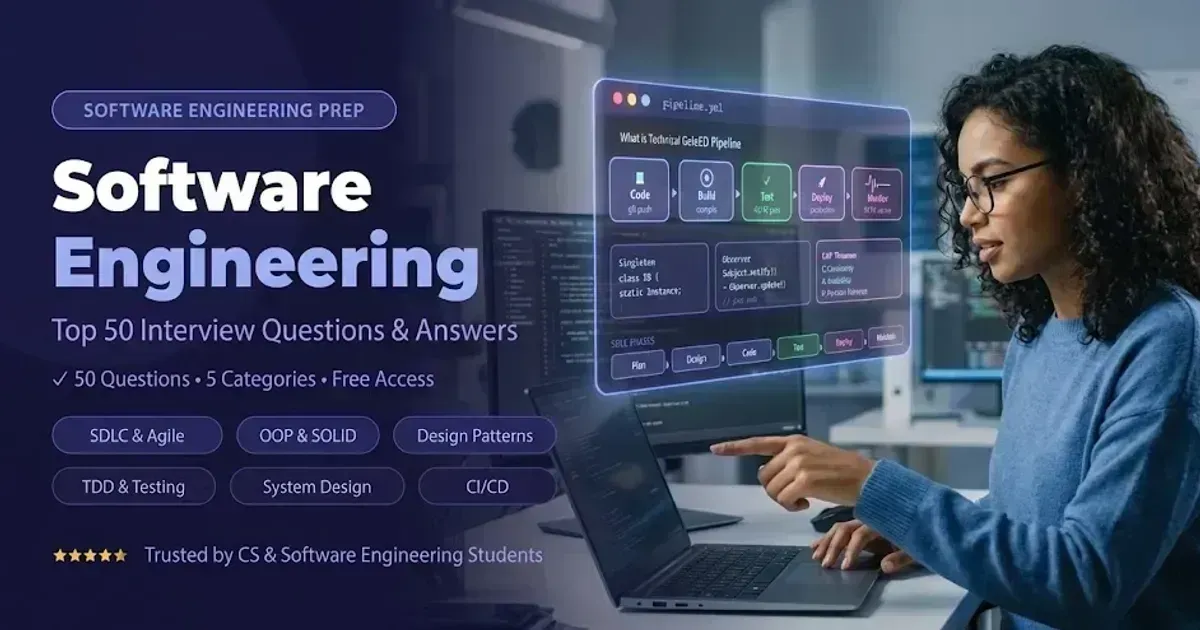
Software engineering interview questions test your knowledge of SDLC methodologies, object-oriented design, architecture patterns, testing practices, and system scalability — the core disciplines every professional software engineer must master.
This guide covers the most frequently asked software engineering interview questions for freshers and professionals — commonly asked for roles like Software Engineer, SDE-I/II, Backend Engineer, Full-Stack Developer, and Engineering Manager.
Every answer includes a "💡 Why Interviewers Ask This" insight so you understand what the recruiter is actually evaluating, not just the surface-level answer.
Contents
- 1.SDLC & Methodologies (Q1–Q10)Agile · Scrum · CI/CD · DevSecOps · Technical Debt
- 2.OOP, Requirements & Modeling (Q11–Q20)Cohesion · OOP Pillars · SOLID · DI · UML · DRY/KISS
- 3.Architecture & Design Patterns (Q21–Q30)Singleton · Factory · Observer · Microservices · REST · MVC
- 4.Testing & Quality Assurance (Q31–Q40)TDD · White/Black-box · Regression · Cyclomatic Complexity
- 5.System Design & Scalability (Q41–Q50)CAP · Load Balancer · Caching · Docker · Saga · Circuit Breaker
- 6.Common Interview MistakesWaterfall-only thinking · Ignoring tech debt · No trade-off discussion · Missing testing strategies
- 7.Expert Interview StrategyDesign patterns with scenarios · SOLID principles · Deployment strategies · Testing pyramid
- 8.Real-World Job ApplicationsSoftware Architect · Tech Lead · Principal Engineer
SDLC & Methodologies Interview Questions (Q1–Q10)
What is Software Engineering?
Software Engineering is the systematic, disciplined, and quantifiable application of engineering principles to the design, development, testing, deployment, and maintenance of software. It ensures software is reliable, scalable, and delivered within budget and time constraints.
💡 Why Interviewers Ask This: It establishes your baseline understanding. A strong candidate moves beyond "writing code" and emphasises the systematic and disciplined engineering process.
What is the Software Development Life Cycle (SDLC)?
The SDLC is a structured framework outlining the phases to build a software application: Requirement Analysis → Design → Implementation → Testing → Deployment → Maintenance.
💡 Why Interviewers Ask This: It proves you understand how software goes from an idea to a production-ready application — the core operational framework of every tech team.
What is the difference between Agile and Waterfall methodologies?
- Waterfall: Rigid, sequential — each phase completes before the next begins. Suits fixed-requirement projects.
- Agile: Flexible, iterative — promotes continuous delivery, cross-functional collaboration, and rapid adaptation to user feedback via short sprints.
💡 Why Interviewers Ask This: To check your project management adaptability. Most modern companies use Agile — answering this correctly proves you fit into a fast-paced sprint culture.
What is the Scrum framework?
Scrum is the most popular Agile framework. It breaks work into fixed-length iterations called Sprints (2–4 weeks) and uses specific roles: Scrum Master (removes blockers), Product Owner (prioritises backlog), and Development Team.
💡 Why Interviewers Ask This: If a company uses Agile, they likely use Scrum. They want to know you understand daily stand-ups, sprint planning, and retrospectives.
What is the difference between Verification and Validation?
- Verification: "Are we building the product right?" — checks code and architecture against specifications.
- Validation: "Are we building the right product?" — ensures the final software meets the end-user's actual business needs.
💡 Why Interviewers Ask This: A classic QA question that differentiates internal technical correctness (Verification) from external market fit (Validation).
What is Continuous Integration and Continuous Deployment (CI/CD)?
- CI (Continuous Integration): Automatically merges and tests code changes into a shared repository on every commit.
- CD (Continuous Deployment): Automatically releases validated code directly to the production environment.
💡 Why Interviewers Ask This: CI/CD is the backbone of modern DevOps. Interviewers want to ensure you write code that integrates seamlessly via automated pipelines.
What is Technical Debt?
Technical Debt is the implied cost of future rework caused by choosing a fast, easy solution now instead of a better, well-architected approach. Like financial debt, it accumulates interest in the form of bugs and slowed development if not paid down through refactoring.
💡 Why Interviewers Ask This: Evaluates your engineering maturity. Senior developers understand that quick-and-dirty code is sometimes necessary, but managing the resulting debt is critical.
What is a Minimum Viable Product (MVP)?
An MVP is the earliest version of a software product released with just enough core features to satisfy early adopters and gather validated learning for future development — without over-engineering an untested idea.
💡 Why Interviewers Ask This: Tests your product mindset. Engineers must understand that shipping an MVP validates the market before investing in full-scale development.
What is Version Control, and why is Git important?
Version Control Systems (VCS) track and manage changes to code over time. Git is a distributed VCS that allows multiple developers to collaborate safely, track history, revert to previous states, and manage feature branches.
💡 Why Interviewers Ask This: You cannot work on a modern team without Git. They want to ensure you understand branching, committing, merging, and resolving conflicts.
What is DevSecOps?
DevSecOps integrates security practices directly into the DevOps pipeline — "shifting security left" so code is scanned for vulnerabilities continuously during CI/CD rather than as an afterthought at release time.
💡 Why Interviewers Ask This: Security is paramount. Interviewers want to see that you view security as a shared team responsibility, not just the security team's problem.
OOP, Requirements & Modeling Interview Questions (Q11–Q20)
What are Functional and Non-Functional Requirements?
- Functional: Define what the system must do (e.g., "The system must process credit card payments").
- Non-Functional: Define how well it does it (e.g., "Payment must process within 2 seconds" — covering scalability, performance, security).
💡 Why Interviewers Ask This: Engineers often hyper-focus on features and forget system constraints. Great engineers prioritise both equally.
What is an SRS (Software Requirements Specification)?
An SRS is a comprehensive document that dictates the complete behaviour and specifications of a software system. It acts as a binding agreement between stakeholders and the development team regarding what will be built.
💡 Why Interviewers Ask This: It proves you understand the importance of documentation before writing code — reducing scope creep and miscommunication.
What is the difference between Cohesion and Coupling?
- Cohesion: How closely related the responsibilities of a single module are — High Cohesion is desirable.
- Coupling: The degree of interdependence between modules — Low Coupling is desirable.
💡 Why Interviewers Ask This: "High cohesion, loose coupling" is the golden rule of software design — the exact phrase interviewers are waiting to hear.
What are the four pillars of Object-Oriented Programming (OOP)?
- Encapsulation: Hiding internal state and implementation details within a class.
- Abstraction: Exposing only essential features and hiding complex implementation.
- Inheritance: Reusing and extending behaviour from parent classes.
- Polymorphism: Allowing objects of different types to be treated through a common interface.
💡 Why Interviewers Ask This: The most foundational programming question. You must define all four clearly, ideally with brief real-world analogies.
What are the SOLID principles?
- S — Single Responsibility: A class should have only one reason to change.
- O — Open/Closed: Open for extension, closed for modification.
- L — Liskov Substitution: Subtypes must be substitutable for their base types.
- I — Interface Segregation: No client should depend on methods it does not use.
- D — Dependency Inversion: Depend on abstractions, not on concrete implementations.
💡 Why Interviewers Ask This: Knowing SOLID separates juniors from intermediates — it proves you know how to write clean, scalable, refactorable code.
What is the difference between an Abstract Class and an Interface?
- Abstract Class: Can have both implemented and abstract methods; supports single inheritance. Use for an "is-a" relationship with shared state.
- Interface: Defines a contract with no implementation; a class can implement multiple interfaces. Use for "can-do" capabilities.
💡 Why Interviewers Ask This: Tests deep understanding of polymorphism and architecture design decisions.
What is Dependency Injection (DI)?
Dependency Injection is a design pattern where an object receives its dependencies from an external source rather than creating them internally. It promotes loose coupling and makes unit testing dramatically easier by enabling mock dependencies.
💡 Why Interviewers Ask This: Modern frameworks (Spring Boot, Angular, NestJS) rely entirely on DI. You must show you understand Inversion of Control (IoC).
What is UML (Unified Modeling Language)?
UML is a standardised visual modelling language used to specify, visualise, construct, and document the architecture and artifacts of a software system using standard diagram types — class diagrams, sequence diagrams, use case diagrams, and more.
💡 Why Interviewers Ask This: Visual communication is key. If you cannot draw your system architecture, you cannot communicate it to a team or stakeholders.
What is a Use Case Diagram?
A Use Case Diagram is a behavioural UML diagram that illustrates the interactions between external actors (users or systems) and the software system to achieve a specific goal, bridging business requirements and technical implementation.
💡 Why Interviewers Ask This: Tests your ability to view software from the end-user's perspective — essential for requirements engineering and system design phases.
What are the DRY and KISS principles?
- DRY (Don't Repeat Yourself): Reduce repetition by abstracting logic into reusable functions or modules — every piece of knowledge must have a single, authoritative representation.
- KISS (Keep It Simple, Stupid): Systems work best when kept as simple as possible — avoid over-engineering and unnecessary complexity.
💡 Why Interviewers Ask This: Evaluates your coding philosophy. Over-engineered or copy-pasted code creates technical debt — these principles show you write clean, maintainable code.
Architecture & Design Patterns Interview Questions (Q21–Q30)
What is the difference between Software Architecture and Software Design?
- Architecture: High-level system skeleton — choosing Microservices vs. Monolith, selecting databases, defining communication protocols.
- Design: Low-level code-level organisation — choosing a Singleton pattern, structuring classes, defining interfaces.
💡 Why Interviewers Ask This: Differentiates high-level strategic thinking from low-level tactical execution — a key indicator of engineering seniority.
What are Design Patterns?
Design Patterns are proven, reusable solutions to commonly occurring problems in software design, divided into three categories: Creational (object creation), Structural (object composition), and Behavioral (object communication).
💡 Why Interviewers Ask This: Knowing design patterns means you don't reinvent the wheel — it proves you understand standardised engineering best practices.
What is the Singleton Pattern?
The Singleton is a Creational pattern that restricts instantiation of a class to one single global instance (e.g., a Database Connection Pool or Logger). The downside: it acts like a global variable and makes unit testing harder.
💡 Why Interviewers Ask This: The most commonly asked design pattern. You must also explain its drawback — interviewers respect candidates who know the tradeoffs.
What is the Factory Method Pattern?
The Factory Pattern is a Creational pattern that provides an interface for creating objects without exposing instantiation logic to the client. Subclasses decide which concrete class to instantiate, enabling dynamic object creation without tight coupling.
💡 Why Interviewers Ask This: Tests your ability to handle complex object creation dynamically and decouple object creation from its usage.
What is the Observer Pattern?
The Observer Pattern is a Behavioral pattern where a subject maintains a list of dependents (observers) and notifies them automatically of any state changes. It is the foundation of event-driven architectures and pub/sub messaging systems.
💡 Why Interviewers Ask This: Highly relevant for modern UI frameworks (React/Redux) and message queues (Kafka). Shows you understand reactive and event-driven design.
What is the difference between Monolithic and Microservices architectures?
- Monolith: All components in a single, tightly coupled, deployable unit. Simple to develop initially, but hard to scale and deploy independently.
- Microservices: Small, loosely coupled, independently deployable services communicating via APIs. Enables independent scaling but adds operational complexity.
💡 Why Interviewers Ask This: The hottest debate in modern backend engineering. You must articulate pros, cons, and when to use each.
What is a RESTful API?
REST (Representational State Transfer) is an architectural style for APIs using standard HTTP methods (GET, POST, PUT, DELETE). Key constraint: it must be stateless — each request contains all information needed; the server holds no session state.
💡 Why Interviewers Ask This: APIs are the glue of the internet. Explicitly mentioning stateless is the key signal interviewers listen for.
What is the MVC (Model-View-Controller) pattern?
- Model: Manages data and business logic.
- View: Handles the UI/presentation layer.
- Controller: Accepts user input, updates the Model, and refreshes the View.
💡 Why Interviewers Ask This: MVC is the foundational architecture of almost all web frameworks — Django, Ruby on Rails, ASP.NET, Laravel.
What is Serverless Computing?
Serverless is a cloud execution model where the provider (e.g., AWS Lambda) dynamically manages server allocation. Developers write functions and pay only for actual compute time used — no infrastructure management required.
💡 Why Interviewers Ask This: Cloud engineering is standard. They want to know you understand modern, highly scalable deployment models that reduce infrastructure overhead.
What is an API Gateway?
An API Gateway acts as a single entry point and reverse proxy for clients interacting with a microservices architecture. It handles request routing, authentication, rate limiting, and logging — abstracting internal service topology from clients.
💡 Why Interviewers Ask This: If you are building microservices, you need a gateway. It tests your understanding of how clients securely interact with distributed backends.
Testing & Quality Assurance Interview Questions (Q31–Q40)
What are the different levels of Software Testing?
- Unit Testing: Tests individual functions or methods in isolation.
- Integration Testing: Tests how modules interact with each other.
- System Testing: Tests the fully integrated application end-to-end.
- Acceptance Testing (UAT): Tests whether the system meets business requirements.
💡 Why Interviewers Ask This: Developers own the first two; QA and Product own the last two. Understanding this division is essential for team-based engineering culture.
What is the difference between White-box and Black-box testing?
- White-box testing: Requires knowledge of internal source code and logic — done by developers. Tests how the code works.
- Black-box testing: Evaluates functionality from the outside without knowledge of internals — done by QA testers. Tests what the code does.
💡 Why Interviewers Ask This: A fundamental QA concept that shows you understand the difference between structural correctness and functional correctness.
What is Test-Driven Development (TDD)?
TDD uses the Red-Green-Refactor cycle: write a failing test first (Red), write the minimal code to pass the test (Green), then clean up the code (Refactor). It forces a clear specification before implementation begins.
💡 Why Interviewers Ask This: High-engineering-culture companies favor TDD. It proves you prioritise testing and bug prevention over rushing features.
What is the difference between a Bug, a Defect, and an Error?
- Error: A human mistake in the code written by the developer.
- Bug: The manifestation of that error found during the testing phase.
- Defect: A bug that escapes testing and is discovered by the end-user in production.
💡 Why Interviewers Ask This: Tests precise industry vocabulary — knowing the taxonomy shows maturity in navigating the software defect lifecycle.
What is Regression Testing?
Regression testing involves re-running previously passing tests after a code change to ensure that new changes have not broken existing functionality. It is largely automated within CI/CD pipelines.
💡 Why Interviewers Ask This: As codebases grow, regressions become the #1 cause of production outages. CI/CD pipelines exist largely to automate regression checks.
What is Code Refactoring?
Refactoring is restructuring existing code — improving its internal structure for readability, reduced complexity, and better performance — without changing its external behaviour. It is the primary mechanism for paying down technical debt.
💡 Why Interviewers Ask This: Interviewers want engineers who leave the codebase cleaner than they found it — the "Boy Scout Rule" of engineering.
What is Cyclomatic Complexity?
Cyclomatic Complexity is a metric that measures the number of linearly independent paths through a program's source code — essentially counting if, else, for, and while statements. High complexity (above 10) means code is hard to test and maintain.
💡 Why Interviewers Ask This: Senior engineers use this metric to decide when a function must be decomposed into smaller, testable units.
What is the difference between Top-Down and Bottom-Up Integration Testing?
- Top-Down: Tests highest-level modules first, using Stubs to simulate lower-level modules not yet built.
- Bottom-Up: Tests lowest-level modules first, using Drivers to simulate higher-level modules calling them.
💡 Why Interviewers Ask This: Tests your strategic approach to assembling and validating complex, multi-module systems during development.
What is the difference between Performance, Load, and Stress Testing?
- Performance Testing: Measures system responsiveness under normal conditions.
- Load Testing: Measures behaviour under expected peak user traffic.
- Stress Testing: Pushes the system beyond its limits to find the breaking point and failure mode.
💡 Why Interviewers Ask This: Essential for backend engineers — you must know how to ensure a web application survives traffic spikes like Black Friday sales.
What is Mutation Testing?
Mutation testing deliberately introduces small code changes (mutations) then checks whether existing unit tests detect them. It evaluates the quality and effectiveness of the test suite itself — not just line coverage.
💡 Why Interviewers Ask This: An advanced concept showing you understand that 100% code coverage is meaningless if the tests don't assert meaningful behaviour.
System Design & Scalability Interview Questions (Q41–Q50)
What is the difference between Horizontal and Vertical Scaling?
- Vertical Scaling (Scale Up): Add more CPU/RAM to a single server. Has a hardware limit and creates a single point of failure.
- Horizontal Scaling (Scale Out): Add more servers/nodes to the pool. Enables virtually unlimited scaling and is the modern cloud standard.
💡 Why Interviewers Ask This: The ultimate system design question. Explaining the single-point-of-failure risk of vertical scaling is the key differentiator.
What is a Load Balancer?
A Load Balancer efficiently distributes incoming network traffic across a group of backend servers to ensure high availability, prevent overload, and route around failed nodes. It is the first layer of defence against high traffic and server outages.
💡 Why Interviewers Ask This: You cannot design a scalable system without a load balancer — it's a prerequisite for any distributed architecture discussion.
What is the CAP Theorem?
The CAP Theorem states a distributed data store can only guarantee two of three properties simultaneously: Consistency (all nodes see the same data), Availability (every request gets a response), and Partition Tolerance (system operates despite network drops). Since P is always required, architects must choose between C or A.
💡 Why Interviewers Ask This: The golden rule of distributed systems — knowing this separates engineers who can design databases from those who just use them.
What is Caching?
Caching stores copies of frequently accessed data in a high-speed temporary layer (like Redis or Memcached) so future requests are served faster than querying the primary database. The critical challenge is cache invalidation — keeping cached data in sync with the source of truth.
💡 Why Interviewers Ask This: The easiest way to speed up a slow system is caching. Interviewers want to hear you mention Redis and cache invalidation strategies.
What is a Message Broker (e.g., Kafka, RabbitMQ)?
A Message Broker is an intermediary that allows services to communicate asynchronously — producers publish messages to a queue, consumers process them independently. It prevents data loss if a consuming service goes down and decouples producers from consumers.
💡 Why Interviewers Ask This: Crucial for microservices. It shows you understand event-driven, fault-tolerant system design beyond synchronous REST calls.
What is the difference between Virtual Machines (VMs) and Containers?
- VM: Includes a full heavyweight guest OS running on a Hypervisor. Slower to start, resource-intensive.
- Container (Docker): Packages only the application and its dependencies, sharing the host OS kernel. Lightweight, fast, and highly portable.
💡 Why Interviewers Ask This: Containers revolutionised software deployment. Understanding why Docker replaced bulky VMs in cloud environments is table stakes.
What is the Strangler Fig Pattern?
The Strangler Fig Pattern is an architectural strategy for migrating a monolith to microservices. New features are built as microservices; old monolith features are incrementally replaced and routed via an API gateway until the monolith can be decommissioned — with zero-downtime migration.
💡 Why Interviewers Ask This: A senior-level question. Companies rarely do full rewrites — they want engineers who know how to migrate legacy systems safely.
What is the Saga Pattern?
The Saga Pattern manages distributed transactions across multiple microservices. Instead of a single ACID transaction, a Saga breaks it into local transactions; if one fails, it triggers compensating transactions to undo previous steps — maintaining data consistency without distributed locks.
💡 Why Interviewers Ask This: Microservices don't share a database, making standard ACID transactions impossible. Knowing Saga proves you can build fault-tolerant enterprise systems.
What is the Circuit Breaker Pattern?
The Circuit Breaker Pattern prevents an application from repeatedly calling a failing downstream service. If failures exceed a threshold, the circuit trips and fails fast — returning an error or fallback response instead of waiting for timeouts and causing cascading failures across the system.
💡 Why Interviewers Ask This: Proves you know how to build resilient systems that anticipate failure and protect the network from retry storms.
What is Rate Limiting?
Rate Limiting controls the number of requests a client can make to an API within a specified time window. It prevents DDoS attacks, API abuse, and server resource exhaustion. Common algorithms include the Token Bucket (smooth burst allowance) and Leaky Bucket (strict constant rate).
💡 Why Interviewers Ask This: Tests both security and scalability knowledge. Mentioning Token Bucket or Leaky Bucket elevates your answer from junior to senior level.
Common Mistakes in Software Engineering Interviews
- Explaining SOLID principles without real examples:Candidates often recite textbook definitions. Instead, demonstrate each principle with a code scenario: "Single Responsibility means a class shouldn't handle both database queries and email sending—split into UserRepository and EmailService."
- Confusing design patterns with architecture patterns: Singleton is a design pattern; microservices is an architecture pattern. They operate at different scales. Mixing them up signals shallow understanding.
- Not distinguishing between testing types: Unit tests test a single class in isolation; integration tests verify multiple components work together; end-to-end tests validate full user workflows. Conflating them suggests weak testing fundamentals.
- Saying "test coverage is 100%" as if it's automatically good: High coverage with poor tests is worse than focused tests on critical paths. Mention mutation testing and branch coverage to show sophistication.
- Treating system design like coding: System design is about scalability, trade-offs, and architectural decisions—not implementation details. Focus on CAP theorem, database choices, and distributed patterns, not SQL syntax.
- Ignoring non-functional requirements: Performance, security, maintainability, and testability matter as much as feature delivery. Mention these proactively when designing systems.
Expert Interview Strategy for Software Engineering Roles
- Connect every architectural decision to business impact.Don't just explain microservices—explain why: independent scaling, fault isolation, faster deployment cycles. Interviewers want engineers who think beyond code.
- Use the trade-off framework for every design decision."We chose PostgreSQL for consistency (ACID) but sacrificed horizontal scaling. For read-heavy workloads, we add caching and read replicas." This shows maturity.
- Mention testing strategy before implementation."I'd write unit tests for business logic, integration tests for database interactions, and smoke tests for critical paths." Testing-first thinking separates engineers from developers.
- Always discuss failure modes and resilience.What happens if a service crashes? "We use Circuit Breaker to fail fast, cache for fallbacks, and message queues for async retries." This shows production thinking.
- Reference SOLID principles when justifying architecture."We separated concerns (S), kept modules replaceable (O), and inverted dependencies on abstractions (D) to achieve loose coupling." This connects theory to practice.
How These Concepts Apply in Real Software Jobs
Software Architect
Designs system boundaries and module dependencies using SOLID principles, evaluates architecture patterns (monolith vs. microservices), makes database and API choices, and implements design patterns (Factory, Observer, Strategy) at scale to support team productivity and system scalability.
Staff Engineer
Drives technical strategy and system evolution, enforces SOLID principles in code reviews, mentors team on design patterns and testing best practices, architects resilience patterns (Circuit Breaker, Saga), and bridges business requirements with technical constraints at the organizational level.
Tech Lead
Leads design reviews ensuring SOLID compliance, advocates for quality through testing standards (TDD, coverage targets), implements CI/CD pipelines, manages technical debt, and translates system design concepts into actionable sprint tasks for the development team.
Conclusion: Master Software Engineering Interviews
These 50 software engineering interview questions cover the essential concepts you'll encounter in architect, tech lead, and senior engineer roles. Mastering SOLID principles, design patterns, system architecture, and testing methodologies demonstrates the engineering maturity required for high-impact positions.
The key to software engineering interview success is connecting theory to real-world trade-offs. Each answer includes insights into the architectural thinking behind decisions—from monolith vs. microservices to ACID vs. BASE, from synchronous REST APIs to asynchronous message brokers.
After reviewing these answers, deepen your learning by designing systems end-to-end and studying distributed architecture patterns. The combination of SOLID principles + design patterns + system design + testing fundamentals creates the strongest foundation for senior software engineering interviews.
Topics covered in this guide
Topics in this guide: Software Development Life Cycle (SDLC), Agile methodologies, Scrum framework, CI/CD pipelines, object-oriented programming (OOP), SOLID principles, design patterns (creational, structural, behavioral), REST APIs, GraphQL, microservices architecture, monolithic vs microservice, testing methodologies (unit, integration, end-to-end, regression), test-driven development (TDD), behavior-driven development (BDD), system design, CAP theorem, caching strategies, load balancing, relational vs non-relational databases, transaction management, ACID vs BASE, message queues (Kafka, RabbitMQ), scaling strategies (horizontal vs vertical), code reviews, git workflows, technical debt management, and containerization (Docker, Kubernetes).
For freshers: SDLC phases, Agile and Scrum basics, OOP pillars (inheritance, polymorphism, encapsulation, abstraction), basic Git commands, unit testing, and SOLID principles definitions.
For experienced professionals: Microservices design patterns (Saga, CQRS, API Gateway), database sharding and partitioning, CAP theorem trade-offs, advanced caching policies, technical debt resolution, and setting up automated CI/CD deployment pipelines.
Interview preparation tips: Be ready to walk through a full system design scenario (e.g., URL shortener or parking lot), explain how you apply SOLID principles to your daily coding tasks, compare SQL vs NoSQL for specific workloads, and describe how you handle code reviews and technical debt within your team.
Frequently Asked Questions
Q.What is Software Engineering?
Q.What is the Software Development Life Cycle (SDLC)?
Q.What is the difference between Agile and Waterfall methodologies?
Q.What is Technical Debt?
Q.What are the four pillars of Object-Oriented Programming (OOP)?
Found these questions helpful? Share them with your peers.
Common Interview Mistakes
Errors that eliminate candidates
- Giving textbook definitions without showing a concrete Software Engineering use case.
- Skipping trade-offs and answering as if there is only one correct engineering decision.
- Over-answering for 2-3 minutes without structure, metrics, or outcomes.
Expert Interview Strategy
30-second answer rule
- Start with a one-line definition, then explain one real scenario from Software Engineering.
- Use a 3-step structure: concept, practical example, and interviewer intent.
- Close with one trade-off (performance, scale, security, or maintainability).
Real-World Job Applications
These Software Engineering patterns are directly tested for production roles where interviewers expect clear debugging steps, architecture trade-offs, and communication under time pressure.
Conclusion
Mastering these Software Engineering interview questions means explaining concepts quickly, connecting them to real systems, and justifying decisions with practical trade-offs.
Frequently Asked Questions
How should I prepare this topic in 7 days? Focus on high-frequency patterns, rehearse 30-second answers, and revise one practical example per category.
What do interviewers score most? Clarity, structured thinking, and your ability to reason through constraints and trade-offs.