Top 50 Compiler Design Interview Questions with Answers (2026): Fresher to Compiler Engineer
 PerfectNotes Team~22 min read50 Questions5 CategoriesFree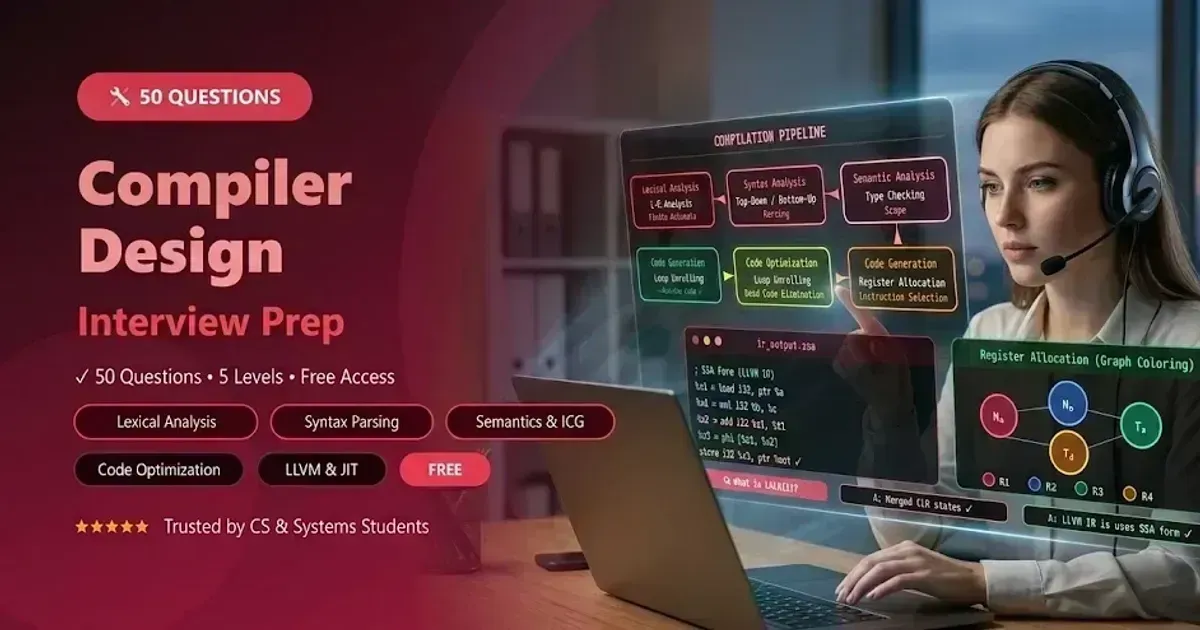
These 50 compiler design interview questions cover every high-frequency topic — from Lexical Analysis, tokenization, and Regular Expressions to advanced concepts like LL(1) vs LALR(1) parsers, Abstract Syntax Trees, Three-Address Code, SSA form, graph-coloring register allocation, and JIT compilation — with “Why Interviewers Ask This” insight for every answer.
Contents
- 1.Basics & Lexical Analysis (Q1–Q10)Compiler Phases · Tokens · RE · DFA · Symbol Table · Bootstrapping · Lex
- 2.Syntax Analysis & Parsing (Q11–Q20)CFG · Ambiguity · Left Recursion · LL(1) · FIRST/FOLLOW · LR · LALR(1)
- 3.Semantics & Intermediate Code (Q21–Q30)AST · SDT · Type Checking · TAC · Quadruples · Activation Records · Scoping
- 4.Code Optimization (Q31–Q40)Basic Blocks · CFG · DAG · Constant Folding · DCE · Loop Hoisting · Peephole
- 5.Code Generation & Modern Compilers (Q41–Q50)Register Allocation · Graph Coloring · JIT · SSA · LLVM · Cross-Compilation · GC
- 6.Common Interview MistakesConfusing parsing phases · Ignoring optimization · Type system gaps · Missing error recovery
- 7.Expert Interview StrategyCompilation pipeline · Parsing algorithms · Real compilers (GCC, LLVM) · Optimization phases
- 8.Real-World ApplicationsCompiler Engineer · Language Runtime Engineer · Systems Software Engineer
Basics & Lexical Analysis Interview Questions (Q1–Q10)
Compiler phases, terminology, interpreters, tokenization, regular expressions, and finite automata.
What is a Compiler?
A compiler is system software that translates high-level source code (C++, Java) into low-level machine code or bytecode that a CPU executes. The entire translation happens before execution.
💡 Why Interviewers Ask This: The baseline question — demonstrate understanding of the full translation pipeline from human-readable syntax to machine-executable instructions.
Compiler vs Interpreter
Compiler: translates the entire program before execution — faster runtime (C, C++, Rust). Interpreter: translates and executes line-by-line at runtime — easier debugging, slower execution (Python, Ruby). Hybrid: Java compiles to bytecode, then JVM interprets/JIT-compiles it.
💡 Why Interviewers Ask This: Tests understanding of programming language execution environments — why C++ programs run faster than Python scripts.
What are the six logical phases of a Compiler?
1. Lexical Analysis — tokenization. 2. Syntax Analysis — parse tree. 3. Semantic Analysis — type checking. 4. Intermediate Code Generation — machine-independent IR. 5. Code Optimization — remove redundancies. 6. Target Code Generation — machine binary.
💡 Why Interviewers Ask This: The roadmap of the entire subject — every other interview question stems from one of these six phases. Memorize this sequence.
Pass vs Phase in a Compiler
A Phase is a logical stage (syntax analysis, semantic analysis). A Pass is a physical traversal of the source or IR. One pass can execute multiple phases simultaneously — e.g., a single-pass compiler runs lexical + syntax + semantic analysis together.
💡 Why Interviewers Ask This: Shows you understand the difference between theoretical compiler architecture and practical software implementation constraints.
Role of the Lexical Analyzer (Scanner)
Reads source code character by character, strips whitespace and comments, and groups characters into Tokens (e.g., keyword int, identifier count, operator +). Outputs a token stream for the parser.
💡 Why Interviewers Ask This: Tests how raw text strings are digitized into structured data — the transition from characters to meaningful units.
Define Token, Lexeme, and Pattern
Token: the logical category (IDENTIFIER, KEYWORD, OPERATOR). Lexeme: the actual character string matched (e.g., count, while). Pattern: the Regular Expression describing how a token is formed (e.g., [a-zA-Z_][a-zA-Z0-9_]* for identifiers).
💡 Why Interviewers Ask This: Mixing up Token and Lexeme is a common beginner mistake. Precision with terminology signals deeper understanding.
Regular Expressions and Finite Automata in compilers
REs define token patterns. Lex/Flex converts REs into an NFA (Thompson Construction), then to a DFA (Subset Construction). This DFA acts as the state machine that efficiently scans and extracts lexemes from the source character stream.
💡 Why Interviewers Ask This: Bridges theoretical computer science (Automata Theory) with practical compiler construction.
What is the Symbol Table?
A central data structure used across all compiler phases. Stores identifier metadata: name, type, scope, memory location, and for functions: parameter types and return type. Created during lexical analysis; referenced heavily in semantic analysis and code generation.
💡 Why Interviewers Ask This: You cannot implement a compiler without a symbol table — it is how the compiler remembers and manages all declarations across scopes.
What is Compiler Bootstrapping?
Writing a compiler in the same language it compiles. Process: (1) Write a simple Compiler A for language X in an existing language. (2) Use A to compile Compiler B written in X. (3) B can now compile itself. Used by C, Rust, and Go compilers.
💡 Why Interviewers Ask This: A classic systems programming question — shows you understand how languages pull themselves up by their own bootstraps.
What is Lex / Flex?
Lex (open-source: Flex) is a Lexical Analyzer Generator. Input: Regular Expression rules with C actions. Output: auto-generated C code for a DFA-based scanner that tokenizes input text according to those rules.
💡 Why Interviewers Ask This: Proves you know the actual tooling used to build language parsers — essential for DSL development roles.
Syntax Analysis & Parsing Interview Questions (Q11–Q20)
CFGs, parse trees, top-down/bottom-up strategies, FIRST/FOLLOW sets, and LR parsers.
Role of the Syntax Analyzer (Parser)
Takes the token stream and verifies it conforms to the language CFG. Builds a Parse Tree (or AST) representing syntactic structure. The scanner checks if words exist; the parser checks if the sentence is grammatically valid.
💡 Why Interviewers Ask This: Distinguishes tokenization (lexical) from structural validation (syntactic) — two completely different problems.
What is a Context-Free Grammar (CFG)?
A set of recursive production rules describing a language. Four components: Terminals (actual tokens), Non-terminals (syntactic variables, e.g., Expr, Stmt), Start Symbol (root non-terminal), and Productions (mapping rules).
💡 Why Interviewers Ask This: CFGs are the mathematical foundation of all programming languages — parsing is impossible to understand without them.
What makes a grammar Ambiguous?
A grammar is ambiguous if one input string produces more than one valid Parse Tree. The compiler would not know which interpretation to execute. Classic examples: the Dangling Else problem and operator precedence in 2 + 3 * 4.
💡 Why Interviewers Ask This: Ambiguity causes non-deterministic compilation — the same source code could produce different executables depending on which parse was chosen.
Left Recursion and why eliminate it
A → Aα | β — top-down parsers enter an infinite loop trying to expand A. Eliminate by rewriting: A → βA', A' → αA' | ε. This right-recursive form is parseable by LL parsers.
💡 Why Interviewers Ask This: A critical parser mechanics question — you must know how to mathematically transform a grammar to make it top-down parseable.
What is Left Factoring?
When productions share a common prefix A → αβ | αγ, factor out: A → αA', A' → β | γ. Ensures a deterministic LL parser can select the correct production using a single lookahead token without backtracking.
💡 Why Interviewers Ask This: Demonstrates ability to optimize a CFG for predictive parsing — a required grammar engineering skill.
Top-Down vs Bottom-Up Parsing
Top-Down: Starts from Start Symbol, expands non-terminals downward (LL(1), Recursive Descent). Simpler to write by hand. Bottom-Up: Starts from leaf tokens, reduces upward to root (LR, LALR, Shift-Reduce). More powerful, handles more grammars.
💡 Why Interviewers Ask This: Evaluates understanding of the two fundamental parse tree construction directions and their trade-offs.
What is an LL(1) Parser?
Left-to-right scan, Leftmost derivation, 1 token lookahead. Uses a predictive parsing table (built from FIRST and FOLLOW sets) to select productions without backtracking. Industry standard for hand-written parsers (GCC front-end, V8).
💡 Why Interviewers Ask This: You must know the acronym definition cold and understand how the predictive table is constructed from FIRST/FOLLOW.
What are FIRST and FOLLOW sets?
FIRST(X): terminals that can begin any string derivable from X (includes ε if X can derive empty). FOLLOW(X): terminals appearing immediately after X in any valid derivation (never ε; always includes $ for start symbol). Together they build LL(1) parsing tables.
💡 Why Interviewers Ask This: Calculating FIRST and FOLLOW sets is the most common whiteboard exercise in any compiler design technical interview.
What is Shift-Reduce Parsing?
A bottom-up method using a stack. The parser either Shifts the next input token onto the stack, or Reduces the top stack contents (a handle) to the corresponding non-terminal when it matches a grammar rule RHS. Accepts when only start symbol remains.
💡 Why Interviewers Ask This: Shift-Reduce is the operational mechanic behind all LR parsers (SLR, LALR, CLR).
SLR vs LALR vs CLR — order by power
SLR(1) (weakest — uses FOLLOW sets) < LALR(1) (merges CLR states — industry standard, used by Yacc/Bison) < CLR(1) (most powerful — largest tables). LALR gives near-CLR power at SLR-like memory cost.
💡 Why Interviewers Ask This: You must understand the trade-off between parser power and state-table memory footprint (state explosion in CLR).
Semantics & Intermediate Code Interview Questions (Q21–Q30)
SDT, ASTs, type checking, Three-Address Code, activation records, and scoping.
Role of Semantic Analysis
Checks the meaning of code — enforcing rules CFGs cannot express: type checking, variables declared before use, correct function argument counts, and scope rules. Syntax error = missing semicolon; Semantic error = type mismatch.
💡 Why Interviewers Ask This: Tests ability to distinguish structural validity (syntax) from logical validity (semantics).
Parse Tree vs Abstract Syntax Tree (AST)
Parse Tree: contains every syntactic detail — parentheses, semicolons, grammar rule nodes. Dense and verbose. AST: strips syntactic artifacts, retains only essential logic. An if node has two children (condition, body). Compilers, linters, and transpilers operate on ASTs.
💡 Why Interviewers Ask This: Modern compilers rarely use full parse trees past the syntax phase — ASTs are the backbone of all compiler backends.
What is Syntax-Directed Translation (SDT)?
Semantic rules or actions are directly attached to grammar productions. As the parser builds the tree, it simultaneously evaluates rules to compute values, generate IR, or perform type checking — combining syntax and semantic phases without building a full parse tree first.
💡 Why Interviewers Ask This: Shows how compilers pipeline multiple phases efficiently to save time and memory.
Synthesized vs Inherited Attributes
Synthesized: value computed from child nodes — flows bottom-up (e.g., node type synthesized from operands). Inherited: value passed from parent or sibling nodes — flows top-down or laterally (e.g., declaration type inherited by all variables declared in it).
💡 Why Interviewers Ask This: Tests deep understanding of how information flows through a tree structure during semantic processing.
What is Intermediate Code Generation (ICG)?
Translates the AST into a machine-independent lower-level IR. Key benefit: decouples the compiler front-end (language) from the back-end (CPU). One C++ front-end targets x86, ARM, WebAssembly, and RISC-V with separate back-ends. Why LLVM bitcode IR dominated.
💡 Why Interviewers Ask This: The secret to LLVM success — mandatory knowledge for compiler infrastructure and toolchain roles.
What is Three-Address Code (TAC)?
Each instruction has at most three operands: two sources + one destination (e.g., t1 = a + b). Complex expressions decompose: x = a + b * c → t1 = b * c, x = a + t1. Flat, simple, ideal for data flow analysis and optimization.
💡 Why Interviewers Ask This: You must know how to break any complex expression into TAC — the standard format for all optimization algorithms.
Quadruples, Triples, and Indirect Triples
Quadruples: (Op, Arg1, Arg2, Result) — easy to reorder. Triples: (Op, Arg1, Arg2) — result is the implicit position index; saves space but reordering breaks pointers. Indirect Triples: array of pointers to triples — reordering done by permuting the pointer array.
💡 Why Interviewers Ask This: Tests knowledge of memory-efficient data structures for IR storage inside the compiler backend.
What is an Activation Record (Stack Frame)?
Memory pushed onto the Call Stack per function call. Contains: local variables, parameters, return address, saved registers, and dynamic/static link. Each recursive call gets its own independent activation record — enabling recursion to work correctly.
💡 Why Interviewers Ask This: Critical for systems engineers — you must understand how function calls map physically to RAM and the call stack.
Static vs Dynamic Scoping
Static (Lexical): bindings resolved at compile time from source layout — used by C, Java, Python. Predictable. Dynamic: bindings resolved at runtime from call chain — used by Bash, early Lisp. A function's behavior changes depending on its caller.
💡 Why Interviewers Ask This: Directly impacts how the symbol table and scope chain are implemented in the compiler.
How do compilers handle Exception Handling?
Compilers generate a side-table mapping instruction address ranges to catch block locations. On exception, the runtime looks up the PC in this table and stack unwinds to the handler. This is C++ zero-cost exceptions — no overhead unless an exception actually fires.
💡 Why Interviewers Ask This: A highly advanced systems question bridging static compilation and dynamic runtime behavior.
Code Optimization Interview Questions (Q31–Q40)
Basic blocks, DAGs, data flow analysis, loop optimizations, and machine-independent passes.
Golden Rule of Code Optimization
Optimization transforms IR to consume fewer resources (CPU cycles, memory) while strictly preserving the observable program output. Every optimization must be provably safe — it cannot change what the program computes. Efficiency vs correctness is never a trade-off.
💡 Why Interviewers Ask This: Ensures you understand optimization is purely about efficiency — safety of program semantics is non-negotiable.
Local vs Global Optimization
Local: within a single Basic Block — fast, no control-flow awareness (constant folding, local CSE). Global: across the entire CFG — analyzes loops, branching, inter-block data flow (loop hoisting, global DCE). More powerful but computationally more expensive.
💡 Why Interviewers Ask This: Tests understanding of optimization scope and the compiler time complexity trade-offs involved.
What is a Basic Block?
A maximal sequence of consecutive IR instructions with exactly one entry point and one exit point. No branches enter in the middle; branching only at the very end. Basic blocks are the atomic units of a Control Flow Graph — always executed as a complete unit.
💡 Why Interviewers Ask This: Fundamental to all code optimization algorithms — CFG analysis is impossible without understanding basic blocks.
What is a Control Flow Graph (CFG)?
A directed graph where nodes = Basic Blocks and edges = possible jumps or branches between them. Represents all possible execution paths through a function. GCC and Clang build CFGs to perform global optimization and data flow analysis.
💡 Why Interviewers Ask This: Understanding CFGs is prerequisite for any advanced optimization or static analysis discussion.
DAG for Optimization
A Directed Acyclic Graph within a Basic Block identifies Common Subexpressions and performs Constant Folding. Each unique expression is one node — duplicate references share it, computing it only once. Also reveals computation dependencies for instruction scheduling.
💡 Why Interviewers Ask This: Demonstrates how graph theory eliminates redundant computations efficiently at the local level.
Constant Folding vs Constant Propagation
Constant Folding: evaluates constant expressions at compile time — x = 2 * 3 → x = 6. Constant Propagation: when a variable is a known constant, replaces all subsequent uses with the constant value directly, enabling further folding downstream.
💡 Why Interviewers Ask This: The most common low-hanging-fruit optimizations in every modern compiler — fast, safe, and highly effective.
What is Dead Code Elimination?
Removes instructions with no effect on program output: variables assigned but never read (dead stores), code after a return statement (unreachable code), and branches whose condition is always true or false. Relies on Liveness Analysis and Reachability Analysis.
💡 Why Interviewers Ask This: Proves you understand liveness and reachability — essential for optimization and static analysis tools like SonarQube.
Loop Invariant Code Motion (Hoisting)
Detects expressions inside a loop that compute the same value every iteration and moves them to a pre-header block before the loop. If len = arr.length never changes, hoisting it out saves N−1 redundant computations.
💡 Why Interviewers Ask This: Loops are where programs spend ~90% of execution time — loop optimizations are highest priority in any compiler.
What is Strength Reduction?
Replaces an expensive operation with an algebraically equivalent cheaper one. Examples: x * 2 → x << 1; loop multiplication i * stride replaced by an accumulation variable that increments by stride each iteration.
💡 Why Interviewers Ask This: Tests knowledge of actual CPU hardware costs — multiply/divide have higher latency than add/shift on most architectures.
What is Peephole Optimization?
A final pass over target machine code. A small window slides over generated instructions applying local replacement rules: eliminating redundant load/store pairs, replacing slow sequences with faster CPU-specific equivalents, removing unreachable jump targets.
💡 Why Interviewers Ask This: The most common machine-dependent optimization — proves you understand assembly-level tweaks and CPU-specific idioms.
Code Generation & Modern Compilers Interview Questions (Q41–Q50)
Register allocation, LLVM, JIT, SSA form, instruction scheduling, cross-compilation, and GC integration.
Role of the Target Code Generator
Final compiler phase. Translates optimized IR into architecture-specific machine code (x86-64, ARM64, RISC-V). Tasks: selecting machine instructions, managing register allocation, choosing memory addressing modes. Outputs relocatable object code.
💡 Why Interviewers Ask This: Tests understanding of the bridge between software abstraction and actual silicon hardware.
What is Register Allocation?
Deciding which IR variables reside in fast, limited hardware registers versus being spilled to RAM. Poor allocation causes register spilling — thrashing memory with loads/stores, devastating performance. One of the hardest problems in compiler back-end design.
💡 Why Interviewers Ask This: Register allocation is one of the hardest NP-Complete problems that compilers must solve heuristically in polynomial time.
Graph Coloring in Register Allocation
Variables = nodes. Edges connect variables that are simultaneously live. Colors = registers. Goal: assign colors so no two adjacent nodes share a color. If more colors are needed than registers, some variables are spilled to the stack. NP-Complete graph theory in practice.
💡 Why Interviewers Ask This: A brilliant intersection of graph theory and hardware constraints — a definitive senior-level systems engineering question.
What is Instruction Scheduling?
Reorders assembly instructions to prevent CPU pipeline stalls and maximize Instruction-Level Parallelism (ILP). Modern superscalar CPUs stall when a later instruction depends on a result not yet ready. The scheduler inserts independent instructions between dependent ones.
💡 Why Interviewers Ask This: Deep systems architecture knowledge — proves you understand superscalar processors and pipeline hazards.
What is Cross-Compilation?
A cross-compiler runs on one architecture (e.g., x86 PC) but generates machine code for a different target (e.g., ARM Raspberry Pi, STM32 microcontroller). Host and target differ in CPU, instruction set, and possibly OS. Essential for embedded and IoT firmware.
💡 Why Interviewers Ask This: Essential for firmware and embedded engineering roles — you must understand host vs target environments clearly.
What is JIT (Just-In-Time) Compilation?
Takes bytecode (Java .class, C# IL) and dynamically compiles hot methods into native machine code at runtime, optimizing using live profiling (e.g., inlining only actual call targets). JIT powers the JVM, V8 (Node.js/Chrome), and .NET CLR.
💡 Why Interviewers Ask This: Mandatory knowledge for modern backend and runtime engineers — explains why JVM can match C++ speed in long-running workloads.
Lex & Yacc / Flex & Bison
Lex/Flex: Regular Expression rules → DFA-based C scanner (Lexical Analyzer). Yacc/Bison: LALR(1) CFG → C shift-reduce parser (Syntax Analyzer). Together: a complete compiler-compiler pipeline — the foundation of Unix language tooling for 40+ years.
💡 Why Interviewers Ask This: Proves you can rapidly build a custom DSL or language front-end using industry-standard generator tools.
What is Data Flow Analysis?
Propagates facts about variable states through the CFG. Key analyses: Reaching Definitions (which assigns reach a point), Liveness Analysis (variables used before being overwritten), Available Expressions (for CSE). Enables safe DCE and constant propagation.
💡 Why Interviewers Ask This: The mathematical backbone of all advanced compiler optimization and static analysis tools (SonarQube, Coverity, Clang-Tidy).
What is SSA (Static Single Assignment) Form?
Every variable is assigned exactly once. Redefinitions create new versions (x₁, x₂). At control-flow merges, a Phi (Φ) function selects the correct version: x₃ = Φ(x₁, x₂). SSA trivializes constant propagation, DCE, and copy elimination. The core IR of LLVM.
💡 Why Interviewers Ask This: Definitive senior-level question — SSA form is why LLVM dominates compiler infrastructure. Understanding SSA separates engineers from architects.
How does a compiler support Garbage Collection?
Embeds two artifacts: Stack Maps — metadata tables telling the GC where object pointers live in registers/stack at every safe point; and Write Barriers — code at every pointer store notifying the GC of reference graph changes. Enables tracing GCs (JVM, Go) without fully stopping the world.
💡 Why Interviewers Ask This: Bridges static compilation and dynamic memory management — essential for runtime engineers on JVM, Go runtime, or V8.
Common Mistakes in Compiler Design Interviews
- Not explaining lexical analysis before parsing: The lexer generates tokens, the parser builds AST. Skipping lexical analysis or conflating it with parsing shows you haven't internalized the compilation pipeline's separation of concerns.
- Confusing top-down and bottom-up parsing: Top-down (recursive descent) is intuitive but restricted (LL grammars). Bottom-up (LR parsing) handles more grammars but is harder to implement. Knowing the trade-offs and when each is used matters.
- Not understanding precedence and associativity: Without operator precedence rules (PEMDAS-style), "2+3*4" becomes ambiguous. Precedence climbing or Pratt parsing solve this. Not explaining how your parser handles precedence is a gap.
- Treating optimization as optional: Constant folding, dead code elimination, loop unrolling, and register allocation are standard. Not mentioning optimization phases shows you think of compilers as just translators, not performance-critical software.
- Ignoring the symbol table: The symbol table tracks identifiers, their types, scope, and storage location. Poor symbol table design leads to incorrect semantic analysis. Explaining scope resolution (nested lexical scopes, name shadowing) shows design depth.
- Not discussing error recovery: Production compilers don't stop at the first error. Explaining panic mode, error tokens, or local error recovery shows you've thought about real compiler robustness, not just toy implementations.
Expert Interview Strategy for Compiler Design Roles
- Draw the compilation pipeline end-to-end: Source → Lexer → Parser → AST → Semantic Analysis → Intermediate Code → Optimization → Code Generation → Binary. Sketch this for every question to stay structured.
- Know a concrete grammar library: Reference ANTLR (LL(*) parser generator), Yacc/Bison (LALR), or Tree-sitter. Saying "I'd write a hand-written recursive descent parser" is valid, but naming real tools shows practical experience.
- Explain Abstract Syntax Trees clearly: An AST represents the program structure (not the parse tree with all syntax details). Showing how an AST enables semantic analysis and code generation demonstrates you understand the purpose of each compilation phase.
- Connect compiler concepts to real languages: "Python has dynamic typing, so type checking happens at runtime. C has static typing, so type checking is at compile time. This affects how the compiler generates code." Concrete examples beat abstract theory.
- Know register allocation heuristics: Graph coloring for register allocation, spill and reload for limited registers, and instruction selection trade-offs are topics that separate compiler academics from practitioners. Even a basic overview shows seriousness.
How These Concepts Apply in Real Compiler Jobs
Compiler Engineer
Develops parsers and code generators for production languages, optimizes compilation time and code quality, implements new language features, and maintains backward compatibility across compiler versions.
JIT / Runtime Engineer
Builds just-in-time compilers for high performance, profiles hot code paths, implements tiered compilation strategies, and optimizes runtime dispatch for dynamic languages like JavaScript and Python.
Hardware Description Language Engineer
Works on HDL compilers (Verilog, VHDL, SystemVerilog), targets FPGA and ASIC synthesis, implements hardware-specific optimizations, and bridges software and hardware design.
Conclusion: Master Compiler Design Interviews
These 50 compiler design interview questions cover the essential concepts for compiler engineer, language designer, and systems software roles. Mastering these topics demonstrates understanding of lexical analysis, parsing, semantic analysis, intermediate code generation, optimization, and code generation.
After reviewing, reinforce with hands-on compiler construction and theory notes. Understanding the compilation pipeline + implementing a parser + studying optimizations creates the strongest interview foundation.
Topics covered in this guide
Topics in this guide: Lexical analysis, parsing algorithms, AST, semantic analysis, intermediate representation, code optimization, target code generation.
For freshers: Compiler phases, tokenization, regular expressions to DFA, LL(1) parsing, grammar ambiguity, symbol tables.
For experienced professionals: LR parsing algorithms (SLR, LALR), AST traversal, type checking systems, static single assignment (SSA) form, loop optimization techniques.
Interview preparation tips: Review parser generators like Lex/Yacc, practice building simple parsing tables by hand, and understand compiler optimization flags (-O2, -O3).
Frequently Asked Questions
Q.What compiler design topics are most asked in interviews?
Q.What is the difference between SLR, LALR, and CLR parsers?
Q.Why is SSA form important in modern compilers?
Q.What is the difference between local and global optimization?
Q.How long does it take to prepare for compiler design interviews?
Master the theory behind every answer
Read Compiler Design Theory Notes ·Explore all interview guidesFound these questions helpful? Share them with your peers.
Common Interview Mistakes
Errors that eliminate candidates
- Giving textbook definitions without showing a concrete Compiler Design use case.
- Skipping trade-offs and answering as if there is only one correct engineering decision.
- Over-answering for 2-3 minutes without structure, metrics, or outcomes.
Expert Interview Strategy
30-second answer rule
- Start with a one-line definition, then explain one real scenario from Compiler Design.
- Use a 3-step structure: concept, practical example, and interviewer intent.
- Close with one trade-off (performance, scale, security, or maintainability).
Real-World Job Applications
These Compiler Design patterns are directly tested for production roles where interviewers expect clear debugging steps, architecture trade-offs, and communication under time pressure.
Conclusion
Mastering these Compiler Design interview questions means explaining concepts quickly, connecting them to real systems, and justifying decisions with practical trade-offs.
Frequently Asked Questions
How should I prepare this topic in 7 days? Focus on high-frequency patterns, rehearse 30-second answers, and revise one practical example per category.
What do interviewers score most? Clarity, structured thinking, and your ability to reason through constraints and trade-offs.