Top 50 Theory of Computation Interview Questions with Answers (2026): Fresher to Theoretical CS Expert
 PerfectNotes Team~22 min read50 Questions5 CategoriesFree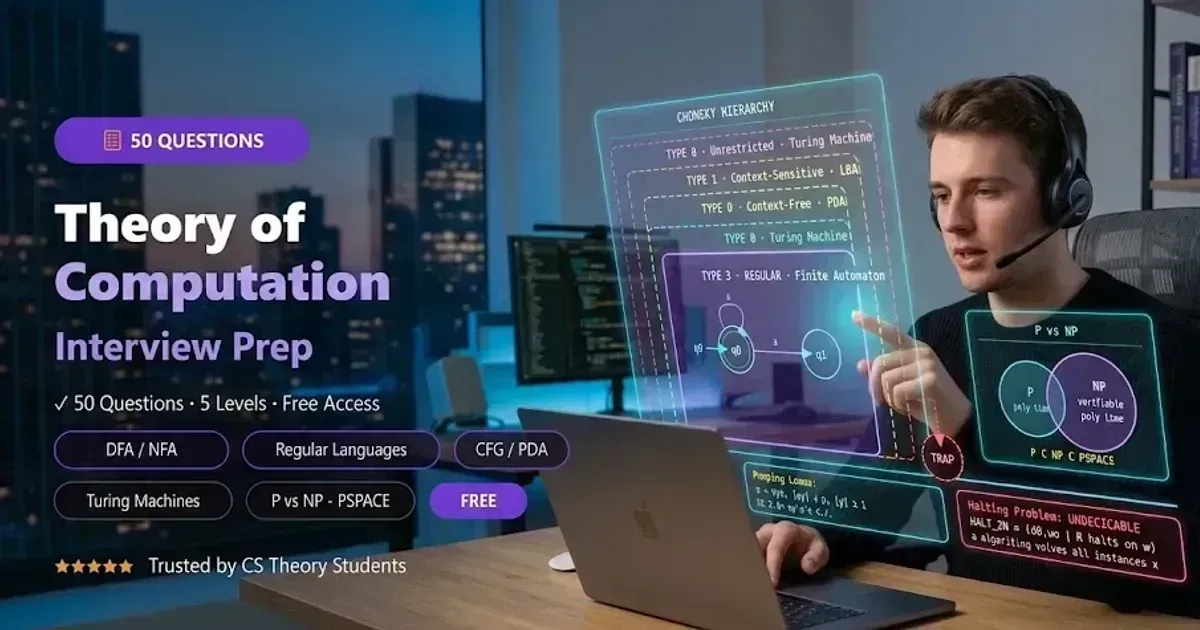
These 50 Theory of Computation interview questions span every high-frequency topic — from DFA/NFA equivalence, Regular Expressions, and the Pumping Lemma to advanced concepts like Context-Free Grammars, Pushdown Automata, Turing Machine decidability, the Halting Problem, and P vs NP complexity classes — with “Why Interviewers Ask This” insight for every answer.
Contents
- 1.Automata Basics & Languages (Q1–Q10)Alphabets · Strings · Chomsky Hierarchy · States · Transitions · Accept States
- 2.Finite Automata & Regular Expressions (Q11–Q20)DFA · NFA · Subset Construction · Pumping Lemma · Myhill-Nerode
- 3.CFGs & Pushdown Automata (Q21–Q30)CFG · PDA · Parse Trees · Ambiguity · CNF · GNF · Closure Properties
- 4.Turing Machines & Decidability (Q31–Q40)TM · UTM · Church-Turing · Halting Problem · RE Languages · PCP · LBA
- 5.Complexity Theory — P, NP & Beyond (Q41–Q50)P · NP · NP-Hard · NP-Complete · Cook's Theorem · Reductions · PSPACE
- 6.Common Interview MistakesAutomata hierarchy gaps · NP vs NP-Complete · Reduction proofs · Halting problem · Closure properties
- 7.Expert Interview StrategyDraw DFAs/NFAs · Turing machine universality · Complexity classes · Proof by reduction
- 8.Real-World Job ApplicationsFormal Methods Engineer · Algorithm Designer · Compiler Designer
Automata Basics & Languages Interview Questions (Q1–Q10)
Formal language theory fundamentals: alphabets, strings, the Chomsky Hierarchy, states, transitions, and what defines a language.
What is the Theory of Computation (ToC)?
ToC is a branch of computer science and mathematics dealing with whether and how efficiently problems can be solved on a model of computation. Three main branches: Automata Theory (abstract machines), Computability Theory (what can be computed), and Complexity Theory (what can be efficiently computed).
💡 Why Interviewers Ask This: The baseline question — proves you understand the theoretical limits of computation, not just programming syntax.
Define Alphabet, String, and Language in ToC
Alphabet (Σ): A finite, non-empty set of symbols (e.g., {0, 1}). String: A finite sequence of symbols from an alphabet. Language: A set of strings formed from a specific alphabet by a specific set of rules or grammar (e.g., all binary strings with equal 0s and 1s).
💡 Why Interviewers Ask This: Atomic building blocks of the entire subject — you cannot explain any formal language theory without this vocabulary.
Kleene Star (*) vs Kleene Plus (+)
Kleene Star (Σ*): All possible strings over Σ including the empty string (ε). Kleene Plus (Σ+): All possible strings over Σ excluding the empty string. Formally: Σ+ = Σ* \ {ε}.
💡 Why Interviewers Ask This: Tests precision with mathematical notation used heavily in regular expressions and formal proofs.
Explain the Chomsky Hierarchy
A containment hierarchy of formal grammars ranked by generative power: Type 3: Regular Grammars → Finite Automata. Type 2: Context-Free Grammars → Pushdown Automata. Type 1: Context-Sensitive Grammars → Linear Bounded Automata. Type 0: Unrestricted Grammars → Turing Machines.
💡 Why Interviewers Ask This: Most important classification system in ToC — you must know which automaton matches which grammar type cold.
What is an Automaton?
An abstract mathematical model of a computing machine. It consists of states, transitions, inputs, and rules dictating how the machine moves between states based on input symbols. The type of memory available determines the power tier (finite memory → FA, stack → PDA, tape → TM).
💡 Why Interviewers Ask This: Evaluates understanding of state machines — which underpin UI frameworks, game AI, network protocols, and lexers.
What is a State in Automata Theory?
A state represents the current condition or "memory snapshot" of the system at a given moment. The automaton transitions between states in response to input symbols. Finite automata have finite memory precisely because they have only a finite number of states.
💡 Why Interviewers Ask This: State is the core concept of memory in ToC — finite states = finite memory, the fundamental constraint of FAs.
What is the Transition Function (δ)?
Maps the current state and current input symbol to the next state. In a DFA: δ: Q × Σ → Q. In an NFA: δ: Q × (Σ ∪ {ε}) → P(Q) (returns a power set of states). The entire behavior of an automaton is encoded in this function.
💡 Why Interviewers Ask This: Tests ability to read mathematical formalisms — essential for implementing finite state machines in code.
What is the Empty String (ε or λ)?
A string of length zero — it contains no symbols from the alphabet. It is the identity element for string concatenation: w · ε = ε · w = w. Critically: ε ∈ Σ* but ε ∉ Σ+.
💡 Why Interviewers Ask This: A critical edge-case concept — algorithms and proofs fail if the empty string is not explicitly handled.
What is a Trap State (Dead State)?
A non-accepting state from which no sequence of inputs can ever lead to an accepting state. Once entered, the machine is trapped. DFAs require explicit trap states to handle all invalid inputs — essential for compiler lexer design to explicitly reject malformed tokens.
💡 Why Interviewers Ask This: Shows you understand how to design machines that explicitly and deterministically reject invalid inputs.
What is an Accept State (Final State)?
A designated state (or set of states) in an automaton. If the machine finishes reading the entire input string and lands in an accept state, the string is accepted — it belongs to the language. Otherwise, the string is rejected.
💡 Why Interviewers Ask This: Tests understanding of how a finite state machine makes its final binary Accept/Reject decision.
Finite Automata & Regular Expressions Interview Questions (Q11–Q20)
DFA/NFA equivalence, converting between representations, pumping lemmas, and properties of regular languages.
What is a Deterministic Finite Automaton (DFA)?
A finite state machine where, for every state and every input symbol, there is exactly one defined transition to a next state. No ε-transitions allowed. Formally: 5-tuple (Q, Σ, δ, q₀, F) where δ is total. The theoretical model behind all pattern matchers and lexical analyzers.
💡 Why Interviewers Ask This: DFAs are the foundation of all regex engines, string searching algorithms, and compiler scanners.
What is a Non-Deterministic Finite Automaton (NFA)?
A finite state machine where, for a given state and input symbol, there can be zero, one, or multiple transitions. It can also use ε-transitions (move to another state without consuming input). Conceptually, an NFA explores all paths in parallel.
💡 Why Interviewers Ask This: NFAs introduce the concept of non-determinism — key to understanding parallel computation and NP.
Which is more powerful: DFA or NFA?
Neither — they are computationally equivalent. Any language recognized by an NFA can be recognized by a DFA (Subset Construction). However, an NFA is often exponentially smaller and easier to design. Converting NFA→DFA can cause exponential state explosion (from N states to up to 2ᴺ states).
💡 Why Interviewers Ask This: Classic "gotcha" — candidates assume non-deterministic = more powerful. Knowing this equivalence wins interviews.
How do you convert an NFA to a DFA?
Using the Subset Construction (Powerset Construction) Algorithm: Each DFA state represents a subset of NFA states. Compute the ε-closure of each reachable subset. A DFA state is accepting if any NFA state in its subset is accepting. DFA can have up to 2ᴺ states for an N-state NFA.
💡 Why Interviewers Ask This: Tests knowledge of the algorithmic transformation used internally by every regex engine to compile patterns.
What is a Regular Expression (RE)?
An algebraic formula describing a Regular Language using three base operations: Union (a|b), Concatenation (ab), and Kleene Star (a*). Any RE can be converted to an NFA (Thompson Construction), then to a DFA (Subset Construction). The foundation of grep, Python re module, and all pattern matching.
💡 Why Interviewers Ask This: Regex is used daily — knowing its theoretical grounding shows you understand why certain patterns are impossible.
What is Arden's Theorem?
If R = Q + R·P where P doesn't contain ε, then the unique solution is R = Q·P*. This theorem enables systematic conversion of a DFA to a Regular Expression by treating state equations as algebraic equations and solving for the start state's variable.
💡 Why Interviewers Ask This: A deep academic question — proves you understand the mathematical duality between automata and algebra.
What is the Pumping Lemma for Regular Languages?
For any regular language L, there exists a pumping length p such that any string s ∈ L with |s| ≥ p can be split into s = xyz where: |xy| ≤ p, |y| ≥ 1, and xyiz ∈ L for all i ≥ 0. Key: it is a negative test only — used to prove non-regularity, not regularity.
💡 Why Interviewers Ask This: The most famous theorem in automata theory — critical to prove languages cannot be recognized by finite automata.
Are Regular Languages closed under union, intersection, and complement?
Yes — closed under all standard operations: Union, Intersection, Complement, Concatenation, Kleene Star, Difference, Reversal, Homomorphism. Performing any of these operations on regular languages always yields another regular language. This is why regex is so composable.
💡 Why Interviewers Ask This: Tests understanding of set theory closure properties within formal language theory.
Example of a language that is NOT regular
L = {aⁿbⁿ | n ≥ 0} — equal numbers of a's then b's. A finite automaton cannot accept this because it has finite memory (finite states) and cannot count how many a's it saw to match the b's. Proven by the Pumping Lemma: pump the a's, break the balance.
💡 Why Interviewers Ask This: Perfectly illustrates the fundamental limitation of FA: inability to count arbitrarily (no unbounded memory).
What is the Myhill-Nerode Theorem?
Provides a necessary and sufficient condition for a language to be regular: a language L is regular if and only if it has a finite number of equivalence classes under the Nerode right-invariant equivalence relation. In practice, it is the mathematical foundation of DFA Minimization.
💡 Why Interviewers Ask This: Shows advanced knowledge of how compilers optimize their lexical analysis phases to minimize memory usage.
Context-Free Grammars & Pushdown Automata Interview Questions (Q21–Q30)
Recursive grammars, parse trees, ambiguity, stack-based computation, and closure properties of CFLs.
What is a Context-Free Grammar (CFG)?
A set of recursive production rules of the form A → γ, where any single non-terminal A is replaced by a string γ of terminals and/or non-terminals, regardless of the context surrounding A. Example: S → aSb | ε generates {aⁿbⁿ}. The backbone of all programming language syntax.
💡 Why Interviewers Ask This: CFGs are used in every parser generator (Yacc, Bison, ANTLR) and underpin all programming language specifications.
What is a Pushdown Automaton (PDA)?
Essentially a Finite Automaton with an infinite Stack (LIFO memory). The stack allows the PDA to "count" and match nested symbols. Accepts exactly the Context-Free Languages. Can push symbols when descending, pop when ascending — enables recognition of balanced parentheses, XML, and recursive grammars.
💡 Why Interviewers Ask This: Tests how hardware memory structures (stacks) upgrade theoretical machine power.
How does a DPDA differ from an NPDA?
A DPDA has exactly one valid transition per (state, input, stack-top) combination. Unlike finite automata, DPDAs are strictly less powerful than NPDAs. NPDAs accept all CFLs; DPDAs accept only Deterministic CFLs (a proper subset). Most practical programming language grammars are designed to be DCFL (parseable by LALR(1)).
💡 Why Interviewers Ask This: A critical distinction — determinism limits PDA power, which is why grammar design matters for real parsers.
What is a Derivation Tree (Parse Tree)?
A hierarchical tree representing how a string is derived from a CFG. Root = Start symbol. Interior nodes = Non-terminals. Leaf nodes = Terminals. Reading leaves left to right yields the derived string. This is the exact data structure built by a compiler's syntax analyzer.
💡 Why Interviewers Ask This: The Parse Tree is the output of every parser — understanding it proves you know how compilers actually work.
What makes a grammar Ambiguous?
A grammar is ambiguous if it can generate more than one distinct Parse Tree for the same input string (equivalently: more than one leftmost or rightmost derivation). Classic example: Dangling Else problem — an else clause could attach to either of two if statements.
💡 Why Interviewers Ask This: Ambiguity is fatal in compiler design — without a unique parse tree, the compiler cannot know which code to generate.
What is Chomsky Normal Form (CNF)?
A CFG where all production rules take one of exactly two forms: A → BC (two non-terminals) or A → a (one terminal). Every CFG (without ε) can be converted to CNF. CNF is required by the CYK (Cocke-Younger-Kasami) parsing algorithm which runs in O(n³).
💡 Why Interviewers Ask This: CNF normalizes grammars enabling polynomial-time parsing — foundational for understanding parsing complexity.
What is Greibach Normal Form (GNF)?
A CFG where all production rules take the form A → aα — a single terminal first, followed by zero or more non-terminals. Key property: every derivation step consumes exactly one terminal symbol. Derivation length = string length, making proofs about PDAs much cleaner.
💡 Why Interviewers Ask This: GNF's structural guarantee that each step consumes one symbol simplifies complexity proofs.
Are Context-Free Languages closed under intersection?
No — CFLs are NOT closed under intersection. Proof by counterexample: {aⁿbⁿcᵐ} ∩ {aᵐbⁿcⁿ} = {aⁿbⁿcⁿ} which is NOT a CFL. However: CFL ∩ Regular Language = CFL always (by the Intersection Theorem). This distinction is critical and frequently confused.
💡 Why Interviewers Ask This: Classic trap — candidates assume CFLs follow the same closure rules as regular languages. They do not.
Pumping Lemma for Context-Free Languages
For any CFL L, there exists p such that any s ∈ L with |s| ≥ p can be split into s = uvwxy where |vwx| ≤ p, |vx| ≥ 1, and uvⁱwxⁱy ∈ L for all i ≥ 0. Both v and x are pumped simultaneously. Used to prove languages are not context-free.
💡 Why Interviewers Ask This: Tests advanced mathematical proof techniques for understanding the structural limits of stack-based memory.
Example of a language that is NOT Context-Free
L = {aⁿbⁿcⁿ | n ≥ 0}. A PDA cannot recognize this: it can push a's and pop them against b's, but then the stack is empty with no way to verify n c's. Essentially, one stack cannot manage two independent counting constraints simultaneously.
💡 Why Interviewers Ask This: Perfectly illustrates the single-stack limitation — one stack cannot count two independent sequences simultaneously.
Turing Machines & Decidability Interview Questions (Q31–Q40)
The limits of computation: Turing machines, computability theory, the Halting Problem, and what is truly undecidable.
What is a Turing Machine (TM)?
The ultimate model of computation. A TM has: a finite state control, an infinite tape (cells of symbols), and a read/write head that moves left or right. It can read, write, and change state. It can compute anything any modern computer can compute — the theoretical blueprint of all computation.
💡 Why Interviewers Ask This: The Turing Machine is the conceptual foundation of all computer science — every computational model is measured against it.
Explain the Church-Turing Thesis
The hypothesis that any function computable by an algorithm can be computed by a Turing Machine. It equates intuitive human computation with formal TM computation. Not a provable theorem — rather a universally accepted definition of what "computable" means. Every known model of computation (RAM, λ-calculus, circuits) matches TM power.
💡 Why Interviewers Ask This: The philosophical foundation of CS — proves you understand what "computability" fundamentally means.
What is a Universal Turing Machine (UTM)?
A TM that can simulate any other TM. Input: description of TM M (as a string) + input w. Output: whatever M would output on w. The UTM is the theoretical blueprint for the modern stored-program computer — programs are just data (encoded TMs) stored in memory.
💡 Why Interviewers Ask This: The UTM directly maps to the von Neumann architecture — the single most impactful idea in computer engineering history.
What is a Decidable (Recursive) Language?
A language L is decidable if there exists a Turing Machine that always halts — it accepts if the string is in L and rejects if it is not. No infinite loops. Decidable = algorithm exists that gives a definitive YES/NO answer for every input.
💡 Why Interviewers Ask This: Determines your understanding of guaranteed termination — the line between solvable and unsolvable problems.
What is a Recursively Enumerable (RE) Language?
A language L is RE (Partially Decidable) if there is a TM that halts and accepts if the string is in L, but if the string is NOT in L, the TM might reject OR loop infinitely. RE ⊃ Decidable — the TM recognizes the language but cannot always decide membership.
💡 Why Interviewers Ask This: Tests grasp of the terrifying concept of infinite loops — programs that may never terminate on no-instances.
What is the Halting Problem?
The question: "Given a description of an arbitrary program and its input, does this program halt or run forever?" Formally: HALTTM = {⟨M, w⟩ | TM M halts on input w}. Alan Turing proved in 1936 it is undecidable — no algorithm can solve it for all inputs.
💡 Why Interviewers Ask This: The most famous problem in computer science — proves the existence of unsolvable problems even for powerful computers.
Why is the Halting Problem Undecidable?
Turing's diagonalization proof by contradiction: Assume a Halting Predictor H exists. Build program D: if H says "M halts on ⟨M⟩", D loops forever; if H says "M loops on ⟨M⟩", D halts. Run D on ⟨D⟩ — both cases produce a contradiction. Therefore H cannot exist.
💡 Why Interviewers Ask This: Evaluates ability to understand and explain diagonalization — the most elegant proof technique in all of mathematics.
What is the Post Correspondence Problem (PCP)?
An undecidable problem: given a set of "domino" pairs (top string, bottom string), can you arrange a sequence of these dominoes such that the concatenation of the top strings equals the concatenation of bottom strings? No algorithm solves this for all cases. Widely used to prove CFG ambiguity is undecidable.
💡 Why Interviewers Ask This: PCP is the classic reduction tool — used to show problems like grammar ambiguity cannot be algorithmically solved.
What is a Linear Bounded Automaton (LBA)?
A restricted Turing Machine where the read/write head cannot move beyond the initial input region of the tape. This finite tape represents computers with bounded memory. LBAs accept exactly the Context-Sensitive Languages (Chomsky Hierarchy Type 1) — the layer between CFGs and full TMs.
💡 Why Interviewers Ask This: Bridges infinite TM memory and practical computers with finite RAM — the missing middle layer of the Chomsky Hierarchy.
Are Multi-Tape TMs more powerful than Single-Tape TMs?
No — computationally equivalent. A k-tape TM can be simulated by a 1-tape TM (with overhead). However, multi-tape TMs can be much faster: a function requiring O(n²) time on a 1-tape TM may need only O(n) time on a 2-tape TM. Power (what is computable) ≠ efficiency (how fast).
💡 Why Interviewers Ask This: Reinforces the core ToC distinction: computational power relates to WHAT is computable, not HOW FAST.
Complexity Theory & P, NP Interview Questions (Q41–Q50)
Tractability and intractability: polynomial time, NP-completeness, Cook's Theorem, reductions, and computational hardness.
Computability Theory vs Complexity Theory
Computability Theory: "Can this problem be solved at all?" — concerned with decidability, e.g., the Halting Problem. Complexity Theory: "Can this problem be solved efficiently?" — concerned with time and space resources required, e.g., polynomial vs exponential time algorithms.
💡 Why Interviewers Ask This: Differentiates the absolute boundary of computation from the practical constraints of real software engineering.
Define the complexity class P
The class of all decision problems solvable by a Deterministic TM in polynomial time — O(nᵏ) for some constant k. Examples: Sorting, shortest path (Dijkstra), primality testing (AKS), linear programming. These are considered "tractable" — efficiently solvable in practice.
💡 Why Interviewers Ask This: P is the gold standard for algorithms — anything in P is considered computationally feasible.
Define the complexity class NP
All decision problems where a "YES" solution can be verified by a Deterministic TM in polynomial time. Equivalently: solvable by a Non-Deterministic TM in polynomial time. Critical distinction: NP = Non-deterministic Polynomial time, NOT "Non-Polynomial." Examples: SAT, Graph Coloring, Knapsack.
💡 Why Interviewers Ask This: Massive misconception: NP does NOT mean "Non-Polynomial." Defining it via verification is the correct answer.
What is the P vs NP Problem?
The most important unsolved problem in mathematics and CS: Does P = NP? If YES: any problem whose solution can be quickly verified can also be quickly solved — modern cryptography breaks immediately (RSA, AES key search becomes trivial). Consensus: P ≠ NP, but unproven. Clay Millennium Prize: $1,000,000.
💡 Why Interviewers Ask This: Tests depth of CS knowledge — the implications for cryptography and security are profound and immediate.
What is an NP-Hard problem?
A problem H is NP-Hard if every problem in NP can be reduced to H in polynomial time. NP-Hard problems are "at least as hard as the hardest NP problems." Critically: NP-Hard does NOT require membership in NP — the Halting Problem is NP-Hard but not in NP (its solution is not even verifiable).
💡 Why Interviewers Ask This: Precision matters — many developers confuse NP-Hard with NP-Complete. The difference is membership in NP.
What is an NP-Complete problem?
A problem C is NP-Complete if: (1) C ∈ NP (solution verifiable in poly time) AND (2) C is NP-Hard (every NP problem reduces to C in poly time). NP-Complete = hardest problems inside NP. If ANY NP-Complete problem is in P, then P = NP — all NP-Complete problems collapse to polynomial time.
💡 Why Interviewers Ask This: Identifying a problem as NP-Complete tells engineers: stop seeking exact polynomial algorithms, use approximations instead.
Cook's Theorem (Cook-Levin Theorem)
Proved in 1971 by Stephen Cook (independently Leonid Levin): the Boolean Satisfiability Problem (SAT) is NP-Complete. SAT was the first problem proven NP-Complete and serves as the foundational anchor for every subsequent NP-Completeness proof. All others reduce FROM SAT.
💡 Why Interviewers Ask This: An elite academic question — every NP-Complete proof chains back through reductions to SAT via Cook's Theorem.
What is a Polynomial-Time Reduction?
An algorithm that transforms instances of Problem A into instances of Problem B in O(nᵏ) time (written A ≤ₚ B). If B ∈ P and A ≤ₚ B, then A ∈ P. If B is NP-Hard and A ≤ₚ B, then A is NP-Hard. Reduction is the mathematical mechanism for proving relative difficulty between problems.
💡 Why Interviewers Ask This: Reduction is the core analytical tool of complexity theory — essential for algorithm design decisions.
Examples of NP-Complete problems
SAT: Can a boolean formula evaluate to TRUE? 3-SAT: SAT with clauses of exactly 3 literals. TSP (Decision): Route through all cities ≤ K distance? Graph Coloring: Color graph with k colors, no adjacent same color? Knapsack: Pack items to reach target value? Hamiltonian Path: Visit all vertices exactly once?
💡 Why Interviewers Ask This: You must recognize these in the wild — seeing them means stop seeking exact poly-time algorithms.
What is Space Complexity and PSPACE?
PSPACE: All problems solvable using polynomial space (memory), regardless of time. Hierarchy: P ⊆ NP ⊆ PSPACE ⊆ EXPTIME. PSPACE-Complete examples: Generalized Chess, Go, TQBF (Quantified Boolean Formula). PSPACE likely strictly contains NP, but P=PSPACE is also unproven.
💡 Why Interviewers Ask This: Shows theoretical breadth — space complexity connects CS theory directly to AI game-playing and formal verification.
Common Mistakes in Theory of Computation Interviews
- Confusing NP with Non-Polynomial: NP means "Non-deterministic Polynomial time" — solvable by an NTM in polynomial time. It does NOT mean "not polynomial." NP-Hard problems may or may not be in NP.
- Assuming NFA is More Powerful than DFA: DFA and NFA have equal computational power. Every NFA converts to a DFA via Subset Construction. An NFA is a notational convenience, not a stronger model.
- Missing ε in Kleene Star: Kleene Star Σ* includes the empty string ε. Kleene Plus Σ+ excludes it. Forgetting this edge case breaks derivations and leads to incorrectly rejected valid strings.
- Misordering Complexity Classes: Memorize: P ⊆ NP ⊆ PSPACE ⊆ EXPTIME, and NP-Complete ⊂ NP-Hard. Getting this hierarchy wrong signals fundamental misunderstanding to an interviewer.
- Thinking Pumping Lemma Proves Regularity: Pumping Lemma is one-directional — it proves NON-regularity only. If a language violates the lemma, it is not regular. The contrapositive does not prove regularity.
- Forgetting CFLs Are Closed Under Intersection with Regular Languages: CFLs are NOT closed under general intersection — but CFL ∩ Regular Language is always a CFL. This exception catches many candidates off-guard.
Expert Interview Strategy for Theory of Computation Roles
- Always draw the automaton. When asked about DFAs, NFAs, or PDAs, sketch the state diagram on the whiteboard first — even a rough diagram shows structural thinking and gives you a visual anchor to reason from.
- State definitions precisely before solving. Define your alphabet Σ, state set Q, transition function δ, start state q₀, and accept states F before building any TM or automaton. Interviewers reward formal rigor.
- Know the Chomsky Hierarchy cold. Be ready to place any language in the correct class (Regular → CFL → Decidable → RE) and justify why. Cite the corresponding model: DFA/NFA, PDA, TM, or NTM.
- Prove non-membership by reduction. When asked if a language is decidable or regular, construct a reduction from a known undecidable problem (Halting, ATMT) or apply the Pumping Lemma systematically — not just intuitively.
- Bridge theory to engineering. Connect automata to regex engines, PDAs to parsers/compilers, and TMs to complexity of real algorithms. Interviewers at Google and Amazon expect you to link ToC to practical systems — this separates A-tier candidates.
How These Concepts Apply in Real Theory of Computation Jobs
Complexity Theorist
Researches computational hardness, NP-completeness, approximation algorithms, and parameterized complexity. Works on SAT solvers, cryptographic constructions, and the P vs NP barrier. Focus: theoretical limits of what can be efficiently computed. Orgs: Bell Labs, Stanford, MIT, UC Berkeley.
Algorithm Designer
Develops algorithms with provable correctness and complexity guarantees. Analyzes reduction relationships, constructs decision procedures, and optimizes for specific computational models. Applies ToC principles to solve real problems. Orgs: Google, Microsoft Research, D.E. Shaw.
Formal Verification Engineer
Uses automata theory, decidability, and model checking to verify hardware and software correctness. Builds theorem provers, SAT/SMT solvers, and specification languages. Ensures critical systems never fail. Orgs: Intel, Nvidia, Formal Systems Lab, AWS.
Conclusion: Master TOC Interviews
Theory of Computation is not just abstract mathematics — it defines the fundamental limits of what computers can achieve. Every major breakthrough in computer science (from Unix to machine learning) has built upon ToC principles. Mastering these 50 questions proves you understand computation itself.
Your interview performance hinges on three things: (1) Formal precision — definitions must be exact, (2) Proof intuition — why does this theorem hold?, and (3) Hierarchy awareness — which model can solve this, and which cannot?
Final tip: Always connect theory to practice. Regex engines use DFAs. Compilers use PDAs. Model checkers use LTL over Büchi automata. Connect what you learn to the tools you use daily.
Topics covered in this guide
Topics in this guide: Automata theory, Chomsky hierarchy, DFA vs NFA, Kleene Star/Plus, transitions and states, Subset Construction, Thompson Construction, Pumping Lemma, Myhill-Nerode, Context-Free Grammars (CFG), Pushdown Automata (PDA), DPDA vs NPDA, derivation trees, ambiguity, Chomsky Normal Form (CNF), Greibach Normal Form (GNF), closure properties, Turing Machines, Church-Turing Thesis, Universal Turing Machine, Decidability, Halting Problem, Recursively Enumerable languages, Post Correspondence Problem, Linear Bounded Automata, Computability vs Complexity, P vs NP, NP-Hard vs NP-Complete, Cook's Theorem, polynomial-time reductions, PSPACE.
For freshers: Regular expressions to DFA, finite automata properties, Chomsky hierarchy levels, context-free grammars, basic closure properties.
For experienced professionals: Pumping Lemma proofs for non-regularity, PDA deterministic vs non-deterministic variants, Turing machine construction, reducibility proofs, NP-Completeness reductions.
Interview preparation tips: Be precise with formal definitions (a DFA must have exactly one transition per input symbol). When discussing NP-Complete problems, remember that NP means "Non-deterministic Polynomial time," not "non-polynomial." Always link theory concepts to their practical applications (e.g., regex, parsers).
Frequently Asked Questions
Q.What ToC topics are most asked in CS interviews?
Q.Are DFA and NFA computationally equivalent?
Q.What is the difference between NP-Complete and NP-Hard?
Q.Why is the Halting Problem important in practice?
Q.How many weeks to prepare for Theory of Computation interviews?
Found these questions helpful? Share them with your peers.
Common Interview Mistakes
Errors that eliminate candidates
- Giving textbook definitions without showing a concrete Theory of Computation use case.
- Skipping trade-offs and answering as if there is only one correct engineering decision.
- Over-answering for 2-3 minutes without structure, metrics, or outcomes.
Expert Interview Strategy
30-second answer rule
- Start with a one-line definition, then explain one real scenario from Theory of Computation.
- Use a 3-step structure: concept, practical example, and interviewer intent.
- Close with one trade-off (performance, scale, security, or maintainability).
Real-World Job Applications
These Theory of Computation patterns are directly tested for production roles where interviewers expect clear debugging steps, architecture trade-offs, and communication under time pressure.
Conclusion
Mastering these Theory of Computation interview questions means explaining concepts quickly, connecting them to real systems, and justifying decisions with practical trade-offs.
Frequently Asked Questions
How should I prepare this topic in 7 days? Focus on high-frequency patterns, rehearse 30-second answers, and revise one practical example per category.
What do interviewers score most? Clarity, structured thinking, and your ability to reason through constraints and trade-offs.