
Zero Trust Architecture MCQ 60 Tests With Answers (2026)
 PerfectNotes TeamUpdated: May 27, 2026~15 min practice 60 Questions · 3 Levels 60 Questions · 3 Levels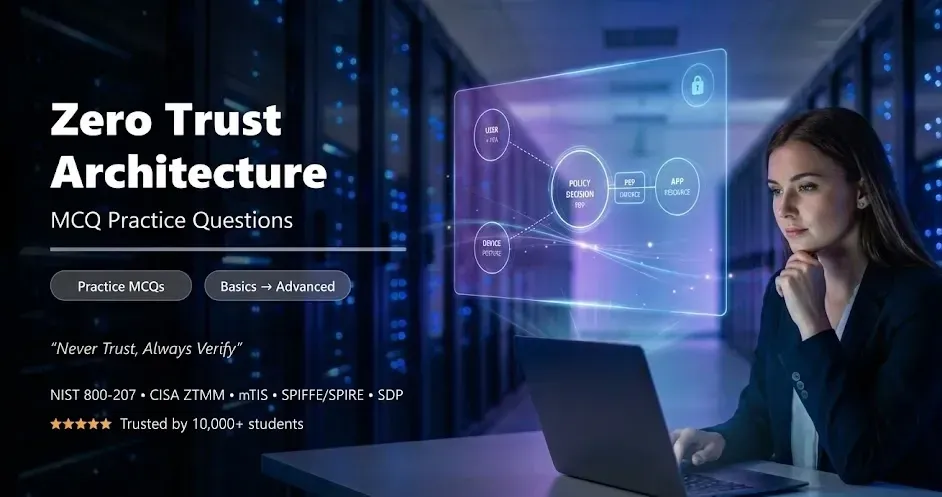
These 60 Zero Trust Architecture MCQs cover the complete ZTA knowledge stack — from the foundational "never trust, always verify" philosophy and why the traditional perimeter model failed, through the NIST SP 800-207 logical architecture (PDP, PEP, Trust Algorithm), to advanced mTLS, SPIFFE/SPIRE workload identity, SPA, CISA Maturity Model, and Post-Quantum Cryptography threats. ZTA concepts are tested across CompTIA Security+, CISSP, CCSP, CEH, and Microsoft SC-900/SC-300.
These questions are organized into three progressive difficulty levels of 20 questions each: Basics (covering core ZTA philosophy, MFA verification, ZTNA brokers, lateral movement prevention, device posture compliance, and micro-segmentation), Concepts (covering NIST SP 800-207 control loops, PDP/PEP logical separations, SASE edge architectures, ABAC conditions, and SIEM monitoring), and Advanced (covering dynamic mTLS orchestration, SPIFFE/SPIRE workload identities, Single Packet Authorization, CISA ZTMM benchmarks, and Post-Quantum Cryptography planning). Each question includes a verified, in-depth explanation to reinforce learning.
Use Study Mode to learn with instant, expert-level explanations, or switch to Exam Mode for a timed, scored practice session.
Contents
- 1.Basics (20 Questions)Never trust · always verify · ZTNA · MFA · lateral movement · device posture · micro-segmentation
- 2.Concepts (20 Questions)NIST 800-207 · PDP/PEP · Trust Algorithm · SDP · SASE · EDR · ABAC · IAM lifecycle
- 3.Advanced (20 Questions)mTLS · SPIFFE/SPIRE · SPA · CISA ZTMM · JIT access · behavioral biometrics · SOAR · PKI · PQC
- 4.Conclusionsummary · next steps · study tips
- 5.Key Takeawaysquick-fire bullet recap of essential facts
- 6.Quick Review Summaryconcept · definition · key fact table
- 7.FAQcommon questions answered
Zero Trust Architecture — Basics
1What is the core philosophy of Zero Trust Architecture?
CorrectC: Never trust, always verify, regardless of location
Zero Trust Architecture is founded on the principle of "Never trust, always verify" — every user, device, and application must be authenticated and authorized for every resource access, regardless of whether they are inside or outside the corporate network. The underlying assumption is that the network perimeter has been dissolved: attackers may already be present inside the network, cloud services extend beyond any physical boundary, and remote/hybrid work means "inside" has no meaning. Trust is never implicit — it must be continuously earned.
IncorrectC: Never trust, always verify, regardless of location
Zero Trust Architecture is founded on the principle of "Never trust, always verify" — every user, device, and application must be authenticated and authorized for every resource access, regardless of whether they are inside or outside the corporate network. The underlying assumption is that the network perimeter has been dissolved: attackers may already be present inside the network, cloud services extend beyond any physical boundary, and remote/hybrid work means "inside" has no meaning. Trust is never implicit — it must be continuously earned.
2Who is credited with creating the original concept and term "Zero Trust"?
CorrectA: John Kindervag (at Forrester Research)
John Kindervag, a principal analyst at Forrester Research, coined and formalized the term "Zero Trust" in 2010 in his research paper "No More Chewy Centers: Introducing the Zero Trust Model of Information Security." He challenged the prevailing assumption that everything inside the corporate network firewall could be trusted. Bruce Schneier is a renowned security technologist and author; Kevin Mitnick was a famous hacker turned security consultant; Marc Andreessen is a software engineer and venture capitalist.
IncorrectA: John Kindervag (at Forrester Research)
John Kindervag, a principal analyst at Forrester Research, coined and formalized the term "Zero Trust" in 2010 in his research paper "No More Chewy Centers: Introducing the Zero Trust Model of Information Security." He challenged the prevailing assumption that everything inside the corporate network firewall could be trusted. Bruce Schneier is a renowned security technologist and author; Kevin Mitnick was a famous hacker turned security consultant; Marc Andreessen is a software engineer and venture capitalist.
3Zero Trust fundamentally moves away from which traditional security model?
CorrectD: The Castle-and-Moat (Perimeter-based) model
Zero Trust replaces the Castle-and-Moat (Perimeter Security) model, which assumes that everything inside the network perimeter is trusted and everything outside is untrusted. In this model, the firewall is the "moat" — once you are inside (authenticated at the perimeter), you are implicitly trusted to access any internal resource. Zero Trust rejects this: it assumes breach, requires verification for every resource, and enforces least-privilege access regardless of network location. Defense-in-Depth and Least Privilege are principles that are incorporated into Zero Trust, not replaced by it.
IncorrectD: The Castle-and-Moat (Perimeter-based) model
Zero Trust replaces the Castle-and-Moat (Perimeter Security) model, which assumes that everything inside the network perimeter is trusted and everything outside is untrusted. In this model, the firewall is the "moat" — once you are inside (authenticated at the perimeter), you are implicitly trusted to access any internal resource. Zero Trust rejects this: it assumes breach, requires verification for every resource, and enforces least-privilege access regardless of network location. Defense-in-Depth and Least Privilege are principles that are incorporated into Zero Trust, not replaced by it.
4In a Zero Trust network, what is the default access level for any user, device, or application?
CorrectB: Implicit Deny
In Zero Trust, the default posture is Implicit Deny — no access is granted to any resource unless explicitly and specifically authorized through verified identity, device compliance, and policy evaluation. This is the inverse of the traditional perimeter model, which grants broad Implicit Trust to entities inside the network. Implicit Deny means every access request starts from zero and must earn authorization; there is no baseline access granted by default simply by being connected to the internal network.
IncorrectB: Implicit Deny
In Zero Trust, the default posture is Implicit Deny — no access is granted to any resource unless explicitly and specifically authorized through verified identity, device compliance, and policy evaluation. This is the inverse of the traditional perimeter model, which grants broad Implicit Trust to entities inside the network. Implicit Deny means every access request starts from zero and must earn authorization; there is no baseline access granted by default simply by being connected to the internal network.
5Which of the following is a foundational assumption of Zero Trust?
CorrectC: Attackers are already present both inside and outside the network
The "Assume Breach" pillar of Zero Trust mandates that organizations design their security posture assuming that attackers are already present — both inside and outside the network. This directly challenges the castle-and-moat assumption that internal network traffic can be trusted. Historical data confirms this: the average dwell time for attackers in enterprise networks is measurable in months before detection (Mandiant M-Trends 2024). Assuming breach drives micro-segmentation, continuous monitoring, and least-privilege access — because if one segment is compromised, the damage is contained.
IncorrectC: Attackers are already present both inside and outside the network
The "Assume Breach" pillar of Zero Trust mandates that organizations design their security posture assuming that attackers are already present — both inside and outside the network. This directly challenges the castle-and-moat assumption that internal network traffic can be trusted. Historical data confirms this: the average dwell time for attackers in enterprise networks is measurable in months before detection (Mandiant M-Trends 2024). Assuming breach drives micro-segmentation, continuous monitoring, and least-privilege access — because if one segment is compromised, the damage is contained.
6What does ZTNA stand for?
CorrectA: Zero Trust Network Access
ZTNA stands for Zero Trust Network Access — a technology category that provides secure, identity-verified access to specific applications without granting broad network access. Unlike a traditional VPN (which places authenticated users on the full corporate network), ZTNA brokers establish session-specific, least-privilege connections to individual applications. The user and device are verified, the application connection is established, but the user never gains visibility of or lateral access to other network resources. ZTNA is a key enabler of Zero Trust architecture in practice.
IncorrectA: Zero Trust Network Access
ZTNA stands for Zero Trust Network Access — a technology category that provides secure, identity-verified access to specific applications without granting broad network access. Unlike a traditional VPN (which places authenticated users on the full corporate network), ZTNA brokers establish session-specific, least-privilege connections to individual applications. The user and device are verified, the application connection is established, but the user never gains visibility of or lateral access to other network resources. ZTNA is a key enabler of Zero Trust architecture in practice.
7Which security practice is absolutely essential for verifying user identity in a Zero Trust environment?
CorrectD: Multi-Factor Authentication (MFA)
Multi-Factor Authentication (MFA) is non-negotiable in Zero Trust because it dramatically reduces the risk of compromised credentials — the leading attack vector in most breaches. MFA requires users to prove identity with at least two factors: something you know (password), something you have (hardware token, authenticator app), and/or something you are (biometrics). Even if a password is phished or stolen, MFA prevents the attacker from authenticating. FIDO2/WebAuthn-based hardware security keys (like YubiKey) are the gold standard, as they are resistant to phishing.
IncorrectD: Multi-Factor Authentication (MFA)
Multi-Factor Authentication (MFA) is non-negotiable in Zero Trust because it dramatically reduces the risk of compromised credentials — the leading attack vector in most breaches. MFA requires users to prove identity with at least two factors: something you know (password), something you have (hardware token, authenticator app), and/or something you are (biometrics). Even if a password is phished or stolen, MFA prevents the attacker from authenticating. FIDO2/WebAuthn-based hardware security keys (like YubiKey) are the gold standard, as they are resistant to phishing.
8How does a traditional VPN differ from ZTNA?
CorrectB: VPNs grant broad network-wide access upon login; ZTNA grants access only to specific requested applications
A traditional VPN places authenticated users onto the full corporate network — granting broad, flat access to all network resources as if physically present in the office. This violates least-privilege and creates enormous lateral movement risk if credentials are compromised. ZTNA applies identity-aware, application-level access: after verifying the user, device posture, and context, ZTNA establishes a session-level connection directly to the specific application they requested — and nothing else. Users cannot scan the network, reach other workloads, or move laterally.
IncorrectB: VPNs grant broad network-wide access upon login; ZTNA grants access only to specific requested applications
A traditional VPN places authenticated users onto the full corporate network — granting broad, flat access to all network resources as if physically present in the office. This violates least-privilege and creates enormous lateral movement risk if credentials are compromised. ZTNA applies identity-aware, application-level access: after verifying the user, device posture, and context, ZTNA establishes a session-level connection directly to the specific application they requested — and nothing else. Users cannot scan the network, reach other workloads, or move laterally.
9What is "Lateral Movement" in cybersecurity?
CorrectA: An attacker moving horizontally from one compromised system to other systems within a network
Lateral movement describes how attackers, after gaining an initial foothold in one system or account, methodically move across the network to compromise additional systems, escalate privileges, and reach high-value targets (Domain Controllers, databases, sensitive file stores). Techniques include Pass-the-Hash, Kerberoasting, remote service exploitation, and abuse of legitimate administrative tools (PsExec, WMI). Zero Trust specifically targets lateral movement through micro-segmentation and access controls that prevent a compromised system from reaching adjacent resources.
IncorrectA: An attacker moving horizontally from one compromised system to other systems within a network
Lateral movement describes how attackers, after gaining an initial foothold in one system or account, methodically move across the network to compromise additional systems, escalate privileges, and reach high-value targets (Domain Controllers, databases, sensitive file stores). Techniques include Pass-the-Hash, Kerberoasting, remote service exploitation, and abuse of legitimate administrative tools (PsExec, WMI). Zero Trust specifically targets lateral movement through micro-segmentation and access controls that prevent a compromised system from reaching adjacent resources.
10How does Zero Trust specifically prevent lateral movement?
CorrectC: By implementing micro-segmentation and enforcing access controls per individual resource
Zero Trust prevents lateral movement through micro-segmentation: dividing the network into very small zones with strict, individually enforced access policies between every workload, application, and service. Even if an attacker compromises one endpoint, they cannot reach adjacent resources without re-authenticating and satisfying policy conditions for each new connection. Identity-based policies replace implicit network-location trust. This is fundamentally different from perimeter firewalls, which permit broad east-west (internal) traffic by default after entry.
IncorrectC: By implementing micro-segmentation and enforcing access controls per individual resource
Zero Trust prevents lateral movement through micro-segmentation: dividing the network into very small zones with strict, individually enforced access policies between every workload, application, and service. Even if an attacker compromises one endpoint, they cannot reach adjacent resources without re-authenticating and satisfying policy conditions for each new connection. Identity-based policies replace implicit network-location trust. This is fundamentally different from perimeter firewalls, which permit broad east-west (internal) traffic by default after entry.
11In Zero Trust, what does "Device Posture" refer to?
CorrectD: The health, security status, and compliance level of a device before granting it access
Device Posture (also called Device Health) is the assessment of a device's security state before granting it access to resources. Checks include: Is the OS patched and up to date? Is endpoint protection (EDR/antivirus) installed and running? Is disk encryption enabled? Does the device have a valid corporate certificate? Is it jailbroken or rooted? Is it compliant with corporate MDM policy? A device with poor posture — even if the user's identity is verified — can be denied access, forced to a quarantine VLAN, or granted only limited access until remediated.
IncorrectD: The health, security status, and compliance level of a device before granting it access
Device Posture (also called Device Health) is the assessment of a device's security state before granting it access to resources. Checks include: Is the OS patched and up to date? Is endpoint protection (EDR/antivirus) installed and running? Is disk encryption enabled? Does the device have a valid corporate certificate? Is it jailbroken or rooted? Is it compliant with corporate MDM policy? A device with poor posture — even if the user's identity is verified — can be denied access, forced to a quarantine VLAN, or granted only limited access until remediated.
12Is Zero Trust a specific software product you can purchase?
CorrectB: No, it is a strategic framework and architecture that requires multiple integrated technologies
Zero Trust is a security strategy, architecture, and philosophy — not a single product, vendor, or regulation. Vendors market their products as "Zero Trust" enablers, but no single product achieves Zero Trust alone. A full Zero Trust architecture requires integrating multiple technologies: an Identity Provider (IdP) for strong authentication, an MDM/EDR solution for device posture, ZTNA for application access, micro-segmentation for network controls, SIEM/SOAR for continuous monitoring, and DLP for data protection. The strategy requires organizational change, policy design, and technical integration across all of these.
IncorrectB: No, it is a strategic framework and architecture that requires multiple integrated technologies
Zero Trust is a security strategy, architecture, and philosophy — not a single product, vendor, or regulation. Vendors market their products as "Zero Trust" enablers, but no single product achieves Zero Trust alone. A full Zero Trust architecture requires integrating multiple technologies: an Identity Provider (IdP) for strong authentication, an MDM/EDR solution for device posture, ZTNA for application access, micro-segmentation for network controls, SIEM/SOAR for continuous monitoring, and DLP for data protection. The strategy requires organizational change, policy design, and technical integration across all of these.
13What role does encryption play in Zero Trust?
CorrectA: All data must be encrypted both at rest and in transit, regardless of network location
In Zero Trust, encryption is mandatory and universal — not optional or selective. Data must be encrypted at rest (stored data on disks, databases, backups) and in transit (data moving across networks) regardless of whether it travels on the "trusted" internal network or the internet. This is because Zero Trust assumes breach: even if an attacker gains access to a network segment or taps a cable, encrypted data remains protected. Internal network traffic encryption (e.g., mTLS between microservices) is a distinguishing feature of mature Zero Trust implementations — traditional perimeter models only encrypt internet-facing traffic.
IncorrectA: All data must be encrypted both at rest and in transit, regardless of network location
In Zero Trust, encryption is mandatory and universal — not optional or selective. Data must be encrypted at rest (stored data on disks, databases, backups) and in transit (data moving across networks) regardless of whether it travels on the "trusted" internal network or the internet. This is because Zero Trust assumes breach: even if an attacker gains access to a network segment or taps a cable, encrypted data remains protected. Internal network traffic encryption (e.g., mTLS between microservices) is a distinguishing feature of mature Zero Trust implementations — traditional perimeter models only encrypt internet-facing traffic.
14What does "Least Privilege" mean in a Zero Trust environment?
CorrectC: Users and workloads are granted only the minimum access rights necessary to perform their specific tasks
The Principle of Least Privilege, formalized in NIST SP 800-207 as a core Zero Trust tenet, states that every subject (user, service, workload) should be granted only the minimum permissions necessary to perform its specific, current task — and nothing more. This dramatically limits blast radius: a compromised account with least-privilege access can only access the specific resources it needs, not the entire network. Combined with Just-In-Time (JIT) access, privileges are further scoped to the exact window of time they are needed and automatically revoked afterward.
IncorrectC: Users and workloads are granted only the minimum access rights necessary to perform their specific tasks
The Principle of Least Privilege, formalized in NIST SP 800-207 as a core Zero Trust tenet, states that every subject (user, service, workload) should be granted only the minimum permissions necessary to perform its specific, current task — and nothing more. This dramatically limits blast radius: a compromised account with least-privilege access can only access the specific resources it needs, not the entire network. Combined with Just-In-Time (JIT) access, privileges are further scoped to the exact window of time they are needed and automatically revoked afterward.
15What does the principle of "Continuous Verification" imply?
CorrectD: Trust is reassessed constantly throughout a session based on behavior, context, and risk signals
Continuous Verification is a departure from traditional one-time authentication ("log in once, stay trusted all day"). In Zero Trust, authentication and authorization are not point-in-time events — they are ongoing processes. As a session progresses, the policy engine continuously monitors signals: Has the device posture changed (malware detected)? Has the user's location anomalously shifted (impossible travel)? Has behavior deviated from baselines (accessing unusual files at 3am)? If risk signals deteriorate, the system can seamlessly step up authentication, reduce permissions, or terminate the session without waiting for the session to expire.
IncorrectD: Trust is reassessed constantly throughout a session based on behavior, context, and risk signals
Continuous Verification is a departure from traditional one-time authentication ("log in once, stay trusted all day"). In Zero Trust, authentication and authorization are not point-in-time events — they are ongoing processes. As a session progresses, the policy engine continuously monitors signals: Has the device posture changed (malware detected)? Has the user's location anomalously shifted (impossible travel)? Has behavior deviated from baselines (accessing unusual files at 3am)? If risk signals deteriorate, the system can seamlessly step up authentication, reduce permissions, or terminate the session without waiting for the session to expire.
16Why has Zero Trust become necessary for modern business architectures?
CorrectB: Because cloud computing, remote work, and BYOD have dissolved the traditional, defensible network perimeter
The traditional perimeter security model assumed a clearly defined boundary — the corporate network — inside which devices and users could be trusted. Three forces dissolved this boundary: (1) Cloud Computing — applications and data now live in SaaS, IaaS, and PaaS environments far outside any corporate firewall; (2) Remote Work/Hybrid Work — users connect from home, coffee shops, and hotels over untrusted networks; (3) BYOD (Bring Your Own Device) — personally owned devices that are not managed or patched by IT now access corporate resources. There is no longer a meaningful "inside" to protect.
IncorrectB: Because cloud computing, remote work, and BYOD have dissolved the traditional, defensible network perimeter
The traditional perimeter security model assumed a clearly defined boundary — the corporate network — inside which devices and users could be trusted. Three forces dissolved this boundary: (1) Cloud Computing — applications and data now live in SaaS, IaaS, and PaaS environments far outside any corporate firewall; (2) Remote Work/Hybrid Work — users connect from home, coffee shops, and hotels over untrusted networks; (3) BYOD (Bring Your Own Device) — personally owned devices that are not managed or patched by IT now access corporate resources. There is no longer a meaningful "inside" to protect.
17What is a "Micro-perimeter"?
CorrectC: A localized security boundary created around a single application, workload, or data set
A micro-perimeter is a tightly scoped security boundary drawn around a single application, specific data set, individual service, or workload — rather than around an entire network or data center. Instead of one perimeter protecting everything, Zero Trust creates thousands of micro-perimeters. Access to each micro-perimeter requires identity verification, device posture validation, and policy authorization. This granularity means a compromised entity can only breach its own micro-perimeter, not the entire organization. Software-Defined Perimeters (SDP) and service mesh technologies implement micro-perimeters programmatically.
IncorrectC: A localized security boundary created around a single application, workload, or data set
A micro-perimeter is a tightly scoped security boundary drawn around a single application, specific data set, individual service, or workload — rather than around an entire network or data center. Instead of one perimeter protecting everything, Zero Trust creates thousands of micro-perimeters. Access to each micro-perimeter requires identity verification, device posture validation, and policy authorization. This granularity means a compromised entity can only breach its own micro-perimeter, not the entire organization. Software-Defined Perimeters (SDP) and service mesh technologies implement micro-perimeters programmatically.
18In Zero Trust, an access request should be evaluated based on:
CorrectA: Identity, device health, location, time, and behavioral context
Zero Trust evaluates access requests using a rich, multi-dimensional context rather than a binary credential check. The Trust Algorithm (as defined in NIST SP 800-207) aggregates signals including: Identity (who is this user? verified via MFA and IdP), Device Health (is the device patched, encrypted, corporate-managed?), Network Location (is this a known safe location or an unusual country?), Time (is this access at 3am on a Sunday, a behavioral anomaly?), and Behavioral Signals (does this access pattern match the user's typical behavior?). Together, these signals produce a risk score that determines the appropriate access decision.
IncorrectA: Identity, device health, location, time, and behavioral context
Zero Trust evaluates access requests using a rich, multi-dimensional context rather than a binary credential check. The Trust Algorithm (as defined in NIST SP 800-207) aggregates signals including: Identity (who is this user? verified via MFA and IdP), Device Health (is the device patched, encrypted, corporate-managed?), Network Location (is this a known safe location or an unusual country?), Time (is this access at 3am on a Sunday, a behavioral anomaly?), and Behavioral Signals (does this access pattern match the user's typical behavior?). Together, these signals produce a risk score that determines the appropriate access decision.
19What is "Shadow IT" and why does Zero Trust target it?
CorrectD: The use of unauthorized applications/devices; Zero Trust requires complete visibility of all assets to secure the environment
Shadow IT refers to the use of unauthorized software, cloud services, or devices that employees adopt without IT knowledge or approval — for example, using personal Dropbox accounts to share work files, or running unapproved third-party apps on a work laptop. Zero Trust requires complete discovery and inventory of all assets, users, and data flows because you cannot enforce policy on resources you cannot see. Shadow IT creates blind spots — unmanaged devices can bypass device posture checks; unauthorized cloud services may exfiltrate sensitive data outside the organization's DLP controls.
IncorrectD: The use of unauthorized applications/devices; Zero Trust requires complete visibility of all assets to secure the environment
Shadow IT refers to the use of unauthorized software, cloud services, or devices that employees adopt without IT knowledge or approval — for example, using personal Dropbox accounts to share work files, or running unapproved third-party apps on a work laptop. Zero Trust requires complete discovery and inventory of all assets, users, and data flows because you cannot enforce policy on resources you cannot see. Shadow IT creates blind spots — unmanaged devices can bypass device posture checks; unauthorized cloud services may exfiltrate sensitive data outside the organization's DLP controls.
20According to Zero Trust principles, who or what should be trusted by default?
CorrectB: No one and nothing
In Zero Trust, the answer to "who is trusted by default?" is definitively: no one and nothing. Not the CEO, not Domain Administrators, not devices that have valid corporate certificates, not traffic on the internal LAN, and not applications running in your own data center. Every entity must prove its identity, device health, and authorizations for every access attempt — every time. This includes privileged accounts, service accounts, and workloads communicating with each other. Implicit trust based on identity (title, department) or network location (inside the LAN) is the root cause of most breaches via compromised insiders or lateral movement.
IncorrectB: No one and nothing
In Zero Trust, the answer to "who is trusted by default?" is definitively: no one and nothing. Not the CEO, not Domain Administrators, not devices that have valid corporate certificates, not traffic on the internal LAN, and not applications running in your own data center. Every entity must prove its identity, device health, and authorizations for every access attempt — every time. This includes privileged accounts, service accounts, and workloads communicating with each other. Implicit trust based on identity (title, department) or network location (inside the LAN) is the root cause of most breaches via compromised insiders or lateral movement.
Zero Trust Architecture — Concepts
1Which NIST Special Publication provides the authoritative federal guidelines and logical architecture for Zero Trust?
CorrectC: NIST SP 800-207
NIST SP 800-207 (August 2020, titled "Zero Trust Architecture") is the definitive federal framework for Zero Trust. It defines the core ZTA logical components (Policy Decision Point, Policy Enforcement Point, Policy Engine, Policy Administrator), the Trust Algorithm, seven ZTA tenets, and three ZTA deployment models (Device Agent/Gateway, Enclave, Resource Portal). NIST SP 800-53 is the Security and Privacy Controls catalog; SP 800-171 covers protecting Controlled Unclassified Information (CUI); SP 800-61 is the Incident Response guide.
IncorrectC: NIST SP 800-207
NIST SP 800-207 (August 2020, titled "Zero Trust Architecture") is the definitive federal framework for Zero Trust. It defines the core ZTA logical components (Policy Decision Point, Policy Enforcement Point, Policy Engine, Policy Administrator), the Trust Algorithm, seven ZTA tenets, and three ZTA deployment models (Device Agent/Gateway, Enclave, Resource Portal). NIST SP 800-53 is the Security and Privacy Controls catalog; SP 800-171 covers protecting Controlled Unclassified Information (CUI); SP 800-61 is the Incident Response guide.
2In the NIST ZTA logical model, what is the PDP?
CorrectA: Policy Decision Point
The Policy Decision Point (PDP) is the "brain" of the NIST Zero Trust logical architecture. It receives access requests from the Policy Enforcement Point (PEP) and evaluates them using the Trust Algorithm — integrating signals from the Identity Provider, device posture assessment, threat intelligence feeds, and behavioral analytics. The PDP outputs a grant, deny, or conditional decision. The PDP comprises two sub-components: the Policy Engine (PE, which makes the trust decision) and the Policy Administrator (PA, which instructs the PEP to execute that decision by opening or closing the access pathway).
IncorrectA: Policy Decision Point
The Policy Decision Point (PDP) is the "brain" of the NIST Zero Trust logical architecture. It receives access requests from the Policy Enforcement Point (PEP) and evaluates them using the Trust Algorithm — integrating signals from the Identity Provider, device posture assessment, threat intelligence feeds, and behavioral analytics. The PDP outputs a grant, deny, or conditional decision. The PDP comprises two sub-components: the Policy Engine (PE, which makes the trust decision) and the Policy Administrator (PA, which instructs the PEP to execute that decision by opening or closing the access pathway).
3What is the function of the Policy Enforcement Point (PEP)?
CorrectD: To act as the gateway that enables, monitors, and eventually terminates the connection to a resource based on the PDP's commands
The Policy Enforcement Point (PEP) is the operational gateway in the NIST ZTA architecture — it sits between the subject (user/device) and the protected enterprise resource, and physically enforces the access decisions made by the PDP. When the Policy Administrator (part of the PDP) signals "allow," the PEP opens the connection channel; when it signals "deny" or the session risk degrades, the PEP terminates it. The PEP can be implemented as a ZTNA connector, an API gateway, a cloud proxy, or a software agent. It has no independent decision-making authority — it solely executes PDP commands.
IncorrectD: To act as the gateway that enables, monitors, and eventually terminates the connection to a resource based on the PDP's commands
The Policy Enforcement Point (PEP) is the operational gateway in the NIST ZTA architecture — it sits between the subject (user/device) and the protected enterprise resource, and physically enforces the access decisions made by the PDP. When the Policy Administrator (part of the PDP) signals "allow," the PEP opens the connection channel; when it signals "deny" or the session risk degrades, the PEP terminates it. The PEP can be implemented as a ZTNA connector, an API gateway, a cloud proxy, or a software agent. It has no independent decision-making authority — it solely executes PDP commands.
4In Zero Trust Architecture, the control plane is separated from the data plane. What does the control plane do?
CorrectC: It handles the authentication, authorization, and policy evaluation processes before allowing connections
Separating the control plane from the data plane is a fundamental ZTA architectural principle. The control plane handles all authentication, authorization, policy evaluation (the Trust Algorithm), identity verification, device posture assessment, and the issuance of session tokens or connection authorization — all before the data connection is established. Only after the control plane approves the request does the data plane open to carry the actual traffic. This separation means attackers who compromise the data channel cannot influence policy decisions, and the control plane can be hardened, monitored, and scaled independently.
IncorrectC: It handles the authentication, authorization, and policy evaluation processes before allowing connections
Separating the control plane from the data plane is a fundamental ZTA architectural principle. The control plane handles all authentication, authorization, policy evaluation (the Trust Algorithm), identity verification, device posture assessment, and the issuance of session tokens or connection authorization — all before the data connection is established. Only after the control plane approves the request does the data plane open to carry the actual traffic. This separation means attackers who compromise the data channel cannot influence policy decisions, and the control plane can be hardened, monitored, and scaled independently.
5What is a Software-Defined Perimeter (SDP)?
CorrectB: A security approach that hides internet-connected infrastructure and uses software to create individualized, 1-to-1 network connections
A Software-Defined Perimeter (SDP), originally developed by the Cloud Security Alliance (CSA), is an architecture that makes infrastructure invisible to unauthorized users. Unlike a traditional firewall (which has known open ports that attackers can probe), an SDP hides internet-connected resources entirely — they have no public listening ports, so they are invisible to network scanners. Access is granted only after Single Packet Authorization (SPA) proves identity. The SDP controller then creates ephemeral, encrypted, 1-to-1 network connections between authorized subjects and specific resources — individualized tunnels that expire after the session.
IncorrectB: A security approach that hides internet-connected infrastructure and uses software to create individualized, 1-to-1 network connections
A Software-Defined Perimeter (SDP), originally developed by the Cloud Security Alliance (CSA), is an architecture that makes infrastructure invisible to unauthorized users. Unlike a traditional firewall (which has known open ports that attackers can probe), an SDP hides internet-connected resources entirely — they have no public listening ports, so they are invisible to network scanners. Access is granted only after Single Packet Authorization (SPA) proves identity. The SDP controller then creates ephemeral, encrypted, 1-to-1 network connections between authorized subjects and specific resources — individualized tunnels that expire after the session.
6How does ZTNA achieve "Dark Cloud" or application invisibility?
CorrectA: By ensuring applications do not have public, open listening ports; instead, outbound connections are made to a broker
"Dark Cloud" or application cloaking is a core ZTNA security benefit. ZTNA applications do not publish public IP addresses or listen on open inbound ports accessible to the internet. Instead, the ZTNA connector deployed near the application makes an outbound connection to the ZTNA cloud broker (like Zscaler Private Access, Cloudflare Access, or Palo Alto Prisma Access). Authorized user sessions are brokered through this outbound tunnel. Because the application never opens inbound ports, it is invisible to port scanners, internet-wide probing (Shodan), and pre-authentication exploit attempts — dramatically reducing the exposed attack surface.
IncorrectA: By ensuring applications do not have public, open listening ports; instead, outbound connections are made to a broker
"Dark Cloud" or application cloaking is a core ZTNA security benefit. ZTNA applications do not publish public IP addresses or listen on open inbound ports accessible to the internet. Instead, the ZTNA connector deployed near the application makes an outbound connection to the ZTNA cloud broker (like Zscaler Private Access, Cloudflare Access, or Palo Alto Prisma Access). Authorized user sessions are brokered through this outbound tunnel. Because the application never opens inbound ports, it is invisible to port scanners, internet-wide probing (Shodan), and pre-authentication exploit attempts — dramatically reducing the exposed attack surface.
7What is Context-Aware Access?
CorrectC: Dynamically adjusting access rights based on real-time attributes like location, device security posture, and user behavior
Context-Aware Access (also called Risk-Based Authentication or Adaptive Access Control) dynamically evaluates a rich set of real-time attributes before granting, modifying, or revoking access. Context signals include network location (corporate office vs. unknown country), device security posture (compliant/non-compliant), time-of-day (normal business hours vs. 3am), user behavior (normal application usage vs. bulk export), and threat intelligence (device IP on a blocklist). Unlike static role-based rules that apply uniformly regardless of risk, Context-Aware Access adjusts in real-time — it might grant full access from a managed device on a corporate network but require additional MFA and restrict to read-only access from an unmanaged device overseas.
IncorrectC: Dynamically adjusting access rights based on real-time attributes like location, device security posture, and user behavior
Context-Aware Access (also called Risk-Based Authentication or Adaptive Access Control) dynamically evaluates a rich set of real-time attributes before granting, modifying, or revoking access. Context signals include network location (corporate office vs. unknown country), device security posture (compliant/non-compliant), time-of-day (normal business hours vs. 3am), user behavior (normal application usage vs. bulk export), and threat intelligence (device IP on a blocklist). Unlike static role-based rules that apply uniformly regardless of risk, Context-Aware Access adjusts in real-time — it might grant full access from a managed device on a corporate network but require additional MFA and restrict to read-only access from an unmanaged device overseas.
8Which component acts as the definitive source of truth for user identities in a ZTA?
CorrectD: The Identity Provider (IdP)
The Identity Provider (IdP) is the authoritative source of user identity in a ZTA. It manages the full identity lifecycle — account creation, attribute management (roles, groups, department), authentication (verifying credentials and MFA), and the issuance of identity tokens (SAML assertions, OAuth tokens, OIDC ID tokens). The Policy Engine queries the IdP to verify who is requesting access. Examples: Microsoft Entra ID (Azure AD), Okta, Google Workspace, Ping Identity. The IdP integrates with the Trust Algorithm: without a verifiable identity from a trusted IdP, no access is granted — regardless of device or network location.
IncorrectD: The Identity Provider (IdP)
The Identity Provider (IdP) is the authoritative source of user identity in a ZTA. It manages the full identity lifecycle — account creation, attribute management (roles, groups, department), authentication (verifying credentials and MFA), and the issuance of identity tokens (SAML assertions, OAuth tokens, OIDC ID tokens). The Policy Engine queries the IdP to verify who is requesting access. Examples: Microsoft Entra ID (Azure AD), Okta, Google Workspace, Ping Identity. The IdP integrates with the Trust Algorithm: without a verifiable identity from a trusted IdP, no access is granted — regardless of device or network location.
9What does the term "Assume Breach" mean in ZTA design?
CorrectB: Designing and operating the network as if an attacker is already present and actively trying to steal data
"Assume Breach" (one of Microsoft's three Zero Trust principles) means organizations must design, architect, and operate their security posture as if attackers have already gained a foothold — even on the internal network. This mindset shift drives critical architectural decisions: micro-segment everything (so a breached segment cannot reach others), encrypt all east-west traffic (so an internal eavesdropper cannot read data), log and monitor all traffic (because the attacker is watching and moving), and validate every access request end-to-end (because an internal IP address is not trusted). Assume Breach is the adversarial thinking that makes ZTA designs resilient.
IncorrectB: Designing and operating the network as if an attacker is already present and actively trying to steal data
"Assume Breach" (one of Microsoft's three Zero Trust principles) means organizations must design, architect, and operate their security posture as if attackers have already gained a foothold — even on the internal network. This mindset shift drives critical architectural decisions: micro-segment everything (so a breached segment cannot reach others), encrypt all east-west traffic (so an internal eavesdropper cannot read data), log and monitor all traffic (because the attacker is watching and moving), and validate every access request end-to-end (because an internal IP address is not trusted). Assume Breach is the adversarial thinking that makes ZTA designs resilient.
10How does SASE (Secure Access Service Edge) relate to Zero Trust?
CorrectA: SASE integrates ZTNA, cloud security, and SD-WAN into a unified, cloud-delivered service model
SASE (pronounced "sassy"), coined by Gartner in 2019, is a cloud-native architecture that converges multiple network security functions into a single, globally distributed cloud service. SASE integrates: ZTNA (for application access), Cloud Access Security Broker (CASB, for cloud app visibility and control), Secure Web Gateway (SWG, for internet access security), Firewall as a Service (FWaaS), and SD-WAN (for intelligent traffic routing). Zero Trust is the overarching security philosophy embedded throughout SASE. Key SASE vendors: Zscaler, Palo Alto Prisma SASE, Cisco Umbrella, Cloudflare One.
IncorrectA: SASE integrates ZTNA, cloud security, and SD-WAN into a unified, cloud-delivered service model
SASE (pronounced "sassy"), coined by Gartner in 2019, is a cloud-native architecture that converges multiple network security functions into a single, globally distributed cloud service. SASE integrates: ZTNA (for application access), Cloud Access Security Broker (CASB, for cloud app visibility and control), Secure Web Gateway (SWG, for internet access security), Firewall as a Service (FWaaS), and SD-WAN (for intelligent traffic routing). Zero Trust is the overarching security philosophy embedded throughout SASE. Key SASE vendors: Zscaler, Palo Alto Prisma SASE, Cisco Umbrella, Cloudflare One.
11What is the role of Endpoint Detection and Response (EDR) in a Zero Trust ecosystem?
CorrectC: It provides real-time telemetry on device health and threat status to the Policy Decision Point
EDR (Endpoint Detection and Response) is a critical Zero Trust data source. The EDR agent on each endpoint continuously monitors device health and security events — active processes, network connections, file system changes, registry modifications, and threat detections — and streams telemetry to the Policy Decision Point (PDP). The PDP uses this real-time device health signal as input to the Trust Algorithm: if the EDR reports malware detected on a device mid-session, the PDP can immediately revoke the device's access without waiting for the user to re-authenticate. EDR feeds the "Continuous Verification" requirement of Zero Trust.
IncorrectC: It provides real-time telemetry on device health and threat status to the Policy Decision Point
EDR (Endpoint Detection and Response) is a critical Zero Trust data source. The EDR agent on each endpoint continuously monitors device health and security events — active processes, network connections, file system changes, registry modifications, and threat detections — and streams telemetry to the Policy Decision Point (PDP). The PDP uses this real-time device health signal as input to the Trust Algorithm: if the EDR reports malware detected on a device mid-session, the PDP can immediately revoke the device's access without waiting for the user to re-authenticate. EDR feeds the "Continuous Verification" requirement of Zero Trust.
12In Zero Trust, what does "Data-Centric Security" emphasize?
CorrectD: Shifting the security focus from protecting network perimeters to directly protecting the data itself through encryption, tagging, and access controls
Data-Centric Security recognizes that in a Zero Trust world — where users roam across multiple devices, the cloud stores data outside any perimeter, and attackers may be present on the internal network — the only way to truly protect sensitive data is to secure the data itself, not the network boundary around it. This means: classifying all data (public, internal, confidential, restricted), tagging data assets with metadata, encrypting data at rest and in transit (including within the internal network), applying Information Rights Management (IRM/DRM) so data remains protected even when copied to USB or emailed externally, and using DLP to prevent unauthorized data movement. The data pillar is one of the five CISA Zero Trust Maturity Model pillars.
IncorrectD: Shifting the security focus from protecting network perimeters to directly protecting the data itself through encryption, tagging, and access controls
Data-Centric Security recognizes that in a Zero Trust world — where users roam across multiple devices, the cloud stores data outside any perimeter, and attackers may be present on the internal network — the only way to truly protect sensitive data is to secure the data itself, not the network boundary around it. This means: classifying all data (public, internal, confidential, restricted), tagging data assets with metadata, encrypting data at rest and in transit (including within the internal network), applying Information Rights Management (IRM/DRM) so data remains protected even when copied to USB or emailed externally, and using DLP to prevent unauthorized data movement. The data pillar is one of the five CISA Zero Trust Maturity Model pillars.
13What is the primary purpose of IAM (Identity and Access Management) Lifecycle Management in ZTA?
CorrectB: To ensure user access privileges are dynamically updated or revoked as employees change roles or leave the organization
IAM Lifecycle Management in ZTA ensures that access entitlements remain aligned with a user's current role, responsibilities, and employment status — a critical control given that 58% of insider threats involve former employees or contractors (CERT). The lifecycle encompasses: provisioning (granting least-privilege access when hired), access reviews (quarterly/annual reviews to remove excess permissions), role changes (automatically updating access when promoted or transferred), and deprovisioning (immediately revoking all access upon departure). Without lifecycle management, users accumulate excessive permissions over time — a phenomenon called "permission creep" — which dramatically increases the blast radius of a compromise.
IncorrectB: To ensure user access privileges are dynamically updated or revoked as employees change roles or leave the organization
IAM Lifecycle Management in ZTA ensures that access entitlements remain aligned with a user's current role, responsibilities, and employment status — a critical control given that 58% of insider threats involve former employees or contractors (CERT). The lifecycle encompasses: provisioning (granting least-privilege access when hired), access reviews (quarterly/annual reviews to remove excess permissions), role changes (automatically updating access when promoted or transferred), and deprovisioning (immediately revoking all access upon departure). Without lifecycle management, users accumulate excessive permissions over time — a phenomenon called "permission creep" — which dramatically increases the blast radius of a compromise.
14According to the NIST 800-207 model, what is the "Trust Algorithm"?
CorrectA: The process used by the policy engine to evaluate signals (identity, device, context) and determine if access should be granted
The Trust Algorithm (TA) is the decision-making process within the Policy Engine (PE) component of the PDP, as described in NIST SP 800-207. It takes as inputs: the user's identity (from the IdP), device compliance status (from MDM/EDR), threat intelligence data, behavioral analytics (UEBA), resource sensitivity classification, and the subject's requested action. The TA weighs these inputs against the organization's security policy to produce an access decision: Allow, Deny, or Conditional (e.g., allow but step up to MFA, or allow with reduced permissions). The TA continuously re-evaluates these signals throughout the session, not just at the moment of initial authentication.
IncorrectA: The process used by the policy engine to evaluate signals (identity, device, context) and determine if access should be granted
The Trust Algorithm (TA) is the decision-making process within the Policy Engine (PE) component of the PDP, as described in NIST SP 800-207. It takes as inputs: the user's identity (from the IdP), device compliance status (from MDM/EDR), threat intelligence data, behavioral analytics (UEBA), resource sensitivity classification, and the subject's requested action. The TA weighs these inputs against the organization's security policy to produce an access decision: Allow, Deny, or Conditional (e.g., allow but step up to MFA, or allow with reduced permissions). The TA continuously re-evaluates these signals throughout the session, not just at the moment of initial authentication.
15Why is comprehensive logging and monitoring absolutely mandatory in Zero Trust?
CorrectC: Because continuous verification relies on analyzing logs to detect anomalous behavior and feed real-time data back into the Trust Algorithm
Comprehensive logging is the nervous system of Zero Trust — without it, "Continuous Verification" and "Assume Breach" are impossible to implement. Every access request, authentication event, policy decision, session activity, and data access must be logged. These logs feed the SIEM and UEBA (User and Entity Behavior Analytics) systems, which detect anomalous patterns and provide real-time signals back to the Trust Algorithm. If a user account suddenly accesses 10,000 files in 5 minutes (potential data exfiltration), the SIEM must detect and signal the PDP to revoke access immediately. Without logs, lateral movement and data theft remain invisible for months.
IncorrectC: Because continuous verification relies on analyzing logs to detect anomalous behavior and feed real-time data back into the Trust Algorithm
Comprehensive logging is the nervous system of Zero Trust — without it, "Continuous Verification" and "Assume Breach" are impossible to implement. Every access request, authentication event, policy decision, session activity, and data access must be logged. These logs feed the SIEM and UEBA (User and Entity Behavior Analytics) systems, which detect anomalous patterns and provide real-time signals back to the Trust Algorithm. If a user account suddenly accesses 10,000 files in 5 minutes (potential data exfiltration), the SIEM must detect and signal the PDP to revoke access immediately. Without logs, lateral movement and data theft remain invisible for months.
16How does Zero Trust differ from traditional Role-Based Access Control (RBAC)?
CorrectD: Zero Trust uses dynamic Attribute-Based Access Control (ABAC) in addition to roles to make real-time decisions
Traditional RBAC grants access based on static role membership: a user assigned to the "Finance" role gets all Finance application permissions, always, regardless of context. Zero Trust extends this with Attribute-Based Access Control (ABAC) — where the access decision dynamically incorporates real-time attributes: device health, location, time, behavioral risk score, data sensitivity, and the specific action being performed. A "Finance" user on a non-compliant device in an unrecognized country at 3am receives a different access decision than the same user on a compliant device in the office at 9am — even for the same resource. ABAC enables the contextual precision that Zero Trust requires.
IncorrectD: Zero Trust uses dynamic Attribute-Based Access Control (ABAC) in addition to roles to make real-time decisions
Traditional RBAC grants access based on static role membership: a user assigned to the "Finance" role gets all Finance application permissions, always, regardless of context. Zero Trust extends this with Attribute-Based Access Control (ABAC) — where the access decision dynamically incorporates real-time attributes: device health, location, time, behavioral risk score, data sensitivity, and the specific action being performed. A "Finance" user on a non-compliant device in an unrecognized country at 3am receives a different access decision than the same user on a compliant device in the office at 9am — even for the same resource. ABAC enables the contextual precision that Zero Trust requires.
17What is a "Resource Portal" model in ZTA?
CorrectB: A deployment model where users authenticate to a central gateway/portal, which then securely proxies their connection to backend resources
The Resource Portal model (one of three NIST SP 800-207 ZTA deployment approaches) presents users with an authenticated portal (typically web-based) that acts as a gateway to all corporate applications and resources. Users authenticate to the portal with strong identity verification (MFA, SSO), and the portal — acting as a reverse proxy — securely proxies requests to the requested backend resources without exposing those resources directly to the internet. Applications appear as portal links rather than direct network connections. This model is particularly suitable for browser-based applications, legacy apps, and organizations transitioning from VPN without deploying full endpoint agents.
IncorrectB: A deployment model where users authenticate to a central gateway/portal, which then securely proxies their connection to backend resources
The Resource Portal model (one of three NIST SP 800-207 ZTA deployment approaches) presents users with an authenticated portal (typically web-based) that acts as a gateway to all corporate applications and resources. Users authenticate to the portal with strong identity verification (MFA, SSO), and the portal — acting as a reverse proxy — securely proxies requests to the requested backend resources without exposing those resources directly to the internet. Applications appear as portal links rather than direct network connections. This model is particularly suitable for browser-based applications, legacy apps, and organizations transitioning from VPN without deploying full endpoint agents.
18How does Zero Trust mitigate the impact of stolen user credentials?
CorrectA: Contextual checks (like device health, location, and MFA) prevent the attacker from utilizing the stolen password on an unapproved device
Stolen credentials are effective in a traditional perimeter model because a correct password grants VPN or network access from anywhere. Zero Trust nullifies this: even with a valid username and password, the attacker must also satisfy MFA (which they typically lack — hardware FIDO2 tokens are phishing-resistant), device posture checks (the attacker's device will fail MDM compliance and EDR health checks), location and context checks (impossible travel, unknown device fingerprint), and behavioral baselines (anomalous access patterns trigger step-up authentication or session termination). Credentials alone are insufficient to gain access in a mature Zero Trust implementation.
IncorrectA: Contextual checks (like device health, location, and MFA) prevent the attacker from utilizing the stolen password on an unapproved device
Stolen credentials are effective in a traditional perimeter model because a correct password grants VPN or network access from anywhere. Zero Trust nullifies this: even with a valid username and password, the attacker must also satisfy MFA (which they typically lack — hardware FIDO2 tokens are phishing-resistant), device posture checks (the attacker's device will fail MDM compliance and EDR health checks), location and context checks (impossible travel, unknown device fingerprint), and behavioral baselines (anomalous access patterns trigger step-up authentication or session termination). Credentials alone are insufficient to gain access in a mature Zero Trust implementation.
19What is a "Service Account" and why does it present a challenge in ZTA?
CorrectD: A non-human account used by applications to communicate via APIs; they often have excessive privileges and cannot easily use MFA, making them prime targets
Service Accounts are non-human identities used by applications, scripts, and services to authenticate to other systems, databases, and APIs for machine-to-machine communication. They present a critical ZTA challenge because: they typically have broad, static privileges that were "set and forgotten"; they cannot easily participate in interactive MFA workflows; they are often shared across multiple services (making attribution impossible); their credentials rarely rotate; and they are not subject to behavioral monitoring like human accounts. Attackers specifically target service accounts in post-exploitation phases (e.g., Kerberoasting in Active Directory). ZTA solutions: PAM (Privileged Access Management), short-lived mTLS certificates (via SPIFFE/SPIRE), and workload identity frameworks.
IncorrectD: A non-human account used by applications to communicate via APIs; they often have excessive privileges and cannot easily use MFA, making them prime targets
Service Accounts are non-human identities used by applications, scripts, and services to authenticate to other systems, databases, and APIs for machine-to-machine communication. They present a critical ZTA challenge because: they typically have broad, static privileges that were "set and forgotten"; they cannot easily participate in interactive MFA workflows; they are often shared across multiple services (making attribution impossible); their credentials rarely rotate; and they are not subject to behavioral monitoring like human accounts. Attackers specifically target service accounts in post-exploitation phases (e.g., Kerberoasting in Active Directory). ZTA solutions: PAM (Privileged Access Management), short-lived mTLS certificates (via SPIFFE/SPIRE), and workload identity frameworks.
20What is the guiding principle regarding network visibility in ZTA?
CorrectC: You cannot protect what you cannot see; therefore, organizations must discover, classify, and monitor all assets, users, and data flows
Complete asset and traffic visibility is a prerequisite for Zero Trust — you cannot apply policies to resources you do not know exist, and you cannot detect anomalies in traffic patterns you cannot see. Zero Trust requires: a real-time asset inventory (all devices, workloads, APIs, data stores); continuous network traffic monitoring (flow logs, DNS logs, proxy logs); user activity logging; and data flow mapping (understanding which service talks to which data store). This comprehensive visibility feeds the SIEM, informs the Trust Algorithm's risk scoring, and enables threat hunting. Shadow IT and unmanaged devices represent gaps in this visibility that blind the security team.
IncorrectC: You cannot protect what you cannot see; therefore, organizations must discover, classify, and monitor all assets, users, and data flows
Complete asset and traffic visibility is a prerequisite for Zero Trust — you cannot apply policies to resources you do not know exist, and you cannot detect anomalies in traffic patterns you cannot see. Zero Trust requires: a real-time asset inventory (all devices, workloads, APIs, data stores); continuous network traffic monitoring (flow logs, DNS logs, proxy logs); user activity logging; and data flow mapping (understanding which service talks to which data store). This comprehensive visibility feeds the SIEM, informs the Trust Algorithm's risk scoring, and enables threat hunting. Shadow IT and unmanaged devices represent gaps in this visibility that blind the security team.
Zero Trust Architecture — Advanced
1In the NIST 800-207 architecture, what two components collectively make up the Policy Decision Point (PDP)?
CorrectB: The Policy Engine (PE) and the Policy Administrator (PA)
NIST SP 800-207 decomposes the Policy Decision Point (PDP) into two distinct sub-components: the Policy Engine (PE) and the Policy Administrator (PA). The Policy Engine is the decision-making core — it runs the Trust Algorithm, evaluates all input signals (identity, device posture, threat intel, behavioral data), applies the organization's security policies, and produces a trust determination (grant/deny/conditional). The Policy Administrator is the communication component — it translates the PE's decision into operational instructions, communicating with the Policy Enforcement Point (PEP) via a secure control channel to open or close the session pathway to the requested resource.
IncorrectB: The Policy Engine (PE) and the Policy Administrator (PA)
NIST SP 800-207 decomposes the Policy Decision Point (PDP) into two distinct sub-components: the Policy Engine (PE) and the Policy Administrator (PA). The Policy Engine is the decision-making core — it runs the Trust Algorithm, evaluates all input signals (identity, device posture, threat intel, behavioral data), applies the organization's security policies, and produces a trust determination (grant/deny/conditional). The Policy Administrator is the communication component — it translates the PE's decision into operational instructions, communicating with the Policy Enforcement Point (PEP) via a secure control channel to open or close the session pathway to the requested resource.
2What is Mutual TLS (mTLS) in a Zero Trust environment?
CorrectA: A protocol where both the client and the server cryptographically authenticate each other's certificates before establishing a connection
Standard TLS is one-directional: the server proves its identity to the client via a certificate (HTTPS). Mutual TLS (mTLS) extends this to bidirectional authentication — both the client and the server must present valid, trusted X.509 certificates to each other before the TLS session is established. In Zero Trust, mTLS is the standard for service-to-service (east-west) authentication in microservices architectures: each service has its own certificate-based identity, and no service accepts connections from services that cannot prove their identity. SPIFFE/SPIRE are the standards for managing these workload certificates at scale. mTLS eliminates reliance on network location as an implied trust signal.
IncorrectA: A protocol where both the client and the server cryptographically authenticate each other's certificates before establishing a connection
Standard TLS is one-directional: the server proves its identity to the client via a certificate (HTTPS). Mutual TLS (mTLS) extends this to bidirectional authentication — both the client and the server must present valid, trusted X.509 certificates to each other before the TLS session is established. In Zero Trust, mTLS is the standard for service-to-service (east-west) authentication in microservices architectures: each service has its own certificate-based identity, and no service accepts connections from services that cannot prove their identity. SPIFFE/SPIRE are the standards for managing these workload certificates at scale. mTLS eliminates reliance on network location as an implied trust signal.
3How does Zero Trust address security in a dynamic microservices/containerized architecture (e.g., Kubernetes)?
CorrectC: By using a Service Mesh to enforce mTLS and strict access policies for "east-west" traffic between individual containers
Kubernetes and microservices architectures generate enormous volumes of dynamic east-west (intra-cluster, container-to-container) traffic. Applying traditional perimeter firewall rules to thousands of ephemeral pods is operationally impossible. A Service Mesh (Istio, Linkerd, Consul Connect) solves this by injecting lightweight proxy sidecars alongside each container. These sidecars enforce mTLS for all inter-service communication (providing mutual authentication and encryption), apply fine-grained authorization policies (Service A can call Service B on GET /api but not POST /admin), and generate detailed telemetry (request rates, latency, error rates) for observability. This delivers Zero Trust principles at the workload identity level.
IncorrectC: By using a Service Mesh to enforce mTLS and strict access policies for "east-west" traffic between individual containers
Kubernetes and microservices architectures generate enormous volumes of dynamic east-west (intra-cluster, container-to-container) traffic. Applying traditional perimeter firewall rules to thousands of ephemeral pods is operationally impossible. A Service Mesh (Istio, Linkerd, Consul Connect) solves this by injecting lightweight proxy sidecars alongside each container. These sidecars enforce mTLS for all inter-service communication (providing mutual authentication and encryption), apply fine-grained authorization policies (Service A can call Service B on GET /api but not POST /admin), and generate detailed telemetry (request rates, latency, error rates) for observability. This delivers Zero Trust principles at the workload identity level.
4What does SPA (Single Packet Authorization) achieve in a Software-Defined Perimeter (SDP)?
CorrectD: It overcomes the "first packet problem" by silently dropping all traffic unless the sender provides a cryptographically signed packet, making the PEP invisible to port scanners
Single Packet Authorization (SPA) solves the fundamental weakness of traditional network access: any server listening on an open port can be probed and attacked before authentication. In SPA, the SDP gateway silently drops ALL incoming packets by default — including TCP SYN packets and ICMP pings. The only exception: a single specially crafted, cryptographically signed UDP packet (the SPA packet) that encodes the sender's identity, timestamp, and signed HMAC. Only upon validating this SPA packet does the gateway temporarily open a specific port for that sender's IP. To external scanners (Shodan, Nmap), the server appears completely closed and portless — making it effectively invisible before authentication.
IncorrectD: It overcomes the "first packet problem" by silently dropping all traffic unless the sender provides a cryptographically signed packet, making the PEP invisible to port scanners
Single Packet Authorization (SPA) solves the fundamental weakness of traditional network access: any server listening on an open port can be probed and attacked before authentication. In SPA, the SDP gateway silently drops ALL incoming packets by default — including TCP SYN packets and ICMP pings. The only exception: a single specially crafted, cryptographically signed UDP packet (the SPA packet) that encodes the sender's identity, timestamp, and signed HMAC. Only upon validating this SPA packet does the gateway temporarily open a specific port for that sender's IP. To external scanners (Shodan, Nmap), the server appears completely closed and portless — making it effectively invisible before authentication.
5What are the five foundational pillars of the CISA Zero Trust Maturity Model?
CorrectB: Identity, Devices, Networks/Environments, Applications/Workloads, Data
The CISA Zero Trust Maturity Model (ZTMM), published in April 2023, organizes Zero Trust capabilities into five pillars representing the key elements of an enterprise security environment: (1) Identity — who is trying to access; (2) Devices — what device is attempting access; (3) Networks/Environments — the channels through which data travels; (4) Applications/Workloads — the services being accessed; (5) Data — the asset being protected. Each pillar has four maturity levels: Traditional, Initial, Advanced, Optimal. The model also defines three cross-cutting capabilities: Visibility & Analytics, Automation & Orchestration, and Governance.
IncorrectB: Identity, Devices, Networks/Environments, Applications/Workloads, Data
The CISA Zero Trust Maturity Model (ZTMM), published in April 2023, organizes Zero Trust capabilities into five pillars representing the key elements of an enterprise security environment: (1) Identity — who is trying to access; (2) Devices — what device is attempting access; (3) Networks/Environments — the channels through which data travels; (4) Applications/Workloads — the services being accessed; (5) Data — the asset being protected. Each pillar has four maturity levels: Traditional, Initial, Advanced, Optimal. The model also defines three cross-cutting capabilities: Visibility & Analytics, Automation & Orchestration, and Governance.
6What is "Just-In-Time" (JIT) access in Zero Trust?
CorrectA: Granting elevated privileges to a user for a strictly limited period of time to complete a specific task, then automatically revoking them
Just-In-Time (JIT) access is a privileged access management technique that implements least-privilege at a temporal dimension: instead of granting standing (always-on) privileged access, JIT provisions elevated permissions only when needed for a specific task and for a defined, minimal time window, then automatically revokes them when the window expires or the task is complete. A database administrator who needs to run an emergency maintenance script might receive 15-minute database admin access — after that, the privilege is gone. JIT dramatically reduces standing privileges, shrinks the attack surface from credential theft (there are no standing privileged credentials to steal), and creates a clear audit trail of all privileged activity.
IncorrectA: Granting elevated privileges to a user for a strictly limited period of time to complete a specific task, then automatically revoking them
Just-In-Time (JIT) access is a privileged access management technique that implements least-privilege at a temporal dimension: instead of granting standing (always-on) privileged access, JIT provisions elevated permissions only when needed for a specific task and for a defined, minimal time window, then automatically revokes them when the window expires or the task is complete. A database administrator who needs to run an emergency maintenance script might receive 15-minute database admin access — after that, the privilege is gone. JIT dramatically reduces standing privileges, shrinks the attack surface from credential theft (there are no standing privileged credentials to steal), and creates a clear audit trail of all privileged activity.
7In the context of workload identity, what are SPIFFE and SPIRE?
CorrectC: Open-source standards and toolchains used to securely issue and manage short-lived cryptographic identities for dynamic workloads (like containers)
SPIFFE (Secure Production Identity Framework for Everyone) is an open-source standard (CNCF project) that defines how dynamic workloads (containers, microservices, VMs, functions) identify themselves cryptographically. It provides a SPIFFE Verifiable Identity Document (SVID) — an X.509 certificate or JWT token — to each workload. SPIRE (SPIFFE Runtime Environment) is the reference implementation of SPIFFE: it is the server-and-agent system that attests workload identity (verifying what the workload is, not just who deployed it), issues SVIDs, and manages their rotation. Together, SPIFFE/SPIRE enable mTLS and workload identity in dynamic cloud-native environments where IP addresses are meaningless.
IncorrectC: Open-source standards and toolchains used to securely issue and manage short-lived cryptographic identities for dynamic workloads (like containers)
SPIFFE (Secure Production Identity Framework for Everyone) is an open-source standard (CNCF project) that defines how dynamic workloads (containers, microservices, VMs, functions) identify themselves cryptographically. It provides a SPIFFE Verifiable Identity Document (SVID) — an X.509 certificate or JWT token — to each workload. SPIRE (SPIFFE Runtime Environment) is the reference implementation of SPIFFE: it is the server-and-agent system that attests workload identity (verifying what the workload is, not just who deployed it), issues SVIDs, and manages their rotation. Together, SPIFFE/SPIRE enable mTLS and workload identity in dynamic cloud-native environments where IP addresses are meaningless.
8How does a reverse proxy architecture differ from a routed ZTNA architecture?
CorrectD: A reverse proxy terminates the connection and inspects Layer 7 traffic before forwarding; routed ZTNA connects users directly at Layer 3/4 via a local agent
ZTNA deployments have two primary architectures: Reverse Proxy (Clientless ZTNA) — the ZTNA gateway terminates the user's HTTPS connection at Layer 7, inspects the full application payload, and makes a new connection to the backend application. This works for browser-accessed web applications without a client agent, provides deep application inspection, and is simpler to deploy. Routed/Agent-based ZTNA — a lightweight ZTNA agent on the endpoint establishes a Layer 3/4 encrypted tunnel directly to the ZTNA connector near the application, supporting all traffic types (TCP/UDP), including thick-client applications, SSH, and RDP that are not browser-accessible.
IncorrectD: A reverse proxy terminates the connection and inspects Layer 7 traffic before forwarding; routed ZTNA connects users directly at Layer 3/4 via a local agent
ZTNA deployments have two primary architectures: Reverse Proxy (Clientless ZTNA) — the ZTNA gateway terminates the user's HTTPS connection at Layer 7, inspects the full application payload, and makes a new connection to the backend application. This works for browser-accessed web applications without a client agent, provides deep application inspection, and is simpler to deploy. Routed/Agent-based ZTNA — a lightweight ZTNA agent on the endpoint establishes a Layer 3/4 encrypted tunnel directly to the ZTNA connector near the application, supporting all traffic types (TCP/UDP), including thick-client applications, SSH, and RDP that are not browser-accessible.
9What is "Continuous Authentication" using Behavioral Biometrics?
CorrectB: Using machine learning to continuously analyze passive traits (like typing cadence, mouse movements, and gait) to implicitly verify identity post-login
Behavioral biometrics uses machine learning to build a unique behavioral fingerprint for each user based on passive, transparent signals: typing rhythm (keystroke dynamics — timing between keystrokes), mouse movement patterns (trajectory, speed, click pressure), touchscreen gestures (swipe angle, pressure, speed), and even cognitive patterns (navigation sequences within applications). Unlike active MFA (which interrupts the user), behavioral biometrics operate invisibly post-authentication and continuously — if the behavioral profile suddenly deviates (e.g., the account has been passed to an attacker who types differently), the system can step up authentication or revoke the session without disrupting legitimate users.
IncorrectB: Using machine learning to continuously analyze passive traits (like typing cadence, mouse movements, and gait) to implicitly verify identity post-login
Behavioral biometrics uses machine learning to build a unique behavioral fingerprint for each user based on passive, transparent signals: typing rhythm (keystroke dynamics — timing between keystrokes), mouse movement patterns (trajectory, speed, click pressure), touchscreen gestures (swipe angle, pressure, speed), and even cognitive patterns (navigation sequences within applications). Unlike active MFA (which interrupts the user), behavioral biometrics operate invisibly post-authentication and continuously — if the behavioral profile suddenly deviates (e.g., the account has been passed to an attacker who types differently), the system can step up authentication or revoke the session without disrupting legitimate users.
10What is the greatest architectural risk if the Policy Decision Point (PDP) is compromised in a ZTA?
CorrectA: The PDP is a single point of failure; if compromised or knocked offline, legitimate access halts, or the attacker gains total control over all network access policies
The PDP is the crown jewel of a Zero Trust architecture — it controls all access decisions across the entire organization. This centrality creates a critical Single Point of Failure (SPOF) and a high-value attack target. If the PDP is taken offline (DDoS, infrastructure failure), all access requests fail (fail-close) — legitimate users cannot work and the organization grinds to a halt. If the PDP is compromised (an attacker gains admin access), they can modify policies to grant themselves access to all resources. Mitigations: highly available PDP deployment (geo-redundant), strict privileged access controls on PDP administration, continuous integrity monitoring of PDP policy state, and PAM-gated administrative access.
IncorrectA: The PDP is a single point of failure; if compromised or knocked offline, legitimate access halts, or the attacker gains total control over all network access policies
The PDP is the crown jewel of a Zero Trust architecture — it controls all access decisions across the entire organization. This centrality creates a critical Single Point of Failure (SPOF) and a high-value attack target. If the PDP is taken offline (DDoS, infrastructure failure), all access requests fail (fail-close) — legitimate users cannot work and the organization grinds to a halt. If the PDP is compromised (an attacker gains admin access), they can modify policies to grant themselves access to all resources. Mitigations: highly available PDP deployment (geo-redundant), strict privileged access controls on PDP administration, continuous integrity monitoring of PDP policy state, and PAM-gated administrative access.
11How does Zero Trust handle legacy applications that natively lack support for modern authentication protocols (like SAML or OIDC)?
CorrectC: By deploying an Identity-Aware Proxy (IAP) or secure gateway in front of the legacy app to handle modern authentication before passing traffic to the app
Legacy applications (older ERP systems, proprietary internal tools, mainframe interfaces) often cannot be modified to support modern authentication protocols (SAML 2.0, OIDC, OAuth 2.0). An Identity-Aware Proxy (IAP) — like Google's IAP, Cloudflare Access, or Palo Alto Prisma Access's App Connector — acts as a Zero Trust wrapper: users authenticate to the IAP using modern MFA and SSO protocols, and the IAP performs protocol translation to authenticate to the legacy app using its native method (Kerberos, NTLM, form-based login, or mutual TLS with injected credentials). The legacy application never receives unauthenticated requests; users never need to know the application's legacy credentials. This enables Zero Trust for brownfield environments without application code changes.
IncorrectC: By deploying an Identity-Aware Proxy (IAP) or secure gateway in front of the legacy app to handle modern authentication before passing traffic to the app
Legacy applications (older ERP systems, proprietary internal tools, mainframe interfaces) often cannot be modified to support modern authentication protocols (SAML 2.0, OIDC, OAuth 2.0). An Identity-Aware Proxy (IAP) — like Google's IAP, Cloudflare Access, or Palo Alto Prisma Access's App Connector — acts as a Zero Trust wrapper: users authenticate to the IAP using modern MFA and SSO protocols, and the IAP performs protocol translation to authenticate to the legacy app using its native method (Kerberos, NTLM, form-based login, or mutual TLS with injected credentials). The legacy application never receives unauthenticated requests; users never need to know the application's legacy credentials. This enables Zero Trust for brownfield environments without application code changes.
12What is "Risk Scoring" in a Zero Trust policy engine?
CorrectD: A dynamically calculated numerical value based on aggregated telemetry (threat intelligence, device posture, behavior) that dictates whether to allow, block, or step-up authentication
Risk Scoring is the quantitative output of the Trust Algorithm. The Policy Engine aggregates telemetry from multiple sources — threat intelligence feeds (device IP reputation, known malicious domains), EDR device health scores, UEBA behavioral anomaly scores, identity risk signals (credential exposure from HaveIBeenPwned, impossible travel detection), and data sensitivity classifications — and produces a normalized risk score (e.g., 0–100). This score drives dynamic access decisions: low risk → full access; medium risk → allow with MFA step-up; high risk → quarantine the device; critical risk → terminate session and alert SOC. Real-time score updates enable continuous verification throughout a session.
IncorrectD: A dynamically calculated numerical value based on aggregated telemetry (threat intelligence, device posture, behavior) that dictates whether to allow, block, or step-up authentication
Risk Scoring is the quantitative output of the Trust Algorithm. The Policy Engine aggregates telemetry from multiple sources — threat intelligence feeds (device IP reputation, known malicious domains), EDR device health scores, UEBA behavioral anomaly scores, identity risk signals (credential exposure from HaveIBeenPwned, impossible travel detection), and data sensitivity classifications — and produces a normalized risk score (e.g., 0–100). This score drives dynamic access decisions: low risk → full access; medium risk → allow with MFA step-up; high risk → quarantine the device; critical risk → terminate session and alert SOC. Real-time score updates enable continuous verification throughout a session.
13How does Infrastructure as Code (IaC) directly support PEP deployment in Zero Trust?
CorrectB: IaC enables the automated, error-free, and highly scalable deployment of micro-perimeters and PEPs alongside new cloud workloads
Infrastructure as Code (IaC) — using tools like Terraform, Pulumi, AWS CloudFormation, or Kubernetes manifests — enables Zero Trust policies to be co-deployed automatically alongside cloud workloads. When a new microservice is deployed via a CI/CD pipeline, the IaC config simultaneously deploys the ZTNA connector, configures cloud security group rules, provisions the mTLS certificate via SPIRE, and registers the workload in the IAM system — all in a single automated, reproducible, auditable pipeline. This eliminates manual policy configuration errors, ensures no workload is ever deployed without its ZT micro-perimeter, and scales ZTA to thousands of ephemeral cloud resources without human intervention.
IncorrectB: IaC enables the automated, error-free, and highly scalable deployment of micro-perimeters and PEPs alongside new cloud workloads
Infrastructure as Code (IaC) — using tools like Terraform, Pulumi, AWS CloudFormation, or Kubernetes manifests — enables Zero Trust policies to be co-deployed automatically alongside cloud workloads. When a new microservice is deployed via a CI/CD pipeline, the IaC config simultaneously deploys the ZTNA connector, configures cloud security group rules, provisions the mTLS certificate via SPIRE, and registers the workload in the IAM system — all in a single automated, reproducible, auditable pipeline. This eliminates manual policy configuration errors, ensures no workload is ever deployed without its ZT micro-perimeter, and scales ZTA to thousands of ephemeral cloud resources without human intervention.
14In API Security under a Zero Trust framework, how are machine-to-machine APIs treated?
CorrectA: APIs are treated as distinct, highly targeted resources requiring mutual authentication (mTLS), strict authorization, and continuous rate-limiting
APIs are primary attack targets in modern architectures — the OWASP API Security Top 10 catalogs the most critical API vulnerabilities. In Zero Trust, APIs are never implicitly trusted regardless of their machine-to-machine nature. Each API endpoint is treated as a protected resource with its own access policy: mutual authentication (mTLS or signed JWTs with short expiry), strict authorization (OAuth 2.0 scopes, ensuring each caller can only invoke the specific operations it needs), continuous rate-limiting (preventing abuse and sudden unusual call volumes that may indicate compromise), input validation (preventing injection attacks), and comprehensive logging of all API calls for behavioral analysis. API gateways (Kong, AWS API Gateway, Apigee) serve as the PEP for API traffic.
IncorrectA: APIs are treated as distinct, highly targeted resources requiring mutual authentication (mTLS), strict authorization, and continuous rate-limiting
APIs are primary attack targets in modern architectures — the OWASP API Security Top 10 catalogs the most critical API vulnerabilities. In Zero Trust, APIs are never implicitly trusted regardless of their machine-to-machine nature. Each API endpoint is treated as a protected resource with its own access policy: mutual authentication (mTLS or signed JWTs with short expiry), strict authorization (OAuth 2.0 scopes, ensuring each caller can only invoke the specific operations it needs), continuous rate-limiting (preventing abuse and sudden unusual call volumes that may indicate compromise), input validation (preventing injection attacks), and comprehensive logging of all API calls for behavioral analysis. API gateways (Kong, AWS API Gateway, Apigee) serve as the PEP for API traffic.
15What does the "Data Pillar" of the CISA Maturity Model ultimately strive for at the "Optimal" level?
CorrectC: Dynamic, just-in-time, machine-learning-driven data access based on continuous risk assessment and deep data tagging/classification
The CISA ZTMM Data Pillar progression culminates at the "Optimal" maturity level with fully automated, ML-driven, just-in-time data access based on dynamic risk assessment. At this level: all data is classified and tagged with sensitivity and context metadata (who created it, its regulatory category, lifecycle stage); access is granted dynamically per-request based on real-time risk scoring (user identity, device health, behavioral signals) rather than static role assignments; ML models continuously analyze data access patterns to detect anomalies; data is protected by Information Rights Management (IRM) that travels with the data regardless of location; and DLP enforces policies automatically. The organization effectively protects the data itself, not just the perimeter around it.
IncorrectC: Dynamic, just-in-time, machine-learning-driven data access based on continuous risk assessment and deep data tagging/classification
The CISA ZTMM Data Pillar progression culminates at the "Optimal" maturity level with fully automated, ML-driven, just-in-time data access based on dynamic risk assessment. At this level: all data is classified and tagged with sensitivity and context metadata (who created it, its regulatory category, lifecycle stage); access is granted dynamically per-request based on real-time risk scoring (user identity, device health, behavioral signals) rather than static role assignments; ML models continuously analyze data access patterns to detect anomalies; data is protected by Information Rights Management (IRM) that travels with the data regardless of location; and DLP enforces policies automatically. The organization effectively protects the data itself, not just the perimeter around it.
16How does integration with SOAR (Security Orchestration, Automation, and Response) benefit ZTA?
CorrectD: It allows the ZTA policy engine to automatically and instantly revoke access across the entire network the moment a severe threat is detected by a SIEM
SOAR (Security Orchestration, Automation, and Response) turbocharges Zero Trust's "Continuous Verification" capability by closing the detection-to-response gap. Traditional SOC workflows have human analysts reviewing SIEM alerts, which takes minutes to hours. SOAR automates this: when the SIEM detects a high-confidence compromise indicator (malware alert from EDR, impossible travel, mass data download), a SOAR playbook automatically fires — querying additional context, calculating a confidence score, and if threshold exceeded, calling the ZTA Policy Engine API to immediately revoke all sessions and access tokens for the affected user/device across all applications simultaneously — in seconds, not hours. This automated response dramatically limits breach impact.
IncorrectD: It allows the ZTA policy engine to automatically and instantly revoke access across the entire network the moment a severe threat is detected by a SIEM
SOAR (Security Orchestration, Automation, and Response) turbocharges Zero Trust's "Continuous Verification" capability by closing the detection-to-response gap. Traditional SOC workflows have human analysts reviewing SIEM alerts, which takes minutes to hours. SOAR automates this: when the SIEM detects a high-confidence compromise indicator (malware alert from EDR, impossible travel, mass data download), a SOAR playbook automatically fires — querying additional context, calculating a confidence score, and if threshold exceeded, calling the ZTA Policy Engine API to immediately revoke all sessions and access tokens for the affected user/device across all applications simultaneously — in seconds, not hours. This automated response dramatically limits breach impact.
17What is "Identity Federation" in a Zero Trust ecosystem?
CorrectB: A system that allows users to use one set of credentials to authenticate and access multiple systems across different trusted, disparate domains (e.g., using SAML or OAuth)
Identity Federation enables Single Sign-On (SSO) across organizational and domain boundaries by establishing trust relationships between Identity Providers (IdPs). Using standards like SAML 2.0, OAuth 2.0, and OIDC, a user can authenticate once to their corporate IdP (e.g., Microsoft Entra ID) and seamlessly access SaaS applications, partner organization systems, and cloud services in other domains without re-authenticating — the IdP issues signed identity assertions (SAML tokens, JWTs) that federated services accept as proof of identity. In Zero Trust, federation is critical for managing access to the diverse cloud ecosystem (M365, Salesforce, AWS, partner extranets) under a single centralized identity policy.
IncorrectB: A system that allows users to use one set of credentials to authenticate and access multiple systems across different trusted, disparate domains (e.g., using SAML or OAuth)
Identity Federation enables Single Sign-On (SSO) across organizational and domain boundaries by establishing trust relationships between Identity Providers (IdPs). Using standards like SAML 2.0, OAuth 2.0, and OIDC, a user can authenticate once to their corporate IdP (e.g., Microsoft Entra ID) and seamlessly access SaaS applications, partner organization systems, and cloud services in other domains without re-authenticating — the IdP issues signed identity assertions (SAML tokens, JWTs) that federated services accept as proof of identity. In Zero Trust, federation is critical for managing access to the diverse cloud ecosystem (M365, Salesforce, AWS, partner extranets) under a single centralized identity policy.
18Why is a robust Public Key Infrastructure (PKI) critical for scaling Zero Trust?
CorrectA: It provides the lifecycle management of digital certificates necessary for establishing trust, issuing identities to workloads, and enabling mTLS at scale
PKI is the foundational trust infrastructure of Zero Trust — it provides the digital certificate ecosystem that cryptographic verification relies on. For device identity: PKI issues device certificates that prove a device is corporate-managed. For workload identity: SPIFFE/SPIRE implement PKI to issue short-lived X.509 SVIDs to container workloads. For mTLS: all service-to-service authentication relies on mutual certificate verification. For ZTNA: user and device certificates authenticate to ZTNA gateways. At enterprise scale (thousands of devices, thousands of microservices), PKI lifecycle management — issuance, renewal, revocation (OCSP/CRL), and rotation — must be automated. A compromised or poorly managed CA can undermine the entire Zero Trust architecture.
IncorrectA: It provides the lifecycle management of digital certificates necessary for establishing trust, issuing identities to workloads, and enabling mTLS at scale
PKI is the foundational trust infrastructure of Zero Trust — it provides the digital certificate ecosystem that cryptographic verification relies on. For device identity: PKI issues device certificates that prove a device is corporate-managed. For workload identity: SPIFFE/SPIRE implement PKI to issue short-lived X.509 SVIDs to container workloads. For mTLS: all service-to-service authentication relies on mutual certificate verification. For ZTNA: user and device certificates authenticate to ZTNA gateways. At enterprise scale (thousands of devices, thousands of microservices), PKI lifecycle management — issuance, renewal, revocation (OCSP/CRL), and rotation — must be automated. A compromised or poorly managed CA can undermine the entire Zero Trust architecture.
19What is the "First Packet Problem" in traditional network security that Software-Defined Perimeters attempt to solve?
CorrectC: Traditional firewalls must accept and inspect the first packet of any incoming connection, exposing their open ports to network scanning and pre-authentication exploits
The First Packet Problem describes a fundamental architectural vulnerability in traditional firewall-based security: for a firewall to apply rules to incoming traffic, it must first receive and process the packet — meaning the listening port(s) must be open and the server must accept TCP connections before authentication occurs. This exposes the server to reconnaissance (port scanning reveals what services are running), pre-authentication exploits (CVEs that can be triggered before login — like Heartbleed, which attacked TLS before authentication), and denial-of-service attacks (SYN floods against open ports). SDP with SPA eliminates this: the server has no open ports, the first packet is silently dropped unless it is a valid cryptographic SPA authorization — authentication occurs before any connection is possible.
IncorrectC: Traditional firewalls must accept and inspect the first packet of any incoming connection, exposing their open ports to network scanning and pre-authentication exploits
The First Packet Problem describes a fundamental architectural vulnerability in traditional firewall-based security: for a firewall to apply rules to incoming traffic, it must first receive and process the packet — meaning the listening port(s) must be open and the server must accept TCP connections before authentication occurs. This exposes the server to reconnaissance (port scanning reveals what services are running), pre-authentication exploits (CVEs that can be triggered before login — like Heartbleed, which attacked TLS before authentication), and denial-of-service attacks (SYN floods against open ports). SDP with SPA eliminates this: the server has no open ports, the first packet is silently dropped unless it is a valid cryptographic SPA authorization — authentication occurs before any connection is possible.
20What impact will the advent of cryptographically relevant Quantum Computing likely have on current Zero Trust Architectures?
CorrectD: It threatens the underlying public-key cryptographic algorithms (like RSA) that ZTA relies on for identity verification and encryption, requiring a transition to Post-Quantum Cryptography
Quantum computers capable of running Shor's Algorithm at sufficient qubit scale will break the RSA and Elliptic Curve Cryptography (ECC) algorithms that underpin virtually all ZTA cryptographic operations: TLS/mTLS certificate authentication, PKI digital signatures, OIDC/SAML token signing, ZTNA session key exchange, and VPN tunneling. The "harvest now, decrypt later" threat is immediate — adversaries are recording encrypted ZTA traffic today for future quantum decryption. NIST finalized Post-Quantum Cryptography (PQC) standards in 2024 (ML-KEM, ML-DSA, SLH-DSA) based on lattice and hash-based mathematics that quantum computers cannot efficiently break. Organizations must begin transitioning ZTA cryptographic primitives to PQC algorithms now — a multi-year effort termed Cryptographic Agility.
IncorrectD: It threatens the underlying public-key cryptographic algorithms (like RSA) that ZTA relies on for identity verification and encryption, requiring a transition to Post-Quantum Cryptography
Quantum computers capable of running Shor's Algorithm at sufficient qubit scale will break the RSA and Elliptic Curve Cryptography (ECC) algorithms that underpin virtually all ZTA cryptographic operations: TLS/mTLS certificate authentication, PKI digital signatures, OIDC/SAML token signing, ZTNA session key exchange, and VPN tunneling. The "harvest now, decrypt later" threat is immediate — adversaries are recording encrypted ZTA traffic today for future quantum decryption. NIST finalized Post-Quantum Cryptography (PQC) standards in 2024 (ML-KEM, ML-DSA, SLH-DSA) based on lattice and hash-based mathematics that quantum computers cannot efficiently break. Organizations must begin transitioning ZTA cryptographic primitives to PQC algorithms now — a multi-year effort termed Cryptographic Agility.
Conclusion: Master Zero Trust Architecture
These 60 MCQs span the entire Zero Trust knowledge stack — from John Kindervag's founding principle and the collapse of the castle-and-moat perimeter model, through the NIST SP 800-207 logical architecture (Policy Decision Point, Policy Engine, Policy Administrator, Policy Enforcement Point, and the Trust Algorithm), to cutting-edge implementations involving mTLS, SPIFFE/SPIRE workload identities, Kubernetes service meshes, and crypto-agile migration planning for Post-Quantum Cryptography. Each question builds the conceptual precision required for certification exams and real-world ZTA design roles.
After mastering these questions, continue building your cybersecurity foundation with the Firewalls MCQs to understand the network enforcement mechanisms that Zero Trust Policy Enforcement Points rely on.
Key Takeaways — Zero Trust Architecture
- Never Trust, Always Verify: every user, device, and workload must authenticate and authorize for every resource, every time — regardless of network location.
- Assume Breach: design and operate as if attackers are already inside — micro-segment everything, encrypt all east-west traffic, and log every access.
- NIST SP 800-207: Policy Decision Point (Policy Engine + Policy Administrator) + Policy Enforcement Point — control plane evaluates; data plane carries only authorized traffic.
- Micro-segmentation prevents lateral movement by enforcing per-workload access policies — a breached segment cannot reach adjacent resources.
- ZTNA replaces VPN: application-specific, broker-mediated access with no broad network visibility — the app is invisible before authentication.
- mTLS = bidirectional certificate authentication — both client and server prove X.509 identity before any data flows (critical for east-west microservice traffic).
- SPIFFE/SPIRE provides short-lived X.509 SVIDs for container/workload identity — replacing static service account passwords with cryptographic identities.
- SPA (Single Packet Authorization) solves the First Packet Problem — the SDP gateway silently drops everything until a valid cryptographic SPA packet is received.
- CISA ZTMM: Five pillars — Identity, Devices, Networks/Environments, Applications/Workloads, Data — four maturity levels from Traditional to Optimal.
- Post-Quantum threat: Shor's Algorithm will break RSA/ECC underlying all ZTA cryptography — transition to NIST PQC standards (ML-KEM, ML-DSA) now.
Quick Review & Summary
Use this table to consolidate key Zero Trust Architecture concepts before or after attempting the questions above.
| Concept | What It Is | Key Fact / Standard |
|---|---|---|
| Zero Trust | Security philosophy: never trust, always verify | Coined by John Kindervag, Forrester Research, 2010 |
| ZTNA | Application-specific access without broad network entry | Replaces VPN; users never see other network resources |
| NIST SP 800-207 | Federal ZTA logical architecture standard | Defines PDP, PEP, Trust Algorithm, and ZTA deployment models |
| PDP (PE + PA) | Policy Decision Point: evaluate + communicate decision | Policy Engine makes decision; Policy Administrator sends to PEP |
| mTLS | Bidirectional certificate authentication | Both client and server prove X.509 identity before session |
| SPIFFE/SPIRE | Workload identity standard for containers | Issues short-lived SVIDs (X.509/JWT) via CNCF |
| SPA | Single Packet Authorization — servers have no open ports | First packet must be a cryptographic SPA auth packet |
| CISA ZTMM | ZTA maturity roadmap (5 pillars, 4 levels) | Identity · Devices · Networks · Apps/Workloads · Data |
| JIT Access | Time-scoped elevated privileges, auto-revoked | Eliminates standing privileged credentials risk |
| Assume Breach | Design as if attackers are already present | Drives micro-segmentation, encryption, and full logging |
Frequently Asked Questions
Q. How many Zero Trust Architecture MCQs are available on this page?
Q. What topics do these Zero Trust Architecture MCQs cover?
Q. Are these MCQs suitable for cybersecurity certification exams?
Q. What is the difference between NIST SP 800-207 and the CISA Zero Trust Maturity Model?
Q. What is the difference between Study Mode and Exam Mode?
Q. What is the single most important concept to understand about Zero Trust?
Q. Can I practice these MCQs on my mobile phone?
Struggling with some questions? Re-read the full Theory Guide: Zero Trust Architecture