
IPv4 vs IPv6 MCQ 60 Practice Tests With Answers (2026)
 PerfectNotes TeamUpdated: June 2026~20 min practice 60 Questions · 3 Levels 60 Questions · 3 Levels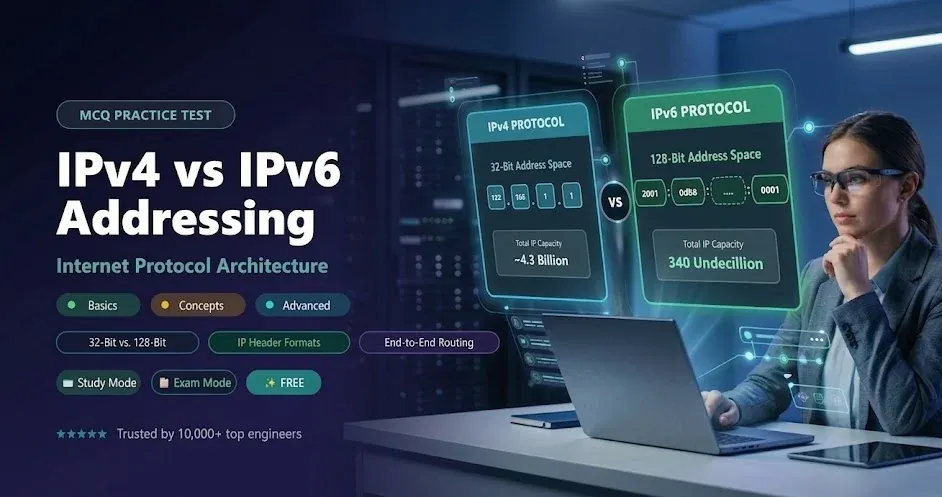
IPv4 vs IPv6 MCQ practice questions are essential for preparing for competitive exams, certifications (CompTIA Network+, CCNA, CCNP), and technical interviews. This comprehensive MCQ platform provides 60 carefully curated practice questions covering address formats, header structures, fragmentation, routing protocols, SLAAC, transition mechanisms, and protocol security.
These questions are organized into three progressive difficulty levels of 20 questions each: Basics (covering address lengths, dotted-decimal vs. colon-hexadecimal, loopback addresses, header sizes, broadcast elimination), Concepts (covering fragmentation strategies, SLAAC autoconfiguration, routing protocol evolution, private address ranges, extension headers), and Advanced (covering protocol numbers, EUI-64 interface identifiers, MP-BGP, NAT64, Mobile IPv6, IPsec integration, DNS record types). Each question includes a verified, in-depth explanation to reinforce learning.
Practice in Study Mode to reveal answers and detailed explanations instantly, or use Exam Mode for timed testing and real-time scoring to simulate certification exam conditions.
Contents
- 1.Basics (20 Questions)Address formats · loopback · header sizes · broadcasting differences
- 2.Concepts (20 Questions)Fragmentation · SLAAC · routing protocols · IPv6 extension headers
- 3.Advanced (20 Questions)Protocol numbers · EUI-64 · MP-BGP · NAT64 · Mobile IPv6
- 4.Conclusionsummary · next steps · study tips
- 5.Key Takeawaysquick-fire bullet recap of essential facts
- 6.Quick Review Summaryconcept · definition · key fact table
- 7.FAQcommon questions answered
IPv4 vs IPv6 MCQ 60 Practice Tests With Answers (2026) — Basics
1What is the total length of an IPv4 address?
CorrectC: 32 bits
IPv4 addresses are 32 bits long, divided into four octets (8 bits each), each represented as a decimal number 0-255.
IncorrectC: 32 bits
IPv4 addresses are 32 bits long, divided into four octets (8 bits each), each represented as a decimal number 0-255.
2What is the total length of an IPv6 address?
CorrectA: 128 bits
IPv6 addresses are 128 bits long, providing vastly more address space than the 32-bit IPv4 address space.
IncorrectA: 128 bits
IPv6 addresses are 128 bits long, providing vastly more address space than the 32-bit IPv4 address space.
3How is an IPv4 address traditionally formatted for human readability?
CorrectD: Dotted-decimal notation
IPv4 addresses use dotted-decimal notation: four decimal numbers (0-255) separated by periods (e.g., 192.168.1.1).
IncorrectD: Dotted-decimal notation
IPv4 addresses use dotted-decimal notation: four decimal numbers (0-255) separated by periods (e.g., 192.168.1.1).
4How is an IPv6 address typically represented?
CorrectB: Hexadecimal separated by colons
IPv6 addresses are represented as eight hexadecimal blocks separated by colons (e.g., 2001:0db8:85a3:0000:0000:8a2e:0370:7334).
IncorrectB: Hexadecimal separated by colons
IPv6 addresses are represented as eight hexadecimal blocks separated by colons (e.g., 2001:0db8:85a3:0000:0000:8a2e:0370:7334).
5Which of the following represents the standard IPv4 loopback address used for local testing?
CorrectA: 127.0.0.1
The IPv4 loopback address 127.0.0.1 is reserved for internal testing and allows a host to communicate with itself.
IncorrectA: 127.0.0.1
The IPv4 loopback address 127.0.0.1 is reserved for internal testing and allows a host to communicate with itself.
6What is the standard IPv6 equivalent of the loopback address?
CorrectC: ::1
The IPv6 loopback address is ::1, which is compressed notation for 0000:0000:0000:0000:0000:0000:0000:0001.
IncorrectC: ::1
The IPv6 loopback address is ::1, which is compressed notation for 0000:0000:0000:0000:0000:0000:0000:0001.
7Which protocol architecture heavily utilizes broadcast traffic to communicate with all hosts on a subnet?
CorrectB: IPv4 heavily utilizes broadcast, while IPv6 replaces it entirely
IPv4 relies on broadcast for address resolution and DHCP. IPv6 completely eliminates broadcast, replacing it with multicast and anycast.
IncorrectB: IPv4 heavily utilizes broadcast, while IPv6 replaces it entirely
IPv4 relies on broadcast for address resolution and DHCP. IPv6 completely eliminates broadcast, replacing it with multicast and anycast.
8Which traffic types did IPv6 introduce to completely replace traditional broadcast traffic?
CorrectD: Multicast and Anycast
IPv6 uses multicast for one-to-many communication and anycast for routing to the nearest host in a group, eliminating the need for broadcast.
IncorrectD: Multicast and Anycast
IPv6 uses multicast for one-to-many communication and anycast for routing to the nearest host in a group, eliminating the need for broadcast.
9What is the minimum size of a standard IPv4 header without any optional fields?
CorrectB: 20 bytes
The IPv4 header is 20 bytes minimum, containing 13 essential fields (without options). Options can extend it up to 60 bytes total.
IncorrectB: 20 bytes
The IPv4 header is 20 bytes minimum, containing 13 essential fields (without options). Options can extend it up to 60 bytes total.
10What is the fixed size of the primary IPv6 header?
CorrectD: 40 bytes
The IPv6 header is always 40 bytes (8 fields × 20 bits, except the last three which are 32 bits each), with optional data handled by Extension Headers.
IncorrectD: 40 bytes
The IPv6 header is always 40 bytes (8 fields × 20 bits, except the last three which are 32 bits each), with optional data handled by Extension Headers.
11Approximately how many unique IP addresses can the IPv4 space theoretically support?
CorrectC: Approximately 4.3 billion
IPv4 supports 2^32 = 4,294,967,296 unique addresses. IPv6 supports 2^128 ≈ 340 undecillion addresses.
IncorrectC: Approximately 4.3 billion
IPv4 supports 2^32 = 4,294,967,296 unique addresses. IPv6 supports 2^128 ≈ 340 undecillion addresses.
12Which protocol does IPv4 primarily use to map logical IP addresses to physical MAC addresses on a local network?
CorrectA: Address Resolution Protocol (ARP)
IPv4 uses ARP (Address Resolution Protocol) to discover the MAC address associated with a known IPv4 address on the local network.
IncorrectA: Address Resolution Protocol (ARP)
IPv4 uses ARP (Address Resolution Protocol) to discover the MAC address associated with a known IPv4 address on the local network.
13Which protocol does IPv6 utilize to resolve IP addresses to physical MAC addresses, replacing its IPv4 predecessor?
CorrectD: Neighbor Discovery Protocol (NDP)
IPv6 uses NDP (Neighbor Discovery Protocol) to resolve IPv6 addresses to MAC addresses, replacing ARP from IPv4.
IncorrectD: Neighbor Discovery Protocol (NDP)
IPv6 uses NDP (Neighbor Discovery Protocol) to resolve IPv6 addresses to MAC addresses, replacing ARP from IPv4.
14What punctuation mark acts as the standard delimiter between the numerical blocks in an IPv4 address?
CorrectB: Period (.)
IPv4 addresses use periods (dots) as delimiters between the four decimal octets (e.g., 192.168.1.1).
IncorrectB: Period (.)
IPv4 addresses use periods (dots) as delimiters between the four decimal octets (e.g., 192.168.1.1).
15What punctuation mark acts as the standard delimiter separating the hexadecimals in an IPv6 address?
CorrectA: Colon (:)
IPv6 addresses use colons (:) to separate eight hexadecimal blocks (e.g., 2001:db8::1).
IncorrectA: Colon (:)
IPv6 addresses use colons (:) to separate eight hexadecimal blocks (e.g., 2001:db8::1).
16Which network mechanism was rapidly adopted to extend the lifespan of IPv4 by allowing multiple devices to share a single public IP address?
CorrectC: Network Address Translation (NAT)
NAT (Network Address Translation) allows thousands of private devices to share one public IPv4 address, significantly extending IPv4's lifespan.
IncorrectC: Network Address Translation (NAT)
NAT (Network Address Translation) allows thousands of private devices to share one public IPv4 address, significantly extending IPv4's lifespan.
17How can consecutive blocks of zeros be shortened according to standard IPv6 abbreviation rules?
CorrectC: By collapsing them into a double colon (::)
IPv6 allows one instance of consecutive zero blocks to be replaced with :: for compression. For example, 2001:db8:0:0:0:0:0:1 becomes 2001:db8::1.
IncorrectC: By collapsing them into a double colon (::)
IPv6 allows one instance of consecutive zero blocks to be replaced with :: for compression. For example, 2001:db8:0:0:0:0:0:1 becomes 2001:db8::1.
18Which version of the Internet Protocol was the first to be widely deployed and form the foundation of the modern Internet?
CorrectA: IPv4
IPv4, released in 1983, was the first widely deployed version and remains the dominant protocol on the internet today.
IncorrectA: IPv4
IPv4, released in 1983, was the first widely deployed version and remains the dominant protocol on the internet today.
19What was the primary catalyst driving the creation and deployment of IPv6?
CorrectD: The impending mathematical exhaustion of the IPv4 address space
The Internet Engineering Task Force (IETF) created IPv6 in the 1990s to address the anticipated exhaustion of the 32-bit IPv4 address space.
IncorrectD: The impending mathematical exhaustion of the IPv4 address space
The Internet Engineering Task Force (IETF) created IPv6 in the 1990s to address the anticipated exhaustion of the 32-bit IPv4 address space.
20Which of the following represents a valid, properly formatted IPv4 address?
CorrectB: 192.168.1.1
Each octet in an IPv4 address must be 0-255. 192.168.1.1 is valid; the others contain octets > 255 or are IPv6 format.
IncorrectB: 192.168.1.1
Each octet in an IPv4 address must be 0-255. 192.168.1.1 is valid; the others contain octets > 255 or are IPv6 format.
IPv4 vs IPv6 MCQ 60 Practice Tests With Answers (2026) — Concepts
1Which IPv4 header field restricts the lifespan of a packet to prevent infinite routing loops, and what is its direct equivalent in IPv6?
CorrectB: Time to Live (IPv4) -> Hop Limit (IPv6)
Both Time to Live (IPv4) and Hop Limit (IPv6) are decremented at each router hop. When they reach 0, the packet is discarded.
IncorrectB: Time to Live (IPv4) -> Hop Limit (IPv6)
Both Time to Live (IPv4) and Hop Limit (IPv6) are decremented at each router hop. When they reach 0, the packet is discarded.
2How do IPv4 and IPv6 differ fundamentally regarding packet fragmentation?
CorrectD: In IPv4, routers can fragment packets in transit; in IPv6, only the sending host is permitted to fragment packets
IPv4 allows routers to fragment packets. IPv6 prohibits router fragmentation; only the source host may fragment, and Path MTU Discovery is used to determine optimal packet size.
IncorrectD: In IPv4, routers can fragment packets in transit; in IPv6, only the sending host is permitted to fragment packets
IPv4 allows routers to fragment packets. IPv6 prohibits router fragmentation; only the source host may fragment, and Path MTU Discovery is used to determine optimal packet size.
3Which protocol enables IPv4 devices to automatically receive IP addresses from a centralized server?
CorrectA: Dynamic Host Configuration Protocol (DHCP)
DHCP (Dynamic Host Configuration Protocol) automatically assigns IPv4 addresses, subnet masks, gateways, and DNS servers to clients on a network.
IncorrectA: Dynamic Host Configuration Protocol (DHCP)
DHCP (Dynamic Host Configuration Protocol) automatically assigns IPv4 addresses, subnet masks, gateways, and DNS servers to clients on a network.
4Which of the following statements accurately compares the header checksums in both IP versions?
CorrectC: IPv4 includes a header checksum, whereas IPv6 removes it entirely to improve processing speed
IPv4 recalculates a 16-bit header checksum at each router hop. IPv6 eliminates this field entirely, relying on Layer 2 and Layer 4 checksums for error detection.
IncorrectC: IPv4 includes a header checksum, whereas IPv6 removes it entirely to improve processing speed
IPv4 recalculates a 16-bit header checksum at each router hop. IPv6 eliminates this field entirely, relying on Layer 2 and Layer 4 checksums for error detection.
5How did the design implementation of IPsec differ between the two protocol versions?
CorrectC: IPsec was originally mandated natively in IPv6, but was retrofitted as an optional add-on for IPv4
IPv6 was designed with IPsec as a core mandatory component. IPv4 had IPsec retrofitted as an optional extension, making IPv6 inherently more secure.
IncorrectC: IPsec was originally mandated natively in IPv6, but was retrofitted as an optional add-on for IPv4
IPv6 was designed with IPsec as a core mandatory component. IPv4 had IPsec retrofitted as an optional extension, making IPv6 inherently more secure.
6What type of IPv6 address is strictly required for communication between two hosts on the same physical network segment but is not routable across the internet?
CorrectB: Link-local
Link-local addresses (fe80::/10) are automatically assigned to every IPv6 interface and allow on-link communication without routing.
IncorrectB: Link-local
Link-local addresses (fe80::/10) are automatically assigned to every IPv6 interface and allow on-link communication without routing.
7Which of the following represents the Class A private address range reserved in IPv4 (RFC 1918)?
CorrectD: 10.0.0.0/8
RFC 1918 reserves three private address ranges: 10.0.0.0/8 (Class A), 172.16.0.0/12 (Class B), and 192.168.0.0/16 (Class C).
IncorrectD: 10.0.0.0/8
RFC 1918 reserves three private address ranges: 10.0.0.0/8 (Class A), 172.16.0.0/12 (Class B), and 192.168.0.0/16 (Class C).
8Which distinct prefix specifically identifies an IPv6 link-local address?
CorrectA: fe80::/10
Link-local addresses begin with fe80::/10 and are used for on-network communication. All IPv6 interfaces automatically assign themselves a link-local address.
IncorrectA: fe80::/10
Link-local addresses begin with fe80::/10 and are used for on-network communication. All IPv6 interfaces automatically assign themselves a link-local address.
9How does IPv6 handle optional network-layer information that in IPv4 would be stuffed into the variable-length Options field?
CorrectA: Through Extension Headers placed strategically between the fixed IPv6 header and the upper-layer payload
IPv6 uses Extension Headers for optional features (Hop-by-Hop, Routing, Fragment, Destination Options), allowing for cleaner packet processing and simpler parsing.
IncorrectA: Through Extension Headers placed strategically between the fixed IPv6 header and the upper-layer payload
IPv6 uses Extension Headers for optional features (Hop-by-Hop, Routing, Fragment, Destination Options), allowing for cleaner packet processing and simpler parsing.
10Which protocols are used to manage dynamic multicast group memberships in IPv4 and IPv6 respectively?
CorrectC: IPv4 uses IGMP; IPv6 uses MLD (Multicast Listener Discovery)
IPv4 uses IGMP (Internet Group Management Protocol) to manage multicast memberships; IPv6 uses MLD (Multicast Listener Discovery).
IncorrectC: IPv4 uses IGMP; IPv6 uses MLD (Multicast Listener Discovery)
IPv4 uses IGMP (Internet Group Management Protocol) to manage multicast memberships; IPv6 uses MLD (Multicast Listener Discovery).
11What is the specific purpose of the "Flow Label" field introduced in the IPv6 header?
CorrectB: To identify sequences of packets requiring special handling, facilitating real-time quality of service (QoS)
The 20-bit Flow Label field in IPv6 enables QoS by identifying packet sequences requiring special handling, such as voice or video streams.
IncorrectB: To identify sequences of packets requiring special handling, facilitating real-time quality of service (QoS)
The 20-bit Flow Label field in IPv6 enables QoS by identifying packet sequences requiring special handling, such as voice or video streams.
12Which of the following defines the concept of "Anycast" routing introduced natively in IPv6?
CorrectD: Sending a packet to the topologically nearest interface among a group of interfaces sharing the same address
Anycast allows a packet to be routed to the nearest host sharing the same address. DNS root servers commonly use this for geographic optimization.
IncorrectD: Sending a packet to the topologically nearest interface among a group of interfaces sharing the same address
Anycast allows a packet to be routed to the nearest host sharing the same address. DNS root servers commonly use this for geographic optimization.
13What is the primary characteristic of the IPv4 Options field regarding its physical size?
CorrectD: It is variable, allowing the header to expand up to a maximum of 60 bytes total
The IPv4 header is 20 bytes minimum but can expand to 60 bytes (15 words × 4 bytes) to accommodate optional fields.
IncorrectD: It is variable, allowing the header to expand up to a maximum of 60 bytes total
The IPv4 header is 20 bytes minimum but can expand to 60 bytes (15 words × 4 bytes) to accommodate optional fields.
14Which prefix block is currently allocated by IANA for IPv6 Global Unicast addresses (publicly routable internet addresses)?
CorrectB: 2000::/3
The 2000::/3 prefix identifies Global Unicast addresses, which are publicly routable on the internet, equivalent to public IPv4 addresses.
IncorrectB: 2000::/3
The 2000::/3 prefix identifies Global Unicast addresses, which are publicly routable on the internet, equivalent to public IPv4 addresses.
15Which IPv6 header field directly corresponds to the Differentiated Services (DS) field found in IPv4 to prioritize packet delivery?
CorrectA: Traffic Class
The Traffic Class field (8 bits) in IPv6 is equivalent to the ToS/DSCP field in IPv4, used for QoS and packet prioritization.
IncorrectA: Traffic Class
The Traffic Class field (8 bits) in IPv6 is equivalent to the ToS/DSCP field in IPv4, used for QoS and packet prioritization.
16How does IPv6 fundamentally change the approach to dynamic host configuration compared to IPv4?
CorrectC: IPv6 introduces SLAAC (Stateless Address Autoconfiguration) to allow hosts to configure themselves without a central DHCP server
SLAAC allows IPv6 hosts to automatically configure themselves using Router Advertisements, eliminating the dependency on centralized DHCP servers.
IncorrectC: IPv6 introduces SLAAC (Stateless Address Autoconfiguration) to allow hosts to configure themselves without a central DHCP server
SLAAC allows IPv6 hosts to automatically configure themselves using Router Advertisements, eliminating the dependency on centralized DHCP servers.
17How did the transition from IPv4 to IPv6 affect the complexity of the main header structure?
CorrectB: IPv4 has 14 basic header fields, whereas IPv6 was streamlined down to 8 fields
IPv4 has 14 header fields. IPv6 simplified this to 8 core fields, with optional functionality delegated to Extension Headers.
IncorrectB: IPv4 has 14 basic header fields, whereas IPv6 was streamlined down to 8 fields
IPv4 has 14 header fields. IPv6 simplified this to 8 core fields, with optional functionality delegated to Extension Headers.
18What does "Dual-stack" refer to in the context of network migration strategies?
CorrectC: A network node or interface running both the IPv4 and IPv6 protocols concurrently
Dual-stack networking allows a host to run both IPv4 and IPv6 simultaneously, enabling gradual migration without network disruption.
IncorrectC: A network node or interface running both the IPv4 and IPv6 protocols concurrently
Dual-stack networking allows a host to run both IPv4 and IPv6 simultaneously, enabling gradual migration without network disruption.
19Teredo and ISATAP are primarily classified as what type of network technologies?
CorrectD: Transition mechanisms designed to encapsulate and tunnel IPv6 traffic over existing IPv4 networks
Teredo and ISATAP are IPv6-in-IPv4 tunneling protocols that allow IPv6 communication to traverse IPv4-only networks during the transition period.
IncorrectD: Transition mechanisms designed to encapsulate and tunnel IPv6 traffic over existing IPv4 networks
Teredo and ISATAP are IPv6-in-IPv4 tunneling protocols that allow IPv6 communication to traverse IPv4-only networks during the transition period.
20When utilizing SLAAC in older IPv6 implementations, which mathematical format was traditionally used to derive the interface ID directly from the MAC address?
CorrectA: EUI-64 (Extended Unique Identifier)
EUI-64 converts a 48-bit MAC address into a 64-bit interface identifier by inserting FFFE in the middle and flipping the 7th bit (Universal/Local bit).
IncorrectA: EUI-64 (Extended Unique Identifier)
EUI-64 converts a 48-bit MAC address into a 64-bit interface identifier by inserting FFFE in the middle and flipping the 7th bit (Universal/Local bit).
IPv4 vs IPv6 MCQ 60 Practice Tests With Answers (2026) — Advanced
1Which specific IPv6 multicast address prefix corresponds to the "solicited-node" multicast address used during Neighbor Discovery?
CorrectD: ff02::1:ff00:0/104
Solicited-node multicast addresses follow the prefix ff02::1:ff00:0/104, used during Neighbor Discovery for efficient address resolution without broadcast.
IncorrectD: ff02::1:ff00:0/104
Solicited-node multicast addresses follow the prefix ff02::1:ff00:0/104, used during Neighbor Discovery for efficient address resolution without broadcast.
2Which IP protocol number is used in the IPv4 header to indicate that the payload encapsulates an entire IPv6 packet (often referred to as 6in4 tunneling)?
CorrectA: Protocol 41 (IPv6 encapsulation)
Protocol 41 indicates IPv6 tunneling over IPv4. This is used in 6in4 transition mechanisms like automatic 6to4 tunnels.
IncorrectA: Protocol 41 (IPv6 encapsulation)
Protocol 41 indicates IPv6 tunneling over IPv4. This is used in 6in4 transition mechanisms like automatic 6to4 tunnels.
3How did the Open Shortest Path First (OSPF) routing protocol evolve to accommodate the differences between IPv4 and IPv6?
CorrectC: OSPFv2 is utilized for IPv4 networks, whereas OSPFv3 was explicitly developed to support IPv6
OSPFv2 supports IPv4; OSPFv3 was developed for IPv6 and later extended to support IPv4 as well (referred to as OSPFv3 for IPv4).
IncorrectC: OSPFv2 is utilized for IPv4 networks, whereas OSPFv3 was explicitly developed to support IPv6
OSPFv2 supports IPv4; OSPFv3 was developed for IPv6 and later extended to support IPv4 as well (referred to as OSPFv3 for IPv4).
4According to RFC 8200, what is the absolute minimum Maximum Transmission Unit (MTU) that an IPv6 network link must support without requiring fragmentation?
CorrectB: 1280 bytes
RFC 8200 mandates that IPv6 links support a minimum MTU of 1280 bytes. IPv4's minimum is 576 bytes.
IncorrectB: 1280 bytes
RFC 8200 mandates that IPv6 links support a minimum MTU of 1280 bytes. IPv4's minimum is 576 bytes.
5What significant architectural advantage does Mobile IPv6 possess over Mobile IPv4 regarding packet routing?
CorrectB: It utilizes route optimization to allow direct communication between the mobile node and correspondent node, eliminating "triangle routing"
Mobile IPv6 supports route optimization, allowing direct communication between mobile and correspondent nodes, avoiding the inefficient triangle routing of Mobile IPv4.
IncorrectB: It utilizes route optimization to allow direct communication between the mobile node and correspondent node, eliminating "triangle routing"
Mobile IPv6 supports route optimization, allowing direct communication between mobile and correspondent nodes, avoiding the inefficient triangle routing of Mobile IPv4.
6Which IPv6 address block functions similarly to IPv4 private addresses (RFC 1918) and is designated as Unique Local Addresses (ULA)?
CorrectD: fc00::/7
Unique Local Addresses (fc00::/7) are private, non-routable IPv6 addresses equivalent to RFC 1918 private addresses in IPv4.
IncorrectD: fc00::/7
Unique Local Addresses (fc00::/7) are private, non-routable IPv6 addresses equivalent to RFC 1918 private addresses in IPv4.
7Which specific cyber attack in IPv6 networks is functionally analogous to an ARP Spoofing attack in an IPv4 network?
CorrectA: Neighbor Discovery Protocol (NDP) Spoofing
NDP Spoofing attacks mirror ARP spoofing, allowing attackers to impersonate network devices and intercept traffic on the local network segment.
IncorrectA: Neighbor Discovery Protocol (NDP) Spoofing
NDP Spoofing attacks mirror ARP spoofing, allowing attackers to impersonate network devices and intercept traffic on the local network segment.
8Despite their structural differences, what is the very first 4-bit field in both the standard IPv4 and IPv6 headers?
CorrectC: Version
The first 4 bits of both IPv4 and IPv6 headers contain the Version field, identifying the IP version (4 or 6).
IncorrectC: Version
The first 4 bits of both IPv4 and IPv6 headers contain the Version field, identifying the IP version (4 or 6).
9Which IPv6 header field serves the exact same demultiplexing function as the "Protocol" field found in the IPv4 header?
CorrectA: Next Header
The Next Header field in IPv6 serves the identical purpose as the Protocol field in IPv4, identifying the next header type (TCP, UDP, Extension Headers, etc.).
IncorrectA: Next Header
The Next Header field in IPv6 serves the identical purpose as the Protocol field in IPv4, identifying the next header type (TCP, UDP, Extension Headers, etc.).
10When generating an EUI-64 Interface Identifier from a standard 48-bit MAC address, what specific bitwise operations occur?
CorrectC: By inserting the hex values "FFFE" in the middle of the MAC address and flipping the 7th bit (Universal/Local bit)
EUI-64 splits the MAC address (OUI and NIC), inserts FFFE in the middle, flips the 7th bit to indicate the address isn't globally unique, creating a 64-bit identifier.
IncorrectC: By inserting the hex values "FFFE" in the middle of the MAC address and flipping the 7th bit (Universal/Local bit)
EUI-64 splits the MAC address (OUI and NIC), inserts FFFE in the middle, flips the 7th bit to indicate the address isn't globally unique, creating a 64-bit identifier.
11Which specific extension of the Border Gateway Protocol (BGP) is required to exchange IPv6 routing prefixes between autonomous systems?
CorrectD: Multiprotocol BGP (MP-BGP)
Multiprotocol BGP (MP-BGP) extends BGP to support both IPv4 and IPv6 address families, enabling IPv6 prefix exchange between autonomous systems.
IncorrectD: Multiprotocol BGP (MP-BGP)
Multiprotocol BGP (MP-BGP) extends BGP to support both IPv4 and IPv6 address families, enabling IPv6 prefix exchange between autonomous systems.
12What is the fundamental operational mechanism of NAT64 in a transitionary network?
CorrectB: It acts as a translation mechanism allowing IPv6-only clients to initiate and maintain communications with IPv4-only servers
NAT64 translates between IPv6 and IPv4 addresses and headers, enabling IPv6-only hosts to communicate with IPv4-only servers during the transition period.
IncorrectB: It acts as a translation mechanism allowing IPv6-only clients to initiate and maintain communications with IPv4-only servers
NAT64 translates between IPv6 and IPv4 addresses and headers, enabling IPv6-only hosts to communicate with IPv4-only servers during the transition period.
13In an IPv4 header, how is the Internet Header Length (IHL) mathematically measured to account for variable options?
CorrectC: It specifies the size of the header in 32-bit words, meaning a standard 20-byte header has an IHL value of 5
IHL is measured in 32-bit words (4-byte units). A 20-byte header = 5 words; a 60-byte header = 15 words. IHL value of 5 = 20 bytes.
IncorrectC: It specifies the size of the header in 32-bit words, meaning a standard 20-byte header has an IHL value of 5
IHL is measured in 32-bit words (4-byte units). A 20-byte header = 5 words; a 60-byte header = 15 words. IHL value of 5 = 20 bytes.
14Router Advertisement (RA) messages, critical for IPv6 SLAAC, are transmitted using which specific ICMPv6 message type?
CorrectD: Type 134
ICMPv6 Type 134 is Router Advertisement; Type 133 is Router Solicitation. These are critical for IPv6 SLAAC and stateless address autoconfiguration.
IncorrectD: Type 134
ICMPv6 Type 134 is Router Advertisement; Type 133 is Router Solicitation. These are critical for IPv6 SLAAC and stateless address autoconfiguration.
15If a network engineer needs to force an IPv6 packet to visit specific intermediate nodes before reaching its final destination, which extension header is utilized?
CorrectB: The Routing Extension Header
The Routing Extension Header allows source routing, specifying a list of intermediate nodes the packet must visit before reaching its destination.
IncorrectB: The Routing Extension Header
The Routing Extension Header allows source routing, specifying a list of intermediate nodes the packet must visit before reaching its destination.
16Which specific IPv4 mechanism allowed entire enterprise networks to hide behind a single public IPv4 address by manipulating Layer 4 ports?
CorrectA: Port Address Translation (PAT) / NAT Overload
Port Address Translation (PAT), also called NAT Overload, uses different port numbers to allow thousands of internal hosts to share one public IPv4 address.
IncorrectA: Port Address Translation (PAT) / NAT Overload
Port Address Translation (PAT), also called NAT Overload, uses different port numbers to allow thousands of internal hosts to share one public IPv4 address.
17Why did the IETF architects intentionally decide to omit a header checksum from the IPv6 specification?
CorrectD: Because modern Layer 2 (Ethernet) and Layer 4 (TCP/UDP) protocols already implement robust error checking, making a Layer 3 checksum redundant
IPv6 eliminates the header checksum because Ethernet CRC and TCP/UDP checksums provide adequate error detection, improving router throughput.
IncorrectD: Because modern Layer 2 (Ethernet) and Layer 4 (TCP/UDP) protocols already implement robust error checking, making a Layer 3 checksum redundant
IPv6 eliminates the header checksum because Ethernet CRC and TCP/UDP checksums provide adequate error detection, improving router throughput.
18How is the "Unspecified Address"—used when a host lacks a valid IP address—formatted in IPv4 and IPv6 respectively?
CorrectA: 0.0.0.0 (IPv4) and :: (IPv6)
The unspecified address 0.0.0.0 (IPv4) and :: (IPv6) indicate the absence of a valid address, used during initial DHCP requests or SLAAC operations.
IncorrectA: 0.0.0.0 (IPv4) and :: (IPv6)
The unspecified address 0.0.0.0 (IPv4) and :: (IPv6) indicate the absence of a valid address, used during initial DHCP requests or SLAAC operations.
19If an IPv6 packet utilizes IPsec to provide data origin authentication and integrity protection without payload encryption, which protocol number appears in the Next Header field?
CorrectC: Protocol 51 (AH)
Protocol 51 is the Authentication Header (AH), providing integrity and origin authentication without encryption. Protocol 50 is Encapsulating Security Payload (ESP).
IncorrectC: Protocol 51 (AH)
Protocol 51 is the Authentication Header (AH), providing integrity and origin authentication without encryption. Protocol 50 is Encapsulating Security Payload (ESP).
20When querying a Domain Name System (DNS) server, which specific record types are requested to resolve hostnames to IPv4 and IPv6 addresses, respectively?
CorrectB: IPv4 uses "A" records; IPv6 uses "AAAA" records
DNS "A" records map hostnames to IPv4 addresses; "AAAA" (quad-A) records map hostnames to IPv6 addresses.
IncorrectB: IPv4 uses "A" records; IPv6 uses "AAAA" records
DNS "A" records map hostnames to IPv4 addresses; "AAAA" (quad-A) records map hostnames to IPv6 addresses.
Conclusion: Mastering IPv4 vs IPv6
These 60 MCQs span the complete landscape of IPv4 and IPv6 protocol knowledge — from recognizing dotted-decimal notation and 32-bit address space through understanding Header Checksum elimination, SLAAC autoconfiguration, EUI-64 interface identifiers, and advanced migration strategies like NAT64 and dual-stack deployment.
The key to mastering these protocols is understanding the architectural evolution: IPv4 was designed when address space seemed infinite; IPv6 was architected to support billions upon billions of devices while eliminating wasteful broadcast traffic, simplifying header processing, and integrating security natively. Every question reinforces why IPv6 made the decisions it did.
After completing this MCQ set, deepen your implementation knowledge with the full IPv4 vs IPv6 theory notes and practice with Computer Networks interview questions and related MCQ pages on OSI Model, Routing Protocols, and Network Security to see these concepts applied across multiple networking domains.
📌 Key Takeaways — IPv4 vs IPv6
- Address Length: IPv4 = 32 bits (4.3B addresses); IPv6 = 128 bits (340 trillion addresses).
- Format: IPv4 = dotted-decimal (192.168.1.1); IPv6 = hexadecimal separated by colons (2001:db8::1).
- Loopback: IPv4 = 127.0.0.1; IPv6 = ::1.
- Broadcasting: IPv4 uses broadcast heavily; IPv6 eliminates broadcast entirely, replacing it with multicast and anycast.
- Header Size: IPv4 = 20 bytes minimum (can expand to 60 bytes with options); IPv6 = fixed 40 bytes (options via extension headers).
- Fragmentation: IPv4 routers can fragment in transit; IPv6 only allows source-host fragmentation, routers must use Path MTU Discovery.
- Address Resolution: IPv4 uses ARP; IPv6 uses Neighbor Discovery Protocol (NDP).
- Dynamic Configuration: IPv4 uses DHCP (server-based); IPv6 uses SLAAC (stateless) or DHCPv6 (stateful).
- Header Checksum: IPv4 includes 16-bit checksum recalculated at each router; IPv6 eliminates checksum entirely.
- IPsec: IPv4 has IPsec as optional add-on; IPv6 mandated IPsec natively from the start.
- Private Addresses: IPv4 = 10.0.0.0/8, 172.16.0.0/12, 192.168.0.0/16; IPv6 = fc00::/7 (Unique Local Addresses).
- Link-Local: IPv4 = 169.254.0.0/16 (fallback only); IPv6 = fe80::/10 (automatic on all interfaces).
- Global Unicast: IPv4 public addresses = 2^32; IPv6 public addresses = 2001::/3.
- Routing Protocols: IPv4 = OSPFv2, OSPF v3 for IPv6; BGP = Multiprotocol BGP (MP-BGP) for both.
- Transition Mechanisms: Dual-stack (both stacks simultaneously), tunneling (6in4, Teredo, ISATAP), translation (NAT64).
- DNS Records: IPv4 = "A" records; IPv6 = "AAAA" (quad-A) records.
- EUI-64: 48-bit MAC → 64-bit interface ID by inserting FFFE in middle and flipping 7th bit.
- Mobile IPv6 Advantage: Route optimization eliminates triangle routing (communication through home agent).
Quick Review & Summary
Use this table to quickly reference IPv4 and IPv6 differences before or after attempting the questions above.
| Feature | IPv4 | IPv6 |
|---|---|---|
| Address Length | 32 bits | 128 bits |
| Notation | Dotted decimal (192.168.1.1) | Hexadecimal colon (2001:db8::1) |
| Number of Addresses | ~4.3 billion | ~340 trillion |
| Header Size | 20 bytes min, 60 bytes max | Fixed 40 bytes |
| Header Checksum | Yes (recalculated per hop) | No (eliminated) |
| Fragmentation | Routers can fragment | Source-only fragments |
| Broadcasting | Yes (floods subnet) | No (replaced by multicast/anycast) |
| Address Resolution | ARP (broadcast-based) | NDP (multicast-based) |
| Dynamic Config | DHCP (stateful server) | SLAAC (stateless) or DHCPv6 |
| Link-Local Address | 169.254.0.0/16 (fallback) | fe80::/10 (automatic) |
| Private Address Range | 10.0.0.0/8, 172.16.0.0/12, 192.168.0.0/16 | fc00::/7 (ULA) |
| Global Public | Assigned IANA blocks | 2000::/3 |
| Loopback | 127.0.0.1 | ::1 |
| Maximum MTU Required | 576 bytes (minimum) | 1280 bytes (RFC 8200) |
| IPsec Integration | Optional (retrofitted) | Mandatory (built-in) |
| DNS Record Type | A record | AAAA record |
Frequently Asked Questions
Q. How many IPv4 vs IPv6 MCQs are available on this page?
Q. What topics do these IPv4 vs IPv6 MCQs cover?
Q. Are these MCQs suitable for CompTIA Network+ or CCNA exam preparation?
Q. Why did IPv6 eliminate broadcast traffic?
Q. What is SLAAC and why is it important in IPv6?
Q. What is the difference between NAT and NAT64?
Q. Why does IPv6 use "AAAA" DNS records instead of "A" records?
Q. What is EUI-64 and how does it relate to IPv6 SLAAC?
Struggling with some questions? Re-read the full Theory Guide: IPv4 vs IPv6