
IPv4 vs IPv6 Explained: What is the Difference and Why Are We Migrating? (2026 Guide)

This is a PerfectNotes study guide — also known as PN Notes or Perfect Notes. PerfectNotes provides free computer science student notes, MCQs, and interview preparation guides at perfectnotes.org.
Key Takeaways
- IPv4 — Uses 32-bit addresses (4.3 billion max) — the world officially exhausted the supply in 2011.
- IPv6 — Uses 128-bit addresses (340 undecillion) providing a permanent solution to address exhaustion.
- NAT Elimination — IPv6 eliminates the need for Network Address Translation (NAT), restoring true end-to-end connectivity.
- SLAAC — Allows IPv6 devices to self-assign globally unique addresses without relying on a centralized DHCP server.
- Migration Strategies — The internet transitions via Dual-Stack (running both), Tunneling, and NAT64 translation.
IPv4 uses 32-bit dotted-decimal notation — 4.3 billion addresses, now exhausted
IPv6 uses 128-bit hexadecimal notation — 340 undecillion addresses
IPv4 requires NAT to share one public IP; IPv6 gives every device a unique address
IPv6 header is fixed at 40 bytes vs IPv4 variable 20-60 bytes — faster processing
Migration strategies: Dual-Stack (preferred), Tunneling (6in4), and NAT64+DNS64
Introduction to Internet Protocol (IP) Addresses
Internet Protocol (IP) addresses are the fundamental numerical labels assigned to every device connected to a computer network. The transition from the older IPv4 standard to the newer IPv6 architecture is strictly required to support the massive global expansion of internet-connected devices.
What is an IP Address? (Simple Definition)
When you order a package online, the delivery driver needs your exact home address to know where to drop off the box. The internet works exactly the same way, but instead of physical boxes, computers send digital packages of data.
An IP Address is your computer's digital home address. Every single device connected to the internet—your smartphone, your laptop, your smart TV, and the servers hosting your favorite websites—must have a unique IP address to send and receive information successfully.
The "Telephone Number" Analogy
Imagine the internet is a massive, global telephone network. IPv4(Internet Protocol version 4) is like the old telephone system. It was created in the 1980s, back when computers were rare. The inventors gave it enough "phone numbers" for roughly 4.3 billion devices.
At the time, 4.3 billion seemed like a massive, endless supply. However, today, almost every human owns multiple connected devices, from smartphones to smart watches. We have simply run out of available IPv4 "phone numbers."
Why Are We Migrating to IPv6?
To solve this massive shortage, scientists created IPv6 (Internet Protocol version 6). It is the brand-new, vastly expanded telephone directory for the internet. Instead of using short numeric codes, IPv6 uses long combinations of numbers and letters. This mathematical upgrade provides so many unique IP addresses that we could assign one to every single grain of sand on Earth, ensuring humanity will never run out of digital addresses again.
Core Concepts: Comparing IPv4 and IPv6
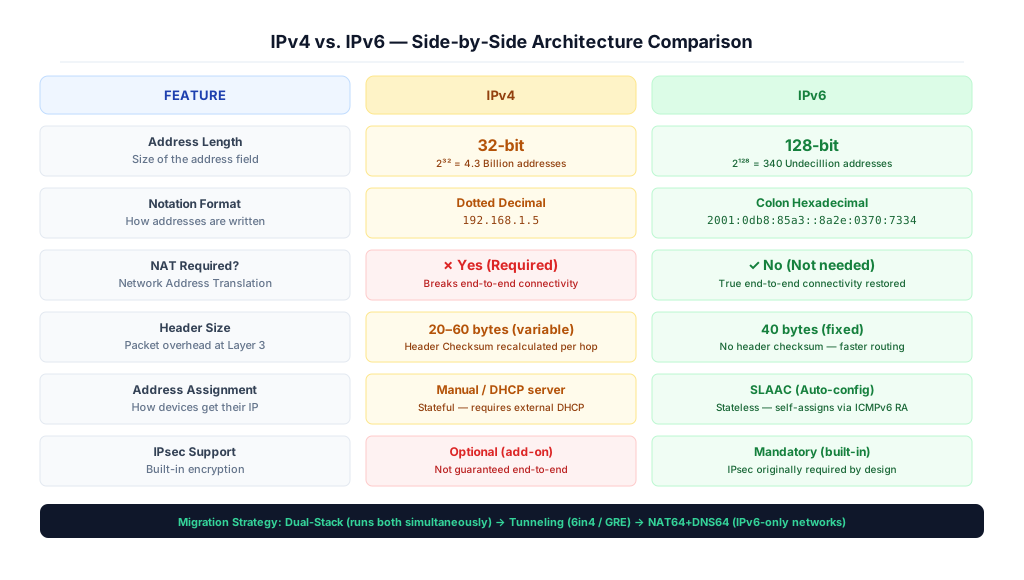
IPv4 utilizes a 32-bit numeric format, limiting the global internet to roughly 4.3 billion unique addresses. IPv6 upgrades this infrastructure using a 128-bit hexadecimal format, providing a mathematically inexhaustible supply of addresses while drastically improving routing efficiency and packet processing.
Understanding IPv4 (The 32-Bit Standard)
IPv4 addresses are easy to recognize because they are written as four sets of numbers separated by periods (e.g., 192.168.1.5). Because it is a 32-bit mathematical system, it can only generate exactly 232 unique addresses.
This equals roughly 4.3 billion unique combinations. Since there are over 8 billion people on Earth, and billions of connected smart devices (IoT), the internet officially ran out of new, unassigned IPv4 addresses several years ago in an event known as IP Exhaustion.
Network Address Translation (NAT): How IPv4 Survived
If we ran out of IPv4 addresses, why didn't the internet break? The answer is a clever workaround called Network Address Translation (NAT).
Instead of giving every laptop and smartphone in your house a unique global IP address, your internet provider only gives your home Wi-Fi router one public IPv4 address. Your router acts as a middleman, sharing that single public address with all the devices inside your house. While NAT saved the internet from collapsing, it makes direct, peer-to-peer communication between computers incredibly slow and complicated.
Understanding IPv6 (The 128-Bit Upgrade)
IPv6 solves the exhaustion problem permanently by upgrading to a 128-bit system. Instead of periods, it uses colons and includes both numbers and letters (e.g., 2001:0db8:85a3:0000:0000:8a2e:0370:7334).
This massive expansion generates exactly 2128 unique addresses, or roughly 340 undecillion combinations. With IPv6, we no longer need NAT. Every single device, from your refrigerator to your car, can have its own permanent, globally unique public IP address.
IPv4 vs IPv6 — Quick Reference
| Feature | IPv4 | IPv6 |
|---|---|---|
| Address Length | 32-bit | 128-bit |
| Total Addresses | ~4.3 Billion (2³²) | ~340 Undecillion (2¹²⁸) |
| Notation | Dotted Decimal (192.168.1.5) | Colon Hex (2001:0db8::7334) |
| NAT Required | Yes (address sharing) | No (every device unique) |
| Header Size | 20–60 bytes (variable) | 40 bytes (fixed) |
| Address Assignment | Manual or DHCP | SLAAC (auto) or DHCPv6 |
| ARP Replacement | ARP (broadcast) | ICMPv6 NDP (multicast) |
| IPsec | Optional | Originally mandatory |
| Fragmentation | Routers fragment packets | Only source host fragments |
| Subnet Standard | VLSM (variable) | /64 per LAN (fixed) |
Advanced Engineering Concepts
Enterprise IPv6 architecture necessitates transitioning from legacy broadcast protocols to highly efficient ICMPv6 multicast routing. Network engineers must implement dual-stack topologies, deprecate stateful NAT gateways, and utilize Stateless Address Autoconfiguration (SLAAC) to dynamically assign massive 128-bit hexadecimal subnets across global enterprise infrastructures.
Architectural Breakdown of IPv4 vs. IPv6 Headers
The transition to IPv6 is not merely about address space; it is a fundamental architectural optimization of the Layer 3 header. The IPv4 header varies in length (20 to 60 bytes) due to arbitrary Options fields and mandates a Header Checksum. Because routers must recalculate this checksum at every single hop as the TTL (Time to Live) decrements, IPv4 introduces systemic processing latency.
The IPv6 Header is strictly fixed at 40 bytes. It entirely eliminates the Header Checksum, relying instead on Layer 2 (Ethernet FCS) and Layer 4 (TCP/UDP checksums) for error detection. Unnecessary fields like Fragmentation Offset are moved into optional Extension Headers, allowing core internet routers to parse and switch IPv6 packets in hardware ASICs at vastly accelerated line rates.
IPv4 Header Fields (20–60 bytes, variable)
Version | IHL | DSCP/ECN | Total Length
Identification | Flags | Fragment Offset
TTL  | Protocol | Header Checksum  ← recalculated at EVERY router hop
Source IP Address (32-bit)
Destination IP Address (32-bit)
Options (0–40 bytes, variable) ← makes header length unpredictable
IPv6 Header Fields (40 bytes, fixed)
Version | Traffic Class | Flow Label
Payload Length | Next Header | Hop Limit
Source Address (128-bit)
Destination Address (128-bit)
← No checksum, no options, no fragmentation offset
← Extension Headers chained via "Next Header" field
Hexadecimal Addressing and /64 Subnetting
An IPv6 address consists of eight groups of four hexadecimal digits. For human readability, engineers compress these addresses by dropping leading zeros and using double-colons :: to represent consecutive blocks of zeros (a compression rule that can strictly be used only once per address).
Enterprise subnetting in IPv6 abandons Variable Length Subnet Masking (VLSM) conservation tactics. The global standard dictates that every single LAN, regardless of whether it holds two hosts or ten thousand hosts, receives a strict /64 subnet prefix. The remaining 64 bits are dedicated exclusively to the host identifier, ensuring a mathematically vast namespace for end-user devices.
IPv6 Address Compression Rules
Full:       2001:0db8:0000:0000:0000:0000:0000:0001
Compress:   2001:db8::1          ← drop leading zeros, :: for consecutive zeros

Full:       FE80:0000:0000:0000:0A00:27FF:FE3D:1234
Compress:   FE80::A00:27FF:FE3D:1234

/64 Enterprise subnet:
  Network prefix: 2001:db8:a:1::/64   (first 64 bits — provider-assigned)
  Host portion:   ::dead:beef:cafe     (last 64 bits — device self-assigns)
SLAAC, ICMPv6, and the Elimination of DHCP
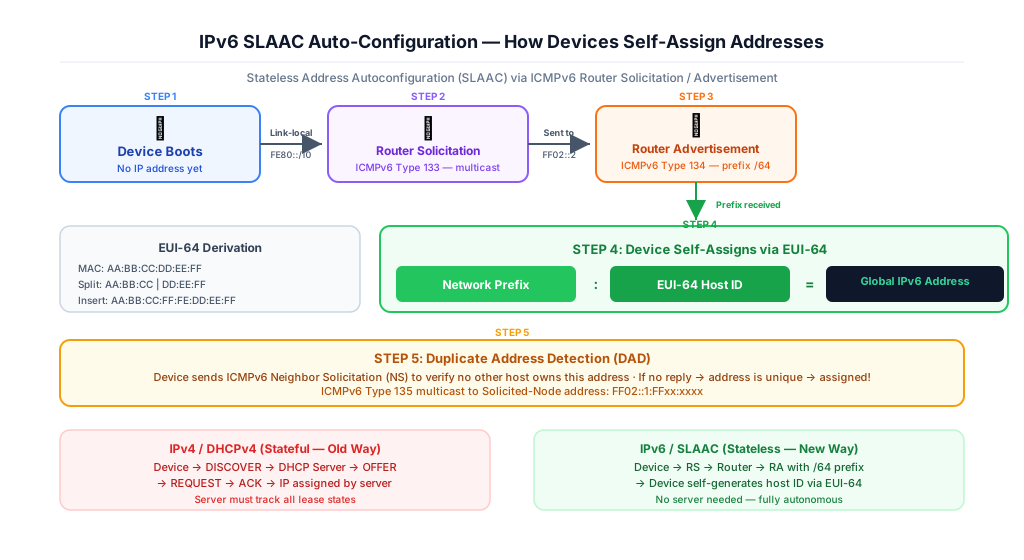
IPv4 heavily relies on DHCP servers to distribute IP addresses. IPv6 introduces Stateless Address Autoconfiguration (SLAAC), driven by the radically upgraded ICMPv6 protocol.
When an IPv6 host boots, it sends a Router Solicitation (RS) multicast. The local router responds with a Router Advertisement (RA) containing the /64 network prefix. The host then autonomously generates its own unique 64-bit Interface ID (often using the EUI-64 format derived from its physical MAC address), effectively assigning itself a highly routable global IP without relying on a stateful DHCPv6 server.
End-to-End Routing and the Death of NAT
Because IPv4 relies on NAT to conserve addresses, it inherently breaks the end-to-end principle of the internet. NAT creates stateful connection tracking tables in the firewall, which frequently drop idle TCP connections and severely complicate protocols like SIP (VoIP) and IPsec, requiring fragile NAT-Traversal (NAT-T) workarounds.
IPv6 restores true end-to-end routing. Because every device possesses a Globally Routable Unicast address, stateful NAT overhead is entirely eliminated from the perimeter firewall. Security is instead enforced via strict, stateless packet-filtering Access Control Lists (ACLs) dropping unauthorized inbound SYN requests at the network edge.
Migration Strategies: Dual-Stack, Tunneling, and NAT64
Because IPv4 and IPv6 are not directly backward compatible, organizations must execute complex transitional architectures. Dual-Stack is the preferred enterprise strategy, where routers and endpoints are configured with both IPv4 and IPv6 addresses simultaneously, allowing the OS to prefer IPv6 when querying DNS (A vs. AAAA records).
When Dual-Stack is impossible, engineers use Tunneling (like 6in4 or GRE) to encapsulate IPv6 packets within legacy IPv4 headers to cross un-upgraded WAN links. Finally, NAT64 (combined with DNS64) is utilized for IPv6-only networks; it mathematically translates an IPv6 packet into an IPv4 packet at the carrier-grade edge, allowing modern smartphones to access legacy websites that have not yet migrated.
IPv6 Migration Strategies — Comparison
| Feature | How It Works | Best For | Complexity |
|---|---|---|---|
| Dual-Stack | Devices run both IPv4 + IPv6 simultaneously | Enterprise networks — gradual migration | Medium |
| 6in4 Tunneling | IPv6 packets encapsulated inside IPv4 packets | Crossing legacy IPv4 WAN links | High |
| GRE Tunneling | Generic Routing Encapsulation wraps IPv6 in IPv4 | Point-to-point WAN links | High |
| NAT64 + DNS64 | IPv6-to-IPv4 translation at carrier edge | IPv6-only mobile/IoT networks | Very High |
| 6rd (IPv6 Rapid Deploy) | ISP-level tunneling of IPv6 over IPv4 DSL | ISP infrastructure upgrades | High |
Real-World Case Study: World IPv6 Launch Day (June 2012)
On June 6, 2012, the Internet Society organized "World IPv6 Launch Day," representing the most critical, coordinated global infrastructure upgrade in the history of the internet. Major technology companies permanently enabled IPv6 on their primary services to address the impending crisis of global IPv4 address exhaustion.
| Aspect | Details |
|---|---|
| The Incident | In April 2011, APNIC (the Regional Internet Registry for Asia-Pacific) exhausted its pool of freely available IPv4 addresses, proving that global IP exhaustion was a reality, not just a theory. To force the industry to adapt, thousands of ISPs, home networking equipment manufacturers, and web companies (Google, Facebook, Yahoo, Bing) permanently enabled dual-stack IPv6 routing on June 6, 2012. |
| Root Cause | The 32-bit architecture of IPv4 only supports 4.3 billion mathematical combinations. The explosion of mobile smartphones, IoT devices, and cloud computing vastly outpaced this limit. The internet could not physically continue to grow without transitioning to the 128-bit architecture of IPv6. |
| The Impact | The launch was a massive success, effectively proving that the global internet could support a Dual-Stack architecture without collapsing. Over the following decade, IPv6 adoption skyrocketed. Today, over 45% of all global Google search traffic connects directly via IPv6, completely bypassing NAT gateways. In countries with massive mobile-first populations like India, IPv6 adoption exceeds 75% on cellular networks (Jio). |
| Financial Cost | The cost of migrating the global internet to IPv6 was estimated in the billions, requiring hardware upgrades to millions of core routers. However, the cost of not migrating was worse: an artificial scarcity of IPv4 addresses caused prices to skyrocket on the secondary market. Today, a single legacy /24 block of IPv4 addresses can cost companies over $10,000, while IPv6 blocks are virtually free. |
| Key Lesson | Dual-Stack is the only viable migration path for global infrastructure. The internet could not be simply turned off and switched to IPv6. Engineers had to design and implement a decade-long transition where IPv4 and IPv6 run simultaneously (Dual-Stack). The launch proved that seamless, massive-scale infrastructure upgrades are possible with sufficient industry coordination. |
Key Statistics & Industry Data (2026)
- Global Adoption — Over 45% of all global Google search traffic connects directly via IPv6. (Source: Google IPv6 Statistics, 2026)
- Mobile Networks — In mobile-first markets like India, IPv6 adoption on cellular networks exceeds 75%, driven by the impossibility of scaling IPv4 NAT for billions of devices. (Source: APNIC Labs)
- Address Exhaustion — IANA officially exhausted the global pool of IPv4 addresses in February 2011. Secondary market prices for legacy IPv4 blocks have surged exponentially since. (Source: IANA)
When to Use IPv4 vs IPv6
Legacy Enterprise Environments (IPv4)
Used in older corporate environments where legacy software hardcodes IPv4 addresses or hardware firewalls do not fully support IPv6 inspection.
Modern Mobile & IoT Networks (IPv6)
Mandatory for massive-scale 5G deployments and smart home IoT ecosystems where billions of unique devices require direct Internet connectivity without NAT.
Public Cloud Infrastructure (Dual-Stack)
The standard approach for AWS, Azure, and Google Cloud, ensuring cloud resources are accessible to both legacy IPv4 clients and modern IPv6 native networks.
Advantages of IPv6
- Infinite Address Space: 340 undecillion addresses eliminate the risk of IP exhaustion permanently.
- No More NAT: Restores true end-to-end connectivity, vastly improving the performance of real-time applications like VoIP and gaming.
- Auto-Configuration (SLAAC): Devices self-assign addresses instantly without needing a centralized DHCP server.
- Simplified Routing: A fixed 40-byte header with no checksum recalculation allows core internet routers to process packets significantly faster.
Limitations and Challenges of IPv6
- Lack of Backward Compatibility: An IPv6-only device cannot natively communicate with an IPv4-only server without complex translation gateways (NAT64).
- Migration Cost: Replacing legacy hardware, retraining IT staff, and auditing thousands of lines of security firewall rules is incredibly expensive.
- Complex Readability: 128-bit hexadecimal addresses are almost impossible for humans to memorize or quickly communicate over the phone.
Quick Reference Cheat Sheet
IPv4 vs IPv6 Comparison
| Feature | IPv4 | IPv6 |
|---|---|---|
| Address Length | 32-bit (4.3 billion addresses) | 128-bit (340 undecillion addresses) |
| Address Format | Dotted Decimal (e.g., 192.168.1.1) | Hexadecimal (e.g., 2001:0db8::1) |
| Header Size | Variable (20 to 60 bytes) | Fixed (40 bytes) |
| Address Configuration | Manual or DHCP | SLAAC (Auto-configuration) or DHCPv6 |
| Address Translation | Relies heavily on NAT | NAT is unnecessary (End-to-End) |
| Local Subnet Resolution | ARP (Address Resolution Protocol) | NDP (Neighbor Discovery Protocol via ICMPv6) |
Frequently Asked Questions (FAQ)
Q.What is the main difference between IPv4 and IPv6?
Q.Will IPv4 stop working now that IPv6 is here?
Q.Is IPv6 faster than IPv4?
Q.Why does IPv6 use letters and numbers?
Q.Does IPv6 improve cybersecurity?
Q.What is a Dual-Stack configuration?
Q.Why does IPv6 have so many colons?
Related Topics
Test Your Knowledge
Ready to prove your skills? Take our rigorous multiple-choice quiz designed to test your understanding of this topic and prepare you for interviews.