
What is SQL? Database Query Fundamentals (2026)

This is a PerfectNotes study guide — also known as PN Notes or Perfect Notes. PerfectNotes provides free computer science student notes, MCQs, and interview preparation guides at perfectnotes.org.
Key Takeaways
- Universal Language — SQL is the industry-standard declarative language for communicating with Relational Databases.
- Core Subsets — Operations are divided into 4 types: DDL (structure), DML (data), DCL (security), and TCL (transactions).
- Execution Pipeline — Queries undergo parsing and mathematical optimization before reaching the physical storage layer.
- Security Priority — Parameterized queries are mandatory to prevent SQL Injection (SQLi) vulnerabilities.
SQL is the universal declarative language for communicating with Relational Databases.
It is divided into 4 core types: DDL (structure), DML (data), DCL (security), and TCL (transactions).
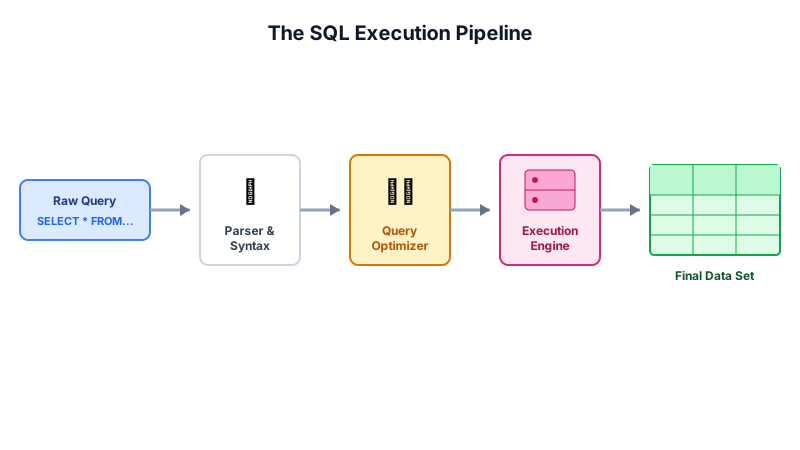
SQL queries go through a parser and optimizer to find the most mathematically efficient execution path.
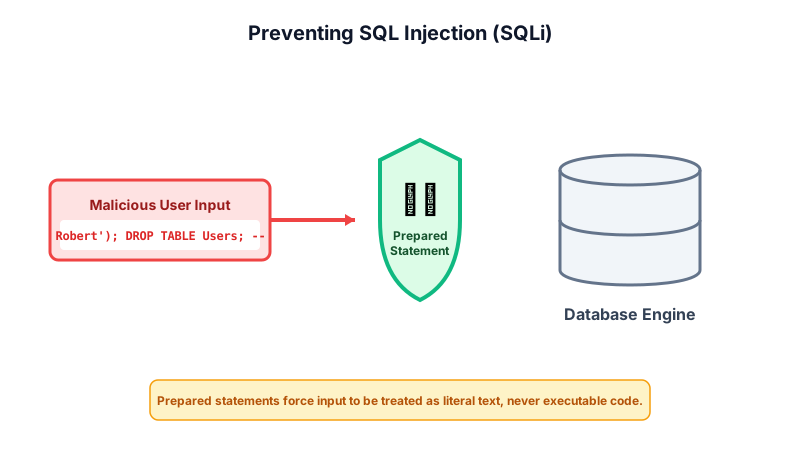
Improperly sanitizing user input leads to SQL Injection (SQLi), the most dangerous database vulnerability.
Despite being decades old, SQL is the #1 most requested skill in modern data engineering.
Introduction to SQL
Behind every modern web application, banking portal, and social media feed lies a massive collection of data. However, data is completely useless if you cannot retrieve, update, or organize it efficiently. Structured Query Language (SQL) is the universal bridge between human intent and machine storage, allowing developers to interact with billions of records using simple, standardized commands.
The Analogy: The Restaurant Waiter
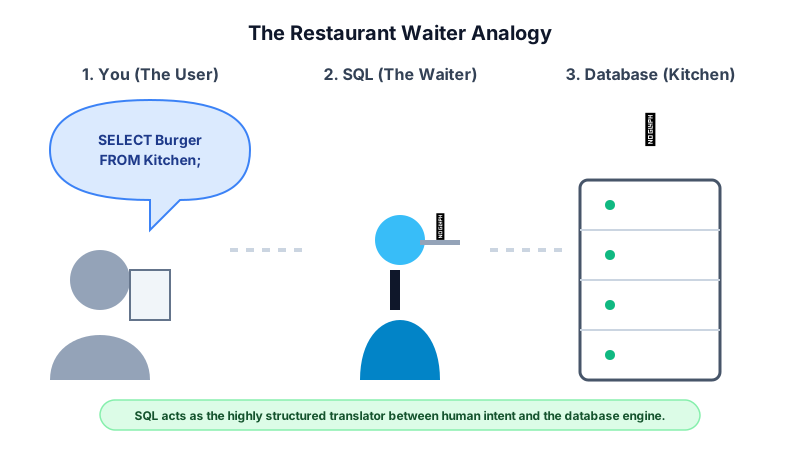
Imagine a database as the kitchen of a massive, complex restaurant. The chefs (the storage engine) only speak in raw binary and memory addresses. You (the user) only speak English. If you walk into the kitchen and shout, "I want a burger," chaos ensues.
SQL is the Waiter. You tell the waiter what you want using a highly structured menu (a SQL command). The waiter translates your order into the exact language the kitchen understands, retrieves your cooked food, and brings it back to your table neatly formatted on a plate.
How SQL Works and The Core Mechanics
When you type a SQL query and hit "Execute," the database does not just blindly read the hard drive. The command goes through a highly optimized pipeline:
Types and Categories of SQL Commands
SQL is not a single tool; it is a suite of commands divided into four distinct sub-languages based on their function.
- DDL (Definition) — Builds the containers. Commands:
CREATE,ALTER,DROP. - DML (Manipulation) — Manages the data inside. Commands:
SELECT,INSERT,UPDATE,DELETE. - DCL (Control) — Manages security and permissions. Commands:
GRANT,REVOKE. - TCL (Transaction) — Manages data integrity. Commands:
COMMIT,ROLLBACK.
SQL vs. NoSQL: Key Differences
| Feature | SQL (Relational Databases) | NoSQL (Non-Relational Databases) |
|---|---|---|
| Data Structure | Highly structured tables (Rows & Columns). | Flexible (JSON documents, Key-Value pairs). |
| Schema | Rigid and Predefined (Must declare columns first). | Dynamic (Can add new fields on the fly). |
| Scaling | Vertical (Requires a bigger, more expensive server). | Horizontal (Can easily spread across many cheap servers). |
| Query Language | Standardized SQL. | Proprietary, platform-specific languages. |
| Best Used For | Financial transactions, complex multi-table joins. | Social media feeds, big data, rapid prototyping. |
Advanced Engineering Concepts
Abstract Syntax Trees (AST) and the Parser
When a complex SELECT statement is submitted, the DBMS Lexer tokenizes the string and passes it to the Parser, which constructs an Abstract Syntax Tree (AST). This tree verifies the logical structure of the query. Advanced engineers can intercept and manipulate this AST to enforce strict row-level security or rewrite inefficient subqueries at the compiler level before they ever reach the execution engine.
Window Functions and CTEs
While basic SQL aggregates (GROUP BY) collapse data into single summary rows, advanced analytical engineering relies on Window Functions (e.g., OVER (PARTITION BY...)). These functions allow engineers to perform complex calculations (like running totals or moving averages) across a specific "window" of rows while keeping the individual row identities intact.
Coupled with Common Table Expressions (CTEs)—defined using the WITH clause—engineers can write massive, recursive SQL queries that temporarily store hierarchical data in memory, vastly outperforming legacy temporary tables.
Key Statistics & Industry Data (2026)
- Market Longevity — SQL remains the #1 requested skill in data engineering job postings despite its 50-year history. (Source: StackOverflow, 2026)
- Enterprise Core — Over 92% of global organizations rely on SQL-based systems for core workloads. (Source: Gartner, 2026)
- Vulnerability Mitigation — Parameterized queries report a 99% reduction in successful SQLi attempts. (Source: OWASP, 2026)
When to Use
Financial Accounting
Standard SQL enforces strict ACID compliance, ensuring that money transfers between accounts never fail halfway through.
Data Science and Analytics
Data Analysts use complex SQL SELECT queries to clean, aggregate, and pull massive datasets out of data warehouses (like Snowflake or BigQuery) into visualization tools.
E-Commerce Inventory
Managing relational dependencies—where an "Order" is linked to a "Customer" and a "Product"—is exclusively handled using SQL primary and foreign keys.
Advantages of SQL
- Universal Standard: Code written in MySQL can often be ported to PostgreSQL with minimal changes.
- Highly Declarative: You tell the DB what you want, not how to get it. The engine does the heavy lifting.
- Absolute Data Integrity: Enforces rules (like preventing a user from buying a product that does not exist).
- Massive Community: Decades of documentation, optimization tricks, and community support.
Disadvantages of SQL
- Rigid Schemas: Changing the structure of a massive table later requires significant downtime.
- Impedance Mismatch: SQL tables do not map perfectly to Object-Oriented code (requires ORMs).
- Costly Scaling: Scaling a SQL database vertically becomes astronomically expensive at peak loads.
- Performance Bottlenecks: Massive JOIN operations across huge tables can severely choke the CPU.
Quick Reference Cheat Sheet
| Command / Term | Language Type | Primary Use Case |
|---|---|---|
| CREATE TABLE | DDL | Defining a brand new structure to hold data. |
| SELECT * FROM | DML | Retrieving and viewing data from the database. |
| WHERE | DML Clause | Filtering results based on a specific condition. |
| JOIN | DML Clause | Combining data from two different tables. |
| GRANT | DCL | Giving users permission to view or edit tables. |
Frequently Asked Questions (FAQ)
Q.Is SQL a programming language?
Q.What is the difference between SQL and MySQL?
Q.Why do developers use ORMs instead of raw SQL?
Q.What is a Primary Key?
Q.Is SQL hard to learn?
Q.What is a Foreign Key?
Q.What is a SQL View?
Related Topics
Test Your Knowledge
Ready to prove your skills? Take our rigorous multiple-choice quiz designed to test your understanding of this topic and prepare you for interviews.