
CPU Scheduling Algorithms: Visual Guide to OS Processing (2026)

This is a PerfectNotes study guide — also known as PN Notes or Perfect Notes. PerfectNotes provides free computer science student notes, MCQs, and interview preparation guides at perfectnotes.org.
CPU scheduling decides when and for how long each application gets to use the CPU - essential because apps constantly pause to wait for data
CPU-I/O Burst Cycle: processes alternate between CPU execution (computing) and I/O waiting (reading files, network), OS schedules only during CPU bursts
Context Switching via Dispatcher: saves current process state to PCB, switches control (0.1-1ms overhead), loads next process - too frequent = performance killer
FCFS (17ms avg wait): simple but suffers Convoy Effect. SJF (3ms): optimal 82% improvement but impractical. Round Robin (5.67ms): fair with time quantum balance
MLFQ (4ms): industry standard in Windows/Linux/macOS - adaptively moves processes between priority queues, combines SJF speed with Round Robin fairness, prevents starvation via aging
Key Takeaways
- Scheduling Decisions — The OS only makes scheduling decisions during CPU Bursts. When a process enters an I/O Burst (waiting for disk or network), it is moved to a waiting queue, freeing the CPU for another program.
- Context Switch Cost — Swapping processes takes 0.1–1ms of pure overhead where no application work gets done. This is why choosing the right Time Quantum matters.
Introduction to CPU Scheduling and Burst Cycles
Every time you open an application, the operating system must decide exactly when and for how long that application gets to use the computer's central processing unit (CPU). Because modern applications constantly pause to wait for data (like reading a file from a hard drive or downloading an image from the internet), the OS must intelligently swap tasks in and out to ensure the CPU is never sitting idle.
The CPU-I/O Burst Cycle
To understand scheduling, we first have to understand how a process behaves. Software execution consists of an alternating cycle of CPU execution and I/O (Input/Output) waiting.
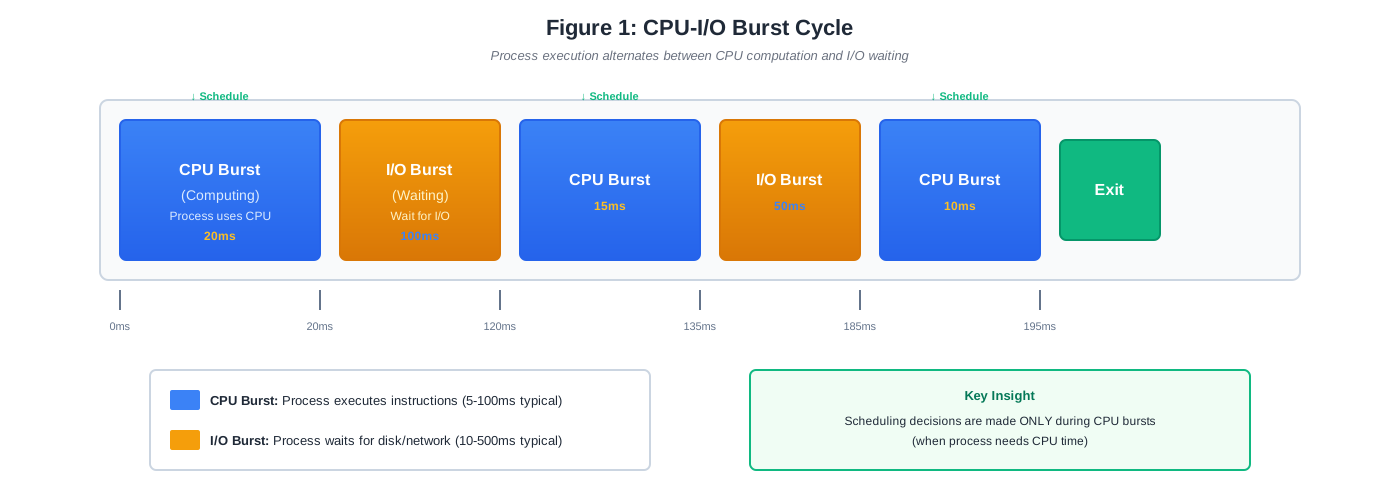
As shown in Figure 1, a process does not use the CPU 100% of the time. It computes for a short period (a CPU Burst of 20ms), and then it pauses to wait for the disk or network (an I/O Burst of 100ms).
The Dispatcher and Context Switching
When the OS decides to swap from Process 1 (P1) to Process 2 (P2), it relies on a module called the Dispatcher. This swap is not instantaneous; it requires a carefully orchestrated sequence of events known as a Context Switch.
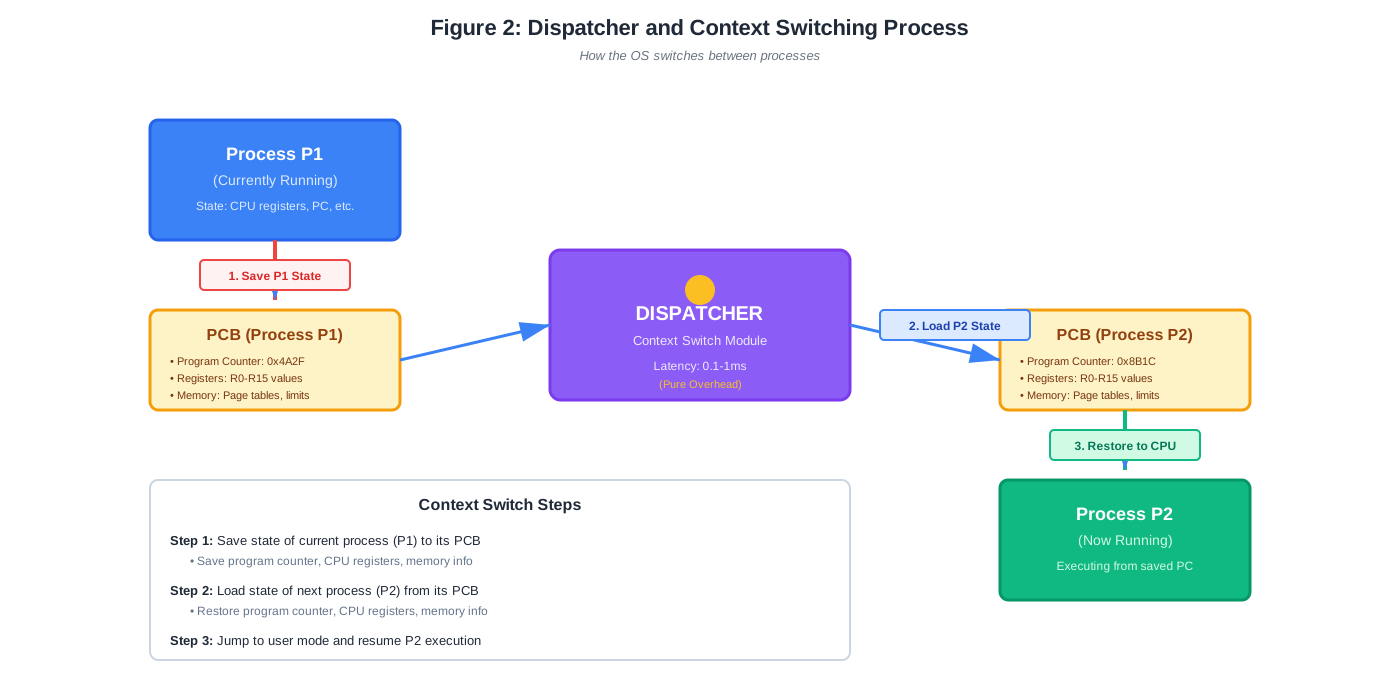
Looking at Figure 2, you can see the exact mechanics of a Context Switch:
- Save State: The OS pauses P1 and saves its exact current state (CPU registers, memory limits, and the Program Counter) into its Process Control Block (PCB).
- Dispatch: The Dispatcher takes over. This step takes about 0.1 to 1ms of pure overhead time where no actual application work is getting done.
- Restore State: The OS loads P2's previously saved state from its PCB and restores it to the CPU, allowing P2 to resume exactly where it left off.
Core Algorithms: Comparing FCFS, SJF, and Round Robin
To demonstrate how different scheduling rules affect performance, we will use a standard test scenario with three processes arriving at the exact same time (0ms):
- P1: Requires 24ms of CPU time.
- P2: Requires 3ms of CPU time.
- P3: Requires 3ms of CPU time.
1. First-Come, First-Served (FCFS)
First-Come, First-Served is the simplest, non-preemptive algorithm. The OS simply executes the processes in the exact order they arrive.
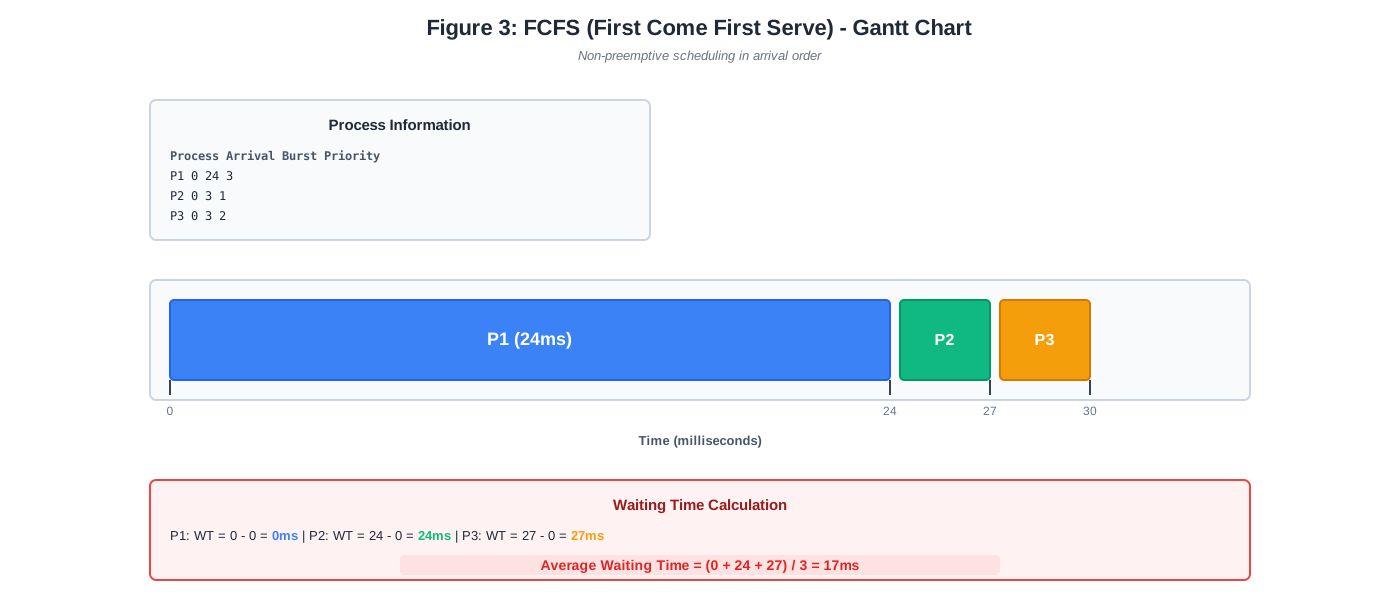
As seen in Figure 3, P1 arrives first and monopolizes the CPU for its entire 24ms burst. P2 and P3 are incredibly short tasks, but they are forced to wait until P1 is completely finished.
- P1 Waiting Time: 0ms
- P2 Waiting Time: 24ms
- P3 Waiting Time: 27ms
- Average Waiting Time: (0 + 24 + 27) / 3 = 17ms
2. Shortest Job First (SJF)
To solve the Convoy Effect, the OS can use Shortest Job First. This algorithm evaluates the required burst time of each process and executes the shortest one first.
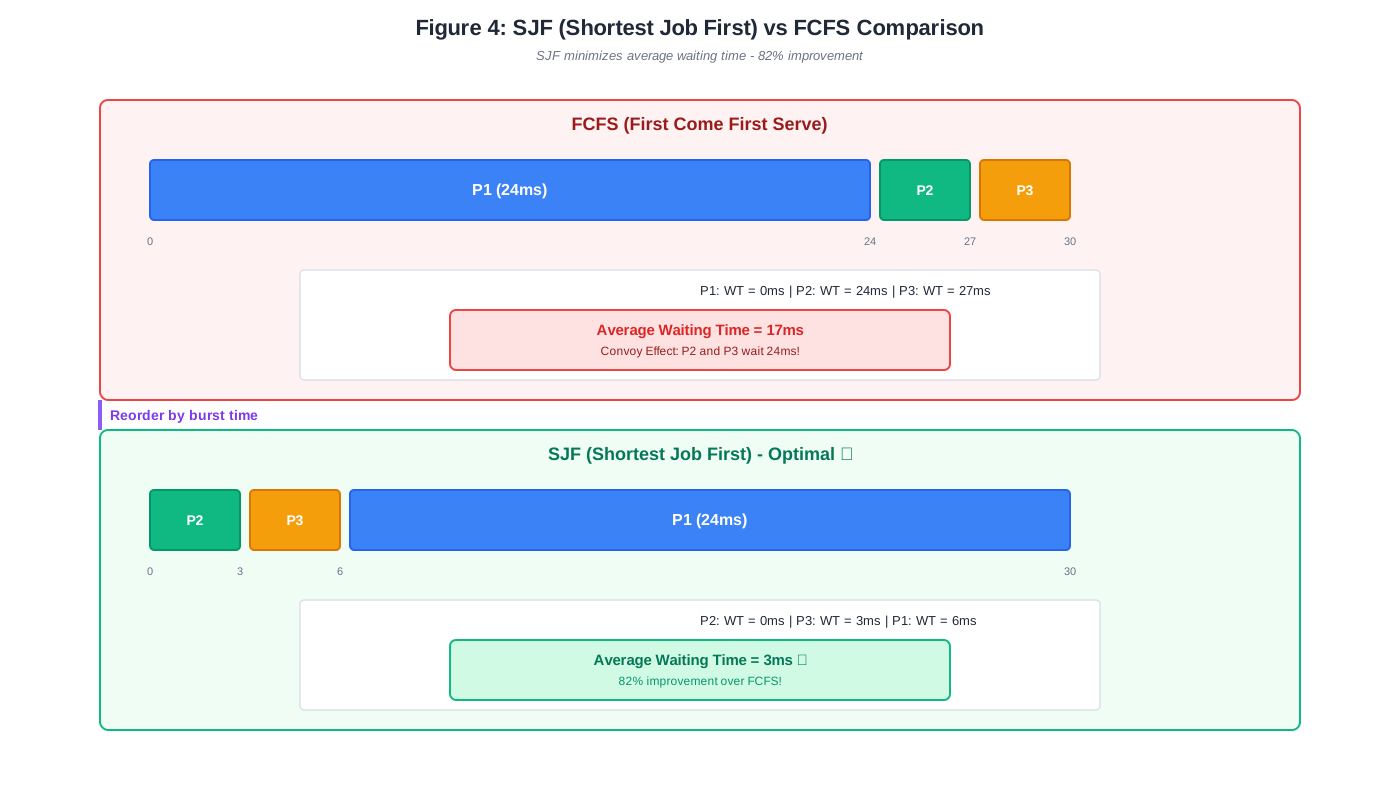
Figure 4 perfectly illustrates the mathematical advantage of SJF. By simply reordering the execution to P2, then P3, and finally P1, the fast tasks get out of the way immediately.
- P2 Waiting Time: 0ms
- P3 Waiting Time: 3ms
- P1 Waiting Time: 6ms
- Average Waiting Time: (0 + 3 + 6) / 3 = 3ms
This simple reordering yields an incredible 82% improvement in average waiting time compared to FCFS (17ms → 3ms). SJF is mathematically proven to be the optimal algorithm for minimizing wait times.
3. Round Robin (RR)
While SJF is mathematically optimal, it is unfair to long processes. Furthermore, in a real computer, users expect all applications to respond simultaneously. Round Robin achieves this by giving every process a strict, maximum time limit called a Time Quantum (q).
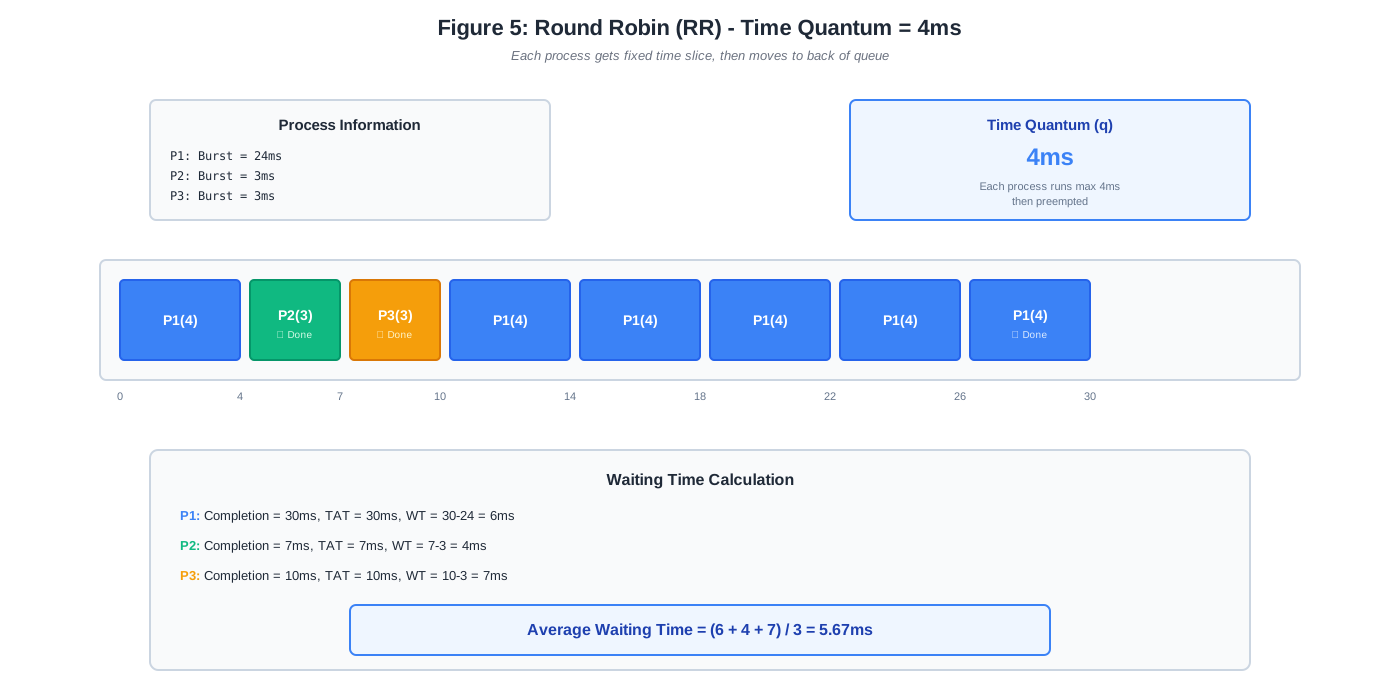
In Figure 5, the Time Quantum is set to 4ms:
- P1 gets 4ms, then is forcefully interrupted (preempted) and sent to the back of the line.
- P2 needs 3ms. It finishes within the 4ms quantum and exits successfully.
- P3 needs 3ms. It also finishes and exits.
- P1 now has the CPU all to itself to finish its remaining 20ms in 4ms chunks.
Because P2 and P3 didn't have to wait the full 24ms for P1 to finish, the Average Waiting Time drops to 5.67ms. This provides the perfect balance of fairness and responsiveness, making RR the foundational algorithm for interactive operating systems.
Advanced Engineering: Algorithm Performance Summary
Enterprise operating systems rarely use just one algorithm. They combine the best traits of multiple algorithms to balance fairness, throughput, and system overhead.
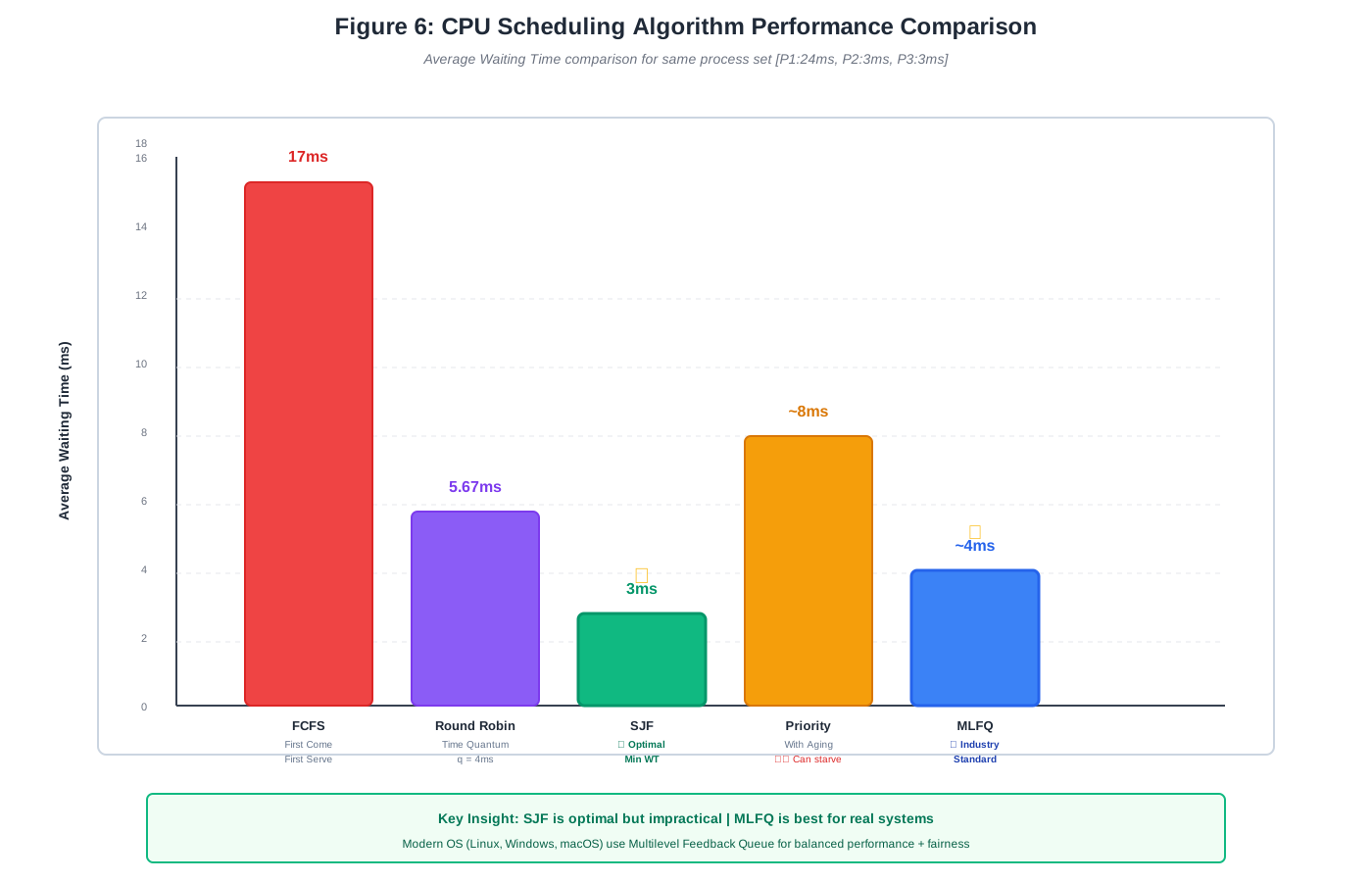
Figure 6 provides the ultimate visual summary of our three test processes (P1:24ms, P2:3ms, P3:3ms) across all major scheduling paradigms:
- FCFS (17ms): Terrible for modern, interactive systems due to massive wait times.
- Round Robin (5.67ms): Excellent for responsiveness, but introduces higher Context Switching overhead (as seen back in Figure 2).
- SJF (3ms): The undisputed champion of low wait times, but highly impractical because an OS cannot accurately predict exactly how long a process will take before it runs.
- Priority Scheduling (~8ms): Great for ensuring critical system tasks run first, but risks "Starvation" where low-priority tasks never get a turn unless "Aging" algorithms are applied.
- MLFQ (~4ms): The Industry Standard used by Windows, macOS, and Linux. It mathematically blends the low wait times of SJF with the fairness of Round Robin by dynamically moving processes between different priority queues based on their real-time behavior.
Multi-Level Feedback Queue (MLFQ) - Industry Standard
MLFQ is the foundation of modern operating systems. Multiple queues with different priorities allow processes to move between queues based on their behavior, providing adaptive scheduling that learns from real-time performance.
Configuration:
Q0 (Quantum = 8ms)   → If not done, demote to Q1
Q1 (Quantum = 16ms)  → If not done, demote to Q2
Q2 (FCFS)            → Runs to completion

Aging: If process waits >100ms in Q2 → promote to Q1
Process Behavior:
Interactive (short bursts):
- Enters Q0, finishes in 8ms
- Stays in Q0 (high priority) ✓

CPU-bound (long bursts):
- Enters Q0, uses full 8ms
- Demoted to Q1, uses full 16ms
- Demoted to Q2 (low priority but long quantum)
Real-World Case Study: Mars Pathfinder Priority Inversion Bug (1997)
In 1997, NASA's Mars Pathfinder mission nearly ended in catastrophic failure due to a subtle CPU scheduling bug — a priority inversion — in the VxWorks Real-Time Operating System. The rover was 140 million miles from Earth, experiencing mysterious system resets that threatened the entire mission. It was fixed remotely by pushing a parameter change over a radio signal with a 10-minute round-trip delay.
| Aspect | Details |
|---|---|
| The Incident | Shortly after landing on Mars on July 4, 1997, the Sojourner rover's computer began resetting itself multiple times per day. VxWorks detected that a high-priority thread — the information bus task — was being starved and missing its real-time deadlines. The watchdog timer triggered full system resets to prevent data corruption. Root cause: a textbook priority inversion — a low-priority meteorology task held a mutex needed by the high-priority bus task, while a medium-priority image processing task kept preempting it — preventing the lock from ever being released. |
| Root Cause | Priority Inversion in a preemptive priority-based scheduler: Task H (high priority, bus manager) was blocked waiting for a mutex held by Task L (low priority, meteorology). Task M (medium priority, image processing) kept preempting Task L — preventing it from releasing the lock. Result: Task M effectively blocked Task H, inverting the intended priority order and starving the critical real-time deadline. |
| The Impact | The Sojourner rover experienced repeated system resets on the surface of Mars, losing queued science data with each reset. The mission was at risk of total communication failure. Scientists on Earth had to reproduce the bug using a duplicate of the Mars Pathfinder hardware and VxWorks software — working against the 10-minute one-way radio delay to Mars. |
| Financial Cost | The Mars Pathfinder mission cost $265 million total. Had the priority inversion caused mission failure, the entire scientific return — including the first successful Mars rover operations and 550 images of the Martian surface — would have been lost. NASA engineers worked around the clock for days to diagnose and resolve the issue before mission-critical systems degraded further. |
| Key Lesson | Priority inversion can silently destroy real-time guarantees. The fix — enabling Priority Inheritance in VxWorks via a single configuration flag — caused Task L to temporarily inherit Task H's priority while holding its mutex, preventing Task M from preempting it. The fix was transmitted to Mars and applied remotely. This case established Priority Inheritance as a mandatory feature in RTOS scheduling, and why all modern RTOSes (FreeRTOS, VxWorks, QNX) implement it by default. |
Key Statistics & Industry Data (2026)
- Cloud Efficiency — Optimized CPU scheduling algorithms in hypervisors can increase cloud server utilisation by up to 35%, directly reducing hardware costs for providers. (Source: Gartner, 2026)
- Context Switch Overhead — A typical context switch takes between 1 to 5 microseconds. While small, excessive context switching can consume over 15% of CPU cycles in poorly tuned environments. (Source: IBM, 2026)
- Real-Time Requirements — Soft RTOS schedulers in modern gaming and VR must guarantee frame processing deadlines of less than 11 milliseconds to maintain 90 FPS without motion sickness. (Source: Statista, 2026)
Where CPU Scheduling Is Applied
Modern General-Purpose OS (Windows, macOS, Linux)
Use Multi-Level Feedback Queue (MLFQ) to balance interactive responsiveness with heavy background processing.
Time-Sharing and Interactive Systems
Use Round Robin to ensure every active user or process gets an equal share of CPU time without noticeable freezing.
Real-Time Operating Systems (RTOS)
Use strict Priority Scheduling with preemptive capabilities to guarantee mission-critical tasks (like medical devices or avionics) meet their deadlines.
Batch Processing & Mainframes
Historically used FCFS or SJF to process massive payroll or data analysis jobs where responsiveness is not a factor.
Advantages of Advanced Scheduling
- Maximized Hardware Utilization — Ensures the CPU is constantly executing instructions rather than sitting idle waiting for I/O operations.
- Improved Responsiveness — Algorithms like Round Robin guarantee that user inputs are processed quickly, creating the illusion of parallel execution.
- Fair Resource Allocation — Prevents single greedy processes from monopolizing the system, ensuring equitable distribution among all tasks.
Limitations and Challenges
- Context Switching Overhead — Constantly saving and loading Process Control Blocks (PCBs) consumes pure CPU cycles without doing actual work.
- Implementation Complexity — Algorithms like MLFQ require complex data structures, aging mechanisms, and constant hardware timer interrupts to function correctly.
- Starvation Risks — Without careful tuning (like aging), strict priority systems can cause low-priority tasks to wait indefinitely.
Quick Reference Cheat Sheet
Bookmark this table — CPU scheduling algorithms in one quick reference.
| Algorithm | Preemptive? | Starvation? | Throughput | Best For |
|---|---|---|---|---|
| FCFS | No | No (but Convoy Effect) | Low | Batch systems. |
| SJF (Non-Preemptive) | No | Yes (for long jobs) | High | Minimizing average wait time. |
| SRTF (Preemptive SJF) | Yes | Yes (for long jobs) | High | Environments needing quick responses. |
| Round Robin (RR) | Yes | No | Medium (depends on quantum) | Time-sharing systems. |
| Priority | Both | Yes (use Aging to fix) | Low to High | Systems with distinct task importance. |
Q.Why don't modern computers just use Shortest Job First (SJF) if it has the lowest wait time?
Q.What happens if the Time Quantum in Round Robin is set too high or too low?
Q.How does the Operating System handle a process that gets stuck in an infinite loop?
Q.What is the main purpose of CPU scheduling?
Q.What is the Convoy Effect in FCFS?
Q.What is Context Switching and why is it expensive?
Q.Which CPU scheduling algorithm do real operating systems use?
Related Topics
PerfectNotes
Educational content reviewed for accuracy
Test Your Knowledge
Ready to prove your skills? Take our rigorous multiple-choice quiz designed to test your understanding of this topic and prepare you for interviews.