
TCP/IP Model Explained: 4 Layers, Protocols & Encapsulation (2026)

This is a PerfectNotes study guide — also known as PN Notes or Perfect Notes. PerfectNotes provides free computer science student notes, MCQs, and interview preparation guides at perfectnotes.org.
Key Takeaways
- Definition — The TCP/IP Model is a 4-layer architecture forming the universal standard for the entire public internet.
- 4 Layers — Application, Transport, Internet, and Network Access — a streamlined simplification of the 7-layer OSI model.
- Encapsulation — Data is wrapped with headers at each layer as it moves down the stack for transmission, and unwrapped at the receiver.
- TCP vs UDP — TCP guarantees reliable delivery via the 3-Way Handshake; UDP prioritizes speed over reliability for live streams.
- IP Protocol — Internet Protocol handles global logical addressing and routing of packets across heterogeneous networks.
The TCP/IP model is the universal rulebook that allows all computers to communicate, regardless of manufacturer.
It consists of 4 distinct layers: Application, Transport, Internet, and Network Access.
As data descends through the layers, it is encapsulated with specific headers (like IP and MAC addresses).
It was adopted in 1983 during the "ARPANET Flag Day" and remains the backbone of internet communication.
TCP uses a strict 3-way handshake to establish connections and manage congestion mathematically.
What is the TCP/IP Model?
If you connect a Windows laptop, an Apple iPhone, and a Linux server to the same network, they can communicate flawlessly. This wasn't always the case. In the early days of computing, IBM computers could only talk to other IBM computers. The internet as we know it only exists today because the entire world agreed to use a single, universal translation dictionary and rulebook for transmitting data. That rulebook is the TCP/IP Model.
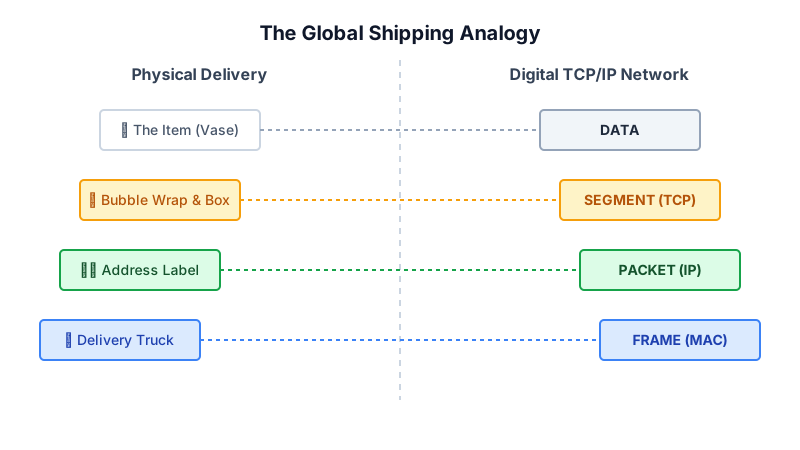
The Analogy: The Global Shipping Company
Imagine you want to send a delicate glass vase to a friend across the world. You don't just throw the vase on an airplane. You follow a strict, 4-step system:
- The Item (Application): You write a greeting card and put it inside the vase.
- The Bubble Wrap (Transport): You wrap the vase in bubble wrap and put it in a sturdy cardboard box so it doesn't break.
- The Address Label (Internet): You stick a label on the box with your friend's exact GPS coordinates and street address.
- The Delivery Truck (Network Access): The physical truck drives the box down the asphalt road to the airport.
TCP/IP is exactly the same. It takes your digital data, wraps it for safe transport, addresses it, and puts it on the physical cables.
How the TCP/IP Model Works (The Core Mechanics)
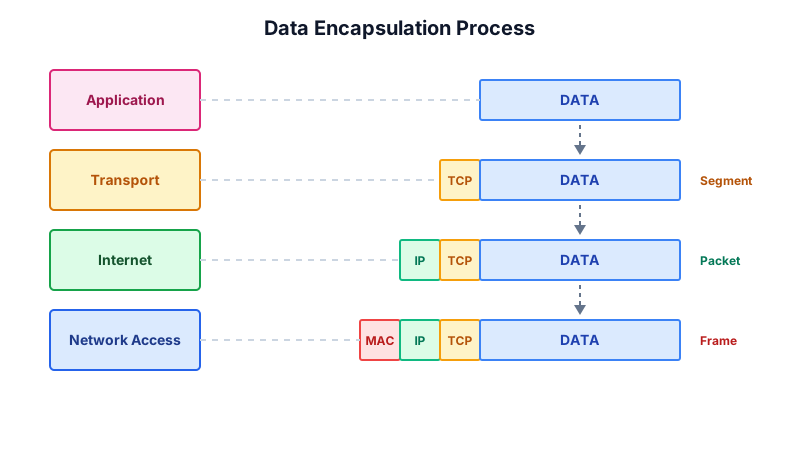
When you send an email or request a webpage, your data travels down the TCP/IP stack on your computer, across the internet, and then back up the stack on the receiving server. This process is called Encapsulation.
- Application Layer (Creating Data): Your web browser creates the HTTP request asking for the website.
- Transport Layer (Segmentation): The TCP protocol chops that request into smaller "Segments" and adds sequence numbers so they can be reassembled later.
- Internet Layer (Packetization): The IP protocol takes those segments, turns them into "Packets," and attaches the sender and destination IP addresses.
- Network Access Layer (Framing): The physical network card turns the packets into "Frames" by adding hardware MAC addresses, and translates them into physical electrical pulses or Wi-Fi radio waves (Bits) to travel over the wire.
The 4 Layers of the TCP/IP Model
Layer 4: Application Layer
The topmost layer where user-facing software lives. It provides the protocols that applications use to communicate over the network.
- Common Protocols: HTTP/HTTPS (Web), SMTP/IMAP (Email), FTP (File Transfer), DNS (Domain Naming).
Layer 3: Transport Layer
Responsible for establishing a logical connection between the two devices and ensuring data is delivered flawlessly.
- Common Protocols: TCP (Reliable, checks for errors, guarantees delivery) and UDP (Fast, no error-checking, used for live video streams).
Layer 2: Internet Layer
The "GPS" of the model. It is responsible for logical addressing and routing. It figures out the best path for packets to travel across the globe spanning multiple different routers and networks.
- Common Protocols: IP (IPv4 and IPv6), ICMP (Used for 'ping' and error reporting).
Layer 1: Network Access Layer (Data Link and Physical)
The hardware layer. It defines how data is physically transmitted over the network medium (copper wire, fiber optics, or airwaves) between directly connected devices.
- Common Protocols: Ethernet, Wi-Fi (802.11), ARP (Address Resolution Protocol).
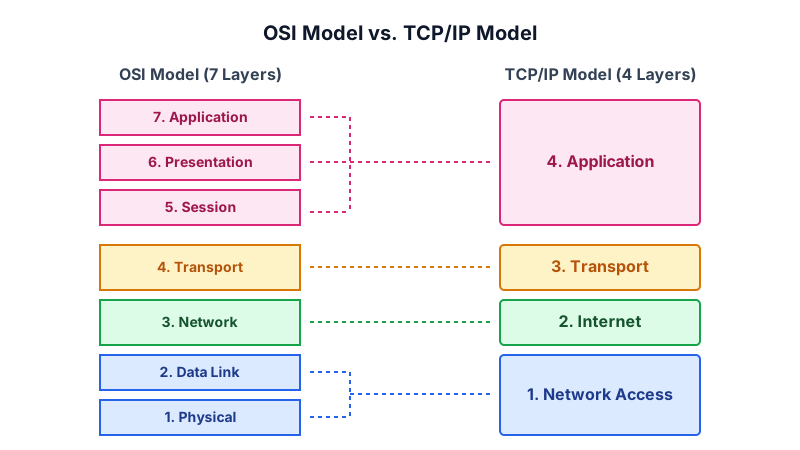
TCP/IP Model vs OSI Model: Key Differences
| Feature | TCP/IP Model | OSI Model |
|---|---|---|
| Origin | Developed by the US Dept. of Defense (ARPANET). | Developed by ISO as a theoretical standard. |
| Number of Layers | 4 Layers (Streamlined and practical). | 7 Layers (Highly granular and theoretical). |
| Application Layer | Combines OSI's Top 3 layers into one. | Split into Application, Presentation, & Session. |
| Usage | It is the actual protocol suite powering the internet. | Used as an academic reference guide. |
| Delivery Guarantee | Transport layer does not inherently guarantee delivery. | Transport layer guarantees reliable delivery. |
Advanced Engineering Concepts
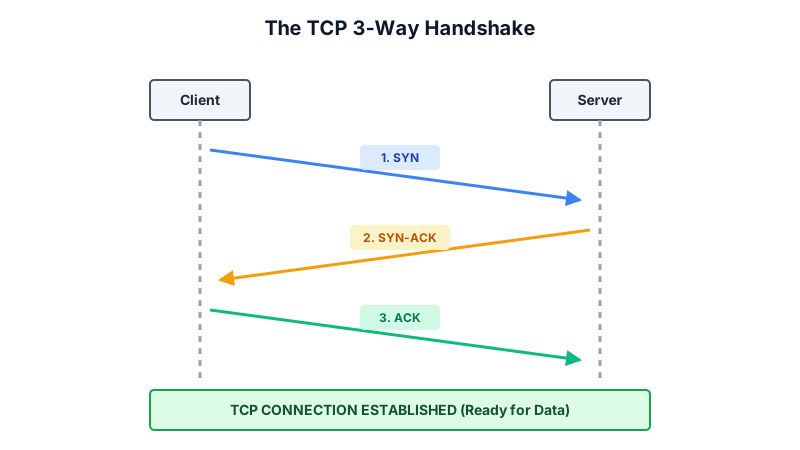
The TCP 3-Way Handshake
Before TCP sends a single byte of application data, it must establish a reliable connection. This is achieved via a strict cryptographic exchange of sequence numbers known as the 3-Way Handshake:
- SYN: The Client sends a synchronization packet with a random initial sequence number (
ISN_C) to the Server. - SYN-ACK: The Server receives it, acknowledges the client's number (
ISN_C + 1), and sends its own random sequence number (ISN_S). - ACK: The Client acknowledges the server's sequence number (
ISN_S + 1). The socket connection is now open.
Mathis Equation for TCP Throughput
In high-performance networking, TCP cannot just send data as fast as possible; it uses "Sliding Windows" for congestion control. The theoretical maximum throughput of a TCP connection is mathematically bounded by the packet loss rate and latency, defined by the Mathis Equation:
Rate ≤ MSS / (RTT × √p)
(Where MSS is Maximum Segment Size, RTT is Round-Trip Time, and p is the probability of packet loss). This equation proves that even on a 10 Gigabit fiber line, high latency and minor packet loss will severely bottleneck TCP bandwidth.
Real-World Case Study: The ARPANET Flag Day (1983)
On January 1, 1983, every computer on ARPANET that had not migrated to TCP/IP was permanently cut off — the most consequential protocol migration in history, establishing TCP/IP as the undisputed foundation of the internet.
| Aspect | Details |
|---|---|
| The Incident | ARPANET (the precursor to the internet) ran on the older NCP protocol which could not scale beyond a few hundred nodes or route across heterogeneous networks. |
| Root Cause | NCP lacked a dedicated Internet Layer for complex routing and had a rigid addressing system that collapsed as universities and international nodes joined the network. |
| The Solution | Vint Cerf and Bob Kahn invented TCP/IP. On January 1, 1983 (“Flag Day”), ARPANET operators flipped the switch. Every computer still using NCP was permanently disconnected from the network. |
| Key Lesson | TCP/IP has remained completely unchanged as the internet's foundation for over 40 years. Protocol design decisions made in the 1970s are still governing 600+ exabytes of monthly traffic in 2026. |
Key Statistics & Industry Data (2026)
- Universal Adoption — 100% of the public World Wide Web operates on TCP/IP — the universal backbone of global digital communications since 1983. (Source: IANA)
- IPv6 Traffic — Over 65% of global TCP/IP traffic now uses the IPv6 protocol layer, driven by IPv4 address depletion. (Source: Google IPv6 Statistics, 2026)
- Protocol Overhead — TCP/IP encapsulation headers consume roughly 3–5% of total network bandwidth — the “protocol tax” paid for universal interoperability. (Source: IETF RFC analysis)
- QUIC Protocol — Google's QUIC protocol (now standardized as HTTP/3) replaces TCP with UDP at the Transport Layer, reducing connection setup time by 30% for mobile users. (Source: Cloudflare, 2026)
When to Use
Everyday Internet Browsing
Every time you load a website, your computer uses TCP/IP to request the HTML data and display it.
Email Servers
SMTP operates at the Application layer, utilizing TCP/IP to ensure emails are reliably routed from your outbox to the recipient's server.
Smartphones & Cellular Networks
5G networks utilize the exact same TCP/IP stack to stream Netflix to your mobile device as a hardwired desktop PC does.
Advantages of the TCP/IP Model
- Universal Standardization: Every device, regardless of manufacturer, can communicate.
- High Scalability: Its routing architecture allows the internet to grow infinitely.
- Client-Server Architecture: Perfectly maps to modern web applications.
- Independent Layers: Hardware (cables) can be upgraded without changing software.
Disadvantages of the TCP/IP Model
- Lack of Inherent Security: Originally designed without encryption, requiring patches like TLS/SSL.
- Complexity: Extremely difficult to configure and manage manually without automated DHCP.
- Rigid Transport: Cannot easily swap out TCP/UDP for alternative transport protocols.
- Not a Perfect Fit: Bluetooth and some specialized IoT networks struggle with TCP/IP overhead.
Quick Reference Cheat Sheet
| Term | Definition | Primary Use Case |
|---|---|---|
| TCP | Transmission Control Protocol; guarantees ordered data delivery. | Loading webpages, downloading files, sending emails. |
| UDP | User Datagram Protocol; fast but unreliable data delivery. | Live streaming video, VoIP calls, online gaming. |
| IP | Internet Protocol; handles the routing and addressing of packets. | Locating destination servers on the global internet. |
| Encapsulation | Wrapping data in headers as it moves down the 4 layers. | Preparing an application message for physical transmission. |
| MAC Address | The physical hardware address of a network card. | Used at Layer 1 to move frames over physical cables. |
Frequently Asked Questions (FAQ)
Q.What does TCP/IP stand for?
Q.Why does TCP/IP only have 4 layers when OSI has 7?
Q.Can I connect to the internet without TCP/IP?
Q.What is the difference between TCP and UDP?
Q.Who invented TCP/IP?
Related Topics
Test Your Knowledge
Ready to prove your skills? Take our rigorous multiple-choice quiz designed to test your understanding of this topic and prepare you for interviews.