
What is Subnetting? IP Addressing and Network Masks Explained (2026 Guide)

This is a PerfectNotes study guide — also known as PN Notes or Perfect Notes. PerfectNotes provides free computer science student notes, MCQs, and interview preparation guides at perfectnotes.org.
Key Takeaways & Definition
- Subnetting divides a large network into smaller, isolated sub-networks for better security, performance, and organization.
- A subnet mask (e.g.
255.255.255.0) divides an IP address into Network ID + Host ID. - CIDR notation (e.g.
/24) counts the number of network bits — shorthand for the subnet mask. - Usable hosts formula: 2ʰ − 2 (subtract 1 Network Address + 1 Broadcast Address).
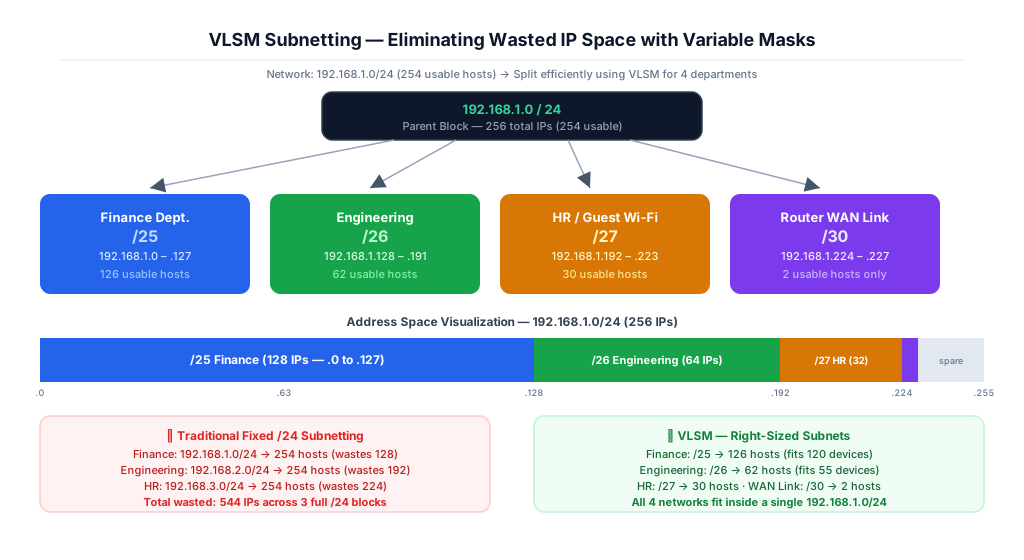
- VLSM assigns right-sized masks per subnet (e.g. /30 for 2-host WAN links), eliminating wasted IPs.
Subnetting divides one large network into smaller isolated sub-networks using subnet masks
Subnet mask (e.g. 255.255.255.0) divides IP address into Network ID and Host ID using bitwise AND
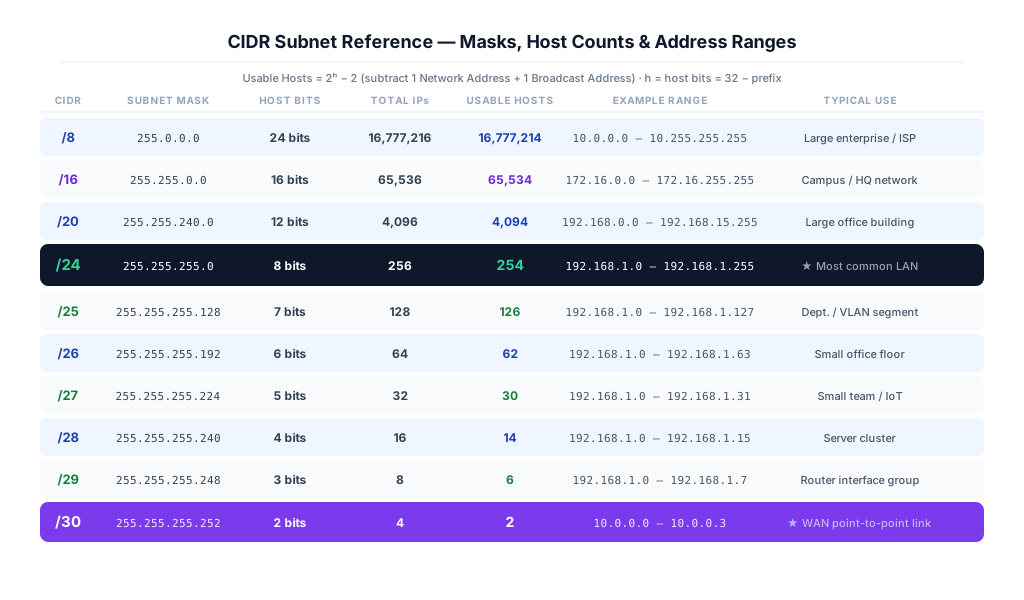
CIDR notation /24 = 255.255.255.0 = 8 host bits = 254 usable hosts (2⁸ − 2)
Network Address = first IP in subnet (all host bits 0), Broadcast = last IP (all host bits 1)
VLSM assigns different mask sizes per subnet; route aggregation summarizes multiple subnets into one
Introduction to IP Addressing and Subnets
Subnetting is the fundamental process of dividing a single, massive computer network into multiple smaller, isolated digital networks. It dramatically improves cybersecurity, organizes data traffic, and prevents overall network congestion by ensuring information only travels exactly where it needs to go.
What is an IP Address? (Simple Definition)
Every device connected to the internet needs a digital home address to send and receive information. This is called an IP Address. It is a unique string of numbers assigned to your laptop, smartphone, or smart TV.
Just like a mail carrier needs your physical home address to deliver a package, the internet needs your IP address to deliver a website to your screen. Without it, the data would not know where to go.
The "City Streets and Neighborhoods" Analogy
Imagine a massive city with only one incredibly long street and a million houses on it. If a mail carrier had to deliver a letter, they would have to search the entire street, which would take forever.
To fix this, city planners divide the city into specific neighborhoods, each with its own zip code. Subnetting is the digital version of this. Instead of throwing thousands of computers onto one giant digital street, we divide them into smaller, organized "neighborhoods" called subnets.
Why Do We Need to Split Networks?
We split networks primarily for security and organization. In a school building, you do not want the students' laptops on the same exact network as the principal's private computer. By using subnetting, the IT department creates one subnet for "Students," one for "Teachers," and one for "Guest Wi-Fi." Even though everyone is inside the same physical building, their digital data is kept completely separate and secure.
Core Concepts: Understanding Network Masks
A subnet mask determines exactly which part of an IP address represents the overarching network and which part represents the specific device. It acts as a digital filter, allowing network routers to efficiently direct internet traffic to the correct local sub-network without confusion.
What is a Subnet Mask?
A Subnet Mask is a companion number that always travels alongside an IP address (for example, 255.255.255.0). It acts as a digital highlighter.
When a computer looks at an IP address, the subnet mask highlights exactly which numbers represent the overarching "neighborhood" and which numbers represent the specific "house." Without the mask, the computer would just see a random string of numbers and would not know how to route the data.
Network ID vs. Host ID
Every IP address is split into two distinct parts:
- ● Network ID: Identifies the specific sub-network you are connected to. Think of this as your street name.
- ● Host ID: Identifies your specific computer or device on that network. Think of this as your exact house number.
Worked Example: Bitwise AND to find Network Address
IP Address:     192.168.1.100  →  11000000.10101000.00000001.01100100
Subnet Mask:    255.255.255.0  →  11111111.11111111.11111111.00000000
                               AND ─────────────────────────────────────
Network Addr:   192.168.1.0    →  11000000.10101000.00000001.00000000
                                  ├─────── Network ID (24 bits) ───────┤└Host┘
Host range:     192.168.1.1 – 192.168.1.254
Broadcast:      192.168.1.255
Preventing Broadcast Storms
Computers are incredibly noisy. They constantly shout invisible messages across the network asking "Are you there?" to find printers or other devices. This shouting is called a Broadcast.
If you have 5,000 computers on a single, un-subnetted network, they will all hear each other shouting, causing the entire network to freeze. Subnets act as soundproof walls, containing these broadcasts to small groups of 50 or 100 computers, keeping the overall network lightning-fast.
Advanced Engineering Concepts
Advanced subnetting architecture requires binary bitwise operations, Variable Length Subnet Masking (VLSM), and Classless Inter-Domain Routing (CIDR). Network engineers utilize these mathematical principles to optimize Layer 3 routing tables, strictly define broadcast domains, and eliminate wasted IP address space within massive enterprise topologies.
Binary Mathematics of IPv4 and CIDR Notation
At the hardware layer, an IPv4 address is not decimal; it is a 32-bit integer. The subnet mask is applied to the IP address using a Bitwise AND operation. The result of this binary multiplication definitively yields the Network ID.
Modern routing relies on Classless Inter-Domain Routing (CIDR), abandoning legacy Class A/B/C boundaries. CIDR uses a slash notation (e.g., /24) to explicitly declare the number of contiguous 1 bits in the subnet mask. A /24 translates to 11111111.11111111.11111111.00000000, which equals the decimal mask 255.255.255.0.
Calculating Usable Host Ranges
To architect a network, engineers must calculate the exact number of usable IP addresses a specific subnet block provides. This is determined by counting the remaining 0 bits (the host bits) in the subnet mask.
The mathematical formula to calculate usable hosts is 2h − 2, where h is the number of host bits. We strictly subtract 2 from the total block because the very first IP address (all binary 0s in the host portion) is reserved as the Network Address, and the very last IP address (all binary 1s) is reserved as the Broadcast Address.
Host Calculation Examples
/24  →  host bits h = 8   →  2⁸ − 2  =  254 usable hosts
/25  →  host bits h = 7   →  2⁷ − 2  =  126 usable hosts
/26  →  host bits h = 6   →  2⁶ − 2  =   62 usable hosts
/27  →  host bits h = 5   →  2⁵ − 2  =   30 usable hosts
/28  →  host bits h = 4   →  2⁴ − 2  =   14 usable hosts
/29  →  host bits h = 3   →  2³ − 2  =    6 usable hosts
/30  →  host bits h = 2   →  2² − 2  =    2 usable hosts  ← WAN point-to-point
Private IP Address Ranges (RFC 1918)
| Class | Range | Default Mask | Max Hosts | Typical Use |
|---|---|---|---|---|
| Class A | 10.0.0.0 – 10.255.255.255 | 255.0.0.0 (/8) | 16,777,214 | Large enterprise, cloud VPCs |
| Class B | 172.16.0.0 – 172.31.255.255 | 255.255.0.0 (/16) | 65,534 | Mid-size corporate networks |
| Class C | 192.168.0.0 – 192.168.255.255 | 255.255.255.0 (/24) | 254 | Home and small office LANs |
| Loopback | 127.0.0.0 – 127.255.255.255 | 255.0.0.0 (/8) | N/A | Local OS testing (127.0.0.1) |
| Link-Local | 169.254.0.0 – 169.254.255.255 | 255.255.0.0 (/16) | 65,534 | APIPA when DHCP fails |
Variable Length Subnet Masking (VLSM)
Traditional subnetting creates equally sized networks, which is highly inefficient. If you use a /24 mask (254 hosts) for a point-to-point WAN link between two routers, you are wasting 252 IP addresses.
VLSM allows engineers to "subnet a subnet." It applies different subnet masks to the same major network class, optimizing address space. For example, a point-to-point router link is always assigned a /30 mask. A /30 provides exactly 22 − 2 = 2 usable hosts, completely eliminating IP address waste on that link.
Implementing Route Aggregation (Supernetting)
Subnetting divides networks, but Route Aggregation (or Supernetting) combines them to optimize enterprise routing tables.
If a router possesses four sequential /24 subnets (192.168.0.0/24, 192.168.1.0/24, 192.168.2.0/24, 192.168.3.0/24), advertising all four across the WAN wastes CPU cycles and memory. Using binary math, the router aggregates these into a single summary route: 192.168.0.0/22.
Route Aggregation Example
4 subnets to summarize:
  192.168.0.0/24  →  11000000.10101000.00000000.00000000
  192.168.1.0/24  →  11000000.10101000.00000001.00000000
  192.168.2.0/24  →  11000000.10101000.00000010.00000000
  192.168.3.0/24  →  11000000.10101000.00000011.00000000
                                    ↑↑ last 2 network bits differ
  Common prefix:                /22 (first 22 bits match)

Summary route: 192.168.0.0/22
→ Covers .0.0/24 + .1.0/24 + .2.0/24 + .3.0/24
→ 4 BGP advertisements → 1 (75% routing table reduction)
Subnetting in IPv6 Architecture
Subnetting IPv6 differs fundamentally from IPv4 because address conservation is no longer a mathematical necessity. An IPv6 address is 128 bits long, and the global enterprise standard dictates that the subnet mask is almost always strictly fixed at /64.
The first 64 bits represent the global routing prefix and subnet ID, while the last 64 bits are dedicated entirely to the Interface ID (the host). Because a single /64 subnet contains exactly 18,446,744,073,709,551,616 potential hosts, engineers completely abandon VLSM and focus purely on hierarchical, logical organization rather than host-count conservation.
Real-World Case Study: AWS us-east-1 Outage (December 2021)
On December 7, 2021, Amazon Web Services (AWS) experienced a massive outage in its primary us-east-1 region. The failure was rooted in a severe subnet IP exhaustion and routing loop issue within their internal network automation system, leading to cascading failures across DynamoDB, Lambda, EC2, and dozens of other critical AWS services for over 7 hours.
| Aspect | Details |
|---|---|
| The Incident | An automated scaling activity triggered an unexpected behavior in the internal network that connects AWS management APIs to backend infrastructure. The system attempted to scale up heavily, consuming massive amounts of internal IP addresses within a specific management subnet, while simultaneously generating a storm of DNS and network routing queries. |
| Root Cause | The internal automation system ran out of IP addresses in a critical management subnet. When new hosts failed to acquire an IP address, they aggressively retried. This generated a massive localized network storm, overwhelming internal DNS and routing equipment. Latency skyrocketed, preventing backend systems (like DynamoDB and EC2 control planes) from communicating, creating a cascading failure. |
| The Impact | Thousands of enterprise companies went completely offline. Services like Disney+, Netflix, Ticketmaster, Robinhood, and even Amazon's own warehouse logistics and delivery driver apps were paralyzed for 7+ hours. Amazon warehouse workers were literally unable to scan packages because the internal API gateways could not route traffic. |
| Financial Cost | Independent analysts estimated the outage cost third-party businesses over $150 million in lost revenue. Amazon's own retail losses were estimated at tens of millions of dollars due to the halt in warehouse processing and e-commerce transactions during the critical holiday shopping season. |
| Key Lesson | Subnet exhaustion causes catastrophic cascading failures. Even in the world's largest cloud provider, the fundamental mathematics of IPv4 subnetting apply. If a critical subnet (like a /24 or /22) runs out of usable host addresses (2ʰ−2), auto-scaling infrastructure will hard-fail. Engineers must meticulously monitor IP exhaustion levels and implement strict exponential backoff protocols to prevent retry storms when IP addresses are depleted. |
Key Statistics & Industry Data (2026)
- Address Waste Reduction — The implementation of VLSM (Variable Length Subnet Masking) allows enterprise engineers to reduce IPv4 address waste by up to 40% on internal networks compared to legacy classful networking. (Source: Network Engineering Analysis)
- Outage Root Causes — In cloud environments, over 60% of internal VPC connectivity failures are traced back to incorrect subnet route propagation or overlapping CIDR blocks. (Source: AWS Architecture Reports)
When to Use Subnetting
Enterprise Departmental Segmentation
Used by corporate IT to place HR, Finance, and Guest Wi-Fi into physically and logically separate /24 subnets to prevent lateral movement of malware.
Cloud VPC Architecture
Mandatory when designing AWS or Azure Virtual Private Clouds to separate public-facing web servers from private backend database instances.
Point-to-Point Router Links
Engineers use tiny /30 subnets (which provide exactly 2 usable host addresses) to connect two routers directly together without wasting IP space.
Advantages of Subnetting
- Broadcast Containment: Dramatically improves network speed by preventing noisy ARP broadcast packets from flooding the entire enterprise network.
- Enhanced Cybersecurity: Allows administrators to deploy hardware firewalls between internal departments (e.g., blocking the Marketing subnet from accessing the Engineering subnet).
- IP Address Conservation: Through VLSM, engineers can perfectly size networks to the exact number of required hosts, preserving expensive IPv4 addresses.
- Geographical Organization: Large corporations can logically map their network topology to physical office locations (e.g., 10.1.x.x for New York, 10.2.x.x for London).
Limitations and Challenges
- Complex Mathematical Planning: Requires network engineers to manually calculate binary ANDing operations, host formulas, and bit boundaries, which is highly prone to human error.
- Wasted Routing Addresses: Every single new subnet created automatically destroys two usable IP addresses (the Network ID and the Broadcast Address).
- Increased Hardware Costs: Devices on different subnets absolutely cannot communicate without buying and configuring an expensive Layer 3 hardware router or multi-layer switch.
Quick Reference Cheat Sheet
Common CIDR Subnet Masks
| CIDR Notation | Decimal Mask | Host Bits | Usable Hosts | Typical Use Case |
|---|---|---|---|---|
| /8 | 255.0.0.0 | 24 bits | 16.7 Million | Massive ISPs or global corporate internal networks (10.x.x.x) |
| /16 | 255.255.0.0 | 16 bits | 65,534 | Large enterprise campus networks or data centers |
| /24 | 255.255.255.0 | 8 bits | 254 | Standard home Wi-Fi networks and corporate departmental VLANs |
| /28 | 255.255.255.240 | 4 bits | 14 | Small remote branch offices or specialized server clusters |
| /30 | 255.255.255.252 | 2 bits | 2 | Direct Point-to-Point WAN connections between two core routers |
| /32 | 255.255.255.255 | 0 bits | 1 | A single, specific host address (often used in firewall block lists) |
Frequently Asked Questions (FAQ)
Q.What is the purpose of a subnet mask?
Q.What does the /24 mean at the end of an IP address?
Q.How does subnetting improve network security?
Q.What is the difference between a public and private IP address?
Q.How do you calculate the number of usable hosts in a subnet?
Q.What is Variable Length Subnet Masking (VLSM)?
Q.Do you need to subnet IPv6?
Related Topics
Test Your Knowledge
Ready to prove your skills? Take our rigorous multiple-choice quiz designed to test your understanding of this topic and prepare you for interviews.