
What is Relational Algebra? Database Query Theory Explained (2026)

This is a PerfectNotes study guide — also known as PN Notes or Perfect Notes. PerfectNotes provides free computer science student notes, MCQs, and interview preparation guides at perfectnotes.org.
Key Takeaways
- Mathematical Engine — Relational Algebra is the procedural foundation that SQL is translated into before execution.
- Closure Property — Every operator takes a table as input and produces a table as output, allowing complex chaining.
- Selection (σ) — filters rows horizontally; Projection (π) filters columns vertically.
- Natural Join (⋈) — mathematically combines relations based on shared attributes, optimizing data retrieval.
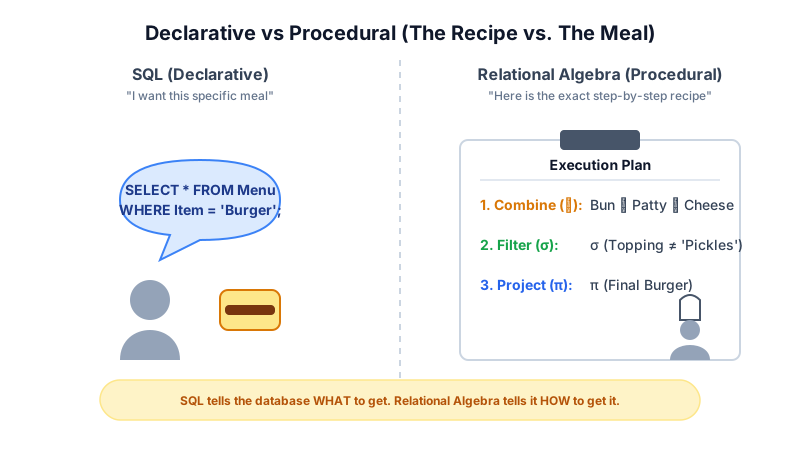
SQL is declarative (what you want); Relational Algebra is procedural (how to get it).
All operators obey the Closure Property: input is a relation, output is a relation.
Fundamental operators: Selection, Projection, Union, Difference, Cartesian Product, Rename.
Derived operators like Natural Join are combinations of fundamental operators.
Query Optimizers rewrite Relational Algebra trees to push selections down, dramatically reducing CPU time.
What is Relational Algebra?
When you write a SQL query to fetch a list of customers, the database doesn't understand the English words you typed. Before the computer can search its hard drives, it must translate your SQL into pure mathematical logic. Relational Algebra is that mathematical foundation. It is the invisible engine that dictates exactly how modern database systems combine, filter, and extract data.
The Analogy: The Recipe vs. The Meal
Think of a database like a restaurant kitchen. When you write SQL, you are the customer ordering a meal: "I want a cheeseburger without pickles." This is Declarative — you state what you want, not how to make it. Relational Algebra is the chef's recipe. It is Procedural. It provides the exact, step-by-step mathematical instructions: "1. Take a bun. 2. Cook a patty. 3. Combine bun and patty. 4. Filter out pickles. 5. Serve."
How Relational Algebra Works (The Core Mechanics)
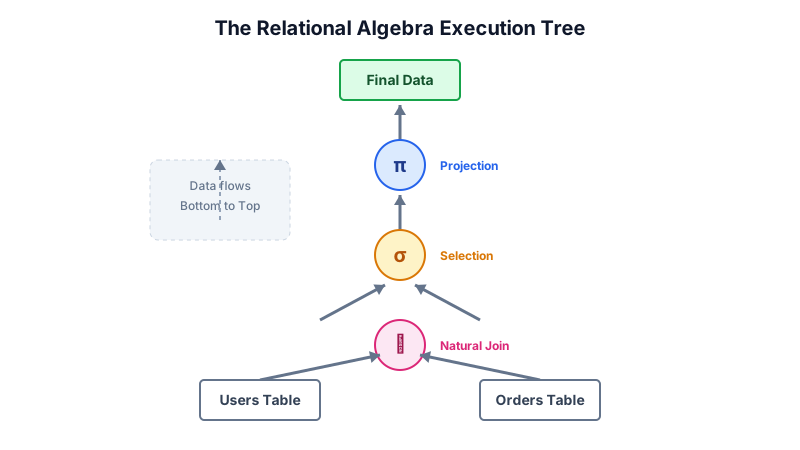
Every operation in Relational Algebra adheres to the Closure Property — the input is always a table, and the output is always a table. This allows operations to be chained together in a strict sequence:
Categories of Relational Operators
Relational Algebra is divided into fundamental operators (which cannot be broken down) and derived operators (which are combinations of the fundamentals).
Category 1: Unary Operators (Single Table)
These operators work on exactly one table at a time.
- Selection (σ) — Filters Rows. Selects specific rows satisfying a condition (e.g., Age > 18). SQL equivalent:
WHERE. - Projection (π) — Filters Columns. Extracts specific columns, discarding the rest. SQL equivalent:
SELECT. - Union (∪) — Combines rows of both tables, automatically removing any duplicates.
- Intersection (∩) — Returns only the rows that exist in both tables simultaneously.
- Set Difference (−) — Returns rows in the first table that do not appear in the second.
Category 3: Cross/Combiner Operators (Two Tables)
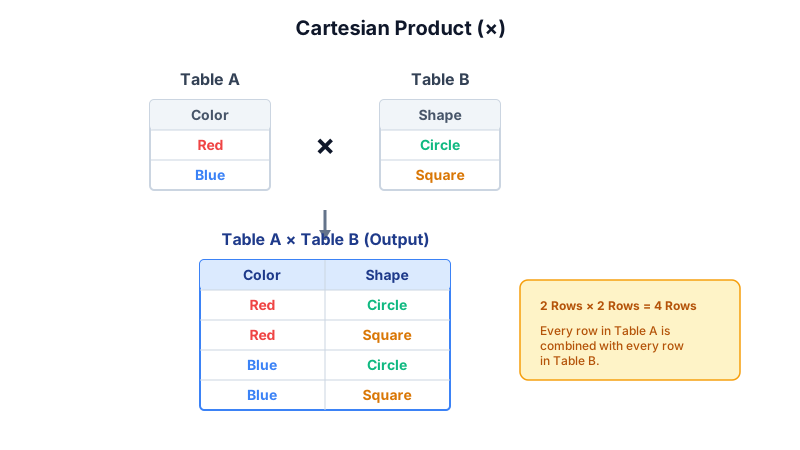
- Cartesian Product (×) — Combines every row of Table A with every row of Table B. SQL equivalent:
CROSS JOIN. - Natural Join (⋈) — The industry standard for combining tables based on shared column names.
Relational Algebra vs Relational Calculus: Key Differences
| Feature | Relational Algebra | Relational Tuple Calculus |
|---|---|---|
| Paradigm | Procedural Language | Declarative Language |
| Functionality | Specifies what data to get AND how to get it. | Specifies only what data to get. |
| Order of Operations | The order of mathematical steps matters heavily. | Order does not matter. |
| Real-World Equivalent | The internal execution engine of an RDBMS. | The standard SQL language typed by users. |
| Mathematical Basis | Set Theory | First-Order Predicate Logic |
Advanced Engineering Concepts
Derived Operators: The Natural Join (⋈)
While the Cartesian Product (×) is fundamental, it creates massive, mostly useless data by matching unrelated rows. To fix this, engineers use the Join operator, which is mathematically derived from a Cartesian Product followed by a Selection (σ).
The most critical derived operator is the Natural Join (⋈). It automatically combines two relations based on columns that share the exact same name and data type, dropping the duplicate column. Mathematically, if relation R and relation S share an attribute A:
R ⋈ S = πAttributes(R∪S)(σR.A = S.A(R × S))
This equation proves that a Join is simply an optimized sequence: take every combination (×), filter for matches (σ), and display the clean columns (π).
Query Optimization and Heuristic Trees
When you submit a SQL query, the DBMS translates it into a Relational Algebra expression. However, the first translation is usually terribly inefficient. The DBMS Query Optimizer uses heuristic rules to rewrite the algebra.
The most important heuristic rule is: Push Selections Down. If a user wants to join a 1-million-row Customers table with a 1-million-row Orders table, but only wants data for "New York", an unoptimized tree performs the massive Join first, then filters. The Optimizer rewrites the algebra tree to apply the Selection operator before the Join, reducing 1 million rows to ~50,000 first — making the subsequent Join exponentially faster.
Real-World Case Study: IBM System R and the Birth of SQL (1970)
Key Statistics & Industry Data (2026)
- Optimization Plans — Modern Query Optimizers evaluate over 10,000 algebraic plans in milliseconds before executing SQL. (Source: IBM Research, 2026)
- CPU Gains — Algebraic optimizations (like pushing selections down) reduce CPU query time by up to 98%. (Source: Gartner, 2026)
- Market Dominance — Over 75% of global transactional data is processed by engines rooted in Relational Algebra. (Source: Statista, 2026)
When to Use
Database Engine Development
Software engineers building new DBMS architectures (like distributed NewSQL) must map their core processing engines entirely in Relational Algebra.
Advanced Query Tuning
Senior Database Administrators use algebraic execution trees (viewed via EXPLAIN commands) to debug exactly why a complex SQL query is running slowly.
Formal Verification
In high-security environments (banking, aerospace), data retrieval logic is written in Relational Algebra to mathematically prove the output will be 100% accurate.
Advantages of Relational Algebra
- Mathematical Precision — Guarantees predictable, highly accurate data retrieval.
- Optimization — Allows databases to rewrite queries for massive speed gains.
- Foundation of SQL — Provides the exact blueprint for how RDBMS software is built.
- Closure Property — Output can immediately be used as input for the next formula.
Disadvantages of Relational Algebra
- Not Human-Friendly — Complex symbols are difficult for non-mathematicians to read.
- Lacks Aggregation — Basic algebra cannot natively handle SUM() or AVG() without extensions.
- No Sorting — Mathematical sets are unordered, so it does not support ORDER BY.
- Steep Learning Curve — Requires solid understanding of discrete mathematics.
Quick Reference Cheat Sheet
| Symbol | Name | SQL Equivalent | Primary Use Case |
|---|---|---|---|
| σ | Selection | WHERE | Filtering rows based on a condition. |
| π | Projection | SELECT | Choosing specific columns to display. |
| × | Cartesian Product | CROSS JOIN | Creating every possible combination of two tables. |
| ⋈ | Natural Join | INNER JOIN | Combining tables on matching column names. |
| ρ | Rename | AS | Temporarily renaming a table or column. |
Frequently Asked Questions (FAQ)
Q.Why do I need to learn Relational Algebra if I already know SQL?
Q.What is the difference between Selection and Projection?
Q.What happens if I try to Union two tables with different columns?
Q.Is Relational Algebra a programming language?
Q.How does a database handle SQL features like COUNT or SUM?
Q.What is an Outer Join in Relational Algebra?
Q.What is the Rename operator (ρ) used for?
Related Topics
Test Your Knowledge
Ready to prove your skills? Take our rigorous multiple-choice quiz designed to test your understanding of this topic and prepare you for interviews.