
What is an ER Diagram? Entity-Relationship Models Explained (2026)

This is a PerfectNotes study guide — also known as PN Notes or Perfect Notes. PerfectNotes provides free computer science student notes, MCQs, and interview preparation guides at perfectnotes.org.
Key Takeaways
- Entity-Relationship Model — The foundational blueprint of a database, ensuring data is organized and scalable.
- Core Components — Entities are objects (nouns), Attributes are their traits (adjectives), and Relationships define how they interact (verbs).
- Cardinality — Sets the mathematical boundaries on relationships (e.g., 1:1, 1:N, M:N).
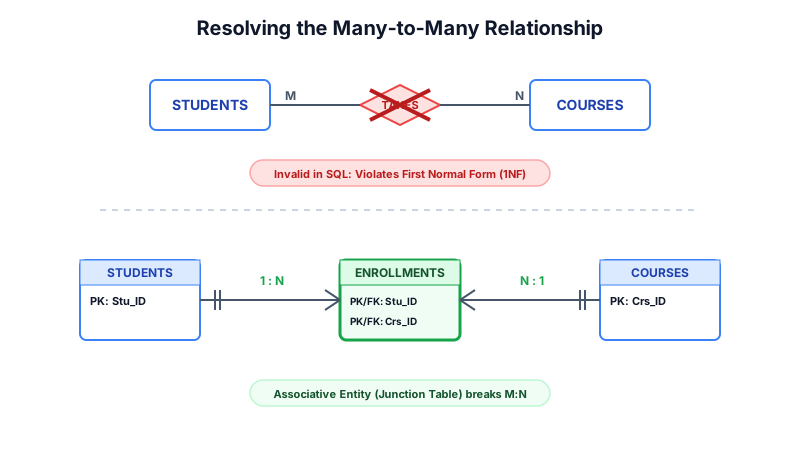
- Resolving M:N — A Many-to-Many relationship cannot be implemented directly in SQL; it must be resolved using a Junction Table.
- Notation Standards —Enterprise engineering strictly utilizes Crow's Foot Notation, rather than the academic Chen Notation.
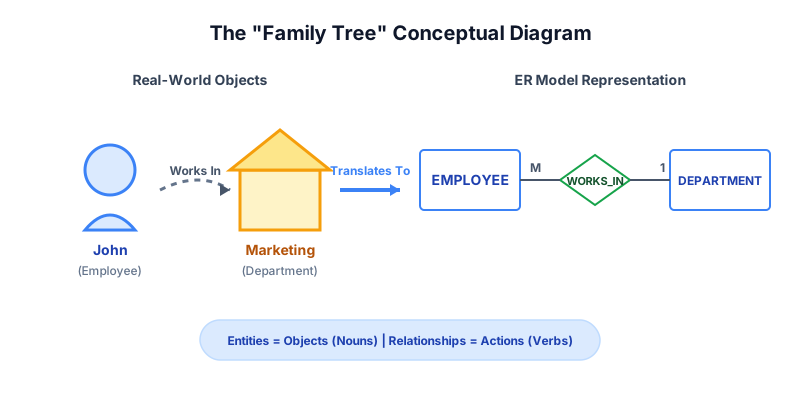
An ER Diagram acts like a massive organizational chart for your database architecture.
Entities are drawn as rectangles, Attributes as ovals, and Relationships as diamonds in traditional Chen notation.
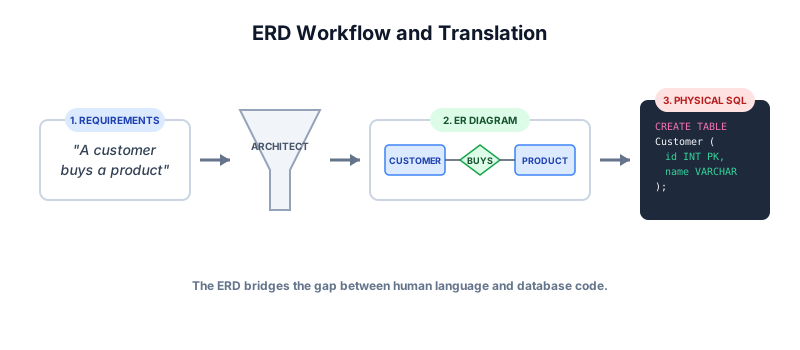
An ERD is a high-level conceptual model meant for business stakeholders and system analysts, completely independent of any specific SQL platform.
M:N relationships violate First Normal Form (1NF) and are resolved by creating an associative entity (junction table) with a composite key.
Poor initial ER modeling leads to severe performance bottlenecks and massive data duplication at scale (e.g., the Healthcare.gov failure).
What is an ER Model?
Before a construction crew pours a single ounce of concrete, an architect draws a comprehensive blueprint. In the world of software engineering, before a developer writes a single line of SQL or creates a database table, they map out the system's entire data architecture. The Entity-Relationship (ER) Model is that foundational blueprint, ensuring data is organized, scalable, and mathematically sound.
How ER Diagrams Work (The Core Mechanics)
To build a functional database, a data architect must follow a strict workflow to translate real-world business requirements into an ERD:
Categories of ER Diagram Components
Category 1: Entities (Strong vs. Weak)
An entity is an object that exists independently (e.g., a Student). A Weak Entity cannot exist without a parent (e.g., a Room cannot exist if the Building entity is deleted). Strong entities are drawn as rectangles; weak entities are drawn as double-rectangles.
Category 2: Attributes
Attributes define the entity. They can be Simple (e.g., Age), Composite (e.g., Address, which breaks down into Street, City, Zip), Multi-valued (e.g., Phone_Numbers, allowing multiple entries, drawn as double ovals), or Derived (e.g., Years_Employed, calculated from the Hire_Date, drawn as a dashed oval).
Category 3: Relationships & Cardinality
Relationships (drawn as diamonds) dictate how entities share data. Cardinality defines the numerical boundaries: 1:1 (One-to-One), 1:N (One-to-Many), and M:N (Many-to-Many).
Conceptual ERD vs. Physical Schema: Key Differences
| Feature | Conceptual ER Diagram (ERD) | Physical Database Schema |
|---|---|---|
| Primary Audience | Business stakeholders, System Analysts | Database Administrators (DBAs), Developers |
| Level of Abstraction | Extremely high (Focuses on what the data is) | Extremely low (Focuses on how it is stored) |
| Syntax Used | Shapes (Rectangles, Ovals, Diamonds) | SQL DDL (Data Definition Language) |
| Platform Specificity | Platform agnostic (Independent of the DBMS) | Highly specific (e.g., written specifically for PostgreSQL) |
| Many-to-Many (M:N) | Fully supported and easily drawn | Impossible to implement directly; requires a Junction Table |
Advanced Engineering Concepts
Resolving M:N Relationships via Junction Tables
In relational database theory, a Many-to-Many (M:N) relationship cannot be physically implemented. If a Student can take many Courses, and a Course can have many Students, implementing this directly violates First Normal Form (1NF). Engineers must resolve this in the ERD by creating an associative entity (Junction Table) that breaks the M:N relationship into two 1:N relationships.
EA ⊆ E1 × E2
PK(EA) = {FK(E1), FK(E2)}
Chen Notation vs. Crow's Foot Notation
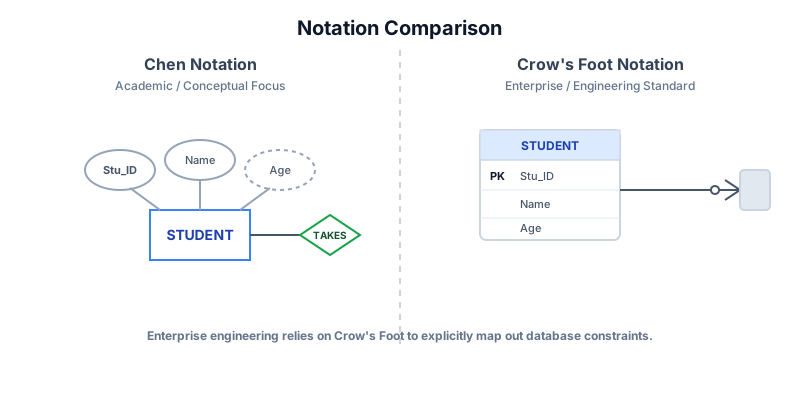
While academic environments favor Chen Notation (using explicit diamonds for relationships and ovals for attributes), enterprise engineering strictly utilizes Crow's Foot Notation(Information Engineering). Crow's foot places attributes directly inside the entity box and uses graphical pronged lines to denote exact cardinality (mandatory vs. optional participation).
For example, a solid line ending in a circle and three prongs mathematically denotes:
0 ≤ N ≤ ∞
(Meaning "Zero through Many" or optional participation). A line with two perpendicular tick marks denotes strict 1:1 mandatory participation.
Specialization & Generalization (ISA Hierarchy)
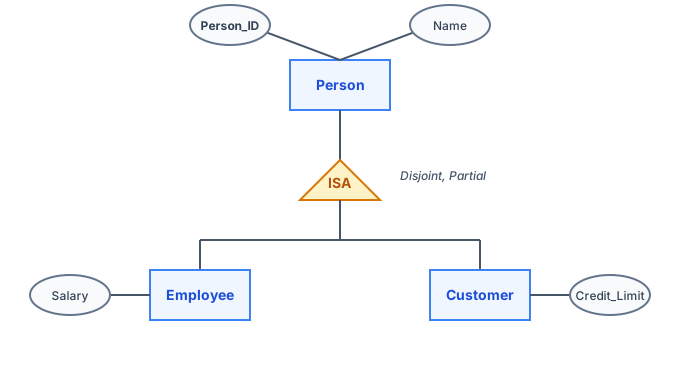
Real-world entity sets often share attributes. Rather than duplicating them, ER modeling uses two complementary processes — Specialization and Generalization — to build an ISA Hierarchy (the name comes from the phrase “A is a B”, e.g., “A Manager is aPerson”).
Specialization (Top-Down)
Specialization starts with a general entity set and breaks it into more specific sub-entity sets that inherit all attributes of the parent but also have unique attributes of their own. This is a top-down approach.
Specialization is drawn in Chen notation as a downward triangle labelled “ISA” connecting the parent to its child entity sets.
Generalization (Bottom-Up)
Generalization is the reverse process — multiple lower-level entity sets are combined into a single higher-level entity set that captures shared attributes. This is a bottom-up approach and is semantically equivalent to specialization; the distinction is only in the design direction.
Overlap vs. Disjoint Constraints
| Constraint | Meaning | Notation | Example |
|---|---|---|---|
| Disjoint | An entity can belong to at most one sub-class (mutually exclusive) | ISA (disjoint) | A vehicle is either a Car OR a Truck — never both |
| Overlapping | An entity can belong to multiple sub-classes simultaneously | ISA (overlapping) | A Person can be both an Employee AND a Customer at the same company |
| Total (Mandatory) | Every entity in the super-class must belong to at least one sub-class | Double line to ISA | Every Employee must be either full-time or part-time |
| Partial (Optional) | An entity in the super-class may not belong to any sub-class | Single line to ISA | A Person may not be classified as Employee or Customer at all |
Aggregation
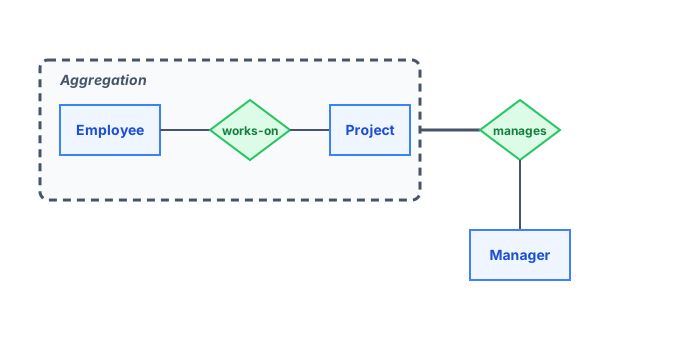
Standard ER models handle binary relationships between two entity sets. But sometimes a relationship itself needs to participate in another relationship. Aggregation is the modeling technique that treats a relationship (plus its participating entities) as a higher-order entity so it can participate in further relationships.
In Chen notation, Aggregation is represented by drawing a dashed rectangle around the existing relationship diamond and its connected entity boxes, and then connecting that rectangle to the new relationship.
Without aggregation, this would require an illegal ternary relationship (Employee, Project, Manager all in one diamond) — which violates the clarity and decomposability of the ER model. Aggregation solves this elegantly.
In relational database mapping, aggregation translates to a separate junction table containing the foreign keys of the aggregated relationship plus the foreign key of the newly related entity.
Weak Entity Sets
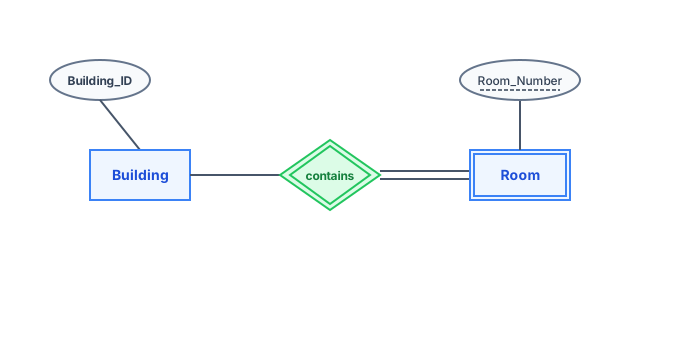
A Weak Entity Set is an entity that cannot be uniquely identified by its own attributes alone — it relies on a parent (owner) strong entity for its existence and identity. This creates an existence dependency.
| Property | Strong Entity | Weak Entity |
|---|---|---|
| Primary Key | Has its own unique Primary Key | Has no complete PK — uses a Discriminator (Partial Key) + parent PK |
| Existence | Exists independently | Cannot exist without its owner strong entity |
| ER Notation | Single rectangle | Double rectangle (weak entity) + Double diamond (identifying relationship) |
| Partial Key | N/A | Discriminator attribute drawn with dashed underline |
| Classic Example | Building (has Building_ID) | Room (identified by Room_Number + Building_ID) |
When mapping to a relational schema, weak entities are represented as a table whose Primary Key is a composite of the parent's PK + the discriminator attribute. Deleting the parent row must cascade to delete all related weak entity rows (ON DELETE CASCADE).
Key Statistics & Industry Data (2026)
- Performance Bottlenecks — Over 85% of critical database issues stem from poor initial ER modeling. (Source: Gartner, 2026)
- Automation Efficiency — Teams using automated ERD tools deploy schema updates 40% faster. (Source: StackOverflow, 2026)
When to Use
Building New Software
ER models are mandatory before writing any backend code for web applications, mobile apps, or enterprise ERP systems.
Database Refactoring
When modernizing a legacy system (e.g., migrating an old monolith to microservices), engineers reverse-engineer the database into an ERD to understand the existing data dependencies.
Data Warehousing (OLAP)
Designing specialized dimensional models (Star Schemas and Snowflake Schemas) for big data analytics requires precise ER diagrams to map Fact and Dimension tables.
Advantages of ER Modeling
- Provides a clear visual roadmap before coding begins.
- Easily understood by non-technical business stakeholders.
- Highlights structural flaws and missing data requirements early.
- Translates perfectly into relational SQL database schemas.
Disadvantages of ER Modeling
- Can become impossibly cluttered for massive enterprise databases.
- Does not natively map well to NoSQL (Document/Graph) databases.
- Chen Notation (academic standard) is rarely used in real enterprise tooling.
- Requires time and upfront planning, which can slow Agile sprints.
Quick Reference Cheat Sheet
Bookmark this table — ER Model components in one quick reference.
| Term | Definition | Primary Use Case |
|---|---|---|
| Entity | A real-world object or concept (Rectangle). | Database tables (Users, Products). |
| Attribute | A property or characteristic (Oval). | Table columns (Email, Price). |
| Relationship | Association between entities (Diamond). | Foreign Key links between tables. |
| Cardinality | Numerical ratio of interaction (e.g., 1:N). | One-to-Many or Many-to-Many limits. |
| Composite Key | A primary key made of two or more attributes combined. | Resolving M:N relationships in associative entities. |
Frequently Asked Questions (FAQ)
Q.What is the difference between an ER Model and an ER Diagram?
Q.What shapes are used in an ER Diagram?
Q.Are ER Diagrams still used in 2026?
Q.Can I use an ER Diagram for a NoSQL database?
Q.What is an Associative Entity?
Q.What is a Composite Key?
Q.What does a double diamond mean in an ER Diagram?
Related Topics
Test Your Knowledge
Ready to prove your skills? Take our rigorous multiple-choice quiz designed to test your understanding of this topic and prepare you for interviews.