
Identity and Access Management (IAM) for AI

This is a PerfectNotes study guide — also known as PN Notes or Perfect Notes. PerfectNotes provides free computer science student notes, MCQs, and interview preparation guides at perfectnotes.org.
IAM for AI is the security framework that verifies and controls artificial intelligence programs, ensuring autonomous agents only access the specific systems and data they are explicitly authorized to use
Non-Human Identities (NHI) use cryptographic keys, OAuth 2.0 Client Credentials grants, and mutual TLS instead of passwords for high-speed machine authentication
Short-lived ephemeral tokens with DPoP binding prevent stolen credentials from being replayed by attackers intercepting agent traffic
Zero Trust architecture enforces continuous verification, mTLS micro-segmentation, and RBAC via Policy-as-Code (OPA/Rego) for every AI agent API request
Workload Identity Federation (WIF) eliminates long-lived service account keys — agents prove identity via OIDC JWT assertions to cloud IAM without storing secrets
Key Takeaways & Definition
- IAM for AI: A system of digital locks and keys that verifies the identity of AI programs and restricts what actions they can perform on a computer network.
- Non-Human Identity (NHI): Any programmatic entity — AI agent, microservice, script, or IoT device — that requires authenticated network access using machine credentials instead of human passwords.
- Core Principle: AI agents must be treated as first-class security principals with their own identity lifecycle, cryptographic credentials, and strictly scoped permissions enforced through automated policy engines.
Introduction to AI Identity and Access Management
Identity and Access Management (IAM) for AI is the security framework used to verify and control artificial intelligence programs. It ensures that smart digital assistants and autonomous agents only access the specific computer systems and private data they are explicitly allowed to see.
When you log into your school or work computer, you type a username and a password. IAM for AI is the exact same concept, but built entirely for machines. It acts like a digital security guard standing in front of your files. Whenever an AI program wants to read a document or send an email, the IAM system checks its identity. If the AI is not on the approved guest list, the security guard blocks it.
The “Digital ID Card” Analogy for AI Agents
Imagine an office building where every employee wears a photo ID badge. The badge lets them open the front door, but it might not let them into the manager's private office. AI agents need their own version of these badges — we call them Machine Identities.
Before an AI helper can look at a company database, it must scan its digital ID card. The building's computer system reads the card and decides exactly which rooms the AI is allowed to enter.
Why Do Smart Machines Need Passwords?
As AI becomes smarter, we ask it to do more important jobs — like organizing bank records or sorting through private medical files. If an AI doesn't have a secure password, anyone on the internet could potentially hijack it.
Hackers could trick the AI into giving away secret information or deleting important data. Giving smart machines their own strict passwords ensures they only take orders from the right people.
Human Users vs. AI Agents: Understanding the Difference
Humans and AI helpers act very differently inside a computer system. A human logs in at 9:00 AM, clicks a few buttons, and logs out to go to sleep. An Autonomous Agent never sleeps — it can perform thousands of tasks in a single second, working 24 hours a day.
Because AI moves so incredibly fast, we need specialized security systems that can check their digital ID cards thousands of times a minute without slowing down. This fundamental difference has forced a massive shift from traditional human-focused IAM to Non-Human Identity (NHI) management.
Human Identity vs. Machine Identity
| Feature | Human Identity (Traditional IAM) | Machine Identity (IAM for AI) |
|---|---|---|
| Authentication | Passwords + MFA prompts | Cryptographic keys, OAuth tokens, x.509 certificates |
| Session Length | Hours (interactive login) | Seconds (ephemeral tokens, auto-rotated) |
| Speed | 1-2 requests/minute | 1,000+ API calls/second |
| Lifecycle | HR onboarding/offboarding | Automated provisioning via CI/CD pipelines |
| Volume | Thousands of employees | Millions of NHIs across microservices |
| Risk Surface | Phishing, credential stuffing | Token theft, key exposure, hardcoded secrets |
Core Concepts: How AI Agents Access Enterprise Systems
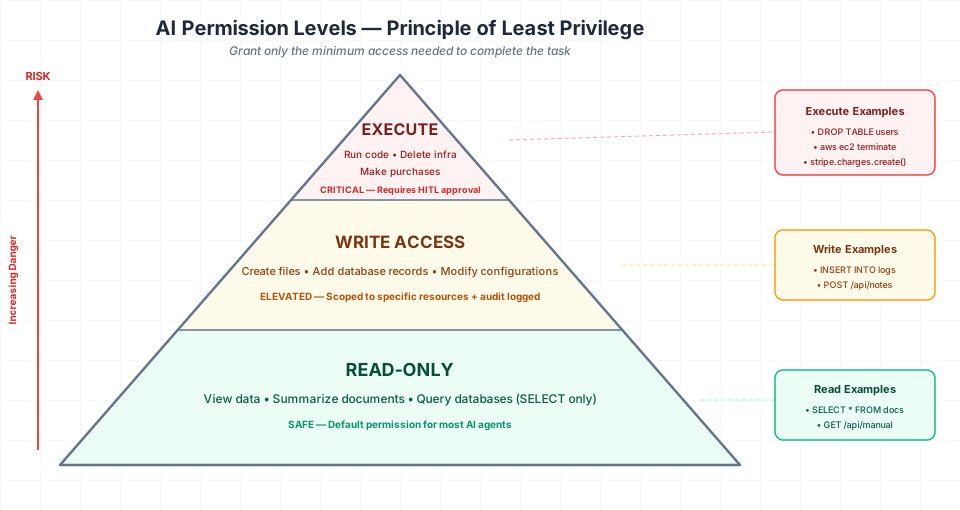
Managing AI access requires shifting from traditional human login credentials to specialized machine identities. Core IAM frameworks utilize automated authentication protocols to grant autonomous agents precise read, write, or execute permissions while centralizing oversight to prevent unauthorized data breaches.
Key Components of an AI IAM System
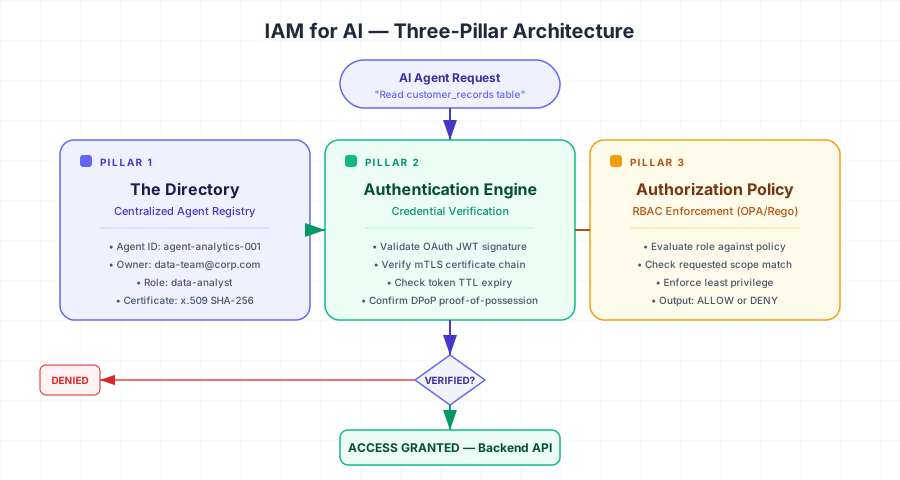
A robust identity framework for artificial intelligence relies on three primary pillars to maintain security:
- The Directory: A centralized database that stores a list of every approved AI agent and its unique digital signature.
- The Authentication Engine: The system that actively verifies the AI's credentials when it attempts to connect to a server.
- The Authorization Policy: The strict set of rules defining exactly what files, networks, and applications the verified AI is allowed to touch.
Types of AI Access Levels
To minimize risk, security teams use the Principle of Least Privilege. This means an AI agent is given only the minimum amount of access necessary to complete its specific job.
Security Risks of Unmanaged AI Actors
When developers create AI tools without connecting them to the central IAM system, they create dangerous blind spots. These unmanaged actors operate outside of compliance frameworks and cannot be audited or revoked.
Hardcoded credentials represent a catastrophic security failure because they are static — they never expire, never rotate, and often have overly broad permissions. When exposed through source code leaks, public repositories, or supply chain attacks, they give attackers persistent backdoor access to the entire infrastructure.
Advanced Engineering Concepts
Enterprise architecture for AI identity necessitates cryptographic Non-Human Identity (NHI) lifecycle management, utilizing OAuth 2.0 Machine-to-Machine (M2M) flows and short-lived ephemeral tokens. Securing LLM-driven autonomous actors requires strict Zero Trust micro-segmentation, behavioral anomaly detection, and deterministic Role-Based Access Control (RBAC).
Architectural Breakdown of Non-Human Identity (NHI) Management
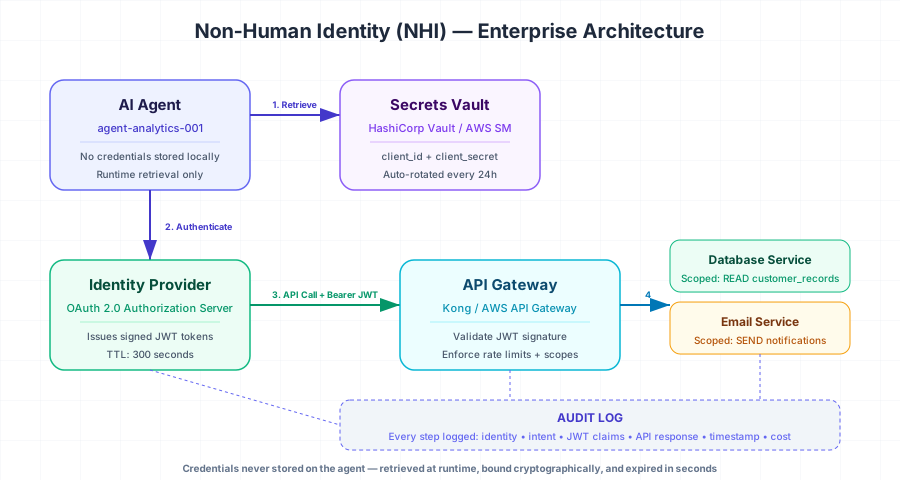
At the enterprise level, managing an NHI requires a decoupled, distributed architecture. The foundation is a centralized Identity Provider (IdP) that acts as the source of truth for all autonomous actors.
Agents do not store their own credentials; instead, they retrieve them at runtime from a highly secure Secrets Vault (such as HashiCorp Vault or AWS Secrets Manager). All agent traffic is subsequently routed through an API Gateway, which intercepts the request, validates the cryptographic signature against the IdP, and enforces rate limiting before routing to the backend microservice.
OAuth 2.0 and Machine-to-Machine (M2M) Authentication
Because autonomous agents operate without human interaction, they cannot utilize traditional authorization code flows that require a browser redirect. Instead, AI architecture relies heavily on the OAuth 2.0 Client Credentials Grant.
In this flow, the AI agent securely authenticates directly with the authorization server using its client_id and client_secret. Upon successful verification, the server issues a signed JSON Web Token (JWT). The agent injects this JWT into the HTTP Authorization header as a Bearer token for all subsequent API requests.
OAuth 2.0 Client Credentials Flow:
1. AI Agent → Authorization Server
   POST /oauth/token
   grant_type=client_credentials
   client_id=agent-001
   client_secret=<secret>
   scope=read:database write:logs
      ↓
2. Authorization Server validates credentials
   Checks scope against RBAC policy
      ↓
3. Authorization Server → AI Agent
   { "access_token": "<signed-JWT>",
     "token_type": "Bearer",
     "expires_in": 300 }
      ↓
4. AI Agent → Backend API
   Authorization: Bearer <signed-JWT>
      ↓
5. API Gateway validates JWT signature
   Enforces scope + rate limits → ALLOW/DENY
Cryptographic Binding and Ephemeral Tokens
A stolen Bearer token is a critical vulnerability if an attacker intercepts an agent's network traffic. To mitigate this, engineers implement Demonstrating Proof-of-Possession (DPoP). This cryptographically binds the access token to the specific AI agent's private key, rendering the token useless if stolen by a third party.
Zero Trust Architecture for LLM-Driven Agents
Applying Zero Trust to agentic AI means the network perimeter is considered inherently hostile. Trust is never granted implicitly, even if the AI agent is operating from a secure internal server.
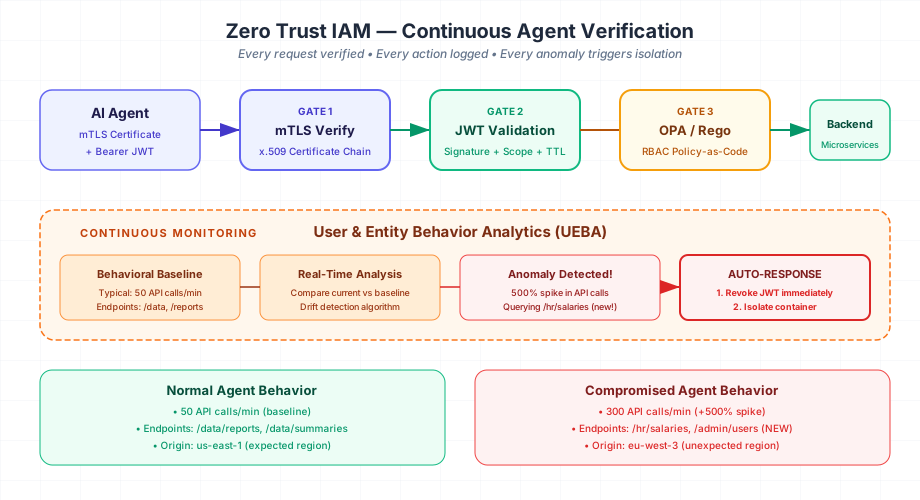
Architecture must enforce Mutual TLS (mTLS) for all agent-to-service communication, ensuring both the client agent and the receiving server cryptographically authenticate each other via x.509 certificates. This strict micro-segmentation ensures that if an LLM is hijacked via prompt injection, the adversary cannot pivot laterally across the internal network.
Algorithmic Anomaly Detection in Agentic API Access
Static permission models are insufficient for highly dynamic AI agents. Enterprise security requires implementing User and Entity Behavior Analytics (UEBA) specifically tuned for machine identities.
By ingesting API gateway logs into a SIEM, machine learning models establish a deterministic baseline of an agent's typical behavior (e.g., call volume, endpoint targets, geographic origin). If a compromised agent suddenly attempts to query an unauthorized HR database or spikes its API call rate by 500%, the anomaly detection engine automatically revokes the agent's JWT and isolates the container.
Enforcing RBAC with Policy-as-Code
To ensure deterministic authorization, access control logic must be decoupled from the AI agent's core code. This is achieved using Policy-as-Code frameworks, such as the Open Policy Agent (OPA) and its query language, Rego.
Example Rego Policy — AI Agent Database Access:
package ai.authorization

# Default: deny all actions
default allow = false

# Allow read access to public datasets
allow {
    input.agent.role == "data-analyst"
    input.action == "read"
    input.resource.classification == "public"
}

# Allow write access only with manager approval
allow {
    input.agent.role == "data-analyst"
    input.action == "write"
    input.approval.manager_signed == true
    input.resource.classification != "restricted"
}

# Block all execute permissions for non-admin agents
deny {
    input.action == "execute"
    input.agent.role != "platform-admin"
}
Real-World Applications
Autonomous Agent Authentication
Securing LLM-driven agents that autonomously browse the web, execute code, and interact with enterprise APIs using ephemeral machine credentials
Microservice-to-Microservice Security
Enforcing mTLS and short-lived JWTs across distributed cloud-native architectures where thousands of services communicate programmatically
CI/CD Pipeline Security
Automating the provisioning and rotation of machine identities for build agents, deployment scripts, and infrastructure-as-code runners
IoT Device Fleet Management
Managing cryptographic identities for millions of IoT edge devices that require authenticated access to cloud data lakes and analytics platforms
Multi-Cloud Governance
Centralizing identity federation across AWS, Azure, and GCP to provide unified RBAC policies for AI workloads spanning multiple cloud providers
Advantages
- Centralized audit logging enables real-time monitoring of every AI agent action across the entire enterprise
- Ephemeral tokens with automatic rotation eliminate the risk of long-lived credential exposure
- Policy-as-Code (OPA/Rego) ensures deterministic, version-controlled authorization that can be reviewed and audited
- Automated NHI lifecycle management scales to millions of machine identities without manual intervention
- Compliance frameworks (GDPR, HIPAA, SOC 2) are satisfied through provable, mathematically verifiable access controls
Disadvantages
- Implementation complexity is significantly higher than traditional IAM, requiring specialized cryptographic expertise
- Token management overhead can introduce latency if secrets vaults or authorization servers become bottlenecks
- Hardcoded credentials in legacy AI systems create dangerous blind spots that are difficult to discover and remediate
- Over-privileged service accounts accumulate permissions over time, violating least-privilege principles if not regularly audited
- Secrets sprawl across multiple vaults and cloud providers makes centralized governance extremely challenging at scale
Quick Reference Cheat Sheet
| Concept | Definition | AI-Specific Application |
|---|---|---|
| Least Privilege | Grant only the minimum permissions required for a task. | AI agents get scoped, task-specific ephemeral tokens — never standing admin rights. |
| Non-Human Identity (NHI) | An identity assigned to software, bots, or AI agents (not people). | Each LLM agent is enrolled in IAM with its own role, audit trail, and rotation policy. |
| RBAC | Role-Based Access Control — permissions tied to job roles. | AI read-only analyst vs. AI write-capable operator — distinct role assignments. |
| ABAC | Attribute-Based Access Control — permissions based on context attributes. | Agent can only access data matching its classification label and project tag. |
| Ephemeral Credentials | Short-lived access tokens that expire automatically after a defined window. | AI agents use 15-minute STS tokens; no long-lived API keys stored in code. |
| Human-in-the-Loop (HITL) | Mandatory human approval gate before critical AI actions are committed. | Production deployments, data deletion, and financial transfers require admin sign-off. |
Frequently Asked Questions (FAQ)
Q.What is the difference between traditional IAM and IAM for AI?
Q.How do autonomous AI agents authenticate without human intervention?
Q.What is a Non-Human Identity (NHI) in cybersecurity?
Q.How can companies prevent AI agents from accessing unauthorized data?
Q.What role does Zero Trust play in AI identity management?
Q.What is mTLS and why is it used for AI agent security?
Q.What are hardcoded credentials and why are they dangerous?
Related Topics
Test Your Knowledge
Ready to prove your skills? Take our rigorous multiple-choice quiz designed to test your understanding of this topic and prepare you for interviews.