
What is the CIA Triad? Definition & Core Cybersecurity Principles Explained (2026)

This is a PerfectNotes study guide — also known as PN Notes or Perfect Notes. PerfectNotes provides free computer science student notes, MCQs, and interview preparation guides at perfectnotes.org.
Key Takeaways
- Foundational Model — The CIA Triad underpins every information security policy globally; every control ever built defends one of its three pillars.
- Confidentiality — Keeps data private; the 2017 Equifax breach exposed 147 million records — the most cited Confidentiality failure in history.
- Integrity — Keeps data accurate and unaltered; violated by SQL Injection, MitM tampering, and virus corruption. Defended by SHA-256 hashing and digital signatures.
- Availability — Keeps systems online 24/7; DDoS attacks cost enterprises an average of $9,000 per minute of downtime. (Gartner, 2026)
- The Impossible Balance — Maximising all three simultaneously is impossible — every security architect must consciously choose a trade-off based on business risk.
The CIA Triad is the foundational model for information security: Confidentiality, Integrity, and Availability
Confidentiality ensures data is accessible only to authorized users through encryption (AES-256) and access controls
Integrity ensures data remains accurate and unmodified through hashing (SHA-256) and digital signatures
Availability ensures authorized users can access data when needed through redundancy and the 3-2-1 backup rule
The 2017 Equifax breach exposed 147 million records — the most cited CIA Triad (Confidentiality) failure in history
What is the CIA Triad?
In the world of cybersecurity, the CIA Triad is the “North Star.” It is the foundational model used to govern information security policies globally. Every single security control — from a simple user password to a massive enterprise firewall — is ultimately designed to uphold one or more of these three fundamental principles.
Security is not just about keeping secrets; it is about ensuring data is perfectly accurate and readily accessible when authorised users actually need it.
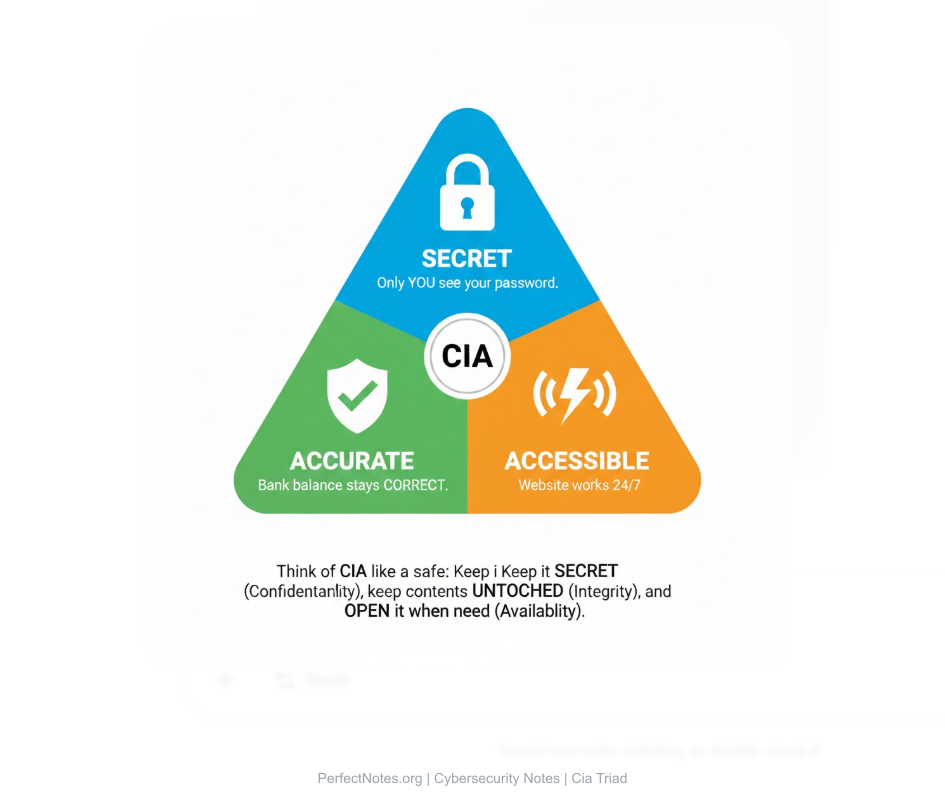
How the CIA Triad Works: The Balancing Act
You cannot simply “maximise” all three pillars without breaking the system. When an engineer builds a new system, they evaluate the architecture through a step-by-step balancing process:
1. Assess the Data
Determine the sensitivity of the information. Does a public blog need the same secrecy as a military database? Different data has different security requirements.
2. Apply Controls
Implement specific software and hardware (like encryption or load balancers) to protect the most critical pillar for that specific dataset.
3. Accept the Trade-Off
Understand that heavily locking down data (High Confidentiality) naturally makes it harder and slower for employees to access it (Lower Availability). This is the fundamental tension every security architect must manage.
4. Tune for Business Needs
Adjust the security friction until the system is both protected from hackers and usable for legitimate employees. A hospital and a social media platform will reach very different conclusions.
Breaking Down C-I-A: The Three Pillars
If a hacker successfully compromises even one of these three pillars, the entire system is considered breached. Here is exactly how they function, how they are attacked, and how engineers defend them.
1. Confidentiality (Privacy)
Confidentiality preserves authorised restrictions on information access and disclosure. It ensures that sensitive information is accessed only by authorised persons.
The Threat: Snooping, packet sniffing on public Wi-Fi, social engineering (phishing), and massive data breaches.
The Defence: Encryption (converting data into unreadable ciphertext using AES-256), Access Control Lists with Role-Based Access Control (RBAC), and Multi-Factor Authentication (MFA). Even if a hacker steals a password, MFA blocks access without the second factor.
2. Integrity (Trust & Accuracy)
Integrity guards against improper information modification or destruction. It ensures that data is accurate, complete, and trustworthy — it has not been maliciously tampered with.
The Threat: Viruses corrupting files, hackers altering database contents via SQL Injection, or Man-in-the-Middle (MitM) attacks.
The Defence: Hash Functions (creating digital fingerprints using SHA-256), Digital Signatures (proving the sender's identity and message integrity), and strict Version Control systems with unalterable audit trails.
3. Availability (Reliability & Access)
Availability ensures timely and reliable access to and use of information. A system must be up and running when authorised users need it.
The Threat: Distributed Denial of Service (DDoS) attacks flooding networks, ransomware encrypting and locking files, hardware failures, or natural disasters.
The Defence: Redundancy (failover clusters and geographic load balancing), Backups following the 3-2-1 rule (3 copies, 2 media types, 1 offsite), and continuous system patching.
CIA Triad vs. DAD Triad: Key Differences (2026)
To fully understand how to defend a system, security professionals also study the exact opposite of the CIA Triad — the DAD Triad(the attacker's perspective).
| Feature | CIA Triad (The Defender) | DAD Triad (The Attacker) |
|---|---|---|
| Pillar 1 | Confidentiality: Keeping data secret. | Disclosure: Leaking private data to the public. |
| Pillar 2 | Integrity: Ensuring data is perfectly accurate. | Alteration: Maliciously changing data to cause harm. |
| Pillar 3 | Availability: Keeping the system online 24/7. | Destruction/Denial: Crashing the system or deleting files. |
| Primary User | Cybersecurity Architects & Network Engineers. | Hackers, Penetration Testers, and Red Teams. |
| Real-World Example | AES-256 encryption, SHA-256 hashing, DDoS scrubbing. | Equifax breach (Disclosure), grade tampering (Alteration), AWS outage (Denial). |
Advanced Engineering Concepts
While the CIA Triad is the bedrock of cybersecurity, modern enterprise security frameworks recognise its limitations — particularly regarding human behaviour and physical device control. Advanced security architects extend it with the Parkerian Hexad.
The Parkerian Hexad
Proposed by Donn B. Parker, the Hexad adds three additional pillars to the base CIA model:
Possession (or Control)
Do you physically control the data? If a thief steals an encrypted laptop, the Confidentiality is still intact (they do not have the password), but you have lost Possessionof the device. The CIA Triad would incorrectly report this as “no breach.” The data could still be destroyed or held for ransom.
Authenticity
Is the data actually from the source it claims to be from? A phishing email might arrive with perfect Integrity (it was not altered in transit), but it lacks Authenticity because it was sent by a scammer masquerading as your bank.
Utility
Is the data in a format that is actually usable? If you have an encrypted backup archive but accidentally lose the decryption key, the data has perfect Integrity and Confidentiality — but zero Utility.
Real-World Case Study: The 2017 Equifax Breach
To understand the devastating impact of a Triad failure, the 2017 Equifax breach is the definitive example of a catastrophic Confidentiality failure — one that exposed the personal data of nearly half the US population.
| Aspect | Details |
|---|---|
| The Incident | Attackers exploited a known vulnerability in the Apache Struts web framework (CVE-2017-5638) that Equifax had failed to patch for two months. |
| Attack Vector | Unpatched web application → lateral network movement → accessed unencrypted (plaintext) consumer databases containing massive amounts of sensitive data. |
| The Impact | Names, Social Security numbers, birth dates, addresses, and credit card details of 147 million Americans exposed. |
| Financial Cost | Over $700 million in settlements and fines to the FTC, CFPB, and 50 US states. |
| Key Lesson | Storing sensitive data in plaintext (no encryption at rest) is a catastrophic Confidentiality failure. Unpatched vulnerabilities are the #1 attack vector — regular patching directly upholds the CIA Triad. |
Key Statistics & Industry Data (2026)
The failure to protect the CIA Triad carries massive financial penalties in the modern economy:
- Cost of Confidentiality Loss — The global average cost of a data breach in 2026 is $4.88 million, heavily driven by regulatory fines and lost customer trust. (Source: IBM Cost of a Data Breach Report, 2026)
- Cost of Availability Loss — Enterprise server downtime costs an average of $9,000 per minute, making DDoS protection and redundancy critical investments. (Source: Gartner, 2026)
- Ransomware Dual Impact — Ransomware attacks both Availability (locking files) and Confidentiality (data theft) simultaneously in 91% of modern attacks. (Source: Verizon DBIR, 2026)
- Human Element — 68% of data breaches involve a non-malicious human action — a phishing click or misconfiguration — violating Confidentiality without any sophisticated hacking. (Source: Verizon DBIR, 2026)
Applications / When to Prioritise Each Pillar
Prioritise Confidentiality: Healthcare & Government
Hospitals (protecting HIPAA patient records) and military branches (protecting state secrets) accept slower, multi-step logins to guarantee total data privacy.
Prioritise Integrity: Financial Institutions & Banking
If a transfer amount is altered by even one decimal point, the entire banking system loses trust. Integrity must be perfect — SHA-256 hashing and digital signatures are non-negotiable.
Prioritise Availability: E-Commerce & Emergency Services
Amazon, emergency 911 dispatch centres, and streaming services cannot afford downtime. For them, a minute of outage means lost revenue or lost lives.
Balance All Three: Enterprise SaaS Platforms
Cloud platforms like Microsoft 365 must maintain strong Confidentiality (tenant isolation), Integrity (data accuracy), and 99.9% Availability SLAs simultaneously.
Advantages of the CIA Triad Framework
- Universal Applicability — works for all types of information systems, from paper files to cloud databases.
- Simplicity — three clear principles make it easy to communicate security goals to non-technical business leaders.
- Risk Prioritisation — helps IT teams balance security investments across different departmental needs.
- Compliance Foundation — GDPR, HIPAA, and PCI-DSS all map their requirements back to the CIA Triad.
Limitations of the CIA Triad
- Incomplete Coverage — does not directly address Non-Repudiation, Possession, Authenticity, or Utility.
- Trade-off Conflicts — maximising one principle (e.g., encryption for Confidentiality) often compromises another (speed/Availability).
- Static Nature — does not fully account for modern, dynamic threats like AI-driven social engineering or deepfakes.
- No Implementation Guidance — describes what to protect, not how to achieve it technically.
Quick Reference Cheat Sheet
Bookmark this table — the entire CIA Triad in one quick reference.
| CIA Pillar | Primary Goal | The Attack Vector | The Engineering Control |
|---|---|---|---|
| Confidentiality | Prevent unauthorised access. | Data breach, snooping, phishing. | Encryption (AES-256), MFA, RBAC Access Controls. |
| Integrity | Prevent unauthorised modification. | SQL Injection, MitM tampering, viruses. | Hashing (SHA-256), Digital Signatures, Audit Trails. |
| Availability | Ensure authorised 24/7 access. | DDoS attacks, ransomware, hardware failure. | Redundancy, Load Balancing, 3-2-1 Backups, Patching. |
| DAD Counter | Attacker's mirror model. | Disclosure / Alteration / Destruction. | Used by Pen Testers & Red Teams. |
| Parkerian Hexad | Extended enterprise model. | Adds Possession, Authenticity, Utility. | Used by advanced security architects & CISOs. |
Frequently Asked Questions (FAQ)
Q.What is the CIA Triad in cybersecurity?
Q.What happens if Integrity is breached?
Q.Is Encryption a part of Confidentiality or Integrity?
Q.Can you have a secure system without Availability?
Q.How do organisations balance the three pillars?
Q.What is the DAD Triad?
Q.Why do some experts consider the CIA Triad outdated?
Related Topics
Test Your Knowledge
Ready to prove your skills? Take our rigorous multiple-choice quiz designed to test your understanding of this topic and prepare you for interviews.