
SQL vs NoSQL Explained: Which Database Architecture is Best? (2026 Guide)

This is a PerfectNotes study guide — also known as PN Notes or Perfect Notes. PerfectNotes provides free computer science student notes, MCQs, and interview preparation guides at perfectnotes.org.
Key Takeaways & Definition
- SQL uses rigid, predefined schemas (tables) with ACID-compliant transactions — best for banking, ERP, and payroll.
- NoSQL uses flexible document/key-value schemas — best for social media, IoT, and big data pipelines.
- SQL scales vertically (bigger machine); NoSQL scales horizontally (more machines in a cluster).
- The CAP Theorem proves a distributed system can only guarantee 2 of: Consistency, Availability, Partition Tolerance.
- ACID (SQL) guarantees transactional integrity; BASE (NoSQL) tolerates temporary inconsistency for higher availability.
- Polyglot Persistence — enterprise apps use both SQL and NoSQL simultaneously for different microservices.
Introduction to Database Architectures
SQL databases store structured data in rigid, predefined tables with strict rules, making them ideal for complex financial transactions. NoSQL databases store unstructured data in flexible, document-based formats, offering massive horizontal scalability perfect for rapidly changing web applications and massive big data pipelines.
Choosing the wrong database architecture is one of the most expensive engineering mistakes a company can make. Migrating billions of rows from a SQL database to a NoSQL cluster (or vice versa) after the product has launched can take months of engineering effort. Understanding the fundamental tradeoffs upfront is critical.
What is a SQL Database? (The Digital Spreadsheet)
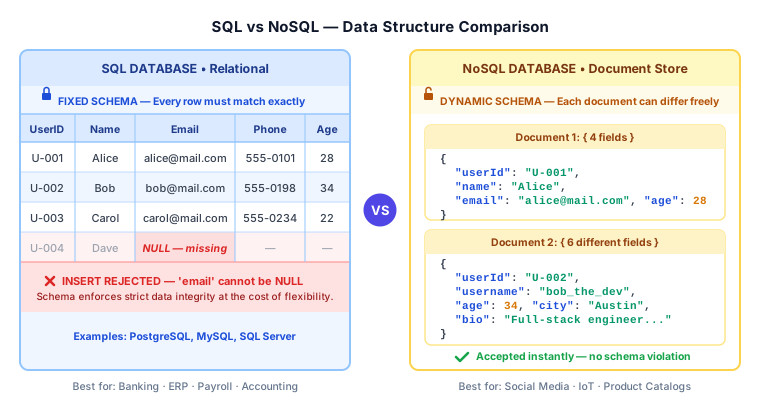
A SQL Database (Structured Query Language) is highly organized. It stores information in rigid tables, consisting of perfectly aligned rows and columns. If you want to add a new user, you must fill out every single required column — First Name,Last Name, andEmail. If a user does not have an email address, the database will strictly reject the entry, preventing accidental missing data.
What is a NoSQL Database? (The Digital Filing Cabinet)
A NoSQL Database (Not Only SQL)is incredibly flexible. Instead of using strict tables, it often stores information as digital documents. In a NoSQL database, you can save one user's profile with just their Username, and the very next user's profile can include Username,Age,Favorite Color, andHome Address — the database accepts whatever data you provide.
Why Do We Need Two Different Systems?
In the early days of the internet, websites were simple text pages, and SQL databases were the only tools required. Today, modern applications generate massive amounts of unpredictable data every single millisecond.
If a popular video game suddenly gets ten million new players overnight, a traditional SQL database will quickly become overwhelmed and crash. NoSQL was specifically invented by tech giants (Amazon, Google, Facebook) to handle this massive, unpredictable scale, allowing servers to process millions of different data types instantly without breaking the underlying system.
Core Concepts: Comparing SQL and NoSQL
Choosing between SQL and NoSQL requires understanding the tradeoff between strict data integrity and massive system scalability. SQL guarantees perfect transaction accuracy, while NoSQL offers unmatched flexibility and the ability to scale globally across thousands of cheap, commodity servers.
Structure vs. Flexibility (Schemas)
SQL relies on a Rigid Schema. Before you can save a single piece of data, a programmer must explicitly define exactly what the tables will look like. If you want to add a new "Phone Number" column later, you must physically halt and alter the entire database — potentially causing downtime on a live system.
NoSQL utilizes a Dynamic Schema. You do not have to define the structure in advance. Developers can instantly add new data fields on the fly without altering the existing database, allowing software teams to launch new app features significantly faster than SQL counterparts.
Scaling Up vs. Scaling Out (Vertical vs. Horizontal)
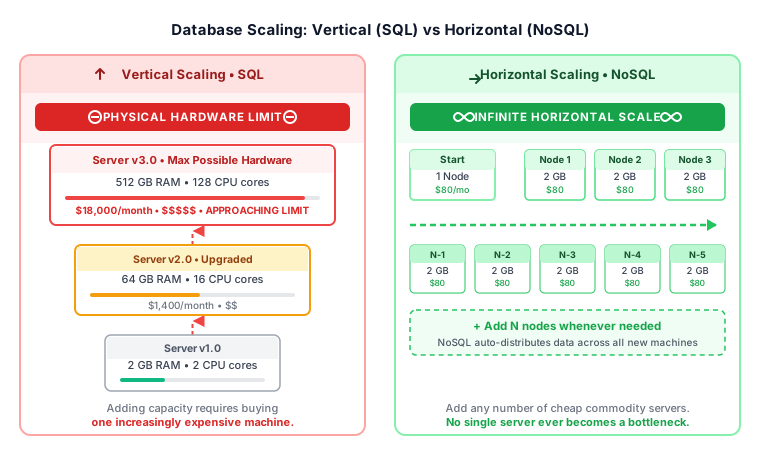
When a SQL database runs out of space, you must use Vertical Scaling. This means buying a bigger, more expensive physical server with a faster CPU and more RAM — costs escalate exponentially ($80/mo jumps to $18,000/mo as you approach hardware limits).
When a NoSQL database runs out of space, you use Horizontal Scaling. Instead of buying one massive supercomputer, you simply add hundreds of cheap, standard commodity servers. The NoSQL software automatically distributes the data across all new machines using consistent hashing algorithms.
The Rules of ACID Compliance
SQL databases strictly follow ACID properties (Atomicity, Consistency, Isolation, Durability). This guarantees that complex transactions — like transferring money between two bank accounts — process flawlessly. If the power goes out mid-transfer, the database automatically rolls back the entire transaction, ensuring money is never accidentally lost.
NoSQL databases generally sacrifice strict ACID compliance to achieve faster speeds. Instead, they follow the BASE model (Basically Available, Soft state, Eventual consistency). This means the database might temporarily show slightly outdated information for a few milliseconds, but it guarantees the system will never completely crash under heavy load.
SQL vs NoSQL: At a Glance
| Feature | SQL (Relational) | NoSQL (Distributed) |
|---|---|---|
| Schema | Rigid, predefined tables | Dynamic, document-flexible |
| Scaling | Vertical (scale up) | Horizontal (scale out) |
| Transactions | ACID compliant | BASE (eventual consistency) |
| Query | Structured SQL language | API / NoSQL-specific DSL |
| Data Model | Tables with rows & columns | Documents / KV / Graph / Column |
| Best For | Banking · ERP · Payroll | Social · IoT · Big Data |
Advanced Engineering Concepts
Enterprise database architecture dictates that the CAP Theorem strictly limits distributed system design. Engineers must evaluate OLTP workloads against B-Tree indexing in RDBMS platforms versus Log-Structured Merge-Trees in distributed NoSQL nodes, utilizing consistent hashing algorithms to prevent hot-spotting across global clusters.
Architectural Breakdown of Relational vs. Distributed Data Stores
A traditional Relational Database Management System (RDBMS) (like PostgreSQL or MySQL) is architecturally monolithic. The storage engine and query execution engine are tightly coupled, utilizing complex table JOIN operations that require reading normalized data from contiguous disk blocks.
Conversely, a distributed NoSQL data store (like Cassandra or DynamoDB) entirely abstracts the storage layer. Data is denormalized and stored as standalone JSON documents or wide-column rows. Because there are no JOIN operations, the engine retrieves the entire application state in a single, high-throughput I/O operation, achieving sub-millisecond latency at the cost of high storage redundancy.
CAP Theorem and Eventual Consistency Models
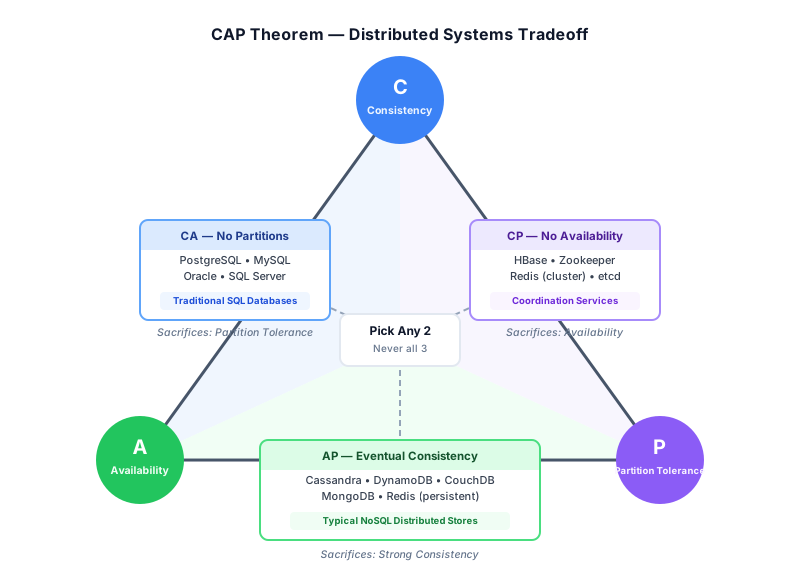
Distributed database engineering is mathematically constrained by the CAP Theorem (Consistency, Availability, and Partition Tolerance). The theorem proves that in the presence of a network partition (P), a distributed system can only guarantee either Consistency (C) or Availability (A), but never both simultaneously.
Modern NoSQL databases are typically AP systems, prioritizing high availability. To manage data synchronization across nodes, engineers implement Quorum Consensus. A read or write operation is considered successful if the acknowledging nodes satisfy the inequality:
Where R = read quorum, W = write quorum, and N = replication factor. This formula determines the strictness of eventual consistency.
B-Tree Indexing vs. LSM Trees (Log-Structured Merge-Trees)
The underlying indexing algorithm fundamentally defines a database's performance profile. SQL databases utilize B-Tree (Balanced Tree) indexes. B-Trees are highly optimized for read-heavy workloads, keeping search depth atO(log n), but they suffer from write-amplification as the tree continuously rebalances during heavy INSERT operations.
High-velocity NoSQL databases utilize Log-Structured Merge-Trees (LSM Trees) — engineered for massive write-heavy workloads. Incoming writes are appended sequentially to an in-memory MemTable. Once full, the MemTable is flushed to an immutable SSTable on disk, completely eliminating random disk I/O and maximizing write throughput at the cost of slightly slower reads (which require checking multiple SSTables during compaction).
| Property | B-Tree (SQL) | LSM-Tree (NoSQL) |
|---|---|---|
| Read Performance | Excellent — O(log n) | Good — may check multiple SSTables |
| Write Performance | Moderate — tree rebalancing overhead | Excellent — sequential append only |
| Storage Pattern | In-place updates (random I/O) | Append-only (sequential I/O) |
| Best For | Read-heavy OLTP workloads | Write-heavy IoT / time-series |
Sharding Strategies and Consistent Hashing
To achieve horizontal scalability, NoSQL databases utilize automated Sharding (data partitioning). A shard key is mathematically hashed to distribute data across the cluster.
To prevent massive data reshuffling when a new server is added, engineers implement Consistent Hashing. The hash space is represented as a digital ring. When a node is added or removed, only the data belonging to its immediate neighbor on the ring is remapped, ensuring anO(K/N) data movement cost, where K is the number of keys and N is the number of nodes — mathematically minimal compared to naive modular hashing.
Key Statistics & Industry Data (2026)
- Database Market Share — Traditional SQL relational databases still retain over 72% of the total enterprise production database footprint. (Source: DB-Engines, 2026)
- Scaling Inefficiencies — Attempts to scale traditional SQL vertically cost enterprises an average of 4.2x more in cloud hosting expenses than equivalent horizontal NoSQL configurations. (Source: Gartner, 2026)
- Data Growth Rates — Unstructured data workloads (IoT, document stores, social graphs) are expanding at 3x the rate of structured relational data. (Source: Statista, 2026)
Real-World Applications of SQL and NoSQL
Banking & Financial Systems
SQL (PostgreSQL, Oracle) is mandatory for ACID-compliant ledger operations — ensuring a transfer is never partially committed and money is never created or destroyed.
Social Media Platforms
NoSQL document stores (MongoDB, DynamoDB) handle billions of flexible user profiles, posts, comments, and reactions where each document has a different structure.
E-Commerce (Polyglot)
Hybrid architecture: NoSQL powers the dynamic product catalog and user reviews; SQL handles the ACID-compliant payment transaction and inventory deduction.
IoT Sensor Networks
NoSQL wide-column stores (Cassandra, InfluxDB) ingest millions of time-series sensor readings per second using sequential LSM-Tree writes across a distributed cluster.
Real-Time Gaming
Redis (in-memory NoSQL key-value store) delivers sub-millisecond leaderboard lookups and session caching for millions of concurrent game sessions.
Healthcare & Clinical Data
SQL (SQL Server, PostgreSQL) stores structured, HIPAA-compliant patient records, diagnoses, and prescriptions in fully relational, auditable schemas.
When to Choose Each Architecture
- SQL ACID guarantees eliminate data corruption in monetary transactions — the bank never loses your money.
- NoSQL horizontal scaling handles 10M+ concurrent users by adding commodity nodes to a cluster.
- NoSQL dynamic schema enables rapid feature deployment — new fields added without migration downtime.
- SQL complex JOINs enable powerful multi-table analytical queries across fully normalized datasets.
- Polyglot Persistence allows each microservice to use the optimal database for its exact access pattern.
- NoSQL document model eliminates expensive ORM (Object-Relational Mapping) layers in application code.
Key Tradeoffs and Limitations
- SQL vertical scaling hits a hard physical hardware ceiling and becomes exponentially expensive at scale.
- NoSQL BASE model allows temporary data inconsistency — stale reads are possible for milliseconds to seconds.
- NoSQL eventual consistency makes financial transactions unsafe without additional application-level locking.
- SQL schema migrations require ALTER TABLE on billion-row production tables, causing costly downtime.
- NoSQL lack of JOINs forces data duplication (denormalization), massively increasing storage costs.
- Choosing the wrong architecture is extremely costly to migrate away from after the system is deployed.
Quick Reference Cheat Sheet
Feature-by-feature comparison of SQL vs NoSQL to help you choose the right database for your project.
| Feature | SQL | NoSQL | When to Choose |
|---|---|---|---|
| Schema | Rigid, predefined. | Flexible, dynamic. | SQL for structured data; NoSQL for unstructured/rapid dev. |
| Scaling | Vertical (scale up). | Horizontal (scale out). | NoSQL for massive, distributed scale. |
| Transactions | ACID compliant. | BASE (Eventual Consistency). | SQL for finance/ledgers; NoSQL for speed/availability. |
| Queries | Complex JOINs via SQL. | Simple document fetch, no JOINs. | SQL for complex relational analysis. |
Frequently Asked Questions (FAQ)
Q.What is the main difference between SQL and NoSQL?
Q.Is NoSQL faster than SQL?
Q.Can I use both SQL and NoSQL in the same application?
Q.What does horizontal scaling mean in NoSQL?
Q.Why do banks strictly use SQL databases?
Q.What is the CAP Theorem?
Q.What is the difference between ACID and BASE in databases?
Test Your Knowledge
Ready to prove your skills? Take our rigorous multiple-choice quiz designed to test your understanding of this topic and prepare you for interviews.