
Database Normalization Explained: 1NF, 2NF, 3NF, and BCNF Examples (2026 Guide)

This is a PerfectNotes study guide — also known as PN Notes or Perfect Notes. PerfectNotes provides free computer science student notes, MCQs, and interview preparation guides at perfectnotes.org.
Key Takeaways & Definition
- Normalization organizes data into smaller linked tables to eliminate redundancy and data anomalies.
- 1NF requires atomic (single) values in every cell — no comma-separated lists.
- 2NF eliminates partial dependencies — every non-key column must depend on the entire composite key.
- 3NF eliminates transitive dependencies — non-key columns must not depend on other non-key columns.
- BCNF is stricter than 3NF: every determinant must be a superkey, resolving overlapping candidate key anomalies.
- Denormalization is intentionally used in OLAP data warehouses to boost read-query performance.
Normalization organizes data into smaller linked tables to eliminate redundancy and data anomalies.
1NF requires atomic (single) values — no comma-separated lists inside a single cell.
2NF removes partial dependencies — every column must depend on the full composite primary key.
3NF removes transitive dependencies — non-key columns cannot depend on other non-key columns.
Denormalization (Star Schema) is intentionally used in OLAP data warehouses for faster analytics.
Introduction to Database Normalization
Database normalization is the step-by-step process of organizing data in a relational database to reduce redundancy and eliminate destructive data anomalies. By dividing massive tables into smaller, mathematically linked tables, it ensures information remains perfectly accurate, consistent, and highly efficient.
What is a Database? (Simple Definition)
A Relational Database is essentially a highly organized digital filing cabinet. Instead of throwing all your information into one massive, confusing spreadsheet, a database stores data in neat, interconnected grids called tables.
Every table has columns (like "First Name" or "Phone Number") and rows(the actual data for one specific person or record). To keep this digital filing cabinet running fast and preventing mistakes, computer scientists invented a strict set of organizing rules called Normalization.
Why Do We Need Normalization?
We need normalization to prevent the "Messy Filing Cabinet" problem in our computers. If a digital database stores the same customer address in 500 different places, it wastes massive amounts of hard drive space.
More importantly, it creates dangerous errors. Normalization solves this by creating one table just for "Customers" and a separate table for "Doctor Visits." Now, John's address is only written down exactly once. If he moves, you update one single row, and the entire database is instantly correct.
The Dangers of Data Anomalies
When a database is not normalized, it suffers from severe digital glitches known as Data Anomalies.
Core Concepts: The Normal Forms Explained
Normal forms are a progressive series of strict structural rules applied to relational databases. Advancing a schema from 1NF through BCNF systematically eliminates repeating groups, partial dependencies, and transitive dependencies, ensuring every attribute mathematically relies exclusively on the primary key.
Understanding Primary Keys and Foreign Keys
Before evaluating normal forms, you must understand how tables link together. A Primary Keyis a unique identifier for a specific row, like a Student ID or a Social Security Number. No two rows can have the same Primary Key.
A Foreign Keyis a column in one table that points directly to the Primary Key of a completely different table. This invisible digital string is what links the "Students" table to the "Classrooms" table without duplicating the classroom's data.
First Normal Form (1NF): Eliminating Repeating Groups
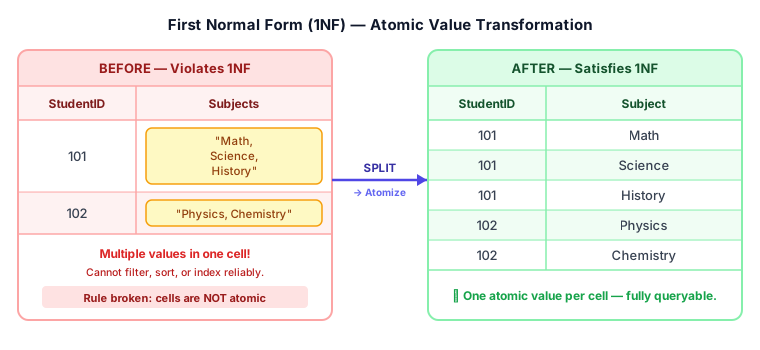
To achieve First Normal Form (1NF), a table must satisfy one fundamental rule: every single cell must contain only one single piece of data (atomic values).
You cannot have a list of items inside a single spreadsheet cell. For example, if a "Student" table has a column for "Subjects," you cannot type "Math, Science, History" into one box. To pass 1NF, you must split those into separate rows so that each subject has its own dedicated cell.
| Violates 1NF | Satisfies 1NF |
|---|---|
| StudentID: 101, Subjects: "Math, Science, History" | StudentID: 101, Subject: "Math" |
| — (list in one cell) | StudentID: 101, Subject: "Science" |
| — | StudentID: 101, Subject: "History" |
Second Normal Form (2NF): Removing Partial Dependencies
To achieve Second Normal Form (2NF), the table must already be in 1NF, and it must have absolutely no Partial Dependencies.
A partial dependency only happens when a table uses a Composite Key (a Primary Key made of two columns combined, like StudentID + ClassID). If a column like StudentNameonly relies on the StudentID but doesn't care about the ClassID, it is partially dependent. To pass 2NF, you must remove StudentNameand put it in its own dedicated "Students" table.
Third Normal Form (3NF): Stopping Transitive Dependencies
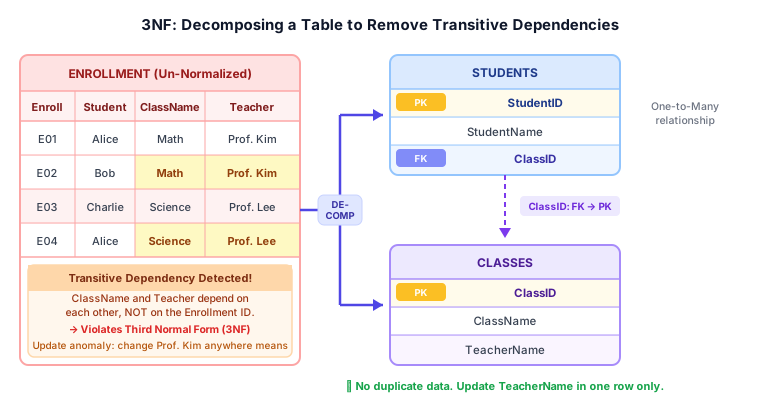
To achieve Third Normal Form (3NF), the table must be in 2NF, and it must have no Transitive Dependencies.
This means a non-key column cannot depend on another non-key column. For example, if a "Tournament" table has columns for WinnerID, WinnerName, and WinnerDateOfBirth — the WinnerName relies on the WinnerID, not the Tournament itself. To pass 3NF, the winner's personal details must be moved into a separate "Players" table.
Boyce-Codd Normal Form (BCNF): The Stricter 3NF
Boyce-Codd Normal Form (BCNF) is a slightly stronger, stricter version of 3NF. It deals with rare edge cases where a table has multiple overlapping candidate keys.
In extremely rare scenarios, a table can be in perfectly valid 3NF, but still suffer from anomalies because a Primary Key is secretly dependent on a standard column. BCNF enforces a strict mathematical rule: if any column determines the value of another column, that determining column must be a unique Primary Key (a superkey).
Normal Forms Comparison
| Feature | Key Rule | Eliminates | Requires |
|---|---|---|---|
| 1NF | Atomic values only | Repeating groups | A defined primary key |
| 2NF | Full key dependency | Partial dependencies | Table in 1NF |
| 3NF | No transitive deps | Transitive dependencies | Table in 2NF |
| BCNF | Every determinant = superkey | Overlapping candidate key anomalies | Table in 3NF |
Advanced Engineering Concepts
Advanced database architecture requires rigorous mathematical validation of functional dependencies utilizing Armstrong's Axioms. Database engineers evaluate relational schemas against BCNF to resolve overlapping candidate key anomalies, and strategically execute denormalization to optimize query latency in read-heavy OLAP data warehousing workloads.
Relational Algebra and Functional Dependencies
The entire foundation of database normalization rests on the mathematical concept of Functional Dependencies (FD). A functional dependency is written asX → Y, which is read as "X functionally determines Y."
Mathematically, this means that for any two tuples (rows) t₁ and t₂ in a relation R, ift₁[X] = t₂[X], then it must be strictly true thatt₁[Y] = t₂[Y].
Engineers utilize Armstrong's Axioms (Reflexivity, Augmentation, and Transitivity) to compute the closure of a set of functional dependencies F⁺, allowing them to programmatically determine all valid candidate keys for a given relational schema.
| Axiom | Rule | Meaning |
|---|---|---|
| Reflexivity | If Y ⊆ X, then X → Y | Any set of attributes determines a subset of itself. |
| Augmentation | If X → Y, then XZ → YZ | Adding attributes to both sides preserves the dependency. |
| Transitivity | If X → Y and Y → Z, then X → Z | The mathematical basis for detecting 3NF violations. |
Mathematical Definition of Boyce-Codd Normal Form (BCNF)
While 3NF allows a non-prime attribute to be functionally dependent on a candidate key, BCNF is uncompromising. A relation schema R is in BCNF if and only if, for every non-trivial functional dependencyX → Ythat holds over R, X is a superkey of R.
If an architecture is in 3NF but fails BCNF, it is typically because there are two overlapping composite candidate keys. Decomposing a 3NF relation into BCNF guarantees the absolute elimination of all redundancy based on functional dependencies, though it may occasionally result in the loss of dependency preservation.
Denormalization: When to Break the Rules (OLTP vs. OLAP)
In enterprise engineering, strict 3NF/BCNF is mandatory for OLTP (Online Transaction Processing) databases (like banking or e-commerce backends) to ensure ACID compliance and high-speed INSERT/UPDATE operations.
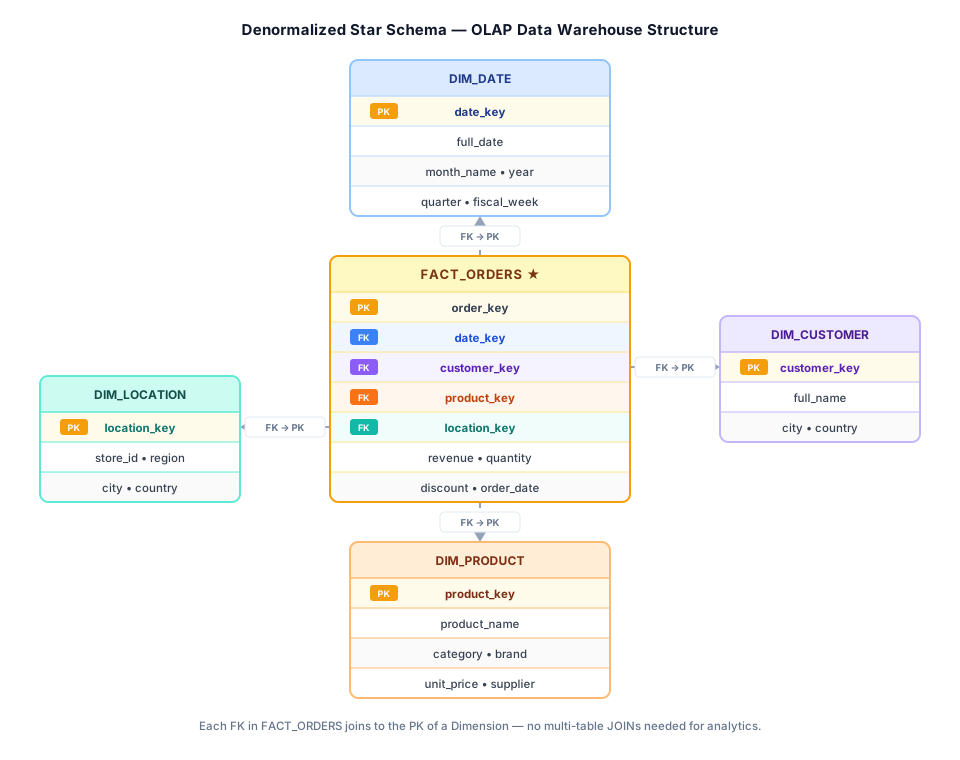
However, for OLAP (Online Analytical Processing) data warehouses, strict normalization is disastrous for performance. Executing a SELECT query that requires a 12-table SQL JOIN across terabytes of normalized data will cause massive latency and CPU bottlenecking. Engineers intentionally break normalization rules — a process called Denormalization — to pre-join data into flat, redundant structures like Star Schemas or Snowflake Schemas, drastically accelerating analytical read operations.
| Aspect | OLTP | OLAP |
|---|---|---|
| Normalization | 3NF / BCNF (strict) | Denormalized (Star/Snowflake) |
| Optimized For | Frequent writes (INSERT/UPDATE) | Large-scale reads & analytics |
| Examples | Banking, e-commerce, ERP | Data warehouses, BI dashboards |
| ACID Compliance | Mandatory | Relaxed (eventual consistency) |
Multi-Valued Dependencies and Fourth Normal Form (4NF)
Functional dependencies handle 1-to-1 relationships, but fail to address independent 1-to-Many relationships within the same table. This creates a Multi-Valued Dependency (MVD), written as X →→ Y.
An MVD occurs when the presence of one or more rows in a table forces the duplication of other rows to maintain consistency. A relation is in Fourth Normal Form (4NF) if and only if it is in BCNF, and for every non-trivial multi-valued dependencyX →→ Y, X is a superkey. Resolving 4NF violations requires splitting the independent multi-valued attributes into their own distinct mapping tables.
Join Dependencies and Fifth Normal Form (5NF)
The highest practical level of normalization is Fifth Normal Form (5NF), also known as Project-Join Normal Form (PJNF). It addresses cases where a relation can be decomposed into three or more smaller tables, but cannot be safely decomposed into just two.
A table suffers from a Join Dependency if decomposing it and then re-joining those decomposed tables using a NATURAL JOIN results in spurious (fake) tuples that did not exist in the original data. A database is in 5NF only if every non-trivial join dependency is strictly implied by the candidate keys of the original relation.
Real-World Applications of Database Normalization
E-Commerce Platforms
Normalized product, customer, and order tables prevent duplicated shipping addresses — updating a customer address in one row instantly reflects across all orders.
Healthcare Information Systems
Patient records are stored separately from appointment data and billing; normalization prevents a patient deletion from accidentally erasing their entire medical history.
Banking & Financial Systems
ACID-compliant OLTP databases use strict 3NF/BCNF so that balance updates are atomic — no partial writes that can corrupt account data.
University Registrar Databases
Students, courses, professors, and enrollment records are stored in separate linked tables — one student record linked to many course enrollments via foreign keys.
Enterprise Resource Planning (ERP)
Relational schemas link employees, departments, payroll, and inventory in normalized tables, ensuring a single HR update propagates correctly across all modules.
OLAP Data Warehousing
Engineers intentionally denormalize normalized transactional data into Star or Snowflake schemas for fast BI dashboards and analytics across billions of rows.
Advantages of Database Normalization
- Eliminates data redundancy — each fact is stored in exactly one place.
- Prevents data anomalies (update, insertion, and deletion) that corrupt data integrity.
- Reduces storage space requirements by removing duplicate data entries.
- Simplifies data modification — one UPDATE affects one table instead of thousands of rows.
- Improves long-term database maintainability and schema evolution.
- Mandatory for ACID-compliant OLTP systems used in banking, healthcare, and e-commerce.
Disadvantages of Database Normalization
- Query complexity increases — highly normalized schemas require multiple SQL JOINs to retrieve related data.
- Read performance degrades in OLAP workloads when JOINing many tables across terabytes of data.
- Higher learning curve — complex normalized schemas are harder for junior developers to understand.
- Over-normalization creates too many tiny tables, causing excessive JOIN overhead and slower application response times.
- Schema redesign is costly once production data is loaded — migrating to higher normal forms requires data transformations.
- BCNF decomposition may sacrifice dependency preservation, making constraint enforcement more complex.
Key Statistics & Industry Data (2026)
- Storage Efficiency — Applying 3NF normalization to legacy enterprise databases typically reduces physical storage requirements by 30% to 50% by eliminating rampant data duplication. (Source: IBM, 2026)
- Data Anomalies — Over 65% of data integrity issues in enterprise applications stem directly from unnormalized schema designs that allow update or deletion anomalies. (Source: Gartner, 2026)
- Read vs. Write — While normalization optimizes write speeds, modern data warehouses often intentionally denormalize data (Star Schema) to improve read query performance by up to 400%. (Source: Statista, 2026)
Quick Reference Cheat Sheet
Bookmark this table — database normalization in one quick reference.
| Normal Form | Rule | Example Violation | Fix |
|---|---|---|---|
| 1NF | Atomic values, unique columns. | "Phone: 123, 789" | Split into separate rows. |
| 2NF | No partial dependencies. | Partial key match. | Move to dedicated table. |
| 3NF | No transitive dependencies. | Non-key depends on non-key. | Move to dedicated table. |
| BCNF | Every determinant = superkey. | Overlapping candidate keys. | Decompose for uniqueness. |
Frequently Asked Questions (FAQ)
Q.What is the main purpose of database normalization?
Q.What is the difference between 3NF and BCNF?
Q.Do I always need to normalize my database to BCNF?
Q.What is a primary key and a foreign key?
Q.What is denormalization and why is it used?
Q.What are the three types of data anomalies?
Q.What is a functional dependency in a database?
Related Topics
Test Your Knowledge
Ready to prove your skills? Take our rigorous multiple-choice quiz designed to test your understanding of this topic and prepare you for interviews.