
AWS vs Azure vs GCP: Which Cloud Provider Should You Choose? (2026)

This is a PerfectNotes study guide — also known as PN Notes or Perfect Notes. PerfectNotes provides free computer science student notes, MCQs, and interview preparation guides at perfectnotes.org.
Key Takeaways & Definition
- Definition: Cloud Computing is the delivery of computing services—servers, storage, databases, networking, and software—over the internet, allowing businesses to rent infrastructure rather than buy it.
- The Big Three: The global market is dominated by Amazon Web Services (AWS), Microsoft Azure, and Google Cloud Platform (GCP).
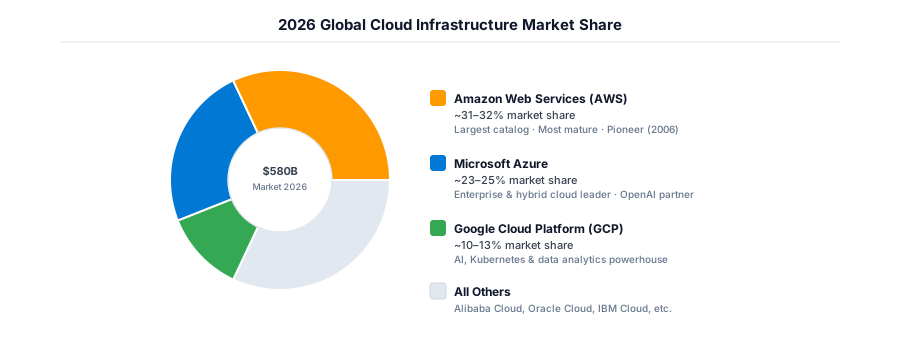
- Market Status (2026): AWS leads overall (widest reach), Azure dominates enterprise & hybrid (Microsoft ecosystem), GCP leads in data analytics and AI (Kubernetes & Gemini).
Cloud computing delivers computing services over the internet, allowing businesses to rent infrastructure from data centers instead of buying physical servers
AWS leads with ~31-32% market share and the broadest service catalog; Azure holds ~23-25% dominating enterprise/hybrid; GCP has ~10-13% and leads in AI and Kubernetes
AWS uses the Nitro System for bare-metal performance; Azure uses Hyper-V + ARM; GCP uses KVM with custom machine types
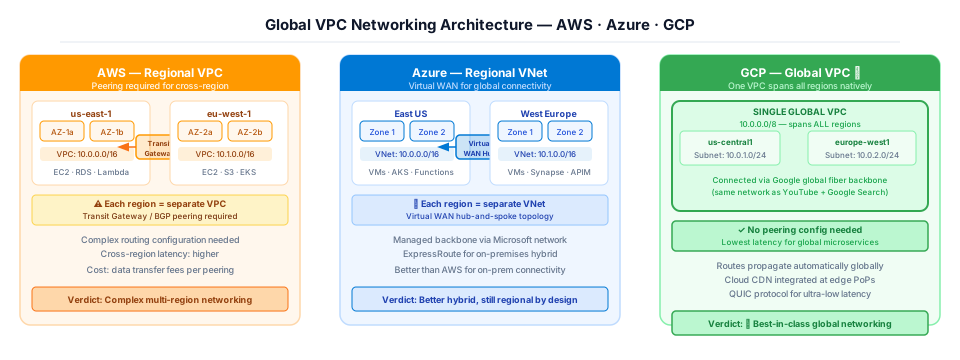
GCP's Global VPC spans regions natively; AWS and Azure require complex peering via Transit Gateway or Virtual WAN
85% of enterprises use a multi-cloud strategy combining two or more providers to prevent vendor lock-in and maximize resilience
Introduction to Cloud Computing Platforms
Cloud computing platforms provide on-demand access to computing power, storage, and databases over the internet. Instead of buying physical servers, businesses rent digital infrastructure from major tech companies like Amazon, Microsoft, and Google to build, run, and scale applications globally.
What is Cloud Computing? (The "Renting a Computer" Analogy)
Imagine you want to start a massive video game company. In the past, you had to buy thousands of expensive computers, store them in a giant warehouse, and pay for the electricity to keep them cool.
Cloud Computing changes this completely. It is exactly like renting a supercomputer by the hour. Instead of buying your own hardware, you log into a website and "rent" computing power from massive data centers located around the world. When your game gets popular, you click a button to rent more power. When players log off at night, you return the power and stop paying.
Who are the "Big Three" Cloud Providers?
Currently, the internet is dominated by three massive tech companies that rent out their computing power. These are known as the "Big Three" hyperscalers:
- Amazon Web Services (AWS): Created by Amazon, it is the oldest and largest cloud provider in the world.
- Microsoft Azure: Built by Microsoft, it is the second-largest provider and integrates seamlessly with Windows and Office tools.
- Google Cloud Platform (GCP): Created by Google, it is the third-largest provider and is famous for its artificial intelligence and data searching tools.
Why Do Companies Need the Cloud?
Companies use the cloud because it is incredibly fast and cost-effective. A small team of two people in a garage can use the exact same supercomputers as a multi-billion-dollar global bank. If a website suddenly gets millions of visitors (like during a Super Bowl advertisement), the cloud automatically provides the website with more power so it does not crash. This concept of instantly shrinking or growing your computing power is called Scalability.
Core Concepts: Comparing AWS, Azure, and GCP
Comparing AWS, Azure, and GCP requires analyzing market share, service ecosystems, and specific technical strengths. AWS dominates with sheer scale and maturity, Azure excels in enterprise hybrid environments, and GCP leads in open-source Kubernetes and advanced data analytics.
Amazon Web Services (AWS): The Pioneer and Market Leader
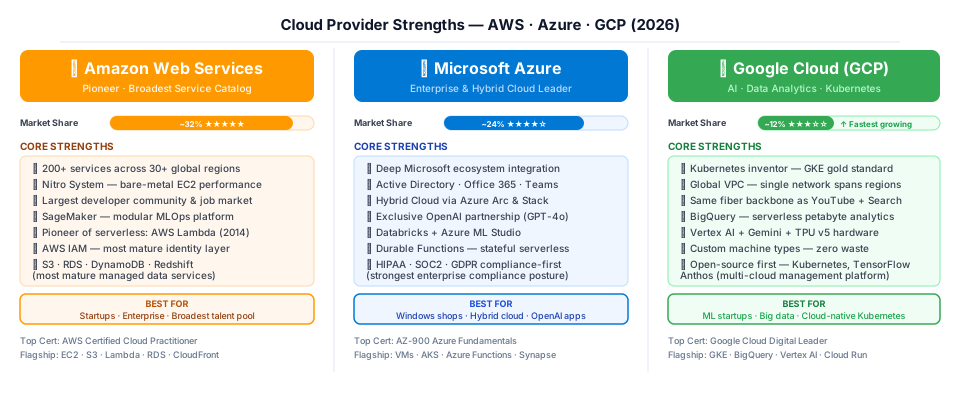
Amazon Web Services (AWS) launched in 2006 and maintains the largest global market share (roughly 31–32%). Because it had a massive head start, AWS offers the broadest and deepest set of digital tools on the market — over 200 fully-featured services from data centers globally. If you need a highly specific tool for robotics, satellite data, or massive storage, AWS likely already has a mature product built for it.
Microsoft Azure: The Enterprise and Hybrid Cloud Giant
Microsoft Azure is the second-largest cloud provider and the fastest-growing among large, traditional corporations. Its biggest strength is its deep, seamless integration with the Microsoft Ecosystem (Windows, Active Directory, Microsoft 365, Teams). Azure dominates the Hybrid Cloudspace, allowing older companies to keep some sensitive servers in their own private basements while moving other parts of their business to the cloud. Furthermore, Azure's exclusive partnership with OpenAI makes it the premier choice for companies building applications powered by ChatGPT-4o and Copilot.
Google Cloud Platform (GCP): The AI and Data Powerhouse
Google Cloud Platform (GCP) is the smallest of the Big Three but excels in highly specialized, modern technologies. Google originally invented the container orchestration system Kubernetes, making GCP the absolute best platform for running modern, open-source microservices. GCP also leverages the same global fiber-optic network that powers YouTube and Google Search, offering unmatched network speed and low latency. It is the top choice for data-heavy companies and machine learning startups that want to use Google's advanced Tensor Processing Units (TPUs) and Gemini AI models.
AWS vs Azure vs GCP — At a Glance (2026)
| Feature | AWS | Microsoft Azure | Google Cloud (GCP) |
|---|---|---|---|
| Founded | 2006 | 2010 | 2008 |
| Market Share (2026) | ~31–32% (1st) | ~23–25% (2nd) | ~10–13% (3rd) |
| Core Strength | Broadest service catalog | Enterprise & hybrid cloud | AI, data analytics, Kubernetes |
| Compute Service | EC2 (Nitro hypervisor) | Virtual Machines (Hyper-V) | Compute Engine (KVM) |
| Managed Kubernetes | Amazon EKS | Azure AKS | Google GKE (Best-in-class) |
| Serverless | AWS Lambda | Azure Functions (Durable) | Google Cloud Functions |
| AI / ML Platform | Amazon SageMaker | Azure ML + OpenAI API | Vertex AI + Gemini + TPUs |
| Data Warehouse | Amazon Redshift | Azure Synapse Analytics | BigQuery (Serverless) |
| Global Network | Region VPC (peering needed) | Regional VNet (Virtual WAN) | Global VPC (single network) |
| Best For | Startups, broad enterprise | Windows/Microsoft shops | ML, big data, cloud-native |
Pricing Models: How Cloud Providers Charge for Services
All three providers use a Pay-As-You-Go model, meaning you only pay for the exact seconds or minutes you use a server. However, cloud bills can quickly become complex and surprisingly expensive.
To save money, companies use Committed Use Discounts (or Reserved Instances). By mathematically promising to use a specific server for 1 to 3 years, AWS, Azure, and GCP will give you a discount of up to 72%. Conversely, you can use Spot Instances, which are excess, unused servers sold at a 90% discount, but the provider can take them back with just a few seconds' notice if capacity is needed elsewhere.
Multi-Cloud Strategy: Using Them All Together
Today, over 85% of large enterprises do not pick just one cloud; they use a Multi-Cloud Strategy. They might use AWS to host their website, Azure to manage their employee logins, and GCP to analyze their customer shopping data. While this strategy prevents vendor lock-in and increases global reliability, it is highly complex. It requires expensive, highly skilled cloud engineers who understand the architecture of all three platforms.
Advanced Engineering Concepts
Enterprise cloud architecture demands deep understanding of compute orchestration, global network topologies, and AI/ML pipelines across hyperscalers. Engineers must architect highly available, fault-tolerant distributed systems utilizing AWS Nitro, Azure Resource Manager (ARM), or Google Kubernetes Engine (GKE) control planes. This closely relates to IAM for AI and Agentic AI Security as cloud platforms are the runtime environment for autonomous agents.
Architectural Breakdown of Compute and Containerization
At the infrastructure layer, compute primitives vary significantly in hypervisor architecture. AWS utilizes the Nitro System, physically offloading virtualization, storage, and networking functions to dedicated hardware accelerators to deliver true bare-metal performance for EC2 instances. Azure Virtual Machines leverage a heavily customized Hyper-V architecture, tightly integrated with the Azure Resource Manager (ARM) for declarative infrastructure provisioning. GCP Compute Engine utilizes KVM and offers custom machine types, allowing engineers to define the exact ratio of vCPUs to RAM to eliminate wasted over-provisioning.
For containerization, Google Kubernetes Engine (GKE) is widely considered the industry gold standard due to its native integration with the open-source Kubernetes control plane. Amazon EKS and Azure AKS are highly capable but generally require more manual configuration for cluster upgrades and ingress scaling.
Cloud-Native Networking and Global Traffic Routing
Network topology design differs fundamentally across the Big Three. AWS Virtual Private Cloud (VPC) and Azure Virtual Network (VNet) are strictly region-specific; creating a global network requires complex BGP routing and peering distinct VPCs across regions via AWS Transit Gateway or Azure Virtual WAN.
In contrast, GCP utilizes a Global VPCout-of-the-box. A single GCP VPC network can seamlessly span multiple global regions without complex peering, leveraging Google's proprietary global fiber backbone. This architectural difference provides GCP with significantly lower latency for globally distributed microservices.
Big Data and Machine Learning Pipelines
Data engineering and MLOps architectures heavily dictate enterprise cloud selection. AWS offers a modular approach with Amazon SageMaker, giving data scientists granular control over model training, deployment endpoints, and hyperparameter tuning. Azure tightly integrates with Databricks and operates the Azure Machine Learning Studio, while its exclusive partnership with OpenAI provides enterprise-grade API access to foundational models with strict HIPAA and SOC2 compliance.
GCP dominates serverless data warehousing with BigQuery, utilizing a columnar storage architecture that decouples compute and storage to query petabytes of structured data in milliseconds.
Serverless Architectures and Event-Driven Computing
Serverless computing abstracts the underlying OS and instance provisioning, executing code strictly in response to event triggers. AWS pioneered this space with AWS Lambda, which offers the largest ecosystem of native event sources (e.g., S3 object puts, DynamoDB streams, API Gateway routing). Azure Functions differentiates itself through "Durable Functions," allowing software engineers to write stateful workflows and orchestrate complex, long-running processes using standard C# or Python code. Google Cloud Functions provides seamless integration with Firebase and Pub/Sub.
Designing for High Availability and Fault Tolerance
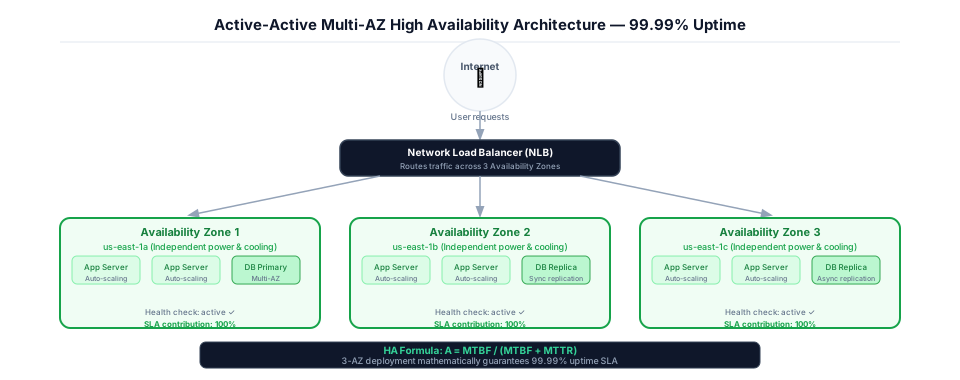
Hyperscalers organize their global infrastructure into Regions and Availability Zones (AZs). A Region is a distinct geographic location (e.g., US-East-1), while an AZ is one or more physically separate data centers within that region, equipped with completely independent power, cooling, and networking.
To survive catastrophic data center failures, engineers architect Active-Active multi-AZ deployments. By placing Network Load Balancers (NLBs) in front of Auto Scaling Groups distributed evenly across three AZs, the architecture mathematically guarantees up to 99.99% uptime, satisfying the most stringent enterprise Service Level Agreements (SLAs).
Real-World Applications
Startup Infrastructure
AWS provides the most comprehensive starter ecosystem — from free-tier compute to managed databases — allowing two-person startups to scale to global enterprise in months
Enterprise Hybrid Cloud
Azure Arc and Azure Stack enable large corporations to manage on-premises and cloud workloads under a unified control plane, maintaining compliance with data sovereignty laws
AI/ML Model Training
GCP Vertex AI and TPU v5 pods give machine learning teams access to Google-scale hardware for training large language models and diffusion models at a fraction of on-premises cost
Global Content Delivery
AWS CloudFront, Azure CDN, and Google Cloud CDN cache static assets at edge locations worldwide, reducing latency for end users from 400ms to under 20ms for cached content
DevSecOps Pipelines
All three providers integrate with Kubernetes and GitHub Actions to enable full CI/CD pipelines with automated security scanning, container image signing, and infrastructure-as-code deployment
Advantages of Cloud Computing
- Infinite scalability on demand — rent 10,000 servers for one hour during peak traffic, return them immediately after, paying only for exact usage in seconds
- Global data center footprint means applications can be deployed near end users worldwide, reducing round-trip latency and satisfying local data residency regulations
- Managed services (databases, queues, AI endpoints) eliminate operational burden, allowing developers to focus on business logic rather than infrastructure maintenance
- Built-in redundancy across Availability Zones provides enterprise-grade fault tolerance that would cost tens of millions of dollars to replicate on-premises
- Continuous innovation — cloud providers release hundreds of new services annually, giving customers immediate access to cutting-edge AI hardware without capital expenditure
Limitations of Cloud Computing
- Vendor lock-in risk: deeply integrating proprietary services (like DynamoDB or Azure Cosmos DB) makes future migration extremely expensive and time-consuming
- Cost unpredictability — cloud bills can spike unexpectedly during traffic surges or misconfigured auto-scaling policies if spending alerts are not properly configured
- Data sovereignty and compliance complexity when storing sensitive personal data across multiple regions with different legal jurisdictions (GDPR, HIPAA, etc.)
- Network latency between on-premises data centers and cloud regions creates challenges for latency-sensitive workloads like real-time trading or industrial control systems
- Multi-cloud operational complexity requires expensive, specialized engineers fluent in all three provider platforms, significantly raising staffing and training costs
Quick Reference Cheat Sheet
| Category | AWS | Azure | GCP |
|---|---|---|---|
| Virtual Machines | EC2 | Azure VMs | Compute Engine |
| Object Storage | S3 | Blob Storage | Cloud Storage |
| Managed Kubernetes | EKS | AKS | GKE |
| Identity & Access | IAM + Cognito | Entra ID (AAD) | Cloud IAM |
| Serverless Functions | Lambda | Azure Functions | Cloud Functions |
| Market Share (2026) | ~31% — market leader | ~25% — enterprise focus | ~12% — AI/data leader |
Frequently Asked Questions (FAQ)
Q.What is the difference between AWS, Azure, and GCP?
Q.Which cloud provider has the largest market share in 2026?
Q.Which cloud platform is best for beginners to learn?
Q.What is a multi-cloud strategy?
Q.How do cloud providers charge for their services?
Q.What is the difference between GCP's Global VPC and AWS VPC?
Q.Which cloud provider is best for machine learning workloads?
Related Topics
Test Your Knowledge
Ready to prove your skills? Take our rigorous multiple-choice quiz designed to test your understanding of this topic and prepare you for interviews.