
Social Engineering via Deepfakes: How Scammers Impersonate Executives

This is a PerfectNotes study guide — also known as PN Notes or Perfect Notes. PerfectNotes provides free computer science student notes, MCQs, and interview preparation guides at perfectnotes.org.
Deepfake social engineering uses AI-generated audio and video to impersonate trusted executives, tricking employees into authorizing fraudulent wire transfers or revealing sensitive passwords
Voice cloning requires only seconds of publicly available audio to generate real-time synthetic speech indistinguishable from the genuine executive
Live video deepfakes use GAN-powered face-swapping during virtual meetings, enabling attackers to visually impersonate CFOs and CEOs on Zoom and Teams calls
Defense requires out-of-band verification, corporate safe words, passive liveness detection, spectral audio analysis, and strict multi-person approval workflows
iBeta ISO 30107-3 Level 2 liveness detection and cryptographic call authentication are the two primary technical defenses against deepfake impersonation attacks
Key Takeaways & Definition
- Deepfake: A piece of digital media altered by AI that takes a real person's face or voice and seamlessly replaces it with someone else's, making forgery indistinguishable from reality.
- Social Engineering: The psychological manipulation of people into performing actions or divulging confidential information — hacking the human brain using trickery and deceit.
- Core Threat: With just a few seconds of publicly available audio or video, attackers can generate real-time synthetic media that completely bypasses human trust verification — seeing is no longer believing.
Introduction to Deepfakes and Social Engineering
Social engineering via deepfakes involves cybercriminals using highly realistic, AI-generated audio and video to impersonate trusted individuals, such as company executives. This manipulation tricks employees into transferring money or revealing sensitive passwords by exploiting human trust and manufactured urgency.
What is a Deepfake? (Simple Definition)
A Deepfakeis a piece of digital media — like a video, picture, or voice recording — that has been secretly altered by artificial intelligence. It takes a real person's face or voice and seamlessly replaces it with someone else's.
To the naked eye or ear, the forged video looks and sounds exactly like the real person. Scammers use this technology to pretend to be someone famous, a trusted friend, or a strict boss to trick people into giving away money or secrets.
The “Digital Mask” Analogy
Imagine a bank robber putting on a highly realistic, Hollywood-style silicone mask that looks exactly like the bank manager. The robber walks into the vault, and the employees let him in because he looks and sounds just like their boss.
Deepfakes are the digital version of this mask. Instead of wearing silicone, the scammer uses AI software to digitally paint the manager's face onto their own face during a live Zoom call. The employees comply with the scammer's requests because they firmly believe they are talking to their boss.
Why Seeing is No Longer Believing
For decades, seeing someone on video or hearing their voice on the phone was the ultimate proof of their identity. If the CEO called you directly, you trusted it was them.
Today, artificial intelligence has broken that trust. With just a few seconds of a person's voice from a YouTube video or social media post, a hacker can program a computer to speak any sentence in that exact same voice. This means we can no longer rely purely on our eyes and ears to verify who we are talking to online.
Core Concepts: How Deepfake Scams Target Organizations
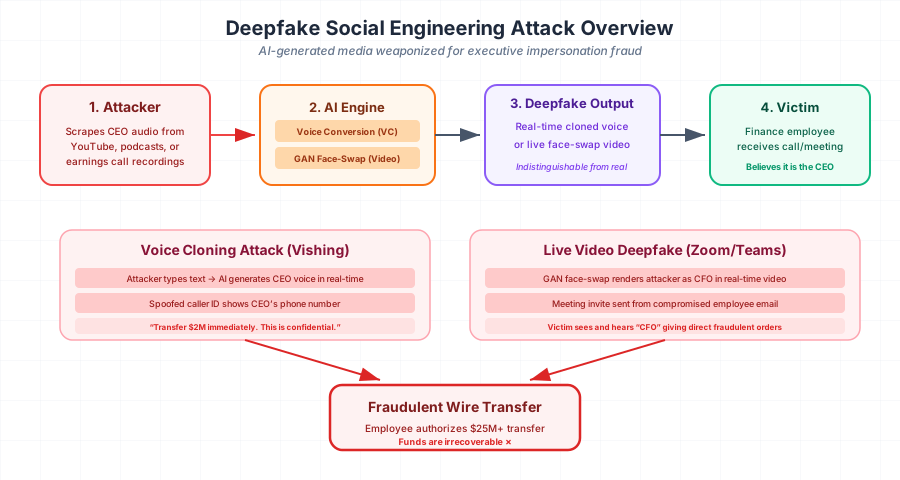
Deepfake scams elevate traditional phishing by utilizing cloned voices and manipulated video feeds during live virtual meetings. Attackers bypass standard verification protocols by creating fabricated scenarios of extreme urgency, forcing victims to override financial controls and authorize fraudulent wire transfers.
The Evolution of Business Email Compromise (BEC)
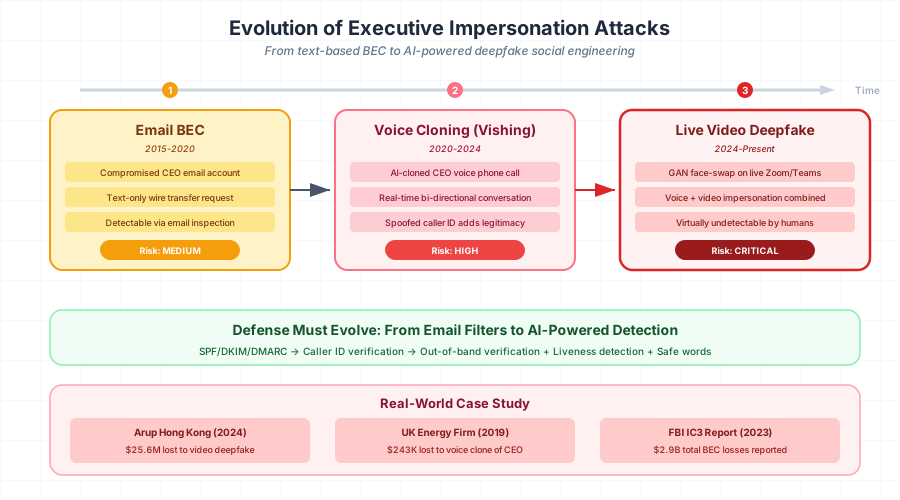
In the past, hackers used Business Email Compromise (BEC). They would hack a CEO's email account and send a text-based message to the finance department asking for an urgent wire transfer. As employees learned to spot these fake emails, the attacks became less effective.
To adapt, attackers evolved to Voice Phishing (Vishing)combined with deepfakes. Instead of an email, the finance employee receives a live phone call sounding exactly like the CEO. The addition of synthetic audio completely disarms the victim's natural skepticism.
Evolution of Executive Impersonation Attacks
| Feature | Traditional BEC (Email) | Deepfake Social Engineering |
|---|---|---|
| Attack Medium | Text-based email from compromised account | AI-generated voice call or live video feed |
| Realism | Low — employees trained to spot fake emails | Extreme — indistinguishable from genuine media |
| Trust Bypass | Email headers can be inspected | Voice and face match the real executive |
| Detection Difficulty | Moderate — email filters catch many attempts | Very High — requires specialized AI detection |
| Average Loss | $125,000 per incident (FBI IC3) | $25M+ per incident (Arup Hong Kong 2024) |
| Defense | Email authentication (SPF, DKIM, DMARC) | Out-of-band verification + liveness detection |
Voice Cloning: The CEO Fraud Phone Call
Voice Cloningrequires incredibly little data. Scammers scrape corporate websites, interviews, or earnings calls to gather a small audio sample of an executive. They feed this sample into an AI tool that maps the executive's pitch, tone, and speech patterns.
During the attack, the scammer types text into a program, and the AI instantly generates the audio in the executive's voice. They use this cloned voice to demand immediate, secret transfers of corporate funds, often claiming they are closing a highly confidential business acquisition.
Live Video Manipulation in Virtual Meetings
Attackers are now executing Live Video Deepfakes during video conferences. Using real-time face-swapping software, a scammer can attend a virtual meeting appearing entirely as the Chief Financial Officer (CFO).
These attacks are highly coordinated. Hackers often compromise a lower-level employee's email to send the meeting invite, adding legitimacy to the trap. When the victim joins the call, they see and hear the deepfaked executive giving direct, fraudulent orders.
Advanced Engineering Concepts
Defending against deepfake social engineering requires advanced liveness detection, spectral analysis of voice conversion models, and cryptographic provenance tracking. Engineers must deploy robust biometric Presentation Attack Detection (PAD) mechanisms to prevent Generative Adversarial Networks from successfully bypassing enterprise authentication frameworks.
Architectural Breakdown of Generative Adversarial Networks (GANs)
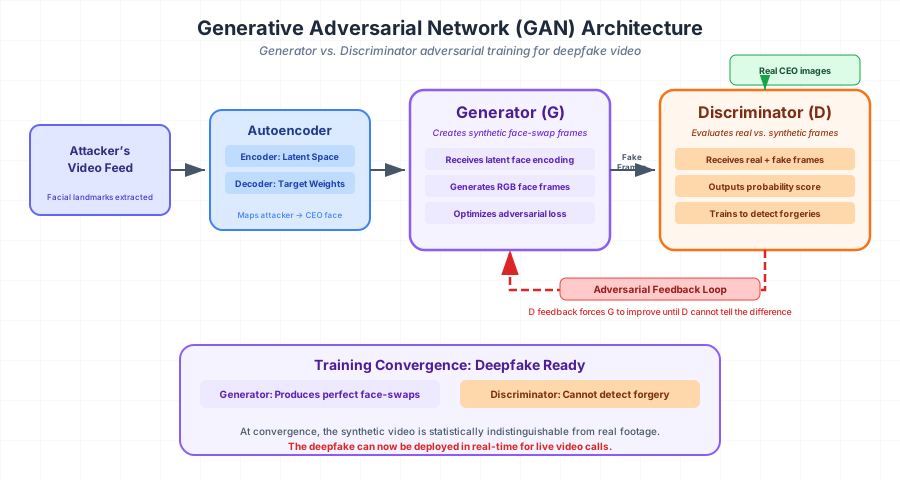
Video deepfakes are primarily generated using Generative Adversarial Networks (GANs). The architecture consists of two neural networks: a Generator and a Discriminator. The Generator attempts to create synthetic image frames of the target executive, while the Discriminator evaluates them against genuine images to detect anomalies.
Through continuous backpropagation, the Generator minimizes the adversarial loss. The training continues until the Discriminator can no longer distinguish between the synthetic face-swap and the ground-truth image. In real-time attacks, an Autoencoderextracts the latent facial landmarks of the attacker and reconstructs them using the target's decoder weights.
Real-Time Audio Deepfakes and Voice Conversion Models
Modern voice cloning utilizes Voice Conversion (VC) models and text-to-speech (TTS) engines leveraging transformers and diffusion models (e.g., VALL-E or ElevenLabs APIs). These systems extract acoustic features — such as Mel-frequency cepstral coefficients (MFCCs) — from a minimal zero-shot audio prompt.
The neural network models the target's prosody, fundamental frequency (F₀), and vocal tract resonance. Because these models can run inference in under 200 milliseconds, attackers can perform real-time, bi-directional conversations, completely bypassing traditional voice-recognition authentication systems.
Voice Cloning Attack Pipeline:
1. Audio Scraping
   Source: YouTube interviews, earnings calls, podcasts
   Duration needed: 3-10 seconds of clean speech
      ↓
2. Feature Extraction
   Extract MFCCs, pitch contour, speaker embedding
   Model: wav2vec 2.0 or HuBERT encoder
      ↓
3. Voice Conversion Model Training
   Map attacker's voice → target's vocal characteristics
   Fine-tune on target speaker embedding
      ↓
4. Real-Time Inference (<200ms latency)
   Attacker speaks → VC model transforms → target voice output
   Bi-directional conversation is fully interactive
      ↓
5. Delivery via Phone/VoIP
   Spoofed caller ID → employee answers
   "This is [CEO]. Transfer $2M immediately."
Bypassing Biometric Authentication (Presentation Attacks)
As enterprises adopt biometric authentication, attackers use deepfakes for Presentation Attack Detection (PAD) bypass. In a typical injection attack, the adversary intercepts the camera feed at the OS level (using virtual camera software) and injects the GAN-generated video stream directly into the authentication application.
This bypasses the physical sensor entirely. If the authentication system relies on static facial recognition or simple motion prompts (e.g., “turn your head”), the real-time deepfake will successfully authenticate the attacker as the privileged executive, granting them full IAM authorization.
Liveness Detection and Deepfake Mitigation Algorithms
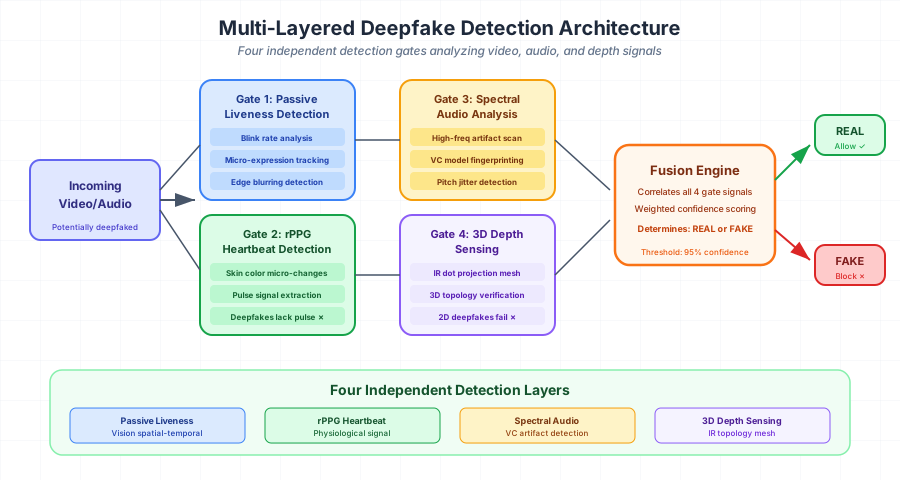
To counter these attacks, cybersecurity engineers implement advanced Liveness Detection algorithms. Passive liveness detection analyzes the video feed for spatial-temporal inconsistencies, such as unnatural blinking rates, heartbeat-induced micro color changes (Remote Photoplethysmography), and localized blurring around the facial blending boundaries.
Audio deepfake detection relies on spectral analysis. AI-generated speech often leaves behind microscopic digital artifacts in the higher frequency bands that the human ear cannot perceive. By passing the audio through a secondary neural network trained on synthetic artifacts, the system can deterministically flag the audio as synthetically generated and immediately terminate the authentication session.
Real-World Applications
Executive Impersonation Fraud
AI-generated voice and video used to impersonate C-suite executives, authorizing fraudulent wire transfers worth millions of dollars
Biometric Authentication Bypass
GAN-generated face-swap video injected into authentication camera feeds to gain unauthorized access to privileged accounts
Political Disinformation
Deepfake videos of political figures spreading false statements to manipulate public opinion and election outcomes
Employment Fraud
Scammers using face-swap technology during remote job interviews to obtain positions at target companies for insider access
Extortion and Blackmail
Fabricated compromising media used to extort individuals and corporate leaders into paying ransoms or revealing secrets
Advantages
- Understanding deepfake threats enables proactive employee training and awareness programs that dramatically reduce successful social engineering attacks
- Out-of-band verification protocols provide a simple, zero-cost defense that completely neutralizes voice and video impersonation attempts
- Corporate safe words create a cryptographic-equivalent authentication layer that AI cannot replicate or predict
- Passive liveness detection using rPPG and spectral analysis can identify deepfakes with over 95% accuracy in real-time deployments
- Multi-person approval workflows for financial transactions eliminate the single point of failure that deepfake scams exploit
Disadvantages
- Deepfake technology improves faster than detection capabilities, creating a persistent arms race between attackers and defenders
- Advanced liveness detection requires specialized hardware (3D depth sensors) not available on standard enterprise laptops and phones
- Employee training degrades rapidly without continuous reinforcement, leaving organizations vulnerable between training cycles
- Real-time voice conversion with sub-200ms latency makes interactive phone-based attacks virtually undetectable by human listeners
- Open-source deepfake tools have dramatically lowered the barrier to entry, enabling unsophisticated attackers to execute previously advanced campaigns
Quick Reference Cheat Sheet
| Attack Type | How it Works | Detection / Defence |
|---|---|---|
| Video Deepfake | GAN-synthesised video impersonating an executive to authorise wire transfers. | Out-of-band verbal verification; check for unnatural blinking and lighting artefacts. |
| Voice Cloning | AI clones a target's voice from 3-second audio clips to impersonate them on calls. | Establish code-word protocols; use call-back verification to known numbers. |
| Spear Phishing | LLM-crafted hyper-personalised emails referencing real employee details from OSINT. | DMARC/DKIM enforcement; security awareness training; phishing simulation. |
| BEC (Business Email Compromise) | Attacker impersonates CEO via email to request urgent fund transfers. | Dual-approval process for all wire transfers; verify via separate channel. |
| Synthetic Identity | AI generates fake photo IDs and personas to bypass KYC onboarding checks. | Liveness detection + biometric verification; deepfake forensic tools. |
| Vishing (Voice Phishing) | Real-time AI voice-cloned phone calls impersonating IT helpdesk to steal passwords. | Never reset credentials verbally; all IT requests must go through ticketing system. |
Frequently Asked Questions (FAQ)
Q.What is a deepfake in cybersecurity?
Q.How do scammers clone a CEO's voice?
Q.Can deepfakes bypass biometric authentication?
Q.How can companies detect a deepfake video call?
Q.What is the best defense against deepfake social engineering?
Q.What is a GAN and how does it create deepfakes?
Q.How do liveness detection systems work against deepfakes?
Related Topics
Test Your Knowledge
Ready to prove your skills? Take our rigorous multiple-choice quiz designed to test your understanding of this topic and prepare you for interviews.