
Threats vs Vulnerabilities: Risk Guide (2026)

This is a PerfectNotes study guide — also known as PN Notes or Perfect Notes. PerfectNotes provides free computer science student notes, MCQs, and interview preparation guides at perfectnotes.org.
Key Takeaways
- 30,000 new CVEs per year — Security teams cannot patch them all, so attackers exploit the gap. Average exploitation window has dropped to just 4 days.
- MOVEit SQL injection zero-day — Exposed 95 million individuals across 2,700 organisations worldwide in 2023–2024.
- Threats are uncontrollable — You cannot stop hackers from existing. Vulnerabilities are controllable — you can patch, configure, and harden.
- Zero-day — Gives defenders zero days to respond — early threat intelligence is the only viable defence.
A Threat is a potential external danger (hacker, malware, disaster); a Vulnerability is an internal weakness (bug, misconfiguration, weak password)
The Golden Formula: Risk = Threat × Vulnerability — eliminate either one and risk drops to zero
Zero-day vulnerabilities are unknown to the vendor — no patch exists on Day Zero, giving defenders zero response time
MOVEit 2023: Cl0p ransomware exploited a SQL injection zero-day to expose 95 million people across 2,700 organisations
CVSS scores rate vulnerability severity 0–10; average enterprise takes 45 days to patch a critical flaw
What are Threats and Vulnerabilities?
Cybersecurity is fundamentally a continuous race between defenders closing gaps and attackers finding them. Understanding the technical distinction between a “Threat” and a “Vulnerability” is the first mandatory step in securing any network. If a system has no vulnerabilities, a threat cannot harm it. Conversely, a vulnerability is harmless if no threat exists to exploit it.
How Cyber Risk Works: The Risk Lifecycle
In information security, risk does not exist in a vacuum. It is the direct result of a threat successfully finding and exploiting a vulnerability. Here is the step-by-step lifecycle:
1. Flaw Creation
A developer accidentally writes a bug into a web application, creating a Vulnerability — an unlocked digital window into the system.
2. Threat Scanning
A malicious hacker (the Threat) uses automated tools to scan the internet looking for that specific unlocked window among millions of servers.
3. Exploitation
The threat actor sends a malicious payload (e.g., a SQL injection string) through the vulnerability to bypass authentication or steal data.
4. Risk Realisation
The system is compromised — resulting in a data breach, financial loss, or service outage (the Risk).
To quantify this, security engineers use the Golden Formula of Cybersecurity:
Risk = Threat × Vulnerability
Eliminate either variable and risk drops to zero. Because external threats cannot be stopped, eliminating vulnerabilities is the primary security strategy.
.png)
Types of Threats and Vulnerabilities
To defend a network, you must understand the different categories of attackers and the specific weaknesses they look for.
The 4 Types of Security Threats
Threats are classified by their vector (method of delivery):
- ● Malware-Based Threats: Ransomware (encrypts files for extortion) and Trojans (disguised as legitimate software).
- ● Network-Based Threats: DoS/DDoS attacks flooding bandwidth to overwhelm servers, or packet sniffing to intercept unencrypted data.
- ● Web Application Threats: SQL Injection manipulating databases, or Cross-Site Scripting (XSS) injecting malicious scripts.
- ● Human / Insider Threats: Social engineering (phishing) or malicious actions by authorised employees with insider access.
The 4 Types of Technical Vulnerabilities
Vulnerabilities stem from system complexity, poor configurations, and connectivity:
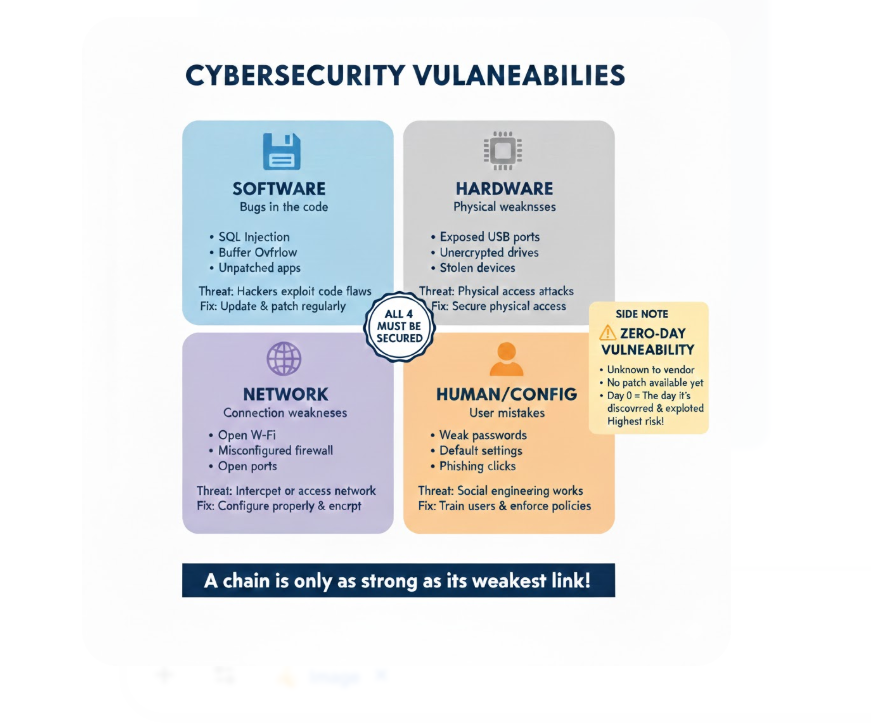
- ● Software Vulnerabilities: Bugs in the code, such as unvalidated input fields allowing SQL injection.
- ● Hardware Vulnerabilities: Physical weaknesses, like unprotected USB ports or side-channel attacks (Spectre/Meltdown).
- ● Network Vulnerabilities: Misconfigured firewalls or weak Wi-Fi encryption (WEP).
- ● Configuration Vulnerabilities: Using factory-default settings (e.g., leaving the admin password as “admin”).
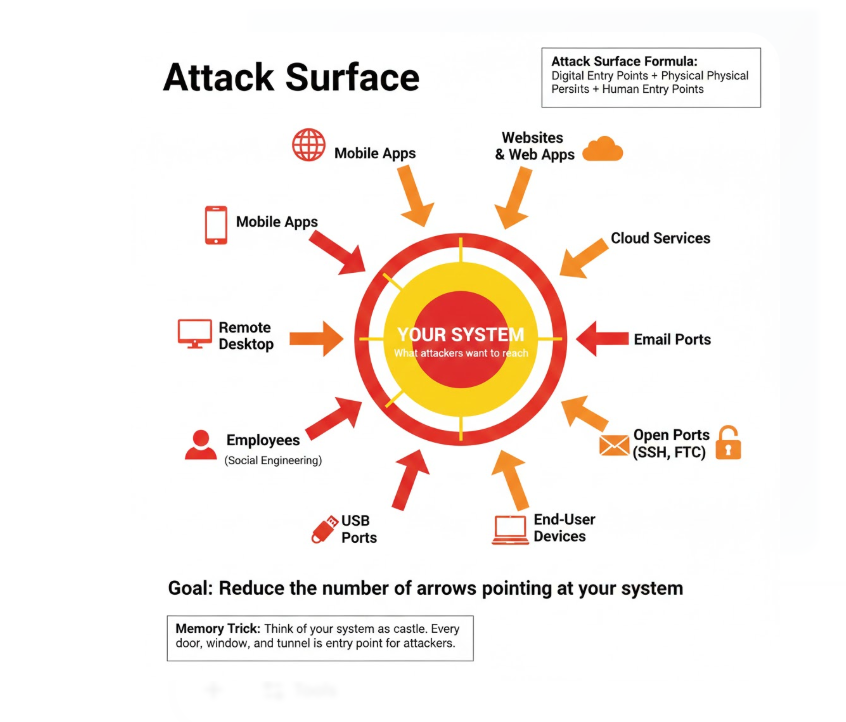
The Attack Surface
The Attack Surface is the sum of all the different points where an unauthorised user can try to enter an environment — open ports, public websites, employee inboxes, and physical USB ports.
Threats vs. Vulnerabilities: Key Differences (2026)
The most frequently tested exam question in cybersecurity. Here is the definitive comparison:
| Feature | Threat | Vulnerability |
|---|---|---|
| Definition | A potential danger that can trigger an incident. | A weakness or flaw in the system. |
| Nature | Usually external (though insiders qualify too). | Internal — exists entirely within your system. |
| Control Level | ❌ Hard to control — you cannot stop hackers from existing. | ✅ Controllable — you can patch, reconfigure, and harden. |
| Example | Ransomware gang, phishing email, hurricane. | Unpatched server, open port, weak default password. |
| Relationship | Exploits the vulnerability. | Is exploited by the threat. |
Advanced Engineering Concepts
When analysing technical risks, advanced security engineers look beyond simple passwords and focus on how software manages computer memory and mathematical logic.
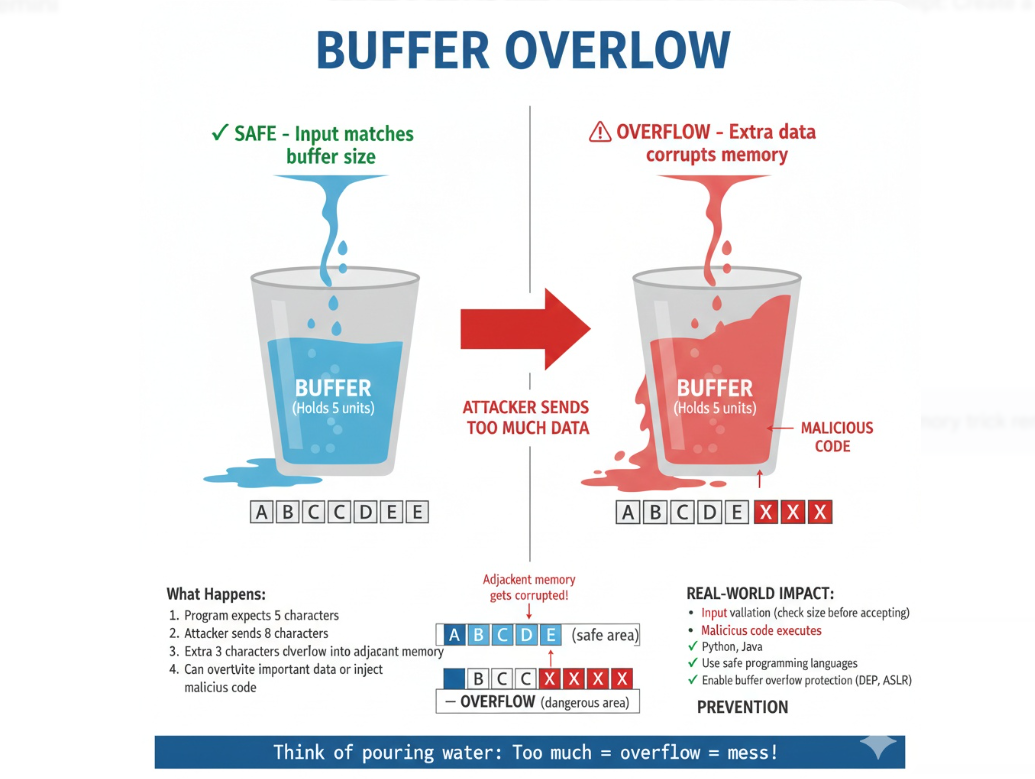
Buffer Overflow Attacks
A Buffer Overflow occurs when a program writes more data to a temporary memory block (the buffer) than it can hold. The excess data overflows, overwriting adjacent memory spaces. Advanced threats use this overwritten space to inject and execute their own malicious code, gaining system-level privileges.
Zero-Day Vulnerabilities & CVSS Scoring
A Zero-Day Vulnerabilityis a software flaw that is completely unknown to the vendor. Because the vendor is unaware, no patch exists. When a threat exploits it, defenders have “zero days” to prepare.
To standardise severity, engineers use the Common Vulnerability Scoring System (CVSS) — a mathematical algorithm evaluating exploitability and impact to assign a score from 0.0 to 10.0:
| CVSS Score | Severity | Action Required |
|---|---|---|
| 9.0 – 10.0 | Critical | Emergency patch — apply within 24 hours. |
| 7.0 – 8.9 | High | Patch within 7 days. |
| 4.0 – 6.9 | Medium | Patch within 30 days. |
| 0.1 – 3.9 | Low | Patch in next planned maintenance window. |
Race Conditions
A race condition occurs when a system attempts to perform two or more operations concurrently, but its security relies on the operations completing in a strict chronological sequence. Attackers manipulate the processing timing to bypass authentication checks — for example, checking a permission before it is fully written to disk, then acting in the gap.
Real-World Case Study: The MOVEit Transfer Breach (2023–2024)
The MOVEit Transfer breach is the definitive textbook example of a sophisticated Threat exploiting an unknown Zero-Day Vulnerability to cause global Risk. It is now the most cited threat-vulnerability case study in modern cybersecurity.
| Aspect | Details |
|---|---|
| The Vulnerability | A massive Zero-Day SQL injection vulnerability (CVE-2023-34362) was discovered in May 2023 in Progress Software's MOVEit Transfer — a widely used enterprise file-sharing application used by thousands of corporations and government agencies. |
| The Threat | The Russian-linked ransomware syndicate Cl0p had discovered this vulnerability before the vendor did, stockpiling it as a zero-day weapon. |
| The Exploitation | Cl0p deployed web shells into thousands of corporate servers simultaneously, bypassing all standard authentication controls using a single SQL injection string. |
| The Risk / Impact | By early 2024, the breach had impacted over 2,700 organisations worldwide and exposed the highly sensitive personal data of over 95 million individuals, costing billions in regulatory fines and recovery costs. |
| Key Lesson | A single unpatched SQL injection zero-day in widely shared software becomes a mass-exploitation weapon. Threat intelligence and rapid patch deployment (within the 4-day exploitation window) is the only defence against this class of attack. |
Key Statistics & Industry Data (2026)
Understanding the current threat and vulnerability landscape helps prioritise vulnerability management investment:
- Vulnerability Volume — Over 30,000 new CVEs published annually. (Source: NVD / NIST, 2026)
- Exploitation Speed — Average time between disclosure and active exploitation has dropped to just 4 days in 2026. (Source: Google Project Zero / Mandiant, 2026)
- The Patch Lag — Average enterprise takes 45 days to deploy a critical patch — leaving a 41-day window of unacceptable risk. (Source: Ponemon Institute, 2026)
- Ransomware Root Cause — Unpatched vulnerabilities are the root cause in over 33% of all successful ransomware attacks. (Source: Verizon DBIR, 2026)
Applications: Vulnerability Management in Practice
Vulnerability Scanning
Automated tools (Nessus, Qualys) continuously check networks against CVE databases for known flaws and missing patches. Best for: daily compliance baseline and identifying low-hanging-fruit vulnerabilities at scale.
Penetration Testing
Ethical hackers manually simulate attacks, chaining small vulnerabilities together to find deep, logical weaknesses automated tools miss. Best for: annual security audits and pre-release testing of new applications.
Threat Intelligence Feeds
Subscriptions to CrowdStrike, Mandiant, or CISA KEV (Known Exploited Vulnerabilities) to monitor what external threat actors are actively using. Best for: anticipating attacks before they hit your industry sector.
Risk-Based Patch Prioritisation
Using CVSS scores combined with real-world exploitability data to prioritise which of the 30,000 annual CVEs to patch first. Best for: organisations that cannot patch everything and must triage rationally.
Advantages of Vulnerability Management
- Proactive defence — identifies and closes weaknesses before attackers can exploit the 4-day exploitation window.
- Compliance support — regular vulnerability scans satisfy audit requirements (PCI-DSS, HIPAA, ISO 27001).
- Reduced attack surface — systematic patching mathematically reduces the number of entry points available to attackers.
- Risk quantification — CVSS scoring allows business leaders to prioritise investment based on actual exploitability data.
Challenges in Vulnerability Management
- Volume overload — 30,000+ new CVEs per year means organisations face an impossible triage decision daily.
- False positives — automated scanners frequently report non-exploitable or duplicate findings, wasting remediation time.
- Patch lag & downtime — applying patches often requires rebooting critical servers, causing planned business downtime.
- Zero-day blindspot — unknown vulnerabilities cannot be detected by any scanner until publicly disclosed.
Quick Reference Cheat Sheet
Bookmark this table — the entire threat/vulnerability model at a glance.
| Element | Can You Control It? | Primary Action / Defence | Real-World Example |
|---|---|---|---|
| Threat | ❌ No | Monitor & Detect via Threat Intelligence | Cl0p ransomware gang |
| Vulnerability | ✅ Yes | Patch, Reconfigure, Harden | CVE-2023-34362 (MOVEit SQL injection) |
| Risk | ⚠️ Partially | Mitigate & Accept (Risk = Threat × Vulnerability) | Financial loss, regulatory fine from breach |
| Zero-Day | ❌ No patch exists | Threat intelligence + network segmentation | MOVEit (May 2023), Log4Shell (Dec 2021) |
| Buffer Overflow | ✅ Yes (via secure coding) | Input validation, memory-safe languages (Rust) | Enables privilege escalation & code injection |
| CVSS Score | — (measurement scale) | 9.0–10.0 = Critical (patch within 24h) | CVE-2023-34362 scored 9.8 Critical |
Frequently Asked Questions (FAQ)
Q.What is the difference between a threat and a vulnerability?
Q.What is the Golden Formula in cybersecurity?
Q.What is a Zero-Day Vulnerability?
Q.What is an Attack Surface?
Q.What is a Buffer Overflow?
Q.What is the difference between vulnerability scanning and penetration testing?
Q.What are CVE and CVSS?
Related Topics
Test Your Knowledge
Ready to prove your skills? Take our rigorous multiple-choice quiz designed to test your understanding of this topic and prepare you for interviews.