
Microservices vs Monolith Architecture: System Design Explained (2026 Guide)

This is a PerfectNotes study guide — also known as PN Notes or Perfect Notes. PerfectNotes provides free computer science student notes, MCQs, and interview preparation guides at perfectnotes.org.
Key Takeaways
- Monolith = one codebase, one deployment. Fast to build but has a large "blast radius" when bugs strike.
- Microservices = independent services, each with its own DB. High fault tolerance, complex to operate.
- Independent Scaling: only scale the overloaded service, not the entire app — massive cost savings.
- Database per Service: each microservice owns its data — no shared SQL database allowed.
- Saga Pattern: replaces SQL transactions across services with compensating events (eventual consistency).
- Circuit Breaker: prevents cascade failures when a downstream service is degraded.
- Service Mesh (Istio): auto-injects Envoy sidecar proxies for zero-config mTLS, metrics, and retries.
Monolith = all features in one codebase. Fast for startups, terrible blast radius at scale.
Microservices = independent services with private DBs. Netflix/Spotify run thousands of them.
Independent scaling: only the bottleneck service scales — saves 80% vs scaling the whole monolith.
Saga Pattern: replaces ACID SQL transactions for cross-service data consistency without 2PC.
Circuit Breaker: CLOSED → OPEN → HALF-OPEN state machine prevents cascade failures.
Introduction to Software Architecture
Before writing a single line of code, software engineers must decide how to organize the system's "brain." This structural decision — known as software architecture — determines how easy the application is to build, how fast it can grow, and how it handles thousands of simultaneous users. The two primary ways to build a system are the traditional Monolith and the modern Microservices architecture.
What is a Monolithic Architecture? (Simple Definition)
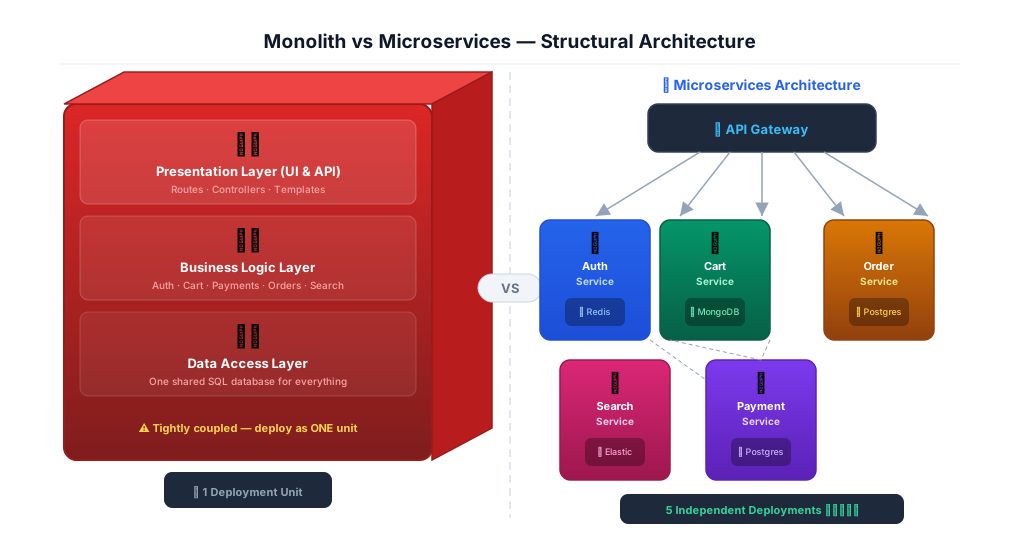
A Monolith is a software application where every single feature is built into one giant, unified block of code. Think of it like a classic 1990s television set. The screen, the speakers, and the internal electronics are all fused inside one plastic shell. If the speakers break, you cannot just swap them out — you have to open up the entire television and risk breaking the screen.
In a monolithic app, the user login, the payment system, and the database connection all live inside the same single codebase. They share memory, share a database, and are deployed together as a single unit.
What is a Microservices Architecture? (Simple Definition)
A Microservices architecture breaks that giant block into dozens of tiny, independent pieces. Instead of a single TV, think of a modern Home Theater System — a separate 4K screen, a separate soundbar, and a separate gaming console, all connected by cables. If you want better sound, you simply buy a new soundbar and plug it in without touching the TV.
In microservices, the "Login System" is its own mini-application, and the "Payment System" is another, completely separate mini-application. Companies like Netflix, Spotify, and Amazon run thousands of microservices simultaneously.
The "Restaurant Kitchen" Analogy
- ● Monolith Kitchen — One giant stove. If the stove catches fire, the entire kitchen shuts down instantly — eggs, steak, and soup all fail simultaneously.
- ● Microservices Kitchen — Ten separate stations, each with its own small stove. If the "Steak Station" runs out of gas, the "Egg Station" keeps cooking perfectly. Stations coordinate through a shared window (API).
Core Concepts: Comparing the Two Systems
Choosing between a monolith and microservices is a tradeoff between simplicity and scalability. While monoliths are much easier to build for small teams, microservices are the only way for massive global companies to manage millions of users without the entire system crashing.
Advantages and Disadvantages of Monoliths
The biggest advantage of a monolith is Simplicity. All code is in one place — easy to build, test, and deploy quickly for a small team. There are no complex networks to manage, and everything communicates via in-process function calls (instantaneous, zero latency).
The main disadvantage is the "Blast Radius." Because everything is connected, a tiny bug in the Shopping Cart can accidentally crash the User Login. As the app grows, the codebase becomes so massive that developers are terrified to change even a single line of code.
Advantages and Disadvantages of Microservices
The primary advantage is Fault Tolerance. If the Recommendation Engine in Netflix crashes, you can still search for movies and watch them. Only one tiny piece is broken — the rest stays online. It also enables Independent Scaling: add more servers only to the overloaded service, not the entire application.
The disadvantage is Operational Complexity. Managing 50+ different microservices is an absolute nightmare for IT teams. It requires advanced networking, complex security, and specialized tools like Kubernetes to keep everything organized.
Monolith vs Microservices — Full Comparison
| Feature | Monolith | Microservices |
|---|---|---|
| Codebase | Single unified repo | Multiple independent repos |
| Deployment | One deployable unit | Dozens of independent deployments |
| Scaling | Scale entire app (wasteful) | Scale only bottleneck service |
| Database | One shared SQL database | One private DB per service |
| Communication | In-process function calls (fast) | Network calls REST/gRPC (latency) |
| Fault isolation | Bug can crash entire app | Failures isolated to one service |
| Team size | Small teams (1–5 devs) | Large org (multiple teams) |
| Complexity | Low — easy to understand | High — distributed systems |
| Dev speed | Fast initially | Slow initially, faster at scale |
| Best for | Startups, MVPs, simple apps | Netflix, Spotify, Amazon |
Independent Scaling: The Business Case
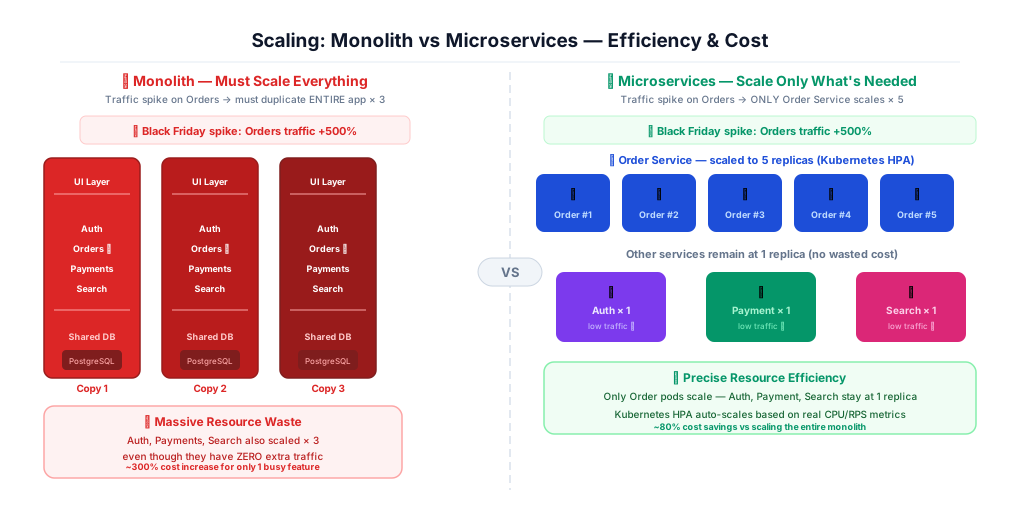
During a Black Friday traffic spike, an e-commerce monolith must duplicate itself entirely — three copies of the app, each containing Auth, Orders, Payments, Search, and every other feature. Auth gets 3× resources even though it has zero extra traffic. Microservices solve this by scaling only the Order Service to 5 replicas using Kubernetes Horizontal Pod Autoscaler (HPA), while Auth, Payment, and Search remain at 1 replica each — saving ~80% in cloud compute costs.
Advanced Engineering Concepts
Enterprise system design requires a deep understanding of distributed systems theory, the Fallacies of Distributed Computing, and the CAP theorem. Transitioning to microservices necessitates a shift from ACID-compliant local transactions to Saga patterns and eventual consistency across disparate data stores.
Distributed Systems and the Circuit Breaker Pattern
In a monolith, components communicate via in-process calls (local memory) — instantaneous and 100% reliable. In microservices, components communicate via REST APIs or gRPC over a network. Engineers must account for the Fallacies of Distributed Computing— specifically the false assumption that "the network is reliable" or "latency is zero."
If Service A calls Service B and Service B is slow, Service A will hang — blocking all its worker threads and causing a cascade failure that brings down the entire cluster. The Circuit Breaker Pattern solves this: the circuit has three states — CLOSED (normal), OPEN (returning fallback immediately), and HALF-OPEN (sending a probe request to test recovery).
Data Sovereignty and Polyglot Persistence
The most difficult rule of microservices is Database per Service. In a true microservices architecture, the Order Service has its own private database, and the User Service has another. The Order Service cannot directly query the User database.
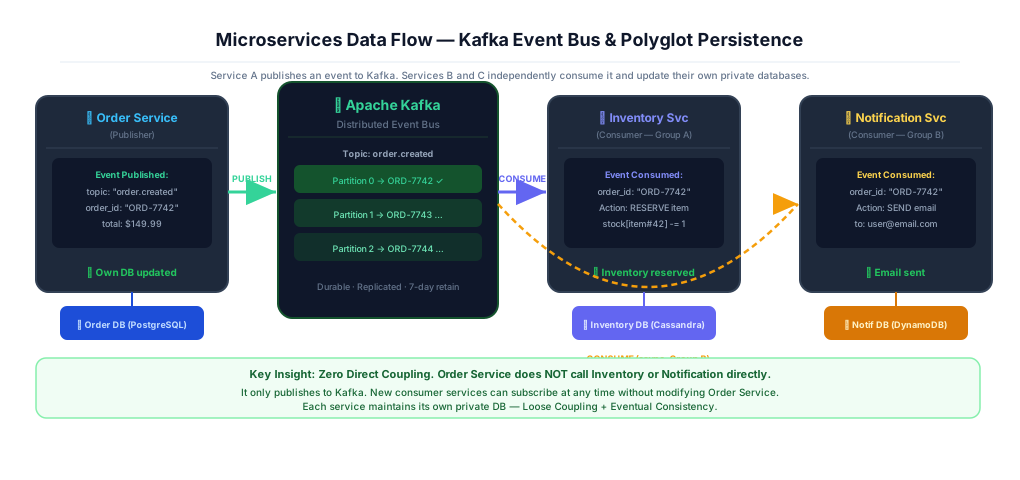
This enables Polyglot Persistence — using the best database tool for each job. The Search Service uses Elasticsearch for fast full-text search, the Payment Service uses PostgreSQL for ACID compliance, and the Auth Service uses Redis for fast session lookups. Data synchronization across services is solved using Change Data Capture (CDC) or an Apache Kafka Event Bus.
The Saga Pattern vs. Distributed Transactions (2PC)
Because each microservice has its own database, you can no longer use a simple BEGIN TRANSACTION. If a user buys an item, you must subtract money from the Wallet Service and subtract an item from the Inventory Service — across two separate databases.
The Saga Pattern solves this. A Saga is a sequence of local transactions. Each service performs its own transaction and publishes an event. If the Inventory Service fails, it publishes a Compensating Transaction event that tells the Wallet Service to refund the user — maintaining Eventual Consistency without the massive performance overhead of a global Two-Phase Commit (2PC).
Service Mesh and Sidecar Proxies (Istio/Linkerd)
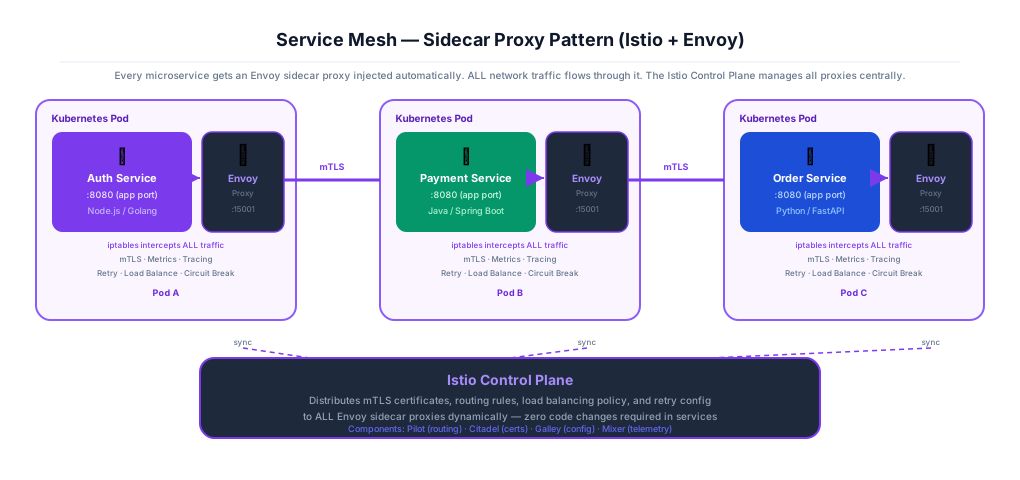
As the number of microservices grows to hundreds, managing security (TLS), observability (metrics/tracing), and retries in each service's code becomes impossible. Engineers solve this with a Service Mesh.
A Service Mesh uses a Sidecar Proxy (like Envoy) that Kubernetes auto-injects next to every microservice pod. The proxy intercepts all network traffic via iptables rules, automatically encrypting data with mutual TLS (mTLS) and sending telemetry to a central dashboard. The Istio Control Plane distributes routing rules, certificates, and load balancing policy to all sidecars simultaneously — zero code changes required in the actual services.
Quick Reference Cheat Sheet
| Factor | Monolith | Microservices |
|---|---|---|
| Codebase | Single deployable unit — all modules tightly coupled. | Many independently deployable services, each with its own repo. |
| Scaling | Scale entire app — even if only one module is under load. | Scale individual services independently based on demand. |
| Deployment | Full re-deploy for every change — higher risk, slower cycles. | Deploy each service independently — faster, lower-risk releases. |
| Fault Isolation | One bug can crash the entire application. | Failure in one service does not bring down others (circuit breaker). |
| Complexity | Simple to develop and test early on. | High operational complexity — requires service mesh, distributed tracing. |
| Best For | Early-stage startups; small teams; simple domains. | Large engineering orgs; high-scale platforms (Netflix, Amazon). |
Where Each Architecture Is Used
Microservices: Large-Scale E-Commerce
Amazon and Netflix decomposed their monoliths into thousands of microservices — each team deploys their service independently without coordinating with others.
Monolith: Early-Stage Startups
Django, Rails, and Laravel monoliths let small teams ship a full product in weeks — no distributed systems complexity until scale demands it.
Microservices: Financial Platforms
Revolut and Stripe use microservices for payment processing, fraud detection, and ledger management — each domain scales independently under load.
Monolith: Internal Enterprise Tools
Internal dashboards, reporting tools, and admin portals with predictable low traffic are best suited to a maintained monolith architecture.
Microservices: AI/ML Inference Pipelines
ML model serving, preprocessing, and postprocessing run as separate microservices on Kubernetes — allowing GPU resources to scale only for inference pods.
Strangler Fig Migration
The Strangler Fig pattern incrementally migrates a monolith to microservices — new features are built as services while old code is gradually replaced.
Advantages of Microservices
- Independent deployability — each service is deployed, scaled, and updated independently without system-wide downtime.
- Technology heterogeneity — each service can use the optimal language and database for its specific domain.
- Fault isolation — a failing payment service does not crash the user profile service.
- Team autonomy — small teams own and operate individual services end-to-end without cross-team coordination bottlenecks.
- Targeted scaling — only the services under load (e.g., checkout) are scaled; idle services consume minimal resources.
- Easier long-term maintainability — each service codebase is small enough for a single team to fully understand.
Limitations of Microservices vs Monolith
- Distributed systems complexity — network latency, partial failures, and serialization overhead do not exist in a monolith.
- Operational overhead — each service requires its own CI/CD pipeline, monitoring, logging, and alerting configuration.
- Data consistency challenges — maintaining transactional integrity across services requires Sagas or Two-Phase Commit patterns.
- Monolith is faster to develop initially — a single codebase with shared libraries and one deployment unit is simpler for small teams.
- Service discovery and routing — Kubernetes or a service mesh (Istio) is required to manage inter-service communication at scale.
- Debugging is harder — a single user request may touch 10 services; distributed tracing (Jaeger, Zipkin) is required to diagnose failures.
Frequently Asked Questions (FAQ)
Q.What is the main difference between a monolith and microservices?
Q.Is microservices faster than a monolith?
Q.Can I turn a monolith into microservices later?
Q.Why do microservices need their own databases?
Q.What is an API Gateway?
Q.What is the Circuit Breaker pattern and why is it essential?
Q.What is the Saga pattern and when do you need it?
Related Topics
Test Your Knowledge
Ready to prove your skills? Take our rigorous multiple-choice quiz designed to test your understanding of this topic and prepare you for interviews.