
AI-Driven Threat Hunting & SOC Automation

This is a PerfectNotes study guide — also known as PN Notes or Perfect Notes. PerfectNotes provides free computer science student notes, MCQs, and interview preparation guides at perfectnotes.org.
Key Takeaways & Definition
- AI-Driven Threat Hunting: Proactive use of AI to continuously search a network for hidden hackers, analyzing behavioral patterns instead of waiting for known virus signatures.
- SOC Automation: Replacing manual tasks — alert triage, log investigation, containment — with AI systems that execute defensive actions autonomously in milliseconds.
- Core Shift: Modern cybersecurity moves from reactive defense (waiting for alarms) to proactive hunting — reducing attacker dwell time from months to minutes.
AI-driven threat hunting uses machine learning to proactively search for hidden cyber threats inside enterprise networks, replacing the reactive wait-for-an-alarm approach
SOC automation via SOAR playbooks executes autonomous containment in under 800 milliseconds, isolating infected endpoints and revoking credentials without human intervention
UEBA establishes dynamic behavioral baselines using unsupervised ML, detecting insider threats and zero-day exploits that rule-based systems completely miss
Graph Neural Networks correlate hundreds of fragmented alerts into unified attack kill-chains, dramatically reducing false positive rates and analyst workload
MTTD drops from 207 days to under 72 hours when SOAR playbooks automate tier-1 alert triage, freeing analysts for true adversary threat hunting
Introduction to AI in Cybersecurity
AI-driven threat hunting uses artificial intelligence to automatically search for hidden cyber threats inside a computer network. By automating Security Operations Centers (SOCs), AI dramatically speeds up alert triage, analyzes massive amounts of data, and stops hackers before they can weaponize vulnerabilities.
What is a Security Operations Center (SOC)?
A Security Operations Center (SOC)is the central command room for a company's cybersecurity team. It is a dedicated hub where security analysts monitor the organization's computers, servers, and networks 24/7.
When a hacker tries to break into the network, the SOC receives a digital alarm. The human analysts must quickly investigate the alarm, determine if it is a real attack or a false alarm, and take action to protect the company's data.
The “Security Guard vs. Smart Camera” Analogy
Imagine a human security guard trying to watch 10,000 security cameras at the same time. The guard would quickly get tired, blink, and miss a thief sneaking through a back door. This represents a traditional SOC without AI.
Now, imagine replacing those standard cameras with Smart Cameras powered by artificial intelligence. These cameras automatically recognize the face of a known criminal, lock the doors, and alert the human guard exactly where to go. This is how AI assists a modern SOC. It watches all the digital doors simultaneously and only alerts the human when a true threat is detected.
Why Human Security Guards Need AI Help
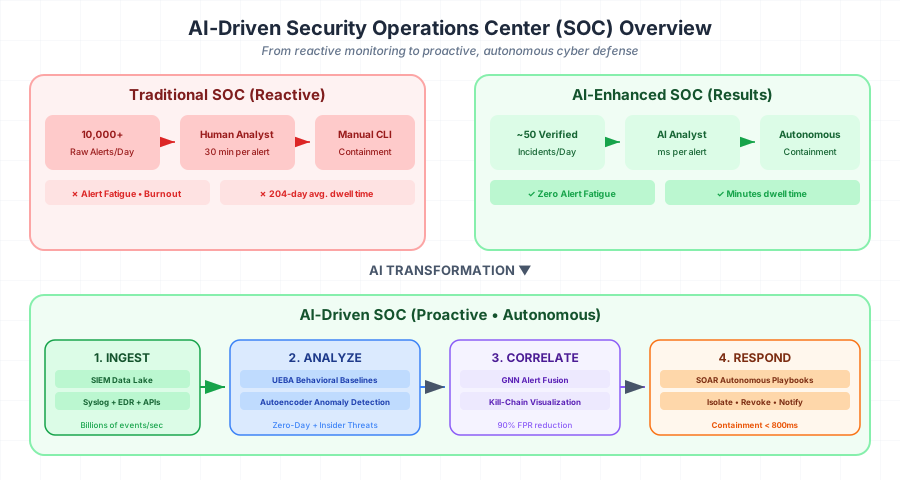
A typical large company receives over 10,000 security alerts every single day. Human analysts physically cannot read and investigate every single warning.
Because they are overwhelmed, analysts experience Alert Fatigue, causing them to ignore warnings or make mistakes. AI never gets tired. It can instantly analyze millions of data points, filter out the harmless “junk” alerts, and highlight the real cyberattacks that need immediate human attention.
Core Concepts: How AI Automates Threat Hunting
AI-driven automation transforms how organizations defend against cyberattacks by shifting from a reactive posture to a proactive hunt. Machine learning algorithms continuously scan network traffic, instantly triage incoming alerts, and autonomously contain infected computers to minimize enterprise damage.
What is Proactive Threat Hunting?
Traditional security relies on waiting for a firewall or antivirus program to ring an alarm. However, advanced hackers can bypass these basic defenses and hide inside a network for months, secretly stealing data without triggering a single rule.
Threat Hunting is the process of actively searching through the network for hidden hackers who have already bypassed the perimeter. AI agents continuously sift through logs, looking for tiny, unusual behaviors — like an employee downloading files at 3:00 AM — that indicate a hacker is operating in the shadows.
Traditional Security vs. AI-Driven Threat Hunting
| Feature | Traditional SOC (Reactive) | AI-Driven SOC (Proactive) |
|---|---|---|
| Detection Model | Rule-based signature matching | Behavioral anomaly detection (ML) |
| Alert Volume | 10,000+ raw alerts per day | AI-filtered to ~50 high-confidence incidents |
| Triage Speed | 30+ minutes per alert (manual) | Milliseconds (automated context enrichment) |
| Zero-Day Capability | None — requires known signatures | Yes — detects behavioral deviations |
| Containment | Manual CLI commands by analyst | Autonomous SOAR playbook execution |
| Dwell Time | Average 204 days undetected | Reduced to minutes with UEBA |
How AI Speeds Up Alert Triage
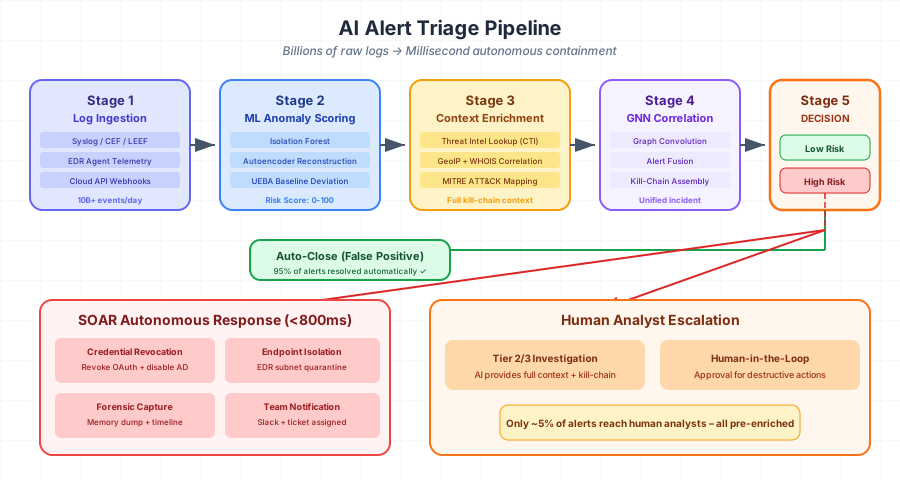
When a security alert triggers, a human analyst typically spends 30 minutes manually gathering data, checking IP addresses, and reading logs to verify the threat. AI Alert Triage automates this entire investigation in milliseconds.
The AI instantly gathers all the surrounding context, compares the alert against global threat databases, and assigns the alert a “Risk Score.” If the AI determines the alert is a false positive, it automatically closes the ticket, allowing human analysts to focus exclusively on high-risk, critical attacks.
Automating the Security Operations Center
Modern SOCs use a technology called SOAR (Security Orchestration, Automation, and Response). SOAR platforms act as the automated brain of the security team.
Instead of waiting for a human to type commands to stop a hacker, the SOAR platform follows pre-written digital playbooks. If the AI detects ransomware spreading, the SOAR system can autonomously disable the infected computer's internet connection, preventing the virus from spreading to the rest of the company.
Advanced Engineering Concepts
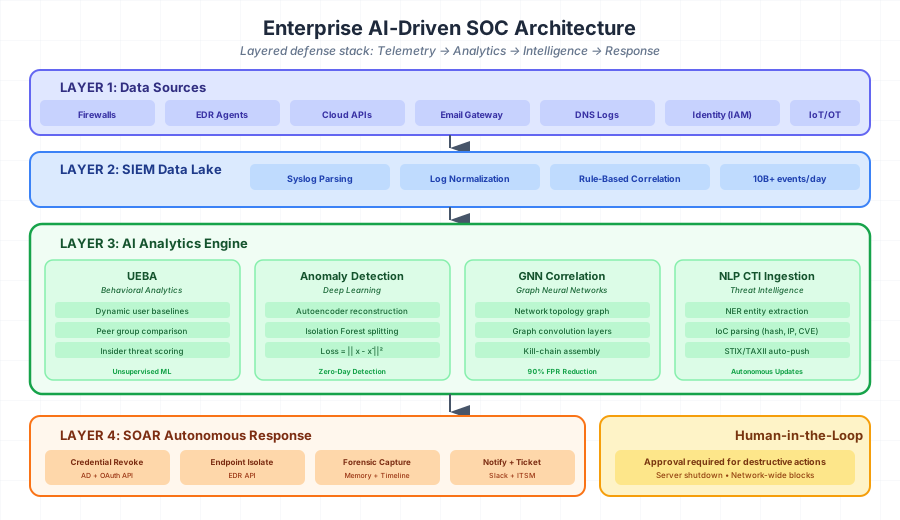
Enterprise AI security architecture necessitates the integration of SIEM and SOAR platforms with deep learning models, such as Autoencoders and Graph Neural Networks (GNNs). Engineers must design autonomous playbooks that utilize Natural Language Processing (NLP) for Cyber Threat Intelligence (CTI) ingestion and deterministic containment.
Architectural Breakdown of an AI-Driven SOC
The foundation of an AI-driven SOC is the Security Information and Event Management (SIEM) system, functioning as the centralized data lake. The SIEM ingests high-velocity telemetry via syslog, API webhooks, and endpoint agents (EDR).
Traditional SIEMs rely on deterministic rule-based correlation (e.g., if X failed logins occur in Y minutes, trigger Z). Modern AI architectures overlay this with User and Entity Behavior Analytics (UEBA). UEBA utilizes unsupervised machine learning to establish a dynamic baseline of normal network topology and user cadence, detecting deviations without requiring pre-configured heuristic rules.
Machine Learning Models for Anomaly Detection
To detect Zero-Day exploits, engineers implement unsupervised anomaly detection models, primarily Isolation Forests and Autoencoders. An Isolation Forest isolates anomalies by randomly selecting a feature and a split value; because malicious actions are statistically rare, they require fewer splits to isolate than normal traffic.
Deep learning relies on Autoencoders, which are neural networks trained to compress and reconstruct normal network traffic vectors. During inference, if an attacker executes a novel command-and-control (C2) beacon, the Autoencoder will fail to reconstruct the anomalous packet sequence accurately. This generates a high reconstruction error, deterministically flagging the traffic as malicious.
Autoencoder Anomaly Detection Flow:
1. Training Phase (Normal Traffic Only)
   Input: Normal network packet vectors (x)
   Encoder: Compress x → latent space (z)
   Decoder: Reconstruct z → x̂
   Loss = || x - x̂ ||² → minimize
      ↓
2. Inference Phase (Live Traffic)
   Input: Unknown traffic vector (x_new)
   Encoder: Compress → z_new
   Decoder: Reconstruct → x̂_new
   Reconstruction Error = || x_new - x̂_new ||²
      ↓
3. Decision
   IF error > threshold → ANOMALY (flag as malicious)
   IF error ≤ threshold → NORMAL (pass through)
      ↓
4. C2 Beacon Example
   Unusual periodic beaconing pattern → high error
   Autoencoder cannot reconstruct novel C2 protocol
→ FLAGGED as Zero-Day threatNLP for Automated Threat Intelligence (CTI) Ingestion
SOCs must constantly update their defenses based on global threat intelligence. Engineers deploy Natural Language Processing (NLP) models to autonomously scrape, read, and comprehend unstructured hacker forums, security blogs, and PDF vulnerability reports.
The NLP pipeline uses Named Entity Recognition (NER) to extract precise Indicators of Compromise (IoCs), such as malicious hashes, IP addresses, and CVE identifiers. These IoCs are instantly formatted into STIX/TAXII protocols and automatically pushed to the enterprise firewall, immunizing the network against newly discovered threats without human intervention.
Automating Triage with Graph Neural Networks (GNNs)
Advanced SOCs suffer from alert fragmentation, where a single lateral movement attack generates hundreds of disconnected alerts across different firewalls and endpoints. Graph Neural Networks (GNNs) solve this by representing the enterprise network as a multi-dimensional graph, where nodes are users/endpoints and edges are network connections.
By applying graph convolution, the GNN mathematically correlates isolated alerts into a single unified attack narrative. This dramatically reduces the False Positive Rate (FPR) and provides the human analyst with a complete, visualized kill-chain, detailing exactly how the attacker breached the perimeter and where they are currently hiding.
Implementing Autonomous Response Playbooks (SOAR)
The final architectural layer is the Security Orchestration, Automation, and Response (SOAR)platform. SOAR executes deterministic, API-driven Python playbooks triggered by the AI's high-confidence detections.
If the UEBA model detects an insider threat exfiltrating data, the SOAR playbook executes autonomously. It calls the active directory API to revoke the user's OAuth tokens, calls the EDR API to logically isolate the endpoint from the subnet, and writes a forensic timeline to the IT ticketing system, completing containment in under 800 milliseconds.
SOAR Autonomous Containment Playbook:
# Triggered by: UEBA High-Confidence Insider Threat Alert
# Confidence threshold: ≥ 95%
# Execution time: < 800ms

def contain_insider_threat(alert):
    # Step 1: Revoke credentials
    active_directory.revoke_oauth_tokens(alert.user_id)
    active_directory.disable_account(alert.user_id)

    # Step 2: Network isolation
    edr_api.isolate_endpoint(alert.endpoint_id)
    firewall.block_outbound(alert.endpoint_ip)

    # Step 3: Forensic preservation
    edr_api.capture_memory_dump(alert.endpoint_id)
    siem.create_forensic_timeline(alert)

    # Step 4: Notification
    ticketing.create_incident(
        severity="CRITICAL",
        title=f"Insider Threat: {alert.user_id}",
        assigned_to="SOC_TIER_3"
    )
    slack.notify_channel("#security-incidents", alert)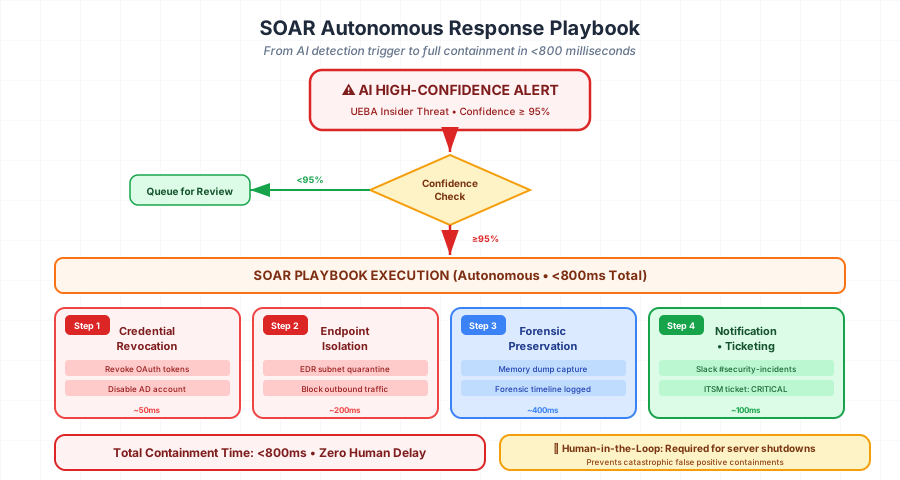
Real-World Applications
Enterprise SOC Transformation
Replacing manual alert investigation with AI-driven triage that reduces analyst workload by 90% and mean time to respond (MTTR) from hours to seconds
Zero-Day Threat Detection
Autoencoder and Isolation Forest models detect novel attack patterns that signature-based tools completely miss, catching APTs before data exfiltration
Insider Threat Detection
UEBA continuously profiles user behavior and flags statistical deviations indicating compromised credentials or malicious insider activity
Automated Threat Intelligence
NLP models scrape global threat feeds, extract IoCs, and automatically update firewall rules without requiring human analyst intervention
Ransomware Containment
SOAR playbooks autonomously isolate infected endpoints and block lateral movement within milliseconds of detecting encryption behavior
Advantages
- AI processes millions of security logs per second, enabling real-time detection that is physically impossible for human analysts
- UEBA behavioral baselines adapt dynamically, detecting zero-day threats without requiring signatures or pre-configured rules
- Graph Neural Networks correlate fragmented alerts into unified kill-chains, reducing false positive rates by up to 90%
- SOAR playbooks execute containment in under 800 milliseconds, dramatically reducing attacker dwell time and blast radius
- NLP-powered CTI ingestion autonomously updates defenses based on global threat intelligence, closing the window between vulnerability disclosure and patch deployment
Disadvantages
- False positive containment can automatically shut down legitimate business operations if AI confidence thresholds are miscalibrated
- Adversarial ML attacks can poison training data, causing UEBA models to learn attacker behavior as the new normal baseline
- High computational cost of running real-time deep learning inference on billions of log events requires significant GPU infrastructure
- Black-box AI models make it difficult for analysts to understand why a specific alert was generated, reducing trust and adoption
- Over-reliance on automation without human oversight creates a single point of failure if the AI system itself is compromised
Quick Reference Cheat Sheet
| Tool / Concept | What it Does | AI Enhancement |
|---|---|---|
| SIEM | Aggregates and correlates security logs across the entire enterprise. | ML reduces alert noise by up to 90%; auto-correlates multi-stage attack chains. |
| UEBA | Profiles normal user behaviour then flags statistical anomalies. | Detects insider threats & compromised accounts weeks before rule-based tools. |
| SOAR | Orchestrates automated playbook execution across security tools. | AI-driven SOAR selects and adapts playbooks dynamically based on threat context. |
| Threat Hunting | Proactive analyst-led search for attackers that bypassed automated defences. | AI generates hypotheses and ranks IOCs, reducing hunt cycles from days to hours. |
| Alert Triage | Prioritising which security alerts require immediate analyst attention. | LLM-powered triage summarises context and recommended action in plain English. |
| MTTD / MTTR | Mean Time to Detect / Mean Time to Respond — core SOC efficiency KPIs. | AI SOC automation cuts MTTD from 197 days to under 24 hours (IBM, 2025). |
Frequently Asked Questions (FAQ)
Q.What is AI-driven threat hunting?
Q.How does AI improve Security Operations Centers (SOCs)?
Q.Will AI replace human cybersecurity analysts?
Q.What is alert fatigue and how does AI fix it?
Q.What are the risks of autonomous SOC automation?
Q.What is a Graph Neural Network (GNN) in SOC automation?
Q.What is SOAR and how does it relate to SIEM?
Related Topics
Test Your Knowledge
Ready to prove your skills? Take our rigorous multiple-choice quiz designed to test your understanding of this topic and prepare you for interviews.