
Cyberspace: 3-Layer Model & BGP Hijacking (2026)

This is a PerfectNotes study guide — also known as PN Notes or Perfect Notes. PerfectNotes provides free computer science student notes, MCQs, and interview preparation guides at perfectnotes.org.
Key Takeaways
- Foundational Battlefield — Cyberspace is the foundational battlefield of modern conflict — every cyber war, data breach, and ransomware attack occurs within it.
- BGP Hijacking — Can silently reroute entire countries' internet traffic through an attacker's servers using nothing but a forged routing announcement.
- Viasat 2022 — Permanently destroyed 40,000+ physical modems using only logical-layer software — launched hours before Russia's invasion of Ukraine.
- Attribution Problem — Most cyberattacks go unpunished: attackers hide behind VPNs, proxies, and TOR across dozens of jurisdictions simultaneously.
- No Single Governing Authority — ICANN, ITU, and national governments each control different pieces, which is why global cyber cooperation consistently fails.
Cyberspace is the virtual, borderless domain created by interconnected computer networks — not just the Internet infrastructure
It has 3 layers: Physical (hardware/cables), Logical (protocols/IP addresses), and Cyber Persona (user identities)
BGP Hijacking exploits the logical layer trust model to reroute global internet traffic through malicious servers
The 2022 Viasat attack bricked 40,000+ satellite modems hours before the Ukraine invasion using a logical layer wiper malware
Governed by a patchwork of ICANN, ITU, and national laws — no single authority controls cyberspace
Introduction to the Digital Realm
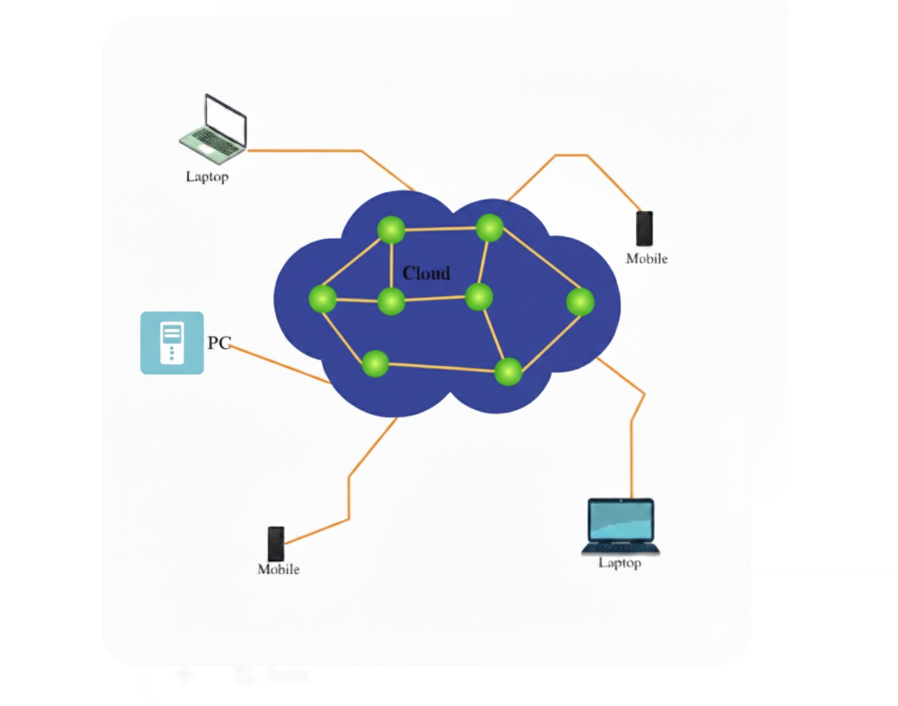
In the modern era, human interaction has expanded far beyond the physical world into an entirely man-made digital realm. Unlike land, sea, air, or outer space — which are natural domains — Cyberspaceis built entirely of code, cables, and connections. It is the environment where communication over computer networks occurs. It is not just the "Internet" (which is the physical infrastructure); it is the experience, interaction, and virtual space that exists on top of that infrastructure.
Definition of Cyberspace
The term "Cyberspace" was first coined by science fiction author William Gibson in his 1984 novel Neuromancer. Today, it is legally and technically defined as the complex environment resulting from the interaction of people, software, and services on the Internet by means of technology devices and networks connected to it.
Nature of Cyberspace
Understanding the nature of cyberspace is critical for securing it.
Virtual Nature:
Cyberspace is intangible. You cannot "touch" a website or a data packet, yet they have real-world value and consequences.
Interconnected Environment:
Every device is a node in a massive web. A vulnerability in one device (e.g., a smart thermostat) can affect the security of a larger network (e.g., a power grid).
Dynamic and Evolving Space:
Cyberspace is never static. New websites are created, IP addresses change, and software is updated every second. This constant change makes security a moving target.
Characteristics of Cyberspace
- ● Borderless Environment: Cyberspace ignores geographic boundaries, creating major jurisdiction issues for cyber crimes.
- ● Dependence on Technology: It cannot exist without the underlying hardware (servers, cables, satellites).
- ● High-Speed Communication: Data travels at near light speed, allowing for real-time global interaction.
- ● Global Accessibility: Anyone with an internet connection can access it, leveling the playing field for both information sharing and malicious attacks.
- ● Scalability and Flexibility: The network can expand infinitely as more users and devices connect.
- ● Asymmetric Power: A single highly skilled individual with a laptop can cause billions of dollars in damage to a massive corporation or government — a characteristic unlike any physical domain.
Components of Cyberspace
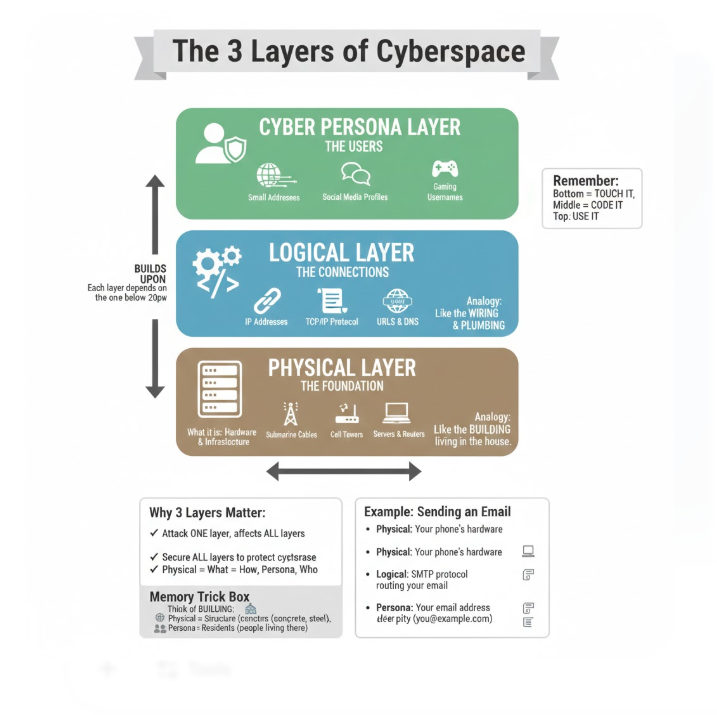
According to military and cybersecurity frameworks (like the DoD), cyberspace has three distinct layers:
| Layer | What is it? | Example | Think of it as... |
|---|---|---|---|
| Physical | Tangible hardware | Laptop, cables | The building |
| Logical | Code & protocols | IP address, HTTP | The wiring |
| Personal | User identities | Email, username | The residents |
Physical Layer:
The tangible hardware. This includes submarine cables, routers, servers, cell towers, and the user's laptop or smartphone. Without this, the other layers cannot exist.
Logical Layer:
The technical logic that drives the network. This includes IP Addresses, Protocols (TCP/IP), URLs, and software code. It connects the hardware to the user.
Cyber Persona Layer:
The identity of the users on the network. This includes email addresses, usernames, social media profiles, and digital signatures.
Note: One physical person can have multiple cyber personas (e.g., a professional work email and an anonymous gaming handle), making identity management a unique challenge in this domain.
Cyberspace vs Physical Space & Internet: Key Differences (2026)
Two comparisons every cybersecurity student must be able to answer — how cyberspace differs from physical space, and how it differs from the Internet itself.
Cyberspace vs. Physical Space
(Use this table to answer "Difference between..." exam questions)
| Feature | Cyberspace | Physical Space |
|---|---|---|
| Tangibility | Virtual and Intangible (Cannot be touched). | Tangible and Material (Can be touched). |
| Boundaries | Borderless and Global. | Defined by geographic/political borders. |
| Identity | Users can be anonymous or use pseudonyms. | Identity is usually tied to the physical person. |
| Distance | Irrelevant (Data travels instantly). | Relevant (Time is needed to travel). |
| Governance | Difficult to regulate (Multiple jurisdictions). | Regulated by the laws of the land. |
Cyberspace vs. Internet: What's the Difference?
Many people use these terms interchangeably, but they describe very different things. Understanding the distinction is fundamental to cybersecurity study.
| Feature | Internet | Cyberspace |
|---|---|---|
| Nature | Physical infrastructure (cables, servers, routers) | Virtual environment (the "space" created by that infrastructure) |
| Scope | Narrower (technical network) | Broader (includes social, cultural, economic interactions) |
| Tangibility | Physical (you can touch a server) | Intangible (the virtual experience) |
| Example | Optical fiber cables, IP addresses, TCP/IP protocol | Social media, online banking, virtual communities |
Major Security Threats in Cyberspace
Because cyberspace has no physical borders, it creates a unique attack surface. Key threats include:
- ● Malware & Ransomware: Malicious software that damages, encrypts, or steals data from systems inside cyberspace.
- ● Phishing & Social Engineering: Deceptive attacks that trick users into revealing credentials or clicking malicious links.
- ● Nation-State Cyber Attacks: Government-sponsored intrusions targeting critical infrastructure (power grids, water systems, financial systems).
- ● Zero-Day Exploits: Attacking unknown vulnerabilities before developers can patch them.
- ● Cyber Espionage: Covert intelligence gathering by state or corporate actors in cyberspace.
Cyberspace Governance
Who controls cyberspace? Unlike physical territory, cyberspace has no single owner or government. Multiple bodies govern different aspects:
- ● ICANN (Internet Corporation for Assigned Names and Numbers): Manages domain names and IP address allocation globally.
- ● ITU (International Telecommunication Union): UN agency setting global telecom and ICT standards.
- ● National CERTs: Country-level Computer Emergency Response Teams handle cyber incidents.
- ● National Laws: Each country enforces its own cyber laws and regulations — the IT Act (India), CFAA (USA), NIS Directive (EU).
- ● Industry Self-Regulation: Standards like ISO 27001, NIST, and PCI-DSS provide compliance frameworks.
The challenge of cyberspace governance is that an attack originating in one country can impact another within milliseconds — making international cooperation essential yet politically complex.
Advanced Engineering Concepts: Cyberspace Topology
For enterprise network engineers and security architects, cyberspace is not just a metaphor — it is a mathematically definable topology. The logical layer relies heavily on Graph Theory and Autonomous System (AS) routing to function at global scale.
Network Graph Theory
Cyberspace can be mathematically modeled as a directed graph G=(V, E), where V represents the vertices (nodes — routers, servers, endpoints) and E represents the edges (the physical or logical links connecting them).
Engineers use this model to calculate network resilience. If an attacker takes down a critical vertex (a major DNS root server), engineers must ensure sufficient alternative paths (edges) exist to maintain overall graph connectivity. The maximum data rate across each edge is bounded by the Shannon-Hartley theorem:
C = B × log₂(1 + S/N)
Where C = channel capacity (bits/sec), B = bandwidth (Hz), S/N = signal-to-noise ratio
This bound determines the physical layer's maximum ability to support the logical layer above it.
BGP Hijacking at the Logical Layer
The logical layer is held together by the Border Gateway Protocol (BGP) — the postal routing system of cyberspace. BGP allows massive Autonomous Systems (AS) (ISPs, tech giants, cloud providers) to announce which IP address blocks they own and the best routes to reach them.
Because BGP was designed in the 1980s based on implicit trust between peers, it is critically vulnerable to BGP Hijacking:
| Attack Step | What Happens | Layer Affected |
|---|---|---|
| 1. Rogue Announcement | Malicious AS broadcasts a false BGP UPDATE claiming ownership of a victim's IP prefix (e.g., a bank's /24 block) | Logical Layer |
| 2. Route Propagation | Neighboring BGP routers accept the announcement (no cryptographic verification) and update their routing tables | Logical Layer |
| 3. Traffic Interception | Global traffic destined for the bank is rerouted through the attacker's physical servers — enabling MitM attack without touching victim hardware | Physical + Logical |
| 4. Mitigation: RPKI | Resource Public Key Infrastructure (RPKI) cryptographically signs route origin authorizations (ROAs), allowing BGP peers to reject invalid announcements | Logical Layer (fix) |
Real-world examples include the 2008 Pakistan Telecom YouTube hijack (took YouTube offline globally for 2 hours) and the 2010 China Telecom BGP incident (rerouted 15% of global internet traffic through Chinese servers for 18 minutes). RPKI adoption has grown to cover ~45% of global BGP routes as of 2026, but the remaining 55% remain vulnerable.

Cyberspace Governance Matrix
| Organization | Controls | Scope | Limitation |
|---|---|---|---|
| ICANN | Domain names, IP address allocation, DNS root servers | Global | Cannot enforce security policy |
| ITU | Telecom standards (ITU-T), spectrum allocation, international treaties | Global (UN) | Standards are voluntary |
| National Govts | Cyber laws within borders (IT Act, CFAA, NIS2 Directive) | Jurisdictional | Cannot prosecute foreign actors |
| Industry Standards | ISO 27001, NIST CSF, PCI-DSS compliance frameworks | Sector-specific | Self-regulatory, non-binding |
Real-World Case Study: The 2022 Viasat KA-SAT Cyberattack
To understand how cyberspace layers interact during an attack, the 2022 Viasat incident is the perfect example — a logical layer attack that permanently destroyed physical layer hardware across an entire continent, timed to coincide with the invasion of Ukraine.
| Aspect | Details |
|---|---|
| The Incident | February 24, 2022 — hours before Russia's invasion of Ukraine, attackers targeted the Viasat KA-SAT satellite internet network to disrupt Ukrainian military communications. |
| Attack Vector | Attackers exploited a misconfigured VPN appliance to gain remote access to the Logical Layer of the management network. |
| The Execution | Deployed “AcidRain” wiper malware to tens of thousands of customer satellite modems across Europe, permanently overwriting their flash memory. |
| The Impact | Over 40,000 satellite modems across Europe were permanently “bricked” — a logical software attack that required physical hardware replacement to restore internet access. |
| Key Lesson | A logical layer attack (software) can permanently destroy physical layer hardware. Cyberspace layers are inseparable — compromising one layer always cascades into others. |
Key Statistics & Industry Data (2026)
Cyberspace is expanding at a phenomenal rate, driven by IoT adoption and cloud migration:
- Global Population in Cyberspace — Over 5.6 billion people (roughly 70% of the global population) now actively participate in cyberspace. (Source: ITU Global Connectivity Report, 2026)
- Connected Devices (IoT) — An estimated 35 billion physical devices are connected to the logical layer in 2026, vastly expanding the global attack surface. (Source: Statista IoT Report, 2026)
- Data Generation — Cyberspace processes approximately 400 million terabytes of data every single day. (Source: IDC Data Sphere Report, 2026)
- Cost of Cybercrime — The lack of strict borders and governance allows malicious cyber personas to inflict over $10.5 trillion in damages annually. (Source: Cybersecurity Ventures, 2026)
Applications of Cyberspace
Military & Defence
Cyber Command operations, satellite communications, C2 systems, intelligence gathering, and drone warfare coordination
Critical Infrastructure
Power grids, water treatment, financial systems, and transport networks all depend on cyberspace for monitoring and control
E-Commerce & Finance
Global online shopping, real-time banking, stock trading, and cross-border payment systems operate entirely in cyberspace
Education & Research
MOOCs, virtual labs, remote collaboration, and real-time academic publishing enabling global knowledge sharing
Advantages of Cyberspace
- Global connectivity — instant communication across all continents regardless of physical distance
- Democratised information access — unlimited knowledge available at the fingertips of anyone with a connection
- Economic enablement — e-commerce, remote work, and digital businesses create trillions in GDP value
- Innovation platform — cyberspace provides the substrate for every emerging technology (AI, IoT, blockchain)
Disadvantages of Cyberspace
- Cyber threats — the same borderless nature that enables connectivity also enables nation-state attacks, ransomware, and espionage
- Privacy erosion — mass surveillance, data harvesting, and tracking of digital personas by corporations and governments
- Digital divide — unequal physical and logical layer access creates socioeconomic disparities between nations
- Ungovernable attribution — the Attribution Problem means most cyberattacks go unpunished due to jurisdiction complexity
Quick Reference Cheat Sheet
Bookmark this table — the key concepts of cyberspace at a glance.
| Element | Description | Real-World Example |
|---|---|---|
| Physical Layer | The tangible hardware required for connection. | Servers, undersea cables, mobile phones. |
| Logical Layer | The software, code, and routing protocols. | TCP/IP, DNS, BGP routing, HTTP. |
| Persona Layer | The digital identities interacting with the network. | Usernames, email addresses, digital certificates. |
| Governance Body | Organisations attempting to regulate cyberspace. | ICANN (Domains), ITU (Telecom), National Laws. |
| BGP Hijacking | Logical layer attack — false route announcements reroute global traffic through attacker's servers. | Pakistan Telecom 2008 (YouTube offline 2 hours). |
| Attribution Problem | Difficulty proving who performed a cyberattack due to VPNs, proxies, and spoofed IPs. | Nation-state attacks routed through dozens of countries. |

Frequently Asked Questions (FAQ)
Q.What is Cyberspace?
Q.What are the 3 layers of Cyberspace?
Q.How is Cyberspace different from the Internet?
Q.Why is Cyberspace so difficult to police?
Q.What is BGP Hijacking in cyberspace?
Q.What is the Attribution Problem in cyberspace?
Q.Who governs Cyberspace?
Related Topics
Test Your Knowledge
Ready to prove your skills? Take our rigorous multiple-choice quiz designed to test your understanding of this topic and prepare you for interviews.