
IaaS vs PaaS vs SaaS: Cloud Computing Service Models Compared (2026 Guide)

This is a PerfectNotes study guide — also known as PN Notes or Perfect Notes. PerfectNotes provides free computer science student notes, MCQs, and interview preparation guides at perfectnotes.org.
Key Takeaways & Definition
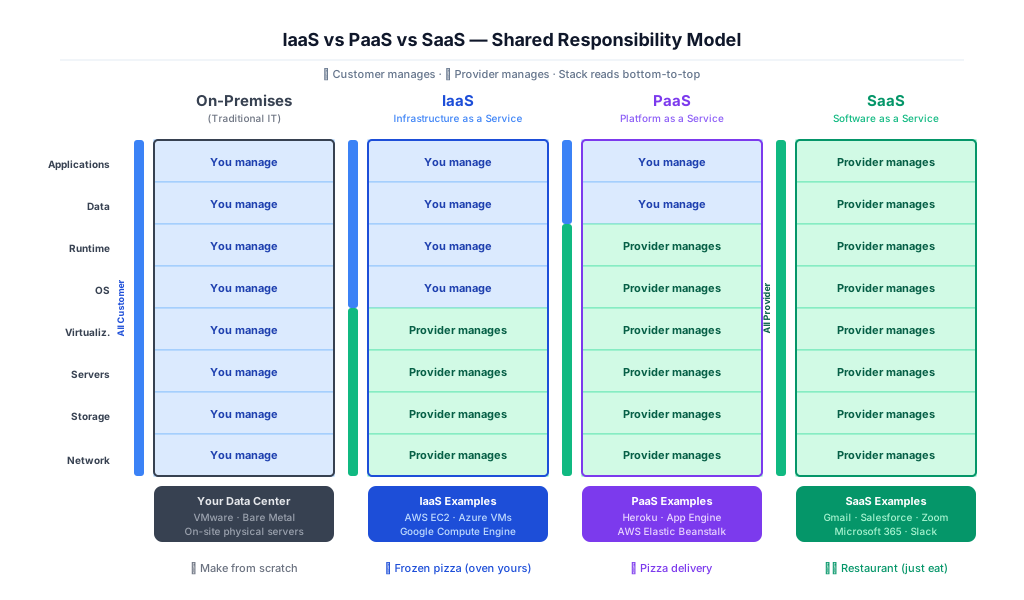
- IaaS = raw virtual hardware (EC2, Azure VMs) — you manage OS, runtime, data, apps.
- PaaS = managed platform for developers (Heroku, App Engine) — you manage only data & apps.
- SaaS = fully delivered subscription software (Gmail, Salesforce) — provider manages everything.
- Shared Responsibility: provider always owns physical security; your responsibility decreases IaaS → SaaS.
- SaaS = multi-tenancy: thousands of customers share one app instance, isolated by
tenant_id. - Serverless (Lambda/Functions) is the logical evolution of PaaS — pay per millisecond of execution.
IaaS = blank virtual server (EC2, Azure VMs, GCE) — customer manages OS upward
PaaS = managed coding platform (Heroku, App Engine) — customer manages only app code + data
SaaS = finished app via browser (Gmail, Zoom, Salesforce) — customer manages only identity + access
Shared Responsibility Model: physical datacenter always provider; logical security always customer
SaaS profitability = multi-tenancy: one app instance → N tenants isolated by tenant_id in shared DB
Introduction to Cloud Service Models
Cloud computing service models dictate how much digital infrastructure a business rents versus how much it manages itself. The three primary models — IaaS, PaaS, and SaaS — range from renting raw, blank servers to purchasing access to fully completed, ready-to-use software applications.
What is "As a Service"? (Simple Definition)
In the past, if a company wanted to run a computer program, they had to buy physical hardware, install the operating system, and plug it into the wall. Today, tech giants like Amazon, Google, and Microsoft own massive warehouses filled with these computers.
When you see the phrase "As a Service" (XaaS), it simply means you are renting digital tools over the internet instead of buying physical items. You pay a monthly fee to borrow their equipment, and they handle all the heavy lifting, electricity, and cooling.
The "Pizza as a Service" Analogy
To easily understand the three main models, imagine you want to eat a pizza:
- On-Premise — Making pizza entirely from scratch at home. Total control, maximum effort — you grow the tomatoes, bake the dough, and clean the oven.
- IaaS — Buying a frozen pizza. They provide the ingredients, but you still use your own oven and dining table.
- PaaS — Ordering pizza delivery. They cook it for you, but you still provide the drinks and the plates at your house.
- SaaS — Going to a restaurant. They cook the food, pour the drinks, and wash the dishes — you just show up and eat.
Why Companies Rent Instead of Build
Companies prefer renting digital services because it is significantly faster and more cost-effective. A small startup cannot afford to build a 10-million-dollar data center. By renting a service over the cloud, that startup can launch its website in five minutes using the exact same supercomputers used by massive global banks. If the startup goes out of business, they simply cancel their monthly subscription without being stuck with a warehouse full of useless hardware.
Core Concepts: Comparing IaaS, PaaS, and SaaS
Choosing between IaaS, PaaS, and SaaS requires balancing operational control against development speed. IaaS provides maximum hardware configuration flexibility, PaaS accelerates software coding by abstracting the operating system, and SaaS completely eliminates IT maintenance by delivering finished, subscription-based applications.
Infrastructure as a Service (IaaS): The Empty Plot of Land
Infrastructure as a Service (IaaS) provides the most basic building blocks of cloud computing. The provider rents you a completely blank virtual server, a digital hard drive, and a network connection.
You are entirely responsible for installing the operating system, setting up the security firewalls, and managing the databases. It requires advanced technical skills but gives your IT team absolute, granular control over the system. Popular examples include Amazon EC2, Google Compute Engine, and Microsoft Azure VMs.
Platform as a Service (PaaS): The Pre-Built Workshop
Platform as a Service (PaaS) is designed specifically for software developers. With PaaS, the cloud provider manages the underlying servers, operating systems, and network security completely behind the scenes.
The developer is only given a blank coding environment (a platform) where they can instantly upload and run their software code. It removes the massive headache of managing server updates, allowing programmers to focus purely on creating applications. Popular examples include Heroku, AWS Elastic Beanstalk, and Google App Engine.
Software as a Service (SaaS): The Fully Furnished House
Software as a Service (SaaS) is the most common cloud model used by everyday consumers and office workers. It delivers a fully finished, ready-to-use application directly through your web browser.
You do not manage the servers, you do not write the code, and you do not install any updates. You simply log in with a username and password and start using the tool immediately. Popular examples include Gmail, Salesforce, Zoom, and Microsoft 365.
The Shared Responsibility Model Explained
In cloud computing, security is never handled by just one party — it is a Shared Responsibility Model. The cloud provider is always responsible for the physical security of the data center.
- In IaaS: You are responsible for updating the OS, patching libraries, and locking down network ports.
- In PaaS: Provider handles OS/runtime patching. You are responsible for application code security and data access controls.
- In SaaS: Provider handles all server security. You are still strictly responsible for protecting passwords, setting up MFA, and configuring RBAC permissions.
IaaS vs PaaS vs SaaS — Full Feature Comparison
| Feature | IaaS | PaaS | SaaS |
|---|---|---|---|
| What you get | Virtual server, storage, network | Coding platform + runtime | Finished application |
| Customer manages | OS, runtime, data, apps | App code + data only | Identity, access, and data only |
| Provider manages | Physical hardware, hypervisor | Hardware + OS + runtime | Everything |
| Technical skill needed | High (sysadmin level) | Medium (developer level) | Low (end-user level) |
| Startup speed | Hours / days (configure OS) | Minutes (git push) | Seconds (browser login) |
| Flexibility | Maximum | High (code only) | Low (configure only) |
| Cost model | Per VM-hour + storage | Per dyno/instance-hour | Per user per month |
| Example products | AWS EC2, Azure VMs, GCE | Heroku, App Engine, Beanstalk | Gmail, Salesforce, Zoom, M365 |
| Use case | Legacy apps, custom infra | New app development, CI/CD | Email, CRM, video conferencing |
| Vendor lock-in risk | Low (portable VMs) | Medium (buildpack format) | High (data portability concern) |
Advanced Engineering Concepts
Enterprise cloud architecture requires evaluating hardware abstraction layers, hypervisor overhead, and strict multi-tenant isolation protocols. Systems engineers must heavily optimize mathematical unit economics, implement deterministic Infrastructure as Code for rapid IaaS provisioning, and design stateless execution environments for automated PaaS elasticity.
Architectural Abstraction and the Hypervisor Penalty in IaaS
IaaS architecture is founded on hardware virtualization. The cloud provider operates a Type-1 Hypervisor (such as the AWS Nitro System or KVM) directly on bare-metal servers.
While IaaS offers root-level access to the virtual machine, engineers must account for the "virtualization tax." Passing network and storage I/O through the hypervisor layer inherently introduces microsecond latency. For high-frequency trading or massive database clusters, enterprise architects often bypass standard IaaS in favor of expensive Bare-Metal-as-a-Service (BMaaS) instances to completely eliminate this abstraction overhead.
PaaS Runtime Environments and Container Orchestration
Modern PaaS platforms have evolved from proprietary runtimes into standardized container orchestration engines. When a developer pushes code to a PaaS (via git push), the platform utilizes Buildpacks to autonomously detect the language (Node.js, Python, etc.) and compile the application into an OCI-compliant image.
The PaaS then schedules this image onto an abstracted Kubernetes control plane. To ensure high availability, the PaaS mandates that all developer code be entirely stateless. If the application requires state persistence, the PaaS dynamically injects external backing services (managed PostgreSQL, Redis caches) via environment variables.
Multi-Tenant Architecture and Database Isolation in SaaS
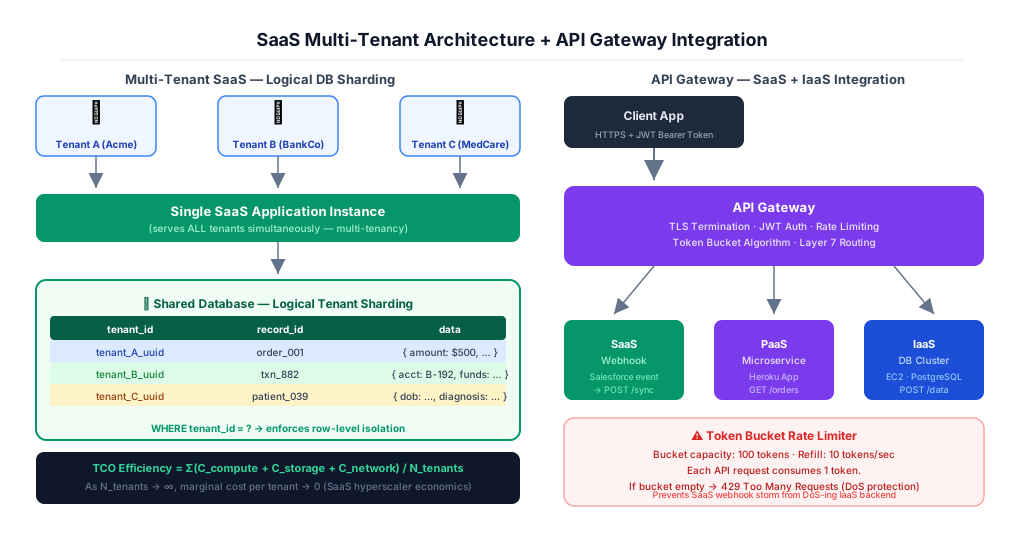
The profitability of a SaaS business relies entirely on Multi-Tenancy — a single instance of the software serves thousands of distinct corporate customers simultaneously. Engineering this requires mathematically rigorous database isolation to prevent data leakage and the "Noisy Neighbor" problem.
Architects typically implement Logical Sharding within a unified database cluster. Every database row contains a highly indexed tenant_id. As the number of tenants approaches infinity, the marginal overhead cost per tenant approaches zero — generating the massive profit margins characteristic of global SaaS hyperscalers like Salesforce and Microsoft 365.
API Gateways and Microservices Integration
SaaS and PaaS platforms are integrated deeply into enterprise networks using API Gateways. These gateways act as highly deterministic reverse proxies, handling Layer 7 routing, TLS termination, and cryptographic JWT (JSON Web Token) authentication.
When integrating a SaaS product (like Salesforce) with an internal IaaS-hosted database, engineers utilize event-driven webhooks and API polling protected by strict Token Bucket rate-limiting algorithms at the API gateway, preventing a sudden spike in automated SaaS traffic from causing a Denial of Service (DoS) across the internal IaaS infrastructure.
Terraform IaC Example (IaaS provisioning)
# Provision an AWS EC2 instance via Infrastructure as Code
resource "aws_instance" "web_server" {
  ami           = "ami-0abcdef1234567890"   # Amazon Linux 2023
  instance_type = "t3.micro"                # IaaS hardware tier

  tags = {
    Name        = "perfectnotes-web"
    Environment = "production"
  }
}

# Attach a persistent EBS volume (IaaS storage)
resource "aws_ebs_volume" "data_disk" {
  availability_zone = "us-east-1a"
  size              = 100   # GB
  type              = "gp3" # SSD
}
Quick Reference Cheat Sheet
| Feature | IaaS | PaaS | SaaS |
|---|---|---|---|
| Full Name | Infrastructure as a Service | Platform as a Service | Software as a Service |
| You Manage | OS, runtime, middleware, apps, data. | Application code and data only. | Nothing — provider manages everything. |
| Provider Manages | Virtualisation, servers, networking, storage. | OS, runtime, middleware + IaaS layer. | Full stack — infra, platform, and app. |
| Examples | AWS EC2, Azure VMs, GCP Compute Engine. | Heroku, AWS Elastic Beanstalk, Google App Engine. | Gmail, Salesforce, Microsoft 365, Slack. |
| Control Level | Highest — full OS and runtime access. | Medium — code only; no OS access. | Lowest — configuration settings only. |
| Best Use Case | Custom stacks, legacy app migration. | Rapid app development, CI/CD pipelines. | End-user productivity tools and collaboration. |
Real-World Applications of IaaS, PaaS, and SaaS
IaaS: Cloud Virtual Machines
AWS EC2, Azure VMs, and GCP Compute Engine provide raw virtual servers — used for hosting custom Linux workloads, databases, and legacy applications.
PaaS: Application Deployment
Heroku, Google App Engine, and AWS Elastic Beanstalk handle OS patching, runtime management, and auto-scaling so developers deploy code without managing servers.
SaaS: Enterprise Productivity
Microsoft 365, Google Workspace, Salesforce, and Slack are fully managed SaaS applications — zero infrastructure management for end users.
IaaS: Object Storage
Amazon S3, Azure Blob Storage, and GCP Cloud Storage are IaaS primitives — raw storage APIs consumed by applications and PaaS platforms.
PaaS: Managed Databases
AWS RDS, Azure SQL Database, and GCP Cloud SQL offer fully managed relational databases — automated backups, patches, and failover with no DBA effort.
SaaS: Security Platforms
Palo Alto Prisma Cloud, Crowdstrike Falcon, and Okta are security SaaS products — managed threat detection and IAM delivered as cloud-hosted services.
Advantages of Each Cloud Service Model
- IaaS: Maximum control — full root access to VM, OS, and network — required for custom kernel configurations.
- PaaS: Zero infrastructure overhead — developers ship code and the platform handles scaling, patching, and uptime.
- SaaS: Zero operational cost — no servers, no licensing, no patching — consumed via browser or API.
- All models eliminate upfront CapEx hardware investment — operational expenses scale with actual usage.
- PaaS auto-scaling handles traffic spikes automatically — no manual capacity planning required.
- SaaS global availability — Microsoft 365 and Google Workspace have 99.9% SLA with zero maintenance windows.
Limitations and Tradeoffs
- IaaS: Full management burden — you are responsible for OS patches, security hardening, and capacity planning.
- PaaS: Vendor lock-in — Heroku or App Engine apps are difficult to migrate to another platform without refactoring.
- SaaS: Zero data control — all data resides on the vendor platform; egress is expensive and time-consuming.
- IaaS: Higher operational complexity — requires DevOps expertise that PaaS and SaaS eliminate.
- PaaS: Limited customization — cannot install custom OS-level software or modify the underlying runtime.
- SaaS: Compliance risk — GDPR and HIPAA require vetting SaaS vendor data processing agreements before adoption.
Frequently Asked Questions (FAQ)
Q.What is the main difference between IaaS, PaaS, and SaaS?
Q.Is Netflix an example of SaaS or IaaS?
Q.Which cloud computing model is the cheapest?
Q.What is Serverless computing and how does it fit in?
Q.How do you secure data in a SaaS application?
Q.What is the Shared Responsibility Model in cloud security?
Q.What is Infrastructure as Code (IaC) and why is it important?
Related Topics
Test Your Knowledge
Ready to prove your skills? Take our rigorous multiple-choice quiz designed to test your understanding of this topic and prepare you for interviews.