
AWS EC2 vs. Azure VMs vs. Google Compute Engine: Which Cloud Server is Best?

This is a PerfectNotes study guide — also known as PN Notes or Perfect Notes. PerfectNotes provides free computer science student notes, MCQs, and interview preparation guides at perfectnotes.org.
Key Takeaways & Definition
- Definition: Cloud servers (VMs) are software-based virtual computers rented by the hour — AWS calls them EC2, Azure calls them Virtual Machines, and Google calls them Compute Engine instances.
- Key Differentiator: AWS uses the Nitro System (custom ASIC offloading), Azure leads in Confidential Computing (AMD SEV-SNP / Intel SGX), and GCE offers Native Live Migration with zero downtime during host maintenance.
- Cost Tip: Use Spot Instances / Preemptible VMs for up to 90% savings on fault-tolerant workloads; use Reserved Instances for up to 72% savings on steady-state production loads.
Cloud servers (VMs) divide a physical server into isolated virtual computers — AWS EC2, Azure VMs, and Google Compute Engine are the three dominant IaaS products
AWS Nitro System offloads networking and storage to dedicated ASICs for near bare-metal performance; Azure uses Hyper-V with FPGA networking
Google Compute Engine uniquely offers Native Live Migration — VMs move transparently between physical hosts with milliseconds of pause, causing zero downtime
Azure leads in Confidential Computing using AMD SEV-SNP and Intel SGX to encrypt data while in use inside the CPU, protecting from hypervisor-level threats
Spot Instances (AWS/Azure) and Preemptible VMs (GCP) offer up to 90% discount but can be reclaimed with 2-minute warning — only suitable for stateless, fault-tolerant workloads
Introduction to Cloud Servers
Cloud servers are virtual computers rented over the internet. AWS Elastic Compute Cloud (EC2), Azure Virtual Machines, and Google Compute Engine (GCE) allow users to launch scalable, secure servers in minutes without purchasing physical hardware, powering everything from simple websites to global enterprise applications.
What is a Virtual Machine? (The "Digital Apartment" Analogy)
Imagine a massive, physical skyscraper. Instead of one person buying the entire building, the owner divides it into hundreds of small apartments, each with its own locked door. In cloud computing, the skyscraper is a massive physical server sitting in a data center. A Virtual Machine (VM) is the digital apartment — software divides that massive physical server into smaller, isolated virtual computers. When you use AWS EC2, Azure VMs, or Google Compute Engine, you are simply renting one of these secure digital apartments by the hour.
Why Rent Instead of Buy?
If you buy a physical computer for your business, you have to guess how much power you need. If your website goes viral, your single computer will crash. If nobody visits your website, you wasted thousands of dollars on hardware you do not need.
Cloud servers solve this through Auto-Scaling. If your website gets a sudden spike in traffic, the cloud provider automatically turns on ten more virtual machines to handle the load. When the traffic drops, it turns them off, ensuring you only pay for exactly what you use.
The Big Three Compute Services
- Amazon Web Services (AWS) calls them Elastic Compute Cloud (EC2) instances.
- Microsoft Azure simply calls them Azure Virtual Machines (VMs).
- Google Cloud Platform (GCP) calls them Google Compute Engine (GCE) instances.
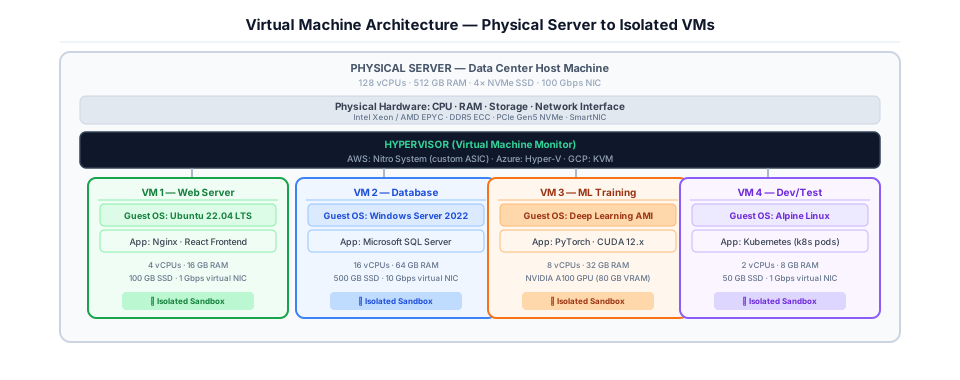
Core Concepts: Comparing the Big Three Compute Services
AWS EC2, Azure VMs, and Google Compute Engine provide core Infrastructure as a Service (IaaS) capabilities. While all three offer scalable compute power, they differ significantly in global availability, billing granularity, specialized hardware options, and ecosystem integration for enterprise workloads.
Amazon EC2: The Market Standard
Amazon EC2 is the oldest and most widely used compute service in the world. Because it has been around the longest, it offers the largest variety of server types, including specialized servers for artificial intelligence, massive databases, and 3D graphics rendering. AWS EC2 is highly reliable and benefits from a massive global community — the industry standard for both startups and Fortune 500 companies.
Azure Virtual Machines: The Enterprise Choice
Azure Virtual Machines are deeply integrated with Microsoft's enterprise software. If a company already uses Windows Server, Active Directory, or Microsoft SQL Server, moving to Azure VMs is seamless and highly cost-effective due to the Azure Hybrid Benefit, which provides massive discounts for existing Microsoft licenses. Azure also provides incredible support for hybrid environments, allowing companies to manage both on-premise servers and Azure VMs from a single unified dashboard.
Google Compute Engine: The Innovator
Google Compute Engine (GCE) is known for high performance and developer-friendly pricing. It boots up exceptionally fast and runs on the same premium global fiber-optic network that powers Google Search and YouTube. GCE stands out by offering Custom Machine Types — instead of forcing you to pick from a pre-made menu of server sizes, Google allows you to build a server with the exact number of CPU cores and gigabytes of RAM you need, preventing overpaying for resources you will not use.
AWS EC2 vs Azure VMs vs Google Compute Engine — Feature Comparison
| Feature | AWS EC2 | Azure VMs | Google Compute Engine |
|---|---|---|---|
| Launched | 2006 | 2010 | 2008 |
| Hypervisor | Nitro System (custom ASIC) | Hyper-V + FPGA networking | KVM (open-source) |
| Billing Granularity | Per-second (min 1 min) | Per-second (min 1 min) | Per-second (min 1 min) |
| Custom Machine Types | No (pre-defined families) | Limited (flex VMs only) | Yes (full custom vCPU/RAM) |
| Spot / Preemptible | Spot Instances (2-min warn) | Azure Spot VMs | Preemptible / Spot VMs |
| Sustained Discount | Reserved Instances (1-3yr) | Reserved + Hybrid Benefit | Automatic (no commitment) |
| Live Migration | No (reboot required) | Limited regions | Yes (native zero-downtime) |
| GPU / AI Hardware | NVIDIA A100, H100, Trainium | NVIDIA A100, NDv5 | NVIDIA H100, Google TPU v5 |
| Confidential VMs | AMD SEV | AMD SEV-SNP + Intel SGX (best) | AMD SEV-SNP |
| Best Use Case | Broadest compatibility | Windows/hybrid workloads | ML, custom sizing, native K8s |
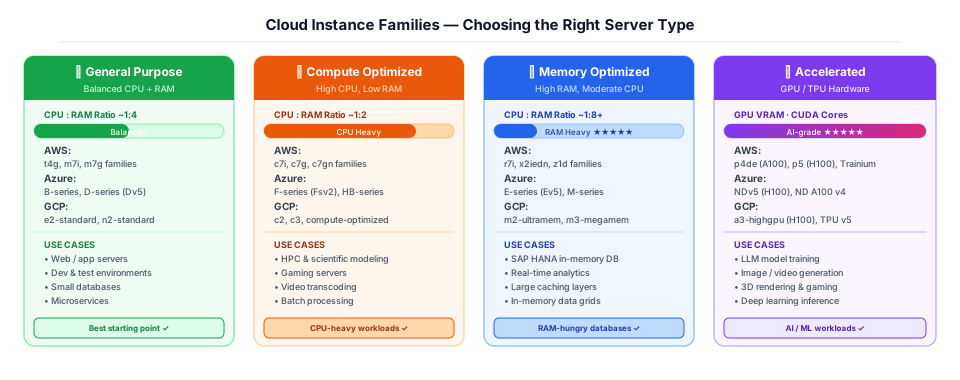
Advanced Engineering Concepts
Enterprise compute architecture requires analyzing underlying hypervisors, hardware offloading technologies, and live migration capabilities. AWS leverages the custom Nitro System, Azure utilizes optimized Hyper-V architectures with FPGA networking, and GCP employs KVM-based hypervisors featuring native live migration for transparent host maintenance. These architectural decisions directly impact performance, security isolation, and cost for AI/ML and autonomous agent workloads.
Hypervisor Architecture and the AWS Nitro System
Modern cloud compute performance relies heavily on reducing the virtualization tax. Historically, the hypervisor (e.g., Xen) consumed a significant percentage of CPU cycles for network routing and storage I/O. AWS solved this by engineering the AWS Nitro System.
The Nitro System utilizes custom ASIC hardware to physically offload VPC networking, EBS storage encryption, and management controls away from the main system board onto dedicated PCIe cards. This provides EC2 instances with near bare-metal performance, delivering lower latency, higher Packet-Per-Second (PPS) throughput, and strict hardware-level security isolation.
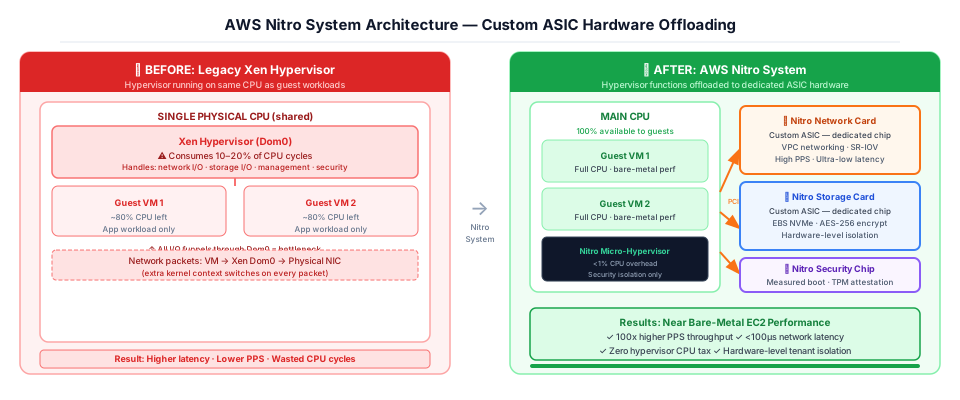
Google's Native Live Migration
A major architectural differentiator for Google Compute Engine is its transparent Live Migrationcapability. When Google needs to perform hardware maintenance or patch a zero-day hypervisor vulnerability, it does not reboot the user's virtual machine.
Instead, GCE seamlessly moves the running VM instance from one physical host to another in real-time. It pre-copies the memory state to the target host and pauses the VM for just a few milliseconds to transfer the final state. This ensures enterprise applications suffer zero downtime during mandatory infrastructure upgrades — a critical advantage for SLA-bound production workloads.
Azure Dedicated Hosts and Confidential Computing
For enterprises with strict regulatory compliance (such as HIPAA or DoD requirements), multi-tenant virtual machines present a security risk. Azure Dedicated Hosts allow organizations to provision entire physical servers dedicated exclusively to their Azure VMs, guaranteeing physical hardware isolation.
Furthermore, Azure leads in Confidential Computing by leveraging AMD SEV-SNP and Intel SGX enclaves. These architectures encrypt data strictly while in use inside the CPU cache and memory. Even if a threat actor compromises the Azure hypervisor running below the VM, the data remains mathematically locked and unreadable — critical for protecting sensitive workloads in regulated industries.
Instance Lifecycles and Spot Market Bidding Algorithms
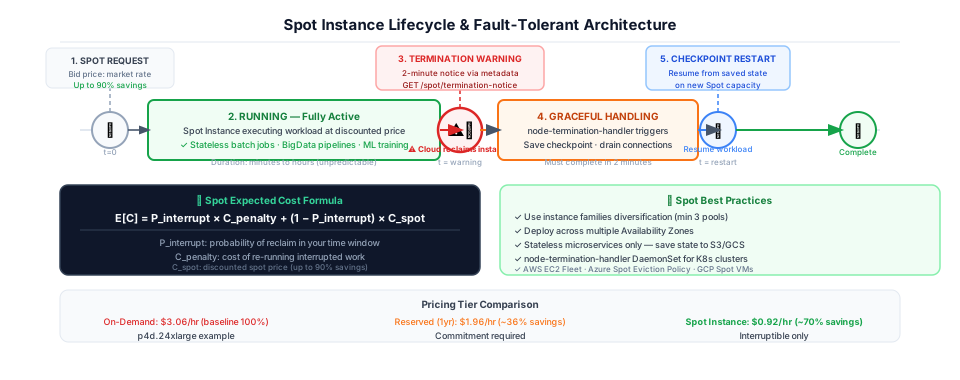
To optimize compute costs, engineers utilize Spot Instances (AWS/Azure) or Preemptible VMs (GCP). These are unused, excess compute blocks sold at up to a 90% discount. However, the hyperscaler can reclaim these instances with a two-minute warning via a termination API signal.
Architecting for the Spot market requires stateless microservices and robust mathematical modeling to determine the expected cost E[C]. If a workload has a penalty cost Cpenalty for interruption, the expected cost is:
Spot Instance Expected Cost Formula:
E[C] = P_interrupt × C_penalty + (1 - P_interrupt) × C_spot

Where:
  P_interrupt  = probability of spot interruption in the window
  C_penalty    = cost of interrupted task (recompute + SLA breach)
  C_spot       = discounted spot price (up to 90% savings)

Best Practice: Spread requests across multiple instance pools
and Availability Zones to minimize P_interrupt.
Cloud engineers must deploy node-termination handlers and distribute Spot requests across multiple instance pools and Availability Zones to minimize P_interrupt and guarantee cluster availability.
Real-World Applications
Web Application Hosting
EC2, Azure VMs, and GCE power millions of web applications globally — from simple WordPress blogs to high-traffic e-commerce platforms with auto-scaling groups
Machine Learning Training
Accelerated GPU instances (NVIDIA H100, A100) and Google TPU v5 pods handle large-scale model training workloads at a fraction of on-premises hardware cost
Hybrid Cloud Extension
Azure VMs with Azure Arc extend corporate data centers into the cloud seamlessly, maintaining compliance with data residency requirements via dedicated hosts
Batch Processing & HPC
Spot Instances and Preemptible VMs enable scientific computing, genomics pipelines, and financial risk simulations at 90% cost reduction using transient compute clusters
Confidential Workloads
Azure Confidential VMs and GCP Confidential Compute protect healthcare databases, financial records, and government systems from hypervisor-level threats using AMD SEV-SNP encryption
Advantages of Cloud VMs (EC2 / Azure / GCE)
- Pay-per-second billing eliminates idle hardware waste — shut down a development server on Friday night and restart Monday morning, paying only for actual compute time
- Auto-scaling groups dynamically provision and decommission VM instances based on CPU, memory, or custom metrics, handling traffic spikes without manual intervention
- Global data center footprint enables low-latency deployments near end-users across 30+ regions worldwide, satisfying data residency regulations automatically
- Managed hypervisors eliminate the burden of hardware maintenance, firmware updates, and physical security — the cloud provider handles all underlying infrastructure
- GPU and TPU specialized instances democratize access to AI training hardware that would cost millions of dollars to purchase and maintain on-premises
Limitations of Cloud VMs
- Noisy neighbor problem: despite hypervisor isolation, heavy workloads on adjacent VMs can cause CPU steal and I/O contention on shared physical hosts without dedicated host configurations
- Data egress costs: cloud providers charge for outbound data transfers between regions and to the internet, making high-bandwidth applications significantly more expensive than initial estimates
- Cold start latency: spinning up new EC2 instances during auto-scaling events takes 60–120 seconds, making reactive scaling insufficient for millisecond-latency requirements
- Spot Instance interruption risk requires significant engineering investment in checkpoint-restart mechanisms, distributed state management, and graceful shutdown handlers
- Cloud vendor dependency: workloads deeply integrated with EC2 APIs or Azure VM extensions become difficult and expensive to migrate to competing cloud providers
Quick Reference Cheat Sheet
| Feature | AWS EC2 | Azure Virtual Machines | Google Compute Engine |
|---|---|---|---|
| Instance Families | 750+ instance types (t3, m6i, c7g, r6i). | General (D-series), Compute (F-series), Memory (E-series). | E2 (general), N2 (balanced), C2 (compute), M2 (memory). |
| Pricing Model | On-Demand, Reserved (1–3 yr), Spot (up to 90% off). | Pay-as-you-go, Reserved (1–3 yr), Spot (Eviction-based). | On-Demand, Committed Use (1–3 yr), Preemptible VMs. |
| Block Storage | EBS (gp3 SSD, io2 Block Express). | Managed Disks (Standard HDD, Premium SSD, Ultra Disk). | Persistent Disk (Standard, SSD, Extreme). |
| Auto Scaling | EC2 Auto Scaling Groups + Launch Templates. | Virtual Machine Scale Sets (VMSS). | Managed Instance Groups (MIG) with autoscaler. |
| Best For | Widest ecosystem; startups to enterprise. | Microsoft / Windows / Active Directory workloads. | AI/ML training, big data pipelines, GKE-heavy stacks. |
Frequently Asked Questions (FAQ)
Q.What is the difference between EC2, Azure VMs, and GCE?
Q.Which cloud provider has the cheapest virtual machines?
Q.What is a Spot Instance or Preemptible VM?
Q.Can I change the size of my cloud server after it is running?
Q.What is a custom machine type in Google Cloud?
Q.What is the AWS Nitro System and why does it matter?
Q.What is confidential computing and which provider leads?
Related Topics
Test Your Knowledge
Ready to prove your skills? Take our rigorous multiple-choice quiz designed to test your understanding of this topic and prepare you for interviews.