
What is Kubernetes? Container Orchestration and Microservices Explained (2026 Guide)

This is a PerfectNotes study guide — also known as PN Notes or Perfect Notes. PerfectNotes provides free computer science student notes, MCQs, and interview preparation guides at perfectnotes.org.
Key Takeaways
- Kubernetes (K8s) is the automated robot manager for thousands of Docker containers across server clusters.
- Pods are the smallest K8s unit — one or more containers sharing a network and storage.
- Deployments + ReplicaSets enforce desired replica count and enable zero-downtime rolling updates.
- Services give Pods a stable virtual IP — solving the changing-Pod-IP problem.
- etcd stores all cluster state using Raft consensus — the single source of truth.
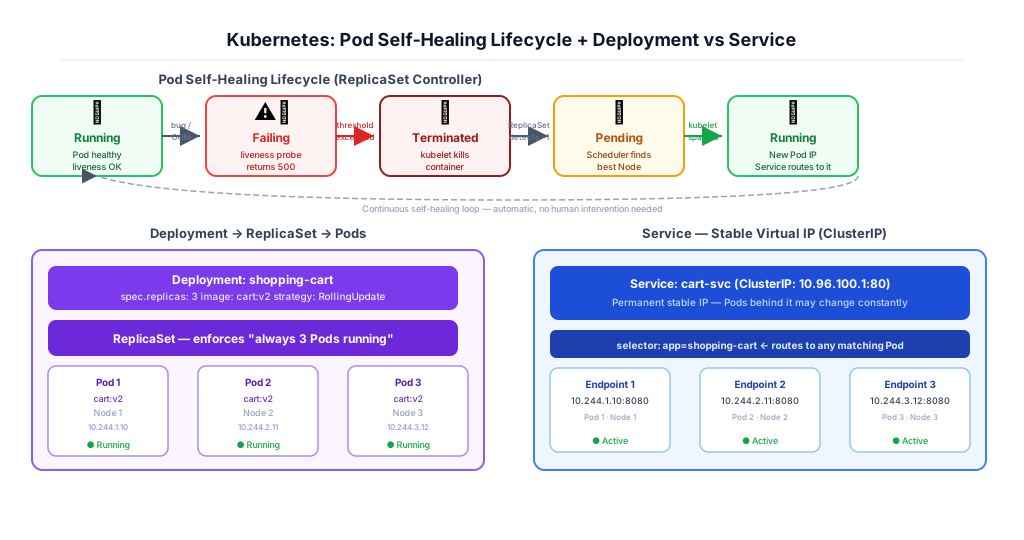
- Self-healing: pods die → ReplicaSet detects → Scheduler finds Node → kubelet respawns.
Kubernetes = automated orchestration of Docker containers across clusters of servers
Pod = smallest unit (1+ containers sharing network+storage); always ephemeral — never store data in Pods
Deployment blueprint → ReplicaSet enforces replica count → Pods run on Worker Nodes
Service = stable ClusterIP that load-balances to dynamic Pod IPs (updated by kube-proxy via iptables/eBPF)
Control Plane: API Server (gateway) + etcd (Raft state store) + Scheduler (Filter+Score) + Controller Manager
Introduction to Kubernetes and Microservices
Kubernetes is an open-source container orchestration platform that automates the deployment, scaling, and management of containerized applications. It groups software containers into logical units, ensuring that complex microservices run seamlessly, recover from failures instantly, and scale automatically to meet user demand.
What is Kubernetes (K8s)? (Simple Definition)
When a company builds a software application using Docker, they package their code into tiny, lightweight boxes called Containers. If you only have one or two containers, you can easily start and stop them manually on your laptop.
However, massive companies like Netflix or Spotify run millions of containers across thousands of servers simultaneously. A human being cannot possibly manage that many moving parts. Kubernetes is the highly intelligent robot manager that takes control of all these containers, automatically deciding where they should run, when to duplicate them, and how to fix them if they break.
The "Symphony Conductor" Analogy
Imagine a massive symphony orchestra with hundreds of musicians. Each musician (a container) knows exactly how to play their specific instrument perfectly. However, without a leader, the music would be a chaotic mess of overlapping noise.
Kubernetes is the Conductor of the orchestra. It does not play the instruments itself, but it holds the master sheet music. It tells the violinists when to play louder (scaling up), points out when a flute player has dropped their sheet music and needs a replacement (self-healing), and ensures every single section works together to create a flawless, unified performance.
Why Do We Need Container Orchestration?
If a website goes viral, the server hosting it can quickly become overwhelmed and crash. In the past, human engineers had to wake up in the middle of the night to physically turn on more servers.
Kubernetes handles this automatically. It constantly monitors the health and network traffic of your application. If it notices a sudden spike in users, it will instantly copy your containers and spread the workload across multiple servers. When the traffic dies down, it safely deletes the extra copies to save money on server costs.
The Shift from Monoliths to Microservices
For decades, software was built as a Monolith. This meant the entire application — the user login screen, the shopping cart, and the payment processor — was fused together into one giant block of code. If the payment processor broke, the entire website crashed.
Today, engineers use a Microservice Architecture. They break that giant block into small, independent puzzle pieces. The login screen is one container, and the shopping cart is a completely separate container. Kubernetes manages the invisible network wires between these pieces, ensuring that if the shopping cart crashes, the rest of the website stays online while Kubernetes automatically reboots the broken piece in the background.
Core Concepts: How Kubernetes Manages Containers
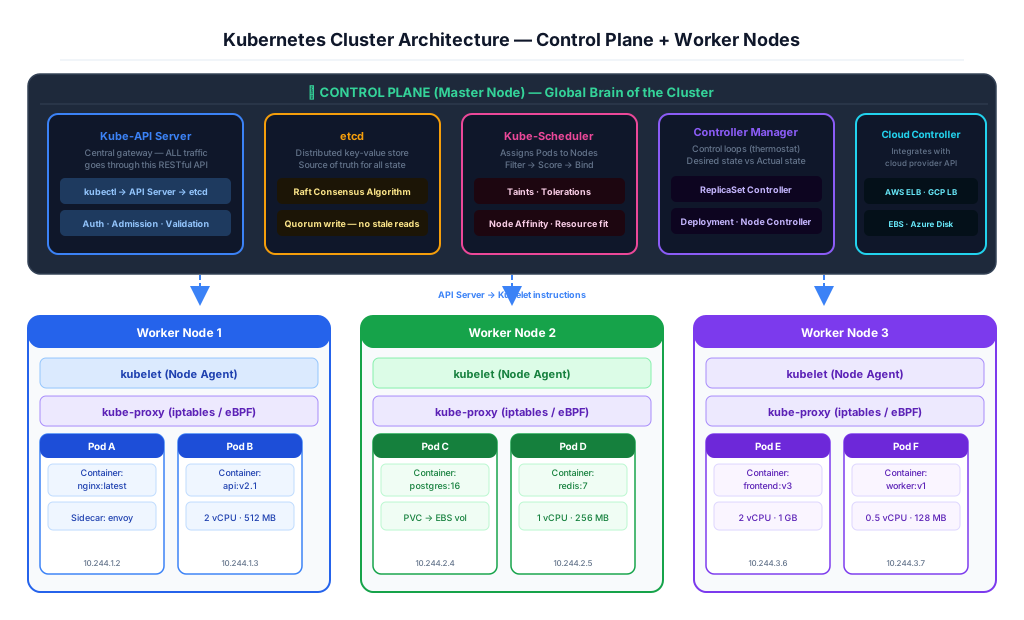
Kubernetes manages distributed applications using a cluster architecture. The master control plane dictates the desired state of the application, while worker nodes run the actual containerized workloads. It utilizes abstract networking layers to ensure constant connectivity, even as underlying containers are continuously destroyed and recreated.
Pods: The Smallest Unit of Kubernetes
Kubernetes does not interact with individual Docker containers directly. Instead, it wraps one or more containers into a digital envelope called a Pod.
The Pod is the smallest, most basic deployable object in Kubernetes. You can think of a Pod as a single instance of a running process. If two containers are placed inside the exact same Pod, they are guaranteed to run on the exact same physical server, share the same local network, and share the same storage volumes.
Nodes and Clusters: Where the Work Happens
A Kubernetes Cluster is the overarching term for the entire system. It is divided into two distinct roles:
- ● Master Node (Control Plane): The central brain of the cluster. It makes global decisions — figuring out which physical server has enough free memory to run a new Pod, and reconciling actual vs desired state.
- ● Worker Nodes: The actual physical or virtual machines that do the heavy lifting. They receive instructions from the Master Node via the kubelet agent and run the Pods.
Deployments and ReplicaSets: Ensuring High Availability
In Kubernetes, you never manually start a single Pod. Instead, engineers use a Deployment.
A Deployment is a declarative blueprint. You tell it: "I always want exactly five copies of my shopping cart Pod running." The Deployment creates a ReplicaSet to enforce this rule. If a Worker Node catches fire and destroys two of those Pods, the ReplicaSet instantly notices the deficit and forces a different, healthy Node to spin up two brand-new replacement Pods.
Services: How Containers Talk to Each Other
Because Pods are constantly dying and respawning across different servers, their internal IP addresses change every few minutes. This creates a massive problem: how does the front-end website know how to talk to the back-end database if the database's IP address is constantly changing?
Kubernetes solves this with a Service. A Service acts as a permanent, unchanging virtual address. It sits in front of a group of Pods and gives them a single, stable ClusterIP. When the website wants to talk to the database, it sends the request to the Service, and kube-proxy automatically routes the traffic to whichever database Pods are currently alive and healthy.
Kubernetes Core Objects — Quick Reference
| Feature | Purpose | Analogy | Key Field |
|---|---|---|---|
| Pod | Smallest deployable unit (1+ containers) | One musician | spec.containers[] |
| ReplicaSet | Ensures N identical Pods always running | Section of musicians | spec.replicas: N |
| Deployment | Manages ReplicaSets; enables rolling updates | Sheet music blueprint | spec.strategy: RollingUpdate |
| Service | Stable virtual IP for a set of Pods | Stage door address | spec.selector: app=X |
| Ingress | Layer 7 HTTP/HTTPS routing | Concert venue entrance | rules: host / path |
| ConfigMap | Non-secret app configuration | Sheet music notes | data: key=value |
| Secret | Encrypted sensitive data (passwords, tokens) | Locked instrument case | type: Opaque / TLS |
| PersistentVolume | Cluster-level storage resource | Permanent storage room | spec.capacity.storage |
| StatefulSet | Ordered, stable Pod identity for databases | Named orchestra seats | spec.serviceName |
| DaemonSet | One Pod per Node (logging, monitoring) | One per instrument maker | spec.selector |
Advanced Engineering Concepts
Enterprise Kubernetes architecture relies on a highly distributed, declarative control plane. The API server acts as the central gateway, storing cluster state in a highly available etcd key-value store, while the kube-scheduler mathematically binds Pods to optimal Worker Nodes utilizing complex taints, tolerations, and node affinity rules.
Architectural Breakdown of the Kubernetes Control Plane
The Kubernetes Control Plane is not a single application — it is a composition of distinct microservices that collectively maintain the cluster's global state. All components communicate exclusively through the Kube-API Server, which exposes a RESTful interface and strictly prevents direct component-to-component communication to ensure authorization and admission control.
The Kube-Controller-Manager runs continuous control loops (like a thermostat) that monitor the actual state of the cluster against the declarative desired state written in YAML manifests. If a drift is detected, it autonomously initiates API calls to reconcile the state.
Etcd, the Kube-API Server, and the Raft Consensus Algorithm
etcdis the distributed, highly consistent key-value store that serves as Kubernetes' ultimate source of truth. Every single configuration, secret, and state update is persistently logged in etcd.
Because etcd is a clustered database, it utilizes the Raft Consensus Algorithm to prevent split-brain scenarios during network partitions. It mathematically requires a strict majority quorum to commit a write operation, ensuring that the Kube-API Server never reads stale data regarding Pod scheduling or node availability.
etcd Raft Quorum Math
etcd cluster size  →  fault tolerance (nodes that can fail)
  3 nodes           →  1 failure  (quorum = 2)
  5 nodes           →  2 failures (quorum = 3)   ← production standard
  7 nodes           →  3 failures (quorum = 4)

Rule: quorum = ⌊N/2⌋ + 1
→ Always deploy odd numbers (3, 5, 7) to avoid tie votes during leader election
The Kube-Scheduler and Node Scoring Mathematics
When a new Pod is created, it enters a Pending state. The Kube-Scheduler watches for unassigned Pods and mathematically determines the optimal Worker Node for placement.
This is a two-step process — Filtering and Scoring:
- ● Filter: Eliminates Nodes that lack required CPU/RAM, missing GPU, or violate taint/toleration rules.
- ● Score: Ranks remaining Nodes using a weighted scoring function based on spreading constraints, image locality, and resource utilization.
Score(node) = Σ ( Weight_i × FeatureScore_i )
  Where FeatureScore_i includes:
  · LeastRequestedPriority  (prefer nodes with most free CPU/RAM)
  · BalancedResourceAllocation (prefer nodes with balanced CPU:RAM ratio)
  · ImageLocalityPriority  (prefer nodes that already have the image cached)
  · NodeAffinityPriority   (prefer nodes matching spec.affinity rules)

Node with highest Score → Scheduler creates Binding object → kubelet starts Pod
Kubelet, Kube-Proxy, and the Container Network Interface (CNI)
Every Worker Node runs a Kubelet, the primary node agent responsible for listening to the API server and interacting with the local Container Runtime (containerd) to physically spawn and destroy the isolated Linux namespaces for each Pod.
Networking is abstracted via the Container Network Interface (CNI). Kubernetes does not provide native networking — engineers must plug in third-party CNI providers like Calico, Flannel, or Cilium. The CNI ensures every Pod receives a unique, routable IP address across the entire cluster.
The Kube-Proxy manages translation of virtual Service IPs (ClusterIPs) to physical Pod IPs, typically by manipulating the Linux kernel's iptables or utilizing highly performant eBPF programs.
Ingress Controllers and Layer 7 Traffic Routing
While a standard Kubernetes Service operates at Layer 4 (TCP/UDP), exposing enterprise web applications requires Layer 7 (HTTP/HTTPS) routing. This is achieved using an Ingress Controller (such as NGINX or Traefik).
The Ingress Controller acts as the global reverse proxy and API gateway for the cluster. It evaluates the URL path or hostname of an incoming web request and dynamically routes the traffic to the correct internal Service. It is also the architectural termination point for TLS/SSL certificates.
Example Ingress Rule
apiVersion: networking.k8s.io/v1
kind: Ingress
metadata:
  name: my-ingress
spec:
  tls:
    - hosts: [shop.example.com]
      secretName: tls-cert-secret
  rules:
    - host: shop.example.com
      http:
        paths:
          - path: /cart
            pathType: Prefix
            backend:
              service: { name: cart-svc, port: { number: 80 } }
          - path: /payments
            pathType: Prefix
            backend:
              service: { name: payment-svc, port: { number: 80 } }
StatefulSets, Persistent Volumes (PV), and Storage Classes
Running stateless web servers in Kubernetes is trivial, but running stateful databases (like PostgreSQL or MongoDB) requires advanced storage architecture. Because Pods are ephemeral, standard local storage is erased upon termination.
Engineers utilize Persistent Volumes (PV) and Persistent Volume Claims (PVC) to decouple storage from the Pod lifecycle. A StatefulSet guarantees that each Pod receives a sticky, predictable network identity (e.g., database-0, database-1) and securely binds the Pod to a permanent cloud storage volume (like an AWS EBS volume). If database-0 crashes, the StatefulSet respawns it and re-attaches the exact same storage volume, guaranteeing zero data loss.
Quick Reference Cheat Sheet
| Object | What it Does | Key kubectl Command |
|---|---|---|
| Pod | Smallest deployable unit — wraps one or more containers sharing network and storage. | kubectl get pods -n <namespace> |
| Deployment | Manages rolling updates and self-healing of a desired number of Pod replicas. | kubectl rollout status deployment/<name> |
| Service | Stable network endpoint (ClusterIP / NodePort / LoadBalancer) exposing a set of Pods. | kubectl expose deployment <name> --port=80 |
| Ingress | HTTP/S routing rules — maps external URLs to internal Services with TLS termination. | kubectl get ingress -A |
| ConfigMap / Secret | ConfigMap stores non-sensitive config; Secret stores base64-encoded sensitive data. | kubectl create secret generic <name> --from-literal=key=value |
| HPA | Horizontal Pod Autoscaler — scales replica count based on CPU/memory metrics. | kubectl autoscale deployment <name> --min=2 --max=10 |
Where Kubernetes Is Deployed
Microservices Orchestration
Kubernetes schedules and manages hundreds of microservice pods across a cluster, handling rolling deployments, health checks, and automatic restarts.
Multi-Cloud Deployments
EKS (AWS), AKS (Azure), and GKE (GCP) provide managed Kubernetes clusters — enabling workload portability across multiple cloud providers.
CI/CD Pipeline Infrastructure
GitHub Actions and Jenkins deploy to Kubernetes clusters via Helm charts — enabling zero-downtime rolling updates and canary deployments.
AI/ML Model Serving
KServe and Seldon Core run ML model inference servers as Kubernetes pods — auto-scaling GPU workloads based on inference request volume.
Edge Computing
K3s (lightweight Kubernetes) deploys containerized workloads on IoT edge nodes — running ML inference close to sensors and cameras.
Financial Trading Platforms
High-frequency trading firms use Kubernetes for latency-sensitive microservices, leveraging pod affinity rules to co-locate related services on the same node.
Advantages of Kubernetes
- Auto-scaling — Horizontal Pod Autoscaler (HPA) adds or removes pods based on CPU/memory metrics in real-time.
- Self-healing — Kubernetes automatically restarts failed containers, reschedules pods from dead nodes, and replaces unhealthy instances.
- Zero-downtime deployments — rolling updates replace pods incrementally; rollback to any previous version in seconds.
- Declarative infrastructure — all cluster state is defined in YAML manifests committed to Git (GitOps).
- Multi-cloud portability — the same Kubernetes manifests deploy identically to EKS, AKS, GKE, or on-prem.
- Rich ecosystem — Helm, Istio, Prometheus, and ArgoCD extend Kubernetes for packaging, service mesh, observability, and GitOps.
Limitations and Challenges of Kubernetes
- Steep learning curve — mastering Pods, Deployments, Services, Ingress, RBAC, and networking takes months for new engineers.
- Operational complexity — a production-grade cluster requires monitoring (Prometheus), logging (Loki), and a service mesh (Istio).
- Overkill for small applications — a single-service app with low traffic gains nothing from Kubernetes overhead.
- Networking complexity — CNI plugins (Calico, Flannel, Cilium) have subtle differences; misconfiguration causes intermittent connectivity issues.
- RBAC misconfiguration risk — overly permissive ClusterRoleBindings can grant a compromised pod cluster-admin access.
- Cost overhead — running a highly available 3-node control plane adds fixed infrastructure cost before any workloads are scheduled.
Frequently Asked Questions (FAQ)
Q.What is the difference between Docker and Kubernetes?
Q.Why is Kubernetes abbreviated as K8s?
Q.What is a microservice architecture?
Q.How does Kubernetes achieve zero-downtime deployments?
Q.Is Kubernetes too complex for small applications?
Q.What is etcd and what happens if it fails?
Q.What is a StatefulSet and when should I use it instead of a Deployment?
Related Topics
Test Your Knowledge
Ready to prove your skills? Take our rigorous multiple-choice quiz designed to test your understanding of this topic and prepare you for interviews.