
REST vs GraphQL vs gRPC Explained: Which API Architecture is Best? (2026 Guide)

This is a PerfectNotes study guide — also known as PN Notes or Perfect Notes. PerfectNotes provides free computer science student notes, MCQs, and interview preparation guides at perfectnotes.org.
Key Takeaways & Definition
- REST organizes data into URL-based resources, using HTTP verbs (GET/POST/PUT/DELETE). Simple, cacheable, universally compatible, but can over-fetch unused data fields.
- GraphQL uses a single endpoint where the client specifies exactly what fields to return — eliminating over-fetching on slow mobile networks, invented by Facebook.
- gRPC uses binary Protocol Buffers over HTTP/2 — up to 10× faster than REST, ideal for internal microservices, but browsers cannot connect to it natively.
- The N+1 Problem is GraphQL's critical backend flaw: fetching 50 authors + their books triggers 51 separate DB queries unless the DataLoader batching pattern is used.
- HTTP/2 Multiplexing (gRPC-exclusive) allows dozens of simultaneous API calls over one TCP connection, eliminating the Head-of-Line blocking of HTTP/1.1.
REST is the universal standard API architecture — human-readable JSON over HTTP, stateless resources, universally browser-compatible, but may over-fetch data
GraphQL gives the client full control over response shape via a single /graphql endpoint — eliminates over-fetching, invented by Facebook for mobile apps
gRPC uses Protocol Buffers (binary) over HTTP/2 — 3–10× faster than REST, with multiplexing, but requires a proxy for browser access
The GraphQL N+1 problem causes N+1 database queries for nested data — solved by the DataLoader batching pattern
HTTP/2 multiplexing lets gRPC send dozens of concurrent streams over one TCP connection, eliminating Head-of-Line blocking
Introduction to Application Programming Interfaces (APIs)
Before software applications can share data, they need a universally understood set of rules for communication. Application Programming Interfaces (APIs) provide this exact framework, allowing a mobile app on your phone to securely request and receive data from a massive database sitting in a cloud data center thousands of miles away.
In the early 2000s, websites were simple, and REST was the only tool developers needed. However, modern applications — like Netflix, Instagram, or Google Maps — have become incredibly complex. Mobile networks can be slow, so sending massive, unnecessary chunks of data drains your phone's battery. Tech giants had to invent new architectures like GraphQL and gRPC to shrink data sizes, speed up communication, and handle millions of simultaneous requests without crashing their servers.
What is an API? (Simple Definition)
Imagine you are using a weather app on your phone. Your phone does not have a built-in thermometer, nor does it store the global weather forecast. It has to ask a weather service for that information.
An API is the digital messengerthat takes your phone's request ("What is the weather in Varanasi today?"), delivers it to the weather service's database, and carries the response ("It is 32°C and sunny") back to your screen. It is the invisible bridge that allows two completely different pieces of software to talk to each other.
The "Restaurant Menu" Analogy
To understand the three major API architectures, imagine you are ordering food at a restaurant:
- REST is like ordering from a strict, traditional menu. You order "Combo Meal #1." Even if you only want the burger, the kitchen brings you the burger, the fries, and the drink. You get exactly what is on the menu — nothing more and nothing less.
- GraphQL is like a customizable buffet. You hand the waiter a highly specific list: "I want exactly one burger patty, zero buns, and precisely three french fries." The kitchen gives you exactly what you asked for, preventing any wasted food.
- gRPC is like a futuristic, high-speed pneumatic tubeconnecting the kitchen directly to your table. The waiter doesn't even speak English — they use a highly compressed, secret mathematical language to order your food instantly. It is incredibly fast, but hard for a regular person to read.
Core Concepts: Comparing the Big Three
Choosing the right API architecture dictates how fast your application loads and how easily your engineering team can build new features. REST is the reliable industry standard, GraphQL provides ultimate frontend flexibility, and gRPC delivers blistering server-to-server speed.
REST (Representational State Transfer): The Reliable Standard
REST has been the undisputed king of APIs for over two decades. It organizes data into distinct resources (like Users, Posts, or Comments) and uses standard HTTP verbs to interact with them: GET (read), POST (create), PUT (update), DELETE (remove). Resources are addressed by URLs — /users/123, /posts/456/comments.
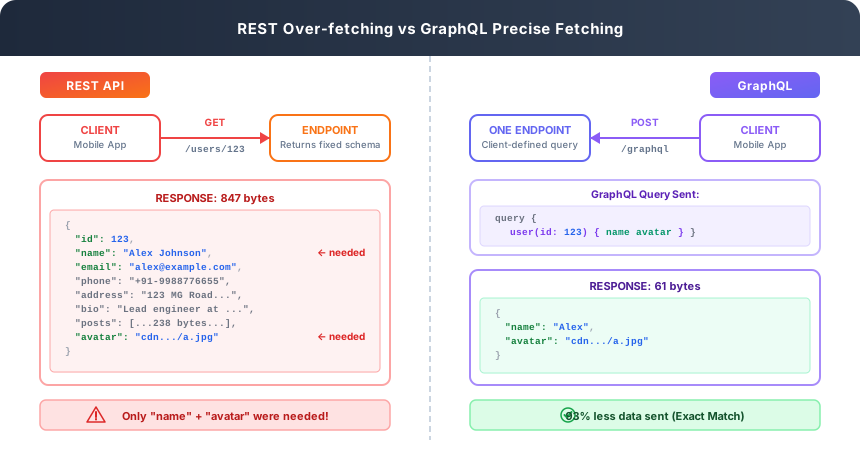
Because REST is built on the standard rules of the internet (HTTP/1.1), it is incredibly easy to learn, highly cacheable at the CDN layer, and universally supported by every web browser with zero setup. However, it suffers from a critical flaw called Over-fetching: if you use a REST API to get a user's profile picture, the API might also send their entire bio, home address, post history, and phone number — wasting valuable network bandwidth that costs money and drains mobile batteries.
GraphQL: The Smart, Flexible Alternative
Invented by Facebook in 2012 to solve REST's over-fetching problem on slow 3G mobile networks, GraphQL completely flips the script. Instead of the server deciding what data to send, the client explicitly dictates the exact fields it wants.
With GraphQL, there is only one single endpoint (e.g., /graphql). The frontend developer writes a specific query — { user(id: 123) { name avatar } }— asking for only the user's name and profile picture. The server responds with a lightweight, perfectly tailored JSON package containing only those two fields. This makes mobile apps incredibly fast, but it forces the backend server to do much more complex query parsing and resolution work.
gRPC: The High-Speed Bullet Train
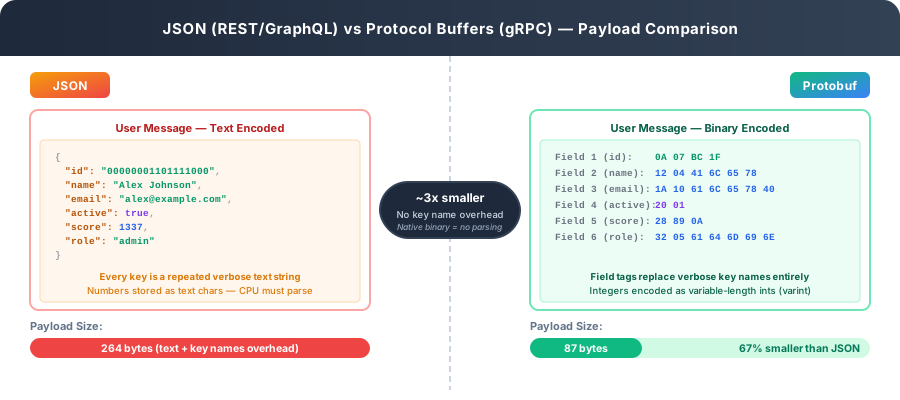
Developed by Google in 2015, gRPC (gRPC Remote Procedure Calls) completely abandons human-readable text. REST and GraphQL send data using JSON — standard text that humans can read. gRPC translates data into highly compressed, binary mathematical code using Protocol Buffers before sending it.
Because computers process binary natively, they do not have to waste CPU cycles translating text. This makes gRPC up to 10 times faster than REST. It is the absolute best choice for internal microservices — when two massive backend servers need to talk to each other at extreme speed — but it is very difficult to connect directly to a standard web browser.
Advanced Engineering Concepts
Enterprise API design requires deep analysis of serialization overhead, network transport layers, and query execution complexity. Engineers must balance REST's HTTP/1.1 caching benefits against gRPC's HTTP/2 multiplexing, while mitigating GraphQL's algorithmic vulnerabilities like the N+1 problem.
Serialization Mechanics: JSON vs. Protocol Buffers
The fundamental performance delta between REST/GraphQL and gRPC lies in data serialization. REST relies on JSON (JavaScript Object Notation), a text-based format. Parsing JSON requires CPU-intensive string manipulation and type reflection — the engine must scan for quote characters, colons, and commas to reconstruct the data structure.
gRPC utilizes Protocol Buffers (Protobuf), a strongly typed, binary serialization format. Engineers define a strict .proto schema file, which the Protobuf compiler uses to generate native data-access classes in Go, Java, C++, Python, or Node.js. Because the payload is encoded into a dense byte stream indexed by field numbers instead of verbose key names, the serialization latency is drastically reduced.
For a given payload, the network transmission time is defined as:
T_transmission = Size_payload ÷ Network_Bandwidth
Because Protobuf payloads are mathematically significantly smaller than equivalent JSON payloads, T_transmission drops precipitously — making gRPC ideal for high-throughput environments.
gRPC and HTTP/2 Multiplexing
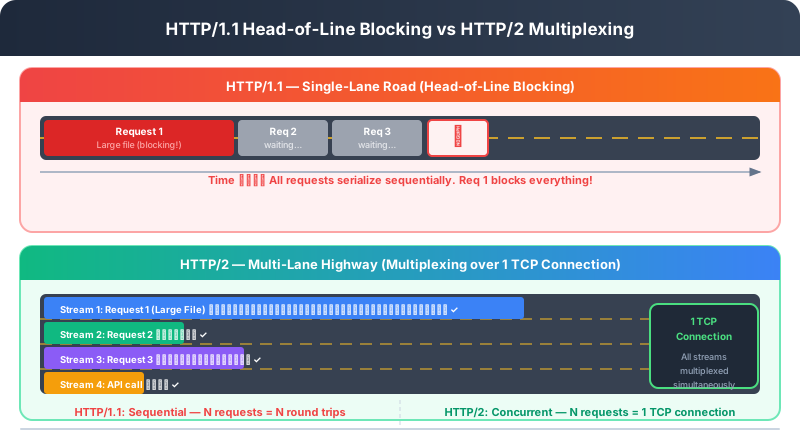
Legacy REST APIs frequently run on HTTP/1.1, which suffers from Head-of-Line (HOL) Blocking. If a client sends three requests over one TCP connection, they must be processed strictly sequentially. If Request 1 is a massive file download, Requests 2 and 3 are completely blocked until it finishes — like traffic stuck behind an accident on a single-lane road.
gRPC strictly mandates HTTP/2, which introduces binary framing and Multiplexing. Multiple independent API calls can be interleaved simultaneously over a single, persistent TCP connection as separate streams. This entirely eliminates HOL blocking at the application layer and drastically reduces the TCP handshake overhead associated with opening a new connection for every REST endpoint call.
GraphQL and the N+1 Query Problem
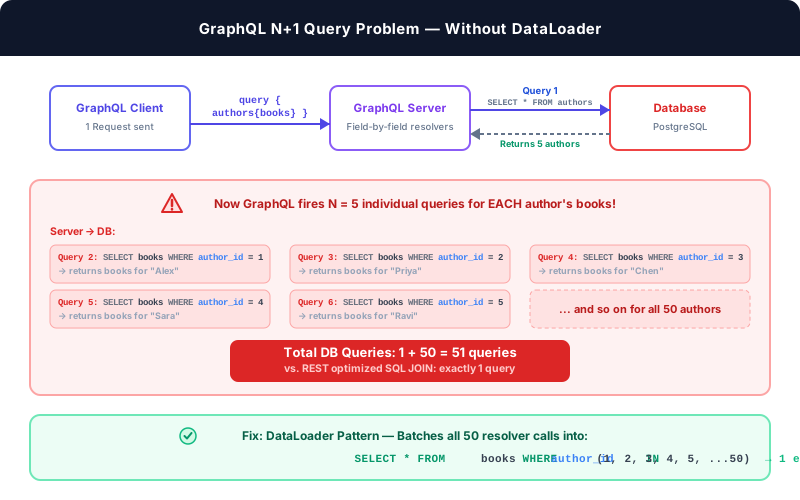
While GraphQL is extraordinarily efficient for the client, it frequently creates severe bottlenecks on the backend database, known as the N+1 Problem.
In REST, a developer writes a single, highly optimized SQL JOIN to fetch a list of 50 Authors and their associated Books in one database query. In GraphQL, queries are resolved field-by-field via isolated Resolver functions. If the client asks for 50 Authors and their Books, the GraphQL engine will execute:
- ● 1 query to fetch the list of 50 Authors
- ● 50 separate queries, one for each author, to fetch their books
- ● Total: 51 database round-trips — the N+1 problem (1 + N)
Engineers must architect around this algorithmic flaw by implementing a DataLoader pattern. DataLoader batches and caches the 50 disparate resolver requests and replaces them with a single efficient SELECT * FROM books WHERE author_id IN (1, 2, 3, …50) query before hitting the database.
RESTful Constraints and HATEOAS
To be considered perfectly "RESTful" at Level 3 of the Richardson Maturity Model, an API must implement HATEOAS (Hypermedia as the Engine of Application State).
This architectural constraint dictates that the API response should not just contain data — it should also include the dynamic hyperlinks required to navigate the application's state. If a client queries a bank account, the REST response includes the balance, plus embedded URLs for the exact endpoints to deposit, withdraw, or close_account. This allows the server to change URI structures dynamically without breaking the client's hardcoded logic — the client simply follows the links provided by the server, like a browser following HTML anchor tags.
Summary Comparison: REST vs GraphQL vs gRPC
| Feature | REST | GraphQL | gRPC |
|---|---|---|---|
| Data Format | JSON (text) | JSON (text) | Protocol Buffers (binary) |
| HTTP Version | HTTP/1.1 (or 2) | HTTP/1.1 (or 2) | HTTP/2 (required) |
| Speed | Moderate | Moderate | 3–10× faster |
| Over-fetching | Yes — server decides payload | No — client dictates fields | No — .proto schema strict |
| Browser Support | Native — zero setup | Native — zero setup | Needs gRPC-Web proxy |
| Caching | Excellent (HTTP CDN) | Complex (POST-only) | Application-level only |
| Best Use Case | Public APIs, web apps | Mobile apps, complex UIs | Microservices, IoT, ML pipelines |
Real-World Applications of REST, GraphQL, and gRPC
Public REST APIs (Twitter / GitHub / Stripe)
REST dominates public-facing developer APIs because third-party developers can call them from any language or browser with simple HTTP and standard JSON parsers — zero proprietary tooling required.
Facebook & Instagram Feeds (GraphQL)
Facebook invented GraphQL to serve their mobile News Feed — fetching exactly the author name, thumbnail, and like count needed per post, reducing 3G mobile data usage by over 50%.
Google Internal Microservices (gRPC)
Google uses gRPC internally across hundreds of microservices (Search, Maps, YouTube). Binary Protobuf payloads and HTTP/2 multiplexing let services communicate with microsecond-level latency at planetary scale.
Netflix GraphQL Federation
Netflix uses GraphQL Federation — a distributed GraphQL architecture — to unify data from 100+ microservices (user profiles, recommendations, billing) into one graph, so the TV app makes one efficient query.
IoT Sensor Networks (gRPC streaming)
Industrial IoT platforms use gRPC's bi-directional streaming feature to push real-time sensor data (temperature, pressure, flow rate) from thousands of embedded devices to cloud analytics services simultaneously.
E-Commerce Checkout APIs (REST)
Payment processors like Stripe and PayPal expose REST APIs because REST's HTTP caching, webhook support, and universal JSON compatibility make integration trivial for merchants' engineers worldwide.
Advantages of Modern API Architectures
- REST — Zero learning curve: any developer who knows HTTP immediately understands REST. Native browser support means no additional client-side libraries are required.
- REST — HTTP CDN caching: GET endpoints are transparently cached by CDNs (Cloudflare, Fastly), dramatically reducing server load for read-heavy APIs with millions of consumers.
- GraphQL — Zero over-fetching: clients specify exactly the fields they need, allowing a single request to replace what would previously require 5 separate REST endpoints.
- GraphQL — Strong introspection: the entire API schema is self-documenting and queryable at runtime, enabling powerful developer tooling like GraphiQL IDE and automatic type generation.
- gRPC — Extreme performance: Protocol Buffers + HTTP/2 multiplexing delivers 3–10× lower latency and bandwidth vs REST, critical for real-time ML inference and high-frequency trading.
- gRPC — Cross-language type safety: .proto schemas auto-generate type-safe client stubs in 12+ languages simultaneously, eliminating entire classes of integration bugs between services.
Disadvantages and Trade-offs
- REST — Over-fetching and under-fetching: fixed endpoints return the same payload to all clients regardless of need, wasting bandwidth on mobile and forcing multiple round-trips for complex UI data.
- REST — Versioning complexity: as APIs evolve, maintaining /v1/, /v2/, /v3/ URL versioning becomes a significant operational burden, with old versions requiring long-term support commitments.
- GraphQL — N+1 query problem: nested resolver architecture can accidentally trigger hundreds of database queries for a single client request without explicit DataLoader batching implementation.
- GraphQL — No native HTTP caching: because all GraphQL queries are POST requests to a single endpoint, standard HTTP CDN caching is impossible, requiring custom application-level caching strategies.
- gRPC — No native browser support: browsers cannot directly consume raw gRPC — a gRPC-Web proxy (Envoy) must translate binary HTTP/2 frames, adding infrastructure complexity and potential latency.
- gRPC — Schema coupling: changing a .proto schema requires regenerating and redeploying client stubs across all consuming services simultaneously, making schema evolution a coordinated multi-team operation.
Quick Reference Cheat Sheet
| Factor | REST | GraphQL | gRPC |
|---|---|---|---|
| Protocol | HTTP/1.1 + JSON | HTTP/1.1 or HTTP/2 + JSON | HTTP/2 + Protocol Buffers (binary) |
| Data Fetching | Fixed endpoints — risk of over/under-fetching. | Client specifies exact fields needed — eliminates over-fetching. | Strongly typed schema (proto file) — predictable payload. |
| Performance | Good — simple, cacheable GET responses. | Variable — complex queries can be expensive. | Excellent — binary serialisation ~5–10× faster than JSON. |
| Security Risk | IDOR, broken authentication, SSRF on endpoints. | Introspection exposure, query depth attacks, batching abuse. | Reflection attacks, unencrypted channels if TLS skipped. |
| Best Use Case | Public APIs, simple CRUD, CDN-cached resources. | Complex UI data requirements; multi-source aggregation (BFF). | High-throughput microservice-to-microservice communication. |
Frequently Asked Questions (FAQ)
Q.What is the main difference between REST and GraphQL?
Q.Is gRPC faster than REST?
Q.Can I use REST, GraphQL, and gRPC in the same project?
Q.What is the N+1 problem in GraphQL?
Q.Why doesn't everyone just use gRPC if it's the fastest?
Q.What is HATEOAS and why do most REST APIs not implement it?
Q.Can GraphQL completely replace REST in an enterprise architecture?
Related Topics
Test Your Knowledge
Ready to prove your skills? Take our rigorous multiple-choice quiz designed to test your understanding of this topic and prepare you for interviews.