
OSI Model MCQ 60 Practice Tests With Answers (2026)
 PerfectNotes TeamUpdated: June 2026~20 min practice 60 Questions · 3 Levels 60 Questions · 3 Levels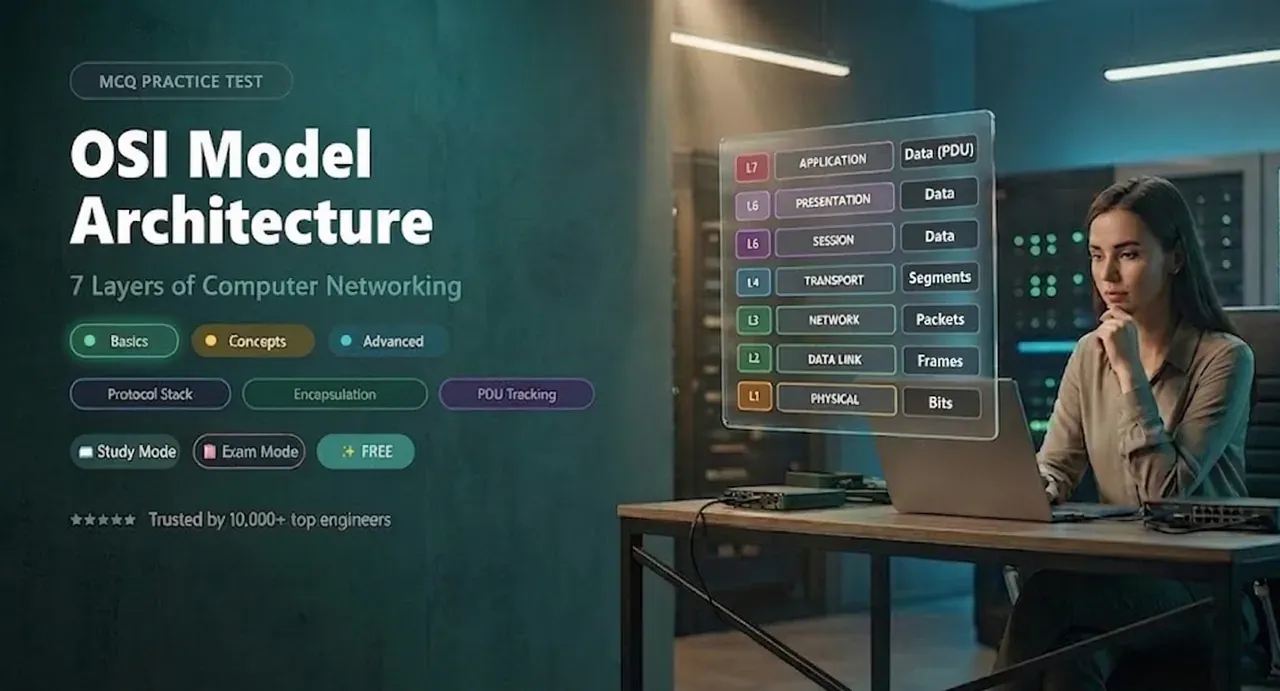
OSI Model MCQ practice questions are essential for preparing for competitive exams, certifications (CompTIA Network+, CCNA), and technical interviews. This comprehensive MCQ platform provides 60 carefully curated practice questions covering the 7 layers, protocols, data units (PDU), hardware devices, encapsulation, and network troubleshooting.
These questions are organized into three progressive difficulty levels of 20 questions each: Basics (covering layer definitions, PDU names, core protocols, and basic hardware), Concepts (covering encapsulation, IEEE standards, VLAN tagging, fragmentation, and layer operations), and Advanced (covering MPLS, BGP, SCTP, ECN, IPv6/NDP, 802.1X security, and complex multi-layer scenarios). Each question includes a verified, in-depth explanation to reinforce learning.
Practice in Study Mode to reveal answers and detailed explanations instantly, or use Exam Mode for timed testing and real-time scoring to simulate CCNA or university exam conditions. The interactive engine tracks your progress and identifies knowledge gaps across Physical, Data Link, Network, and Transport layers.
Contents
- 1.Basics (20 Questions)7 layer definitions · PDU names · hardware devices · basic protocols
- 2.Concepts (20 Questions)Encapsulation · IEEE 802 standards · VLAN tagging · fragmentation
- 3.Advanced (20 Questions)MPLS · BGP · SCTP · ECN · IPv6/NDP · 802.1X
- 4.Conclusionsummary · next steps · study tips
- 5.Key Takeawaysquick-fire bullet recap of essential facts
- 6.Quick Review Summaryconcept · definition · key fact table
- 7.FAQcommon questions answered
OSI Model MCQ 60 Practice Tests With Answers (2026) — Basics
1What is the main purpose of the OSI model in networking?
CorrectA: To provide a standardized framework for network communication
The OSI model provides a standardized, layered framework that defines how network communication occurs. It enables different network devices and systems from various manufacturers to communicate using common standards.
IncorrectA: To provide a standardized framework for network communication
The OSI model provides a standardized, layered framework that defines how network communication occurs. It enables different network devices and systems from various manufacturers to communicate using common standards.
2Which OSI layer is responsible for translating data into a standard format, such as ASCII, GIF, or JPEG?
CorrectB: Presentation Layer
The Presentation Layer (Layer 6) handles data translation and formatting — converting data into formats that applications can understand (ASCII, encryption, compression, JPEG, GIF, etc.).
IncorrectB: Presentation Layer
The Presentation Layer (Layer 6) handles data translation and formatting — converting data into formats that applications can understand (ASCII, encryption, compression, JPEG, GIF, etc.).
3How many layers are in the traditional TCP/IP model compared to the 7 layers of the OSI model?
CorrectB: 5 layers
The TCP/IP model has 5 layers (or sometimes modeled as 4): Link Layer, Internet Layer, Transport Layer, Application Layer. Some models combine Link into 2 sublayers.
IncorrectB: 5 layers
The TCP/IP model has 5 layers (or sometimes modeled as 4): Link Layer, Internet Layer, Transport Layer, Application Layer. Some models combine Link into 2 sublayers.
4Which hardware device operates exclusively at the Physical Layer (Layer 1) to amplify degraded electrical signals?
CorrectD: Repeater
A Repeater operates strictly at Layer 1 — it receives electrical signals on one port, amplifies them, and transmits them out another port. It does not examine or modify data.
IncorrectD: Repeater
A Repeater operates strictly at Layer 1 — it receives electrical signals on one port, amplifies them, and transmits them out another port. It does not examine or modify data.
5At which layer of the OSI model do end-user applications like web browsers and email clients directly interface?
CorrectD: Application Layer
The Application Layer (Layer 7) is where end-user applications (HTTP, SMTP, IMAP, FTP, DNS, SSH, RDP) operate. Users interact directly with applications at this layer.
IncorrectD: Application Layer
The Application Layer (Layer 7) is where end-user applications (HTTP, SMTP, IMAP, FTP, DNS, SSH, RDP) operate. Users interact directly with applications at this layer.
6Which layer is fundamentally responsible for logical addressing and determining the best path for data to travel across multiple networks?
CorrectC: Network Layer
The Network Layer (Layer 3) handles logical addressing (IP addresses) and routing — determining the optimal path for data packets to reach their destination across multiple networks.
IncorrectC: Network Layer
The Network Layer (Layer 3) handles logical addressing (IP addresses) and routing — determining the optimal path for data packets to reach their destination across multiple networks.
7What is the specific Protocol Data Unit (PDU) associated with the Transport layer?
CorrectB: Segment
The Transport Layer (Layer 4) PDU is called a Segment (in TCP) or Datagram (in UDP). At Layer 4, data is organized into segments or datagrams.
IncorrectB: Segment
The Transport Layer (Layer 4) PDU is called a Segment (in TCP) or Datagram (in UDP). At Layer 4, data is organized into segments or datagrams.
8The Data Link layer is unique because it is mathematically subdivided into which two sublayers?
CorrectA: Logical Link Control (LLC) and Media Access Control (MAC)
The Data Link Layer (Layer 2) is divided into two sublayers: MAC sublayer (handles hardware addressing and media access) and LLC sublayer (handles framing and flow control).
IncorrectA: Logical Link Control (LLC) and Media Access Control (MAC)
The Data Link Layer (Layer 2) is divided into two sublayers: MAC sublayer (handles hardware addressing and media access) and LLC sublayer (handles framing and flow control).
9Which layer utilizes Port Numbers to ensure data reaches the correct software process on a host machine?
CorrectB: Transport Layer
The Transport Layer (Layer 4) uses Port Numbers (0-65535) to multiplex data to the correct process. TCP port 80 (HTTP), port 443 (HTTPS), port 22 (SSH) are examples.
IncorrectB: Transport Layer
The Transport Layer (Layer 4) uses Port Numbers (0-65535) to multiplex data to the correct process. TCP port 80 (HTTP), port 443 (HTTPS), port 22 (SSH) are examples.
10What is the primary Protocol Data Unit (PDU) processed and forwarded by a Layer 2 network switch?
CorrectD: Frame
A Layer 2 switch operates at the Data Link Layer and processes Frames. It reads the destination MAC address in each frame and forwards it to the correct port.
IncorrectD: Frame
A Layer 2 switch operates at the Data Link Layer and processes Frames. It reads the destination MAC address in each frame and forwards it to the correct port.
11Which protocol operates at the Application layer to securely transfer files between a client and a server?
CorrectA: SFTP (Secure File Transfer Protocol)
SFTP (Secure File Transfer Protocol) operates at Layer 7 and provides secure file transfer. IPsec is Layer 3, ARP is Layer 2, ICMP is Layer 3.
IncorrectA: SFTP (Secure File Transfer Protocol)
SFTP (Secure File Transfer Protocol) operates at Layer 7 and provides secure file transfer. IPsec is Layer 3, ARP is Layer 2, ICMP is Layer 3.
12What is the primary operational function of the Physical layer?
CorrectC: Transmitting raw binary signals over a communication medium
The Physical Layer (Layer 1) transmits raw binary signals (bits) over physical media — electrical signals through cables, light through fiber, radio waves through wireless.
IncorrectC: Transmitting raw binary signals over a communication medium
The Physical Layer (Layer 1) transmits raw binary signals (bits) over physical media — electrical signals through cables, light through fiber, radio waves through wireless.
13Which address type is physically hardcoded into a Network Interface Card (NIC) and utilized at the Data Link layer?
CorrectC: MAC Address
The MAC Address (Media Access Control address) is a 48-bit hardware address physically burned into a NIC. It operates at Layer 2 for local network communication.
IncorrectC: MAC Address
The MAC Address (Media Access Control address) is a 48-bit hardware address physically burned into a NIC. It operates at Layer 2 for local network communication.
14At which OSI layer does the Internet Protocol (IP) reside?
CorrectA: Network Layer
The Internet Protocol (IP) — both IPv4 and IPv6 — operates at the Network Layer (Layer 3), handling logical addressing and routing.
IncorrectA: Network Layer
The Internet Protocol (IP) — both IPv4 and IPv6 — operates at the Network Layer (Layer 3), handling logical addressing and routing.
15Which layer establishes, manages, and terminates dialogue control, tracking whose turn it is to transmit data?
CorrectD: Session Layer
The Session Layer (Layer 5) manages conversation control — establishing, maintaining, and terminating sessions between applications. It tracks who speaks and when.
IncorrectD: Session Layer
The Session Layer (Layer 5) manages conversation control — establishing, maintaining, and terminating sessions between applications. It tracks who speaks and when.
16If a network technician is troubleshooting a broken fiber-optic cable, which OSI layer are they physically working on?
CorrectB: Physical Layer
A physical cable or any physical transmission medium is Layer 1 (Physical Layer). Troubleshooting cables, connectors, and signal quality occurs at Layer 1.
IncorrectB: Physical Layer
A physical cable or any physical transmission medium is Layer 1 (Physical Layer). Troubleshooting cables, connectors, and signal quality occurs at Layer 1.
17Which layer is responsible for the reliable, sequenced delivery of data using connection-oriented acknowledgments?
CorrectA: Transport Layer
The Transport Layer (Layer 4) provides reliable delivery through TCP — using sequence numbers and acknowledgments to ensure all data arrives in order and without loss.
IncorrectA: Transport Layer
The Transport Layer (Layer 4) provides reliable delivery through TCP — using sequence numbers and acknowledgments to ensure all data arrives in order and without loss.
18Which network device is primarily categorized as a Layer 3 piece of hardware?
CorrectC: Router
A Router operates at Layer 3 (Network Layer) — it reads IP addresses and makes routing decisions. Layer 1 devices: Hub, Repeater. Layer 2: Bridge, Switch. Layer 3: Router.
IncorrectC: Router
A Router operates at Layer 3 (Network Layer) — it reads IP addresses and makes routing decisions. Layer 1 devices: Hub, Repeater. Layer 2: Bridge, Switch. Layer 3: Router.
19When data is moving from a computer down to the network cable, what is the process of adding headers at each OSI layer called?
CorrectB: Encapsulation
Encapsulation is the process of adding headers (and sometimes trailers) at each layer as data moves down the stack. De-encapsulation removes them on the receiving end.
IncorrectB: Encapsulation
Encapsulation is the process of adding headers (and sometimes trailers) at each layer as data moves down the stack. De-encapsulation removes them on the receiving end.
20Which transport layer protocol provides connectionless, unacknowledged "best-effort" data delivery?
CorrectD: UDP
UDP (User Datagram Protocol) is connectionless and provides best-effort delivery without acknowledgments. It is fast but unreliable — ideal for real-time applications like VoIP and gaming.
IncorrectD: UDP
UDP (User Datagram Protocol) is connectionless and provides best-effort delivery without acknowledgments. It is fast but unreliable — ideal for real-time applications like VoIP and gaming.
OSI Model MCQ 60 Practice Tests With Answers (2026) — Concepts
1Which IEEE standard explicitly defines the Media Access Control (MAC) sublayer for standard wired Ethernet networks?
CorrectB: IEEE 802.3
IEEE 802.3 defines Ethernet — the physical and data link specifications for wired LANs. 802.11 is wireless (Wi-Fi), 802.1X is port-based network access control.
IncorrectB: IEEE 802.3
IEEE 802.3 defines Ethernet — the physical and data link specifications for wired LANs. 802.11 is wireless (Wi-Fi), 802.1X is port-based network access control.
2At which layer does a standard, unmanaged network switch inspect incoming traffic to make forwarding decisions?
CorrectD: Data Link Layer
An unmanaged Layer 2 switch reads the destination MAC address in incoming frames and forwards them to the correct physical port. This operates at the Data Link Layer.
IncorrectD: Data Link Layer
An unmanaged Layer 2 switch reads the destination MAC address in incoming frames and forwards them to the correct physical port. This operates at the Data Link Layer.
3Which protocol maps a known logical IPv4 address to an unknown physical MAC address on a local subnet?
CorrectA: Address Resolution Protocol (ARP)
ARP (Address Resolution Protocol) operates at Layer 2.5 (between Layers 2 and 3) to discover the MAC address corresponding to an IP address on the local network.
IncorrectA: Address Resolution Protocol (ARP)
ARP (Address Resolution Protocol) operates at Layer 2.5 (between Layers 2 and 3) to discover the MAC address corresponding to an IP address on the local network.
4How does the Network layer handle a packet that is larger than the Maximum Transmission Unit (MTU) of the outgoing physical interface?
CorrectC: By fragmenting the packet into smaller, compliant packets
If a Layer 3 packet exceeds the MTU (typically 1500 bytes for Ethernet), it is fragmented into smaller packets. The receiving end reassembles them using sequence numbers.
IncorrectC: By fragmenting the packet into smaller, compliant packets
If a Layer 3 packet exceeds the MTU (typically 1500 bytes for Ethernet), it is fragmented into smaller packets. The receiving end reassembles them using sequence numbers.
5Which Transport layer mechanism allows a receiver to dynamically tell a sender exactly how much unacknowledged data it can currently accept?
CorrectC: Sliding Windowing
Sliding Window (or Flow Control) in TCP allows the receiver to advertise a window size — the maximum amount of data the sender can transmit before receiving an acknowledgment.
IncorrectC: Sliding Windowing
Sliding Window (or Flow Control) in TCP allows the receiver to advertise a window size — the maximum amount of data the sender can transmit before receiving an acknowledgment.
6At which layer does the Point-to-Point Protocol (PPP) operate to establish direct connections over serial cables?
CorrectA: Data Link Layer
PPP (Point-to-Point Protocol) operates at Layer 2 — it establishes direct connections between two nodes over serial links, commonly used in dial-up internet.
IncorrectA: Data Link Layer
PPP (Point-to-Point Protocol) operates at Layer 2 — it establishes direct connections between two nodes over serial links, commonly used in dial-up internet.
7Which OSI layer handles the processing of Data Encryption Standard (DES) or Advanced Encryption Standard (AES) payload encryption?
CorrectD: Presentation Layer
The Presentation Layer (Layer 6) handles encryption/decryption, compression, and character set conversion — ensuring data is in a format the receiving application can use.
IncorrectD: Presentation Layer
The Presentation Layer (Layer 6) handles encryption/decryption, compression, and character set conversion — ensuring data is in a format the receiving application can use.
8What specific function does the Frame Check Sequence (FCS) perform in an Ethernet frame?
CorrectB: It detects mathematical data corruption during physical transmission
The FCS (Frame Check Sequence) is a CRC (Cyclic Redundancy Check) computed over the frame data. If corruption is detected, the frame is discarded.
IncorrectB: It detects mathematical data corruption during physical transmission
The FCS (Frame Check Sequence) is a CRC (Cyclic Redundancy Check) computed over the frame data. If corruption is detected, the frame is discarded.
9Which Layer 3 protocol is utilized by the `traceroute` (or `tracert`) command to determine the router path to a destination?
CorrectD: ICMP
Traceroute uses ICMP (Internet Control Message Protocol) Echo Request packets with incrementing TTL values to map the path through routers to the destination.
IncorrectD: ICMP
Traceroute uses ICMP (Internet Control Message Protocol) Echo Request packets with incrementing TTL values to map the path through routers to the destination.
10In the encapsulation process, what specific information does the Network layer add to the segment received from the Transport layer?
CorrectB: Source and Destination IP Addresses
During encapsulation, Layer 3 adds a header containing the Source and Destination IP Addresses, creating a Packet. Port numbers are already in the Layer 4 header.
IncorrectB: Source and Destination IP Addresses
During encapsulation, Layer 3 adds a header containing the Source and Destination IP Addresses, creating a Packet. Port numbers are already in the Layer 4 header.
11Which protocol dynamically assigns IP addresses, subnet masks, and default gateways to hosts, operating at the Application layer?
CorrectC: DHCP
DHCP (Dynamic Host Configuration Protocol) operates at Layer 7 and automatically assigns IP addresses and other network configuration to clients upon connection.
IncorrectC: DHCP
DHCP (Dynamic Host Configuration Protocol) operates at Layer 7 and automatically assigns IP addresses and other network configuration to clients upon connection.
12At which layer does Network Address Translation (NAT) modify packet headers to route private internal IPs to public external IPs?
CorrectA: Network Layer
NAT operates at Layer 3 (Network Layer) and sometimes Layer 4 — it translates internal private IP addresses to external public IP addresses as packets leave a network.
IncorrectA: Network Layer
NAT operates at Layer 3 (Network Layer) and sometimes Layer 4 — it translates internal private IP addresses to external public IP addresses as packets leave a network.
13Which layer is responsible for establishing full-duplex or half-duplex communication checkpoints to allow session recovery?
CorrectA: Session Layer
The Session Layer (Layer 5) manages dialogue checkspoints and synchronization — allowing sessions to be recovered if they disconnect mid-transmission.
IncorrectA: Session Layer
The Session Layer (Layer 5) manages dialogue checkspoints and synchronization — allowing sessions to be recovered if they disconnect mid-transmission.
14What is the primary functional difference between a traditional Layer 2 switch and a multilayer Layer 3 switch?
CorrectC: A Layer 3 switch possesses routing tables to route between different IP subnets
A Layer 3 (multilayer) switch combines switching and routing capabilities — it maintains both MAC address tables (Layer 2) and routing tables (Layer 3) for inter-subnet routing.
IncorrectC: A Layer 3 switch possesses routing tables to route between different IP subnets
A Layer 3 (multilayer) switch combines switching and routing capabilities — it maintains both MAC address tables (Layer 2) and routing tables (Layer 3) for inter-subnet routing.
15Which of the following is a classic example of an attack targeting the Transport layer (Layer 4)?
CorrectB: SYN Flood
A SYN Flood attack targets TCP (Layer 4) by sending massive SYN packets without completing the three-way handshake, exhausting server resources.
IncorrectB: SYN Flood
A SYN Flood attack targets TCP (Layer 4) by sending massive SYN packets without completing the three-way handshake, exhausting server resources.
16How does the Data Link layer identify the precise start and end of a frame on the physical medium?
CorrectD: By utilizing recognizable preambles and frame delimiters
Layer 2 uses Frame Preambles (sync bits) and Frame Delimiters to mark frame boundaries. In Ethernet, the SFD (Start Frame Delimiter) marks the frame start.
IncorrectD: By utilizing recognizable preambles and frame delimiters
Layer 2 uses Frame Preambles (sync bits) and Frame Delimiters to mark frame boundaries. In Ethernet, the SFD (Start Frame Delimiter) marks the frame start.
17Which standard port number is utilized by HTTPS traffic to establish secure web connections at the Transport layer?
CorrectB: Port 443
Port 443 is reserved for HTTPS (HTTP over TLS/SSL). Port 80 is HTTP, Port 22 is SSH, Port 53 is DNS.
IncorrectB: Port 443
Port 443 is reserved for HTTPS (HTTP over TLS/SSL). Port 80 is HTTP, Port 22 is SSH, Port 53 is DNS.
18Which technology logically creates distinct, isolated broadcast domains within a single physical switch at Layer 2?
CorrectA: Virtual Local Area Networks (VLANs)
VLANs (Virtual LANs) are created at Layer 2 using the 802.1Q tag to logically segment a single physical switch into multiple isolated domains.
IncorrectA: Virtual Local Area Networks (VLANs)
VLANs (Virtual LANs) are created at Layer 2 using the 802.1Q tag to logically segment a single physical switch into multiple isolated domains.
19Which Application layer protocol is fundamentally responsible for resolving human-readable domain names into routable IP addresses?
CorrectD: DNS
DNS (Domain Name System) operates at Layer 7 and translates domain names (google.com) into IP addresses (142.250.185.46).
IncorrectD: DNS
DNS (Domain Name System) operates at Layer 7 and translates domain names (google.com) into IP addresses (142.250.185.46).
20At which layer does the Spanning Tree Protocol (STP) actively operate to prevent infinite broadcast network loops?
CorrectC: Data Link Layer
STP (Spanning Tree Protocol) operates at Layer 2 — it prevents redundant Ethernet paths from creating forwarding loops by blocking specific ports.
IncorrectC: Data Link Layer
STP (Spanning Tree Protocol) operates at Layer 2 — it prevents redundant Ethernet paths from creating forwarding loops by blocking specific ports.
OSI Model MCQ 60 Practice Tests With Answers (2026) — Advanced
1Where does the Multiprotocol Label Switching (MPLS) protocol reside in the conceptual OSI model?
CorrectC: It operates between Layer 2 and Layer 3, frequently referred to as Layer 2.5
MPLS operates at Layer 2.5 (between Data Link and Network layers) — it adds labels to packets to enable fast forwarding without full routing table lookups.
IncorrectC: It operates between Layer 2 and Layer 3, frequently referred to as Layer 2.5
MPLS operates at Layer 2.5 (between Data Link and Network layers) — it adds labels to packets to enable fast forwarding without full routing table lookups.
2Which of the following routing protocols runs directly over IP (using Protocol 89) rather than utilizing TCP or UDP for transport?
CorrectA: Open Shortest Path First (OSPF)
OSPF uses IP Protocol 89 and runs directly over IP without TCP or UDP. RIP uses UDP port 520, BGP uses TCP port 179.
IncorrectA: Open Shortest Path First (OSPF)
OSPF uses IP Protocol 89 and runs directly over IP without TCP or UDP. RIP uses UDP port 520, BGP uses TCP port 179.
3In a TCP header, which specific flag is set to initiate the graceful teardown and termination of an active connection?
CorrectD: FIN
The FIN (Finish) flag initiates a graceful connection close. RST forces an abrupt reset. SYN starts a connection. PSH pushes data immediately.
IncorrectD: FIN
The FIN (Finish) flag initiates a graceful connection close. RST forces an abrupt reset. SYN starts a connection. PSH pushes data immediately.
4At which layer does the Internet Group Management Protocol (IGMP) operate to manage multicast group memberships?
CorrectB: Network Layer
IGMP operates at Layer 3 (Network Layer) — it enables hosts to join and leave multicast groups, allowing one-to-many data distribution.
IncorrectB: Network Layer
IGMP operates at Layer 3 (Network Layer) — it enables hosts to join and leave multicast groups, allowing one-to-many data distribution.
5Which of the following accurately describes the technical operation of the Border Gateway Protocol (BGP)?
CorrectB: It operates at the Application layer using TCP port 179 to exchange global routing information
BGP operates at Layer 7 and uses TCP port 179 for route exchange between autonomous systems (ISPs) on the internet.
IncorrectB: It operates at the Application layer using TCP port 179 to exchange global routing information
BGP operates at Layer 7 and uses TCP port 179 for route exchange between autonomous systems (ISPs) on the internet.
6What is the exact function of the Explicit Congestion Notification (ECN) mechanism?
CorrectD: It signals impending congestion at Layer 3 without dropping packets
ECN marks packets at Layer 3 to signal congestion to Layer 4, allowing TCP to reduce transmission rate without actually dropping packets.
IncorrectD: It signals impending congestion at Layer 3 without dropping packets
ECN marks packets at Layer 3 to signal congestion to Layer 4, allowing TCP to reduce transmission rate without actually dropping packets.
7Which protocol encapsulates Layer 2 Ethernet frames inside Layer 3 UDP network to create scalable overlay networks in data centers?
CorrectA: VXLAN (Virtual Extensible LAN)
VXLAN (Virtual Extensible LAN) encapsulates Layer 2 frames in Layer 4 UDP packets, enabling virtual Layer 2 networks to scale across Layer 3 networks.
IncorrectA: VXLAN (Virtual Extensible LAN)
VXLAN (Virtual Extensible LAN) encapsulates Layer 2 frames in Layer 4 UDP packets, enabling virtual Layer 2 networks to scale across Layer 3 networks.
8In IPv6 architecture, which protocol completely replaces the ARP functionality previously used in IPv4?
CorrectC: NDP (Neighbor Discovery Protocol)
NDP (Neighbor Discovery Protocol) replaces ARP in IPv6 — it resolves IPv6 addresses to MAC addresses using ICMPv6 messages.
IncorrectC: NDP (Neighbor Discovery Protocol)
NDP (Neighbor Discovery Protocol) replaces ARP in IPv6 — it resolves IPv6 addresses to MAC addresses using ICMPv6 messages.
9At which layer does a Web Application Firewall (WAF) perform deep packet inspection to block SQL injection and XSS?
CorrectA: Application Layer
A WAF operates at Layer 7 and inspects HTTP payload to detect and block application-layer attacks like SQL injection and cross-site scripting.
IncorrectA: Application Layer
A WAF operates at Layer 7 and inspects HTTP payload to detect and block application-layer attacks like SQL injection and cross-site scripting.
10Which specific field in the IPv4 header is strictly decremented by every router it passes through?
CorrectB: Time to Live (TTL)
The TTL (Time to Live) field is decremented by 1 at each router. When TTL reaches 0, the packet is discarded, preventing infinite loops.
IncorrectB: Time to Live (TTL)
The TTL (Time to Live) field is decremented by 1 at each router. When TTL reaches 0, the packet is discarded, preventing infinite loops.
11How does the Stream Control Transmission Protocol (SCTP) structurally differ from standard TCP at Layer 4?
CorrectC: It supports multi-homing and multiple concurrent data streams within a single association
SCTP supports multi-homing (multiple IP addresses per host) and multiple concurrent streams within a single association, unlike TCP.
IncorrectC: It supports multi-homing and multiple concurrent data streams within a single association
SCTP supports multi-homing (multiple IP addresses per host) and multiple concurrent streams within a single association, unlike TCP.
12At which OSI layer does the Link Aggregation Control Protocol (LACP) negotiate bundling of multiple physical ports?
CorrectD: Data Link Layer
LACP operates at Layer 2 — it negotiates the aggregation of multiple physical ports into a single high-bandwidth logical channel.
IncorrectD: Data Link Layer
LACP operates at Layer 2 — it negotiates the aggregation of multiple physical ports into a single high-bandwidth logical channel.
13What is the explicit purpose of the 802.1Q tag in a standard Ethernet frame?
CorrectD: It identifies VLAN membership and Priority Code Point (PCP) for QoS
802.1Q tagging inserts a 4-byte VLAN tag into Ethernet frames — 12 bits for VLAN ID, 3 bits for PCP (priority), 1 bit for CFI.
IncorrectD: It identifies VLAN membership and Priority Code Point (PCP) for QoS
802.1Q tagging inserts a 4-byte VLAN tag into Ethernet frames — 12 bits for VLAN ID, 3 bits for PCP (priority), 1 bit for CFI.
14Which protocol provides default gateway redundancy at Layer 3 by sharing a virtual IP and virtual MAC across routers?
CorrectC: VRRP
VRRP (Virtual Router Redundancy Protocol) at Layer 3 allows multiple routers to share a virtual IP/MAC. If one fails, another takes over.
IncorrectC: VRRP
VRRP (Virtual Router Redundancy Protocol) at Layer 3 allows multiple routers to share a virtual IP/MAC. If one fails, another takes over.
15In a secure IPsec deployment, which component provides data confidentiality (encryption) at the Network layer?
CorrectB: Encapsulating Security Payload (ESP)
ESP (Encapsulating Security Payload) in IPsec provides encryption, authentication, and anti-replay protection at Layer 3.
IncorrectB: Encapsulating Security Payload (ESP)
ESP (Encapsulating Security Payload) in IPsec provides encryption, authentication, and anti-replay protection at Layer 3.
16What does "Silly Window Syndrome" refer to in the context of Transport layer efficiency?
CorrectA: Degradation from exchanging incredibly small, inefficient data segments
Silly Window Syndrome occurs in TCP when the sender and receiver exchange very small segments and acknowledgments, wasting bandwidth.
IncorrectA: Degradation from exchanging incredibly small, inefficient data segments
Silly Window Syndrome occurs in TCP when the sender and receiver exchange very small segments and acknowledgments, wasting bandwidth.
17At which specific sublayer of Layer 1 does 8B/10B or 64B/66B line coding occur for clock recovery?
CorrectC: Physical Coding Sublayer (PCS)
The Physical Coding Sublayer (PCS) performs line coding like 8B/10B to ensure DC balance, clock recovery, and synchronization on the wire.
IncorrectC: Physical Coding Sublayer (PCS)
The Physical Coding Sublayer (PCS) performs line coding like 8B/10B to ensure DC balance, clock recovery, and synchronization on the wire.
18Which mechanism does TCP strictly use to handle out-of-order packets at their final destination?
CorrectA: It buffers them using sequence numbers, reassembling correctly before passing to Application layer
TCP uses sequence numbers to buffer out-of-order segments and reassemble them in the correct order before delivering to the Application layer.
IncorrectA: It buffers them using sequence numbers, reassembling correctly before passing to Application layer
TCP uses sequence numbers to buffer out-of-order segments and reassemble them in the correct order before delivering to the Application layer.
19How does Remote Procedure Call (RPC) map to the OSI model during cross-network function execution?
CorrectD: It spans Session and Presentation layers to manage connection and cross-network execution
RPC primarily operates at Layers 5 (Session) and 6 (Presentation) to manage remote procedure calls, encoding/decoding, and session control.
IncorrectD: It spans Session and Presentation layers to manage connection and cross-network execution
RPC primarily operates at Layers 5 (Session) and 6 (Presentation) to manage remote procedure calls, encoding/decoding, and session control.
20Which Layer 2 security protocol provides robust port-based network access control before regular data traffic is permitted?
CorrectB: IEEE 802.1X
802.1X is a Layer 2 protocol that enforces port-based network access control — endpoints must authenticate before being allowed to transmit data.
IncorrectB: IEEE 802.1X
802.1X is a Layer 2 protocol that enforces port-based network access control — endpoints must authenticate before being allowed to transmit data.
Conclusion: Mastering the OSI Model
These 60 MCQs cover the full spectrum of OSI Model knowledge — from recognizing which layer a Repeater operates on, to understanding how MPLS functions at Layer 2.5, to knowing why ECN prevents packet loss during congestion.
The key to mastering the OSI model is the memory device: "Please Do Not Throw Sausage Pizza Away" (Physical, Data Link, Network, Transport, Session, Presentation, Application). Once this framework is internalized, and you understand what PDUs, protocols, and devices operate at each layer, OSI model questions become systematic rather than guesswork.
After completing this MCQ set, deepen your knowledge with the full OSI Model theory notes and practice with Computer Networks interview questions to see these concepts applied in real-world network scenarios.
📌 Key Takeaways — OSI Model
- Layer 1 (Physical): Raw bits transmitted over electrical/optical/radio media. Devices: Repeater, Hub, Optical Media, Network Cables.
- Layer 2 (Data Link): Frame forwarding using MAC addresses. Devices: Switch, Bridge. Standards: IEEE 802.3 (Ethernet), 802.11 (Wi-Fi), 802.1Q (VLANs).
- Layer 3 (Network): Packet routing using IP addresses. Devices: Router. Protocols: IP, ICMP, IGMP, ARP, BGP, OSPF.
- Layer 4 (Transport): End-to-end delivery using Port numbers. Protocols: TCP (reliable), UDP (fast), SCTP (multi-stream).
- Layer 5 (Session): Dialogue management, checkpoints, session recovery.
- Layer 6 (Presentation): Data translation (encryption, compression, character sets).
- Layer 7 (Application): User applications (HTTP, SMTP, DNS, FTP, SSH, RDP, Telnet).
- PDU mapping: Layer 1 = Bits, Layer 2 = Frames, Layer 3 = Packets, Layer 4 = Segments/Datagrams, Layers 5-7 = Data.
- Encapsulation: Each layer adds headers moving down the stack. De-encapsulation removes them on the receiving end.
- TCP/IP model: Combines OSI Layers 1-2 into Link Layer, Layer 3 → Internet, Layer 4 → Transport, Layers 5-7 → Application.
- MPLS: Operates at "Layer 2.5" between Data Link (Layer 2) and Network (Layer 3) for fast label-based forwarding.
- 802.1Q: VLAN tag inserted into Layer 2 Ethernet frames — 12 bits for VLAN ID, 3 bits for priority (PCP).
Quick Review & Summary
Use this table to quickly reference OSI layer functions, PDUs, and devices before or after attempting the questions above.
| Layer | Name | PDU | Key Devices | Core Protocols |
|---|---|---|---|---|
| 7 | Application | Data | N/A (Software) | HTTP, SMTP, DNS, FTP, SSH, RDP |
| 6 | Presentation | Data | N/A | Encryption (AES), Compression, ASCII/Unicode |
| 5 | Session | Data | N/A | RPC, NFS, Session Control |
| 4 | Transport | Segment/Datagram | N/A | TCP, UDP, SCTP, DCCP |
| 3 | Network | Packet | Router | IP, ICMP, IGMP, BGP, OSPF, ARP |
| 2 | Data Link | Frame | Switch, Bridge | Ethernet (802.3), Wi-Fi (802.11), VLAN (802.1Q) |
| 1 | Physical | Bit | Repeater, Hub, Cables | Electrical signals, Fiber optics, Radio waves |
Frequently Asked Questions
Q. How many OSI Model MCQs are available on this page?
Q. What topics do these OSI Model MCQs cover?
Q. Are these MCQs suitable for CompTIA Network+ exam preparation?
Q. What are Protocol Data Units (PDUs) and why are they important?
Q. What is encapsulation and why is it important?
Q. Can I use these MCQs to prepare for university computer networks exams?
Q. What is the difference between the OSI model and the TCP/IP model?
Q. Why do I need to memorize layer numbers and PDU names?
Struggling with some questions? Re-read the full Theory Guide: OSI Model